


🩸 THE SKY OUR CHILDREN MAY NEVER KNOW
From Classified Military Experiments to Commercial Geoengineering — A Historical Investigation into the Engineering of Earth’s Atmosphere
Could the atmosphere become humanity’s next invisible technological infrastructure?
By Red Blood
Red Blood Journal | Historical, Scientific and Investigative Special Report
November 25, 2026 | Revised Second Edition
Executive Summary
In May 1963, more than six decades before contemporary debates surrounding solar geoengineering, American military-supported researchers demonstrated that artificial material distributed in orbit around Earth could provide a medium for long-distance radio communications.
Approximately three years later, classified United States government documents described an experiment investigating whether deliberately modified weather could serve military objectives in Southeast Asia.
Neither episode originated in science fiction. Both belong to the documented history of twentieth-century technological development.
Today, researchers are investigating atmospheric cooling, miniature distributed sensors, high-altitude telecommunications platforms, electromagnetic propagation and the possibility of using Earth’s atmosphere itself as a global sensing medium. Private investors are simultaneously financing companies seeking to commercialize planetary climate intervention.
These developments introduce questions extending beyond their individual scientific objectives. They concern the convergence of technologies, environmental sovereignty, classified research, commercial incentives, technological dependency and the natural environment future generations may inherit.
This investigation examines three central questions:
Could sustained solar geoengineering alter the appearance of Earth’s sky sufficiently to change future generations’ understanding of natural atmospheric conditions?
What do documented historical military programs reveal about the potential dual-use applications of atmospheric and orbital technologies?
Could environmental intervention materials eventually serve additional communications or sensing functions, and what evidence would establish that such capabilities exist?
The investigation finds documented historical precedents for artificial communication environments and military weather modification. It also establishes that contemporary atmospheric sensing, telecommunications and solar geoengineering research are active technological fields.
However, no independently verified evidence identified in this investigation establishes that ordinary solar geoengineering aerosols are being used to construct a secret planetary Internet.
The absence of public evidence cannot eliminate every possibility of classified research. Neither can historical secrecy substitute for proof of a specific contemporary program.
This distinction is the foundation of the report’s methodology.
Investigative Methodology and Scope
This report draws upon declassified diplomatic records, historical military research documentation, peer-reviewed scientific literature, government oversight reports, university research disclosures, regulatory correspondence and published financial analyses.
Particular attention is given to distinguishing experimental objectives from demonstrated capabilities, announced investments from actual expenditures, and institutional statements from independently established facts.
The report uses five evidentiary classifications:
Documented fact: Supported by identifiable historical, scientific or government records.
Demonstrated capability: Established through a publicly documented experiment or operational system.
Modeled outcome: Derived from scientific simulations rather than direct observations of sustained deployment.
Investigative hypothesis: A proposition that requires additional evidence before it can be accepted as fact.
Unresolved classified possibility: A potential activity whose existence cannot be established or excluded through the available public record.
This methodology does not presume that government or corporate institutions provide complete information. It also does not presume that concealed activities exist merely because their existence cannot be disproved.
No interviews, independent atmospheric sampling, classified intelligence access or privately obtained corporate records were conducted or acquired for this edition. The report is a documentary public-source investigation, with clearly identified opportunities for further original reporting.
CHAPTER ONE
The Sky Before Technological Intervention
1.1 What makes the sky blue?
Earth’s clear daytime sky derives its characteristic blue appearance primarily from Rayleigh scattering.
Atmospheric molecules scatter shorter wavelengths of visible sunlight more efficiently than longer wavelengths. Under ordinary daytime conditions, this process produces the familiar blue appearance of the sky.
Aerosols introduce additional optical effects. These include natural particles originating from ocean spray, volcanic activity, desert dust and wildfires, as well as particles produced by transportation, industrial activity and other human sources.
Larger atmospheric particles often scatter visible wavelengths less selectively than atmospheric molecules. Depending on their dimensions, composition and concentration, they can contribute to haze and a paler or whiter sky.
Consequently, atmospheric transparency and sky color provide information about the physical environment, although visual observations alone cannot reliably identify the origin or chemical composition of airborne particles.
1.2 What constitutes a natural cloud?
Natural clouds consist primarily of microscopic liquid water droplets, ice crystals or mixtures of both. They form when atmospheric conditions permit water vapor to condense or deposit around suitable particles.
Water vapor itself is generally invisible. The visible appearance of clouds results from the scattering of light by condensed droplets and ice crystals.
Cloud formation is governed by temperature, humidity, pressure, atmospheric circulation and the availability of particles capable of supporting condensation or ice formation.
Aircraft contrails can also form when water vapor associated with aircraft exhaust encounters sufficiently cold atmospheric conditions. Persistent contrails may expand and contribute to artificial cirrus cloud cover under suitable humidity conditions.
The environmental consequences of aviation-related cloudiness constitute a recognized scientific research subject. Their existence does not independently demonstrate deliberate chemical spraying or covert solar geoengineering.
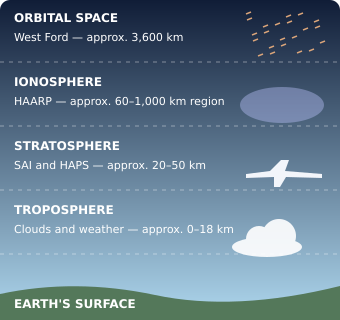
1.3 Four different physical environments
One recurring problem in public discussions of atmospheric technology is the tendency to treat everything above Earth’s surface as belonging to the same operational environment.
The relevant physical regions differ substantially.
The troposphere: Extends from Earth’s surface to approximately 8–18 kilometers, depending on latitude and atmospheric conditions. Most weather and ordinary cloud formation occur within this region.
The stratosphere: Extends from the tropopause to approximately 50 kilometers. It contains the ozone layer and is the principal region considered for stratospheric aerosol injection.
The ionosphere: An electrically active atmospheric region extending approximately from 60 to 1,000 kilometers, overlapping several atmospheric layers. It influences radio propagation and is the subject of ionospheric research.
Orbital space: Satellites and other artificial objects operate at a wide range of altitudes above Earth. Project West Ford operated at approximately 3,600 kilometers, substantially beyond the principal atmospheric regions involved in ordinary weather or aerosol-based geoengineering.
These distinctions matter because technologies operating in different regions encounter different temperatures, pressures, particle behavior, electromagnetic conditions and engineering constraints.
A successful experiment in orbital radio communications does not establish the feasibility of the same technique within the stratosphere.
Nevertheless, the historical experiments examined in this report demonstrate humanity’s expanding interest in treating the environment above Earth’s surface as an engineering platform.
CHAPTER TWO
The Historical Origins of Weather Modification
2.1 From natural observation to deliberate intervention
In 1946, researchers associated with General Electric conducted pioneering experiments demonstrating that the introduction of certain materials into suitable clouds could influence ice-crystal formation.
Vincent Schaefer, Irving Langmuir and Bernard Vonnegut became central figures in the development of early cloud-seeding research.
The experiments contributed to the emergence of weather modification as an organized field of scientific inquiry.
Subsequent research examined potential applications involving agricultural precipitation, drought mitigation, hail suppression and storm behavior.
Project Cirrus, involving General Electric and United States military institutions during the late 1940s and early 1950s, illustrated how atmospheric research could attract both civilian and defense interests.
The historical significance of these developments lies partly in their institutional structure. Universities, industrial researchers and military organizations were examining overlapping scientific capabilities whose potential applications extended beyond any single stated purpose.
2.2 Weather modification is not global climate control
Cloud seeding generally attempts to influence atmospheric processes within suitable existing weather systems. Its effectiveness depends on meteorological conditions and remains difficult to quantify in many circumstances.
Solar geoengineering seeks to alter Earth’s radiation balance, potentially over much larger geographical areas and longer periods.
These activities should not be conflated.
Weather modification operates primarily through atmospheric microphysics and precipitation processes. Stratospheric solar geoengineering seeks to alter the amount of solar energy absorbed by Earth.
The successful demonstration of limited weather intervention does not establish an ability to determine the weather everywhere or control the climate with precision.
This distinction strengthens rather than diminishes the historical investigation. It allows researchers to examine the actual progression of technological capabilities without attributing unsupported powers to earlier experiments.
2.3 The reporting problem
The United States Weather Modification Reporting Act of 1972 established federal reporting obligations for covered weather-modification activities.
Under implementing regulations in Title 15, Part 908 of the Code of Federal Regulations, covered operators generally must submit advance notification before undertaking qualifying activities.
However, reporting is not equivalent to comprehensive regulatory authorization, independent scientific verification or continuous monitoring.
NOAA maintains weather-modification records but does not possess general regulatory authority over every weather-modification activity.
This distinction became particularly significant in 2026, when the Government Accountability Office identified weaknesses in NOAA’s implementation of its reporting responsibilities.
The consequences of those weaknesses are examined in Chapter Eleven.
CHAPTER THREE
Project West Ford: The Artificial Communications Belt
3.1 A Cold War communications problem
During the Cold War, military planners were concerned about the vulnerability of long-distance communications infrastructure.
Undersea communication cables could be damaged, terrestrial facilities could be disrupted, and radio systems relying on the natural ionosphere could experience changing propagation conditions.
In 1958, MIT Lincoln Laboratory researchers conceived an alternative approach supported by the United States Air Force.
The concept involved distributing large numbers of artificial radio reflectors in orbit around Earth, creating a passive communication medium independent of certain conventional transmission arrangements.
The experiment became known as Project West Ford.
3.2 What the technical records establish
MIT Lincoln Laboratory’s historical technical documentation describes the planned distribution of approximately 480 million copper dipoles, each weighing around 40 micrograms.
The total copper mass was approximately 19 kilograms. The objects were intended for orbital distribution at an altitude of approximately 3,600 kilometers.
Following an unsuccessful initial deployment attempt in 1961, a second launch in May 1963 successfully demonstrated the underlying communications concept.
Laboratory records establish that communications were demonstrated between facilities in Massachusetts and California.
This was not merely a theoretical proposal. Researchers demonstrated that radio energy could be scattered through an engineered orbital environment.
The experiment also generated objections from astronomers concerned about potential interference with scientific observations and the introduction of artificial objects into orbital space.
3.3 Quantitative significance
The West Ford experiment illustrates how relatively small total material mass can produce a large number of distributed passive electromagnetic components.
The reported figures are mathematically consistent:
480 million dipoles multiplied by 40 micrograms per dipole equals approximately 19.2 kilograms of copper.
Their electromagnetic usefulness did not arise simply from their small dimensions or metallic composition. They were intentionally designed to interact with radio signals.
This is a crucial distinction when evaluating whether ordinary atmospheric aerosols could possess comparable communications functions.
The historical dipoles were not electronic computers. They did not independently generate electricity, encode information, identify users or route digital traffic.
The communication equipment remained at the transmitting and receiving facilities.
3.4 What West Ford proves — and what it does not
Project West Ford establishes that a government-supported research program successfully investigated an artificial distributed electromagnetic medium around Earth.
It also establishes that such concepts existed more than six decades ago.
It does not establish that modern solar geoengineering aerosols contain comparable radio-reflective structures. Nor does it demonstrate an operational Internet distributed throughout the atmosphere.
West Ford operated in orbital space, where particle motion and persistence differ fundamentally from those of particles suspended within a dense, circulating atmosphere.
Its relevance is therefore historical and conceptual rather than direct proof of a contemporary atmospheric network.
The experiment demonstrates that an engineered environment can sometimes become part of a communication system without containing conventional communication towers at every point.
That is a legitimate historical precedent for investigating future distributed communications technologies.
Primary technical record: MIT Lincoln Laboratory, Thirty Years of Space Communications Research, Lincoln Laboratory Journal.
Historical institutional record: MIT Lincoln Laboratory Historical Timeline, Project West Ford, 1958–1963.
CHAPTER FOUR
Operation Popeye: Weather as a Military Instrument
4.1 The classified memorandum
On September 15, 1966, a United States government memorandum described Project Popeye as a covert and highly classified operational experiment.
The document is available through the State Department’s Foreign Relations of the United States historical archive, Volume XXVIII, Document 250.
This record is important because it establishes the contemporary classification and operational character of the program through an original government document rather than retrospective speculation.
A subsequent memorandum, Document 274, discussed the weather-modification tests conducted in October 1966 and the government’s assessment of their results.
The authors reported favorable experimental results under the specific meteorological and geographical conditions examined.
Their assessments should be understood as the conclusions of government officials involved in evaluating the project, rather than independent proof of every claimed effect.
4.2 From experiment to military application
The subsequent Operation Popeye program operated during the Vietnam War, principally between 1967 and 1972.
Its objective involved increasing rainfall in selected areas to interfere with military transportation and logistical activity.
The program’s historical importance is not that it demonstrated universal weather control. It demonstrated that deliberate modification of environmental conditions could become an instrument of military policy.
The activity also illustrated how environmental interventions could affect populations and territories that had no meaningful opportunity to authorize them.
Its eventual public disclosure contributed to wider international concern regarding hostile environmental modification.
4.3 The international response
On December 10, 1976, the United Nations General Assembly adopted the Convention on the Prohibition of Military or Any Other Hostile Use of Environmental Modification Techniques.
The convention, known as ENMOD, opened for signature in May 1977 and entered into force on October 5, 1978.
Article I prohibits participating states from engaging in military or other hostile use of environmental modification techniques when the effects are widespread, long-lasting or severe and are used as a means of destruction, damage or injury to another state party.
Article II defines environmental modification broadly enough to encompass deliberate manipulation of natural processes affecting the dynamics, composition or structure of Earth and its surrounding environment.
ENMOD is therefore significant beyond the specific historical activities that contributed to its creation.
However, it does not impose a universal prohibition on peaceful atmospheric research or all forms of climate intervention.
Its existence establishes international recognition that environmental manipulation can have strategic consequences comparable in seriousness to other forms of technological power.
4.4 The investigative lesson
The documentary history of Project Popeye establishes three relevant principles.
First, publicly incomplete knowledge of military environmental research has historical precedent.
Second, environmental technologies may possess civilian and military applications.
Third, scientific experimentation can move into operational use before the wider public understands its existence or consequences.
None of these principles establishes the existence of an undisclosed contemporary solar geoengineering program.
They do establish a compelling case for independent environmental monitoring and institutional oversight that does not depend entirely upon voluntary disclosures by those conducting the research.
Primary archival references: United States Department of State, Foreign Relations of the United States, 1964–1968, Volume XXVIII, Documents 250 and 274.
Primary legal reference: United Nations ENMOD Convention, Articles I and II.
CHAPTER FIVE
The Architecture of Government Secrecy
5.1 Why the public record can be incomplete
The history of technological development contains numerous examples of capabilities that remained classified for years before their broader significance became publicly understood.
Nuclear weapons research, reconnaissance satellites, advanced surveillance systems and stealth technologies all demonstrate that public knowledge may lag behind military and intelligence development.
The relevant question is not whether classified research exists. Its existence is an acknowledged feature of government administration.
The question is what conclusions an investigator can legitimately draw when examining a particular suspected technology without access to classified records.
5.2 Executive Order 13526
Executive Order 13526, issued on December 29, 2009, established a framework for classifying, protecting and declassifying United States national security information.
It identifies categories of information potentially eligible for classification, including military plans, weapons systems, intelligence activities and certain scientific or technological matters relating to national security.
The order also establishes three principal classification levels: Confidential, Secret and Top Secret.
These levels correspond to differing assessments of the potential national security damage resulting from unauthorized disclosure.
Classification is not supposed to be used merely to conceal violations of law, prevent embarrassment or suppress information that does not require national security protection.
The existence of these restrictions is important because secrecy is legally structured rather than an unrestricted authority to conceal any government activity.
Whether those restrictions are consistently enforced in practice remains a legitimate matter for oversight and investigation.
5.3 Special Access Programs
Section 4.3 of Executive Order 13526 provides for Special Access Programs that impose enhanced restrictions beyond ordinary classification arrangements.
Such programs can limit access to narrowly defined groups of individuals.
Their existence demonstrates that even individuals holding security clearances may lack authorization to access particular programs.
Special Access Programs are not inherently exempt from all government oversight. Applicable laws and procedures establish reporting and oversight arrangements, although access to sensitive details may be highly restricted.
For investigative journalism, the significance is straightforward: a publicly acknowledged research program may not represent the full range of related classified research.
Nevertheless, the existence of Special Access Programs cannot establish that a particular atmospheric technology belongs to one.
5.4 Freedom of Information Act exemptions
The Freedom of Information Act provides a mechanism through which members of the public may request records from federal agencies.
Its disclosure requirements are subject to nine exemptions.
Exemption 1 concerns properly classified national security information. Other exemptions may protect information restricted by statute, confidential commercial information, personal privacy or specified law-enforcement interests.
A request for research contracts, scientific correspondence or atmospheric program records may therefore produce full disclosure, partial disclosure, redactions or a legally justified withholding.
Mandatory Declassification Review offers an additional procedure for requesting review of specifically identified classified records under applicable rules.
Neither procedure guarantees access to all relevant information.
5.5 Classification does not suspend physical reality
Classified research remains subject to physical laws.
A hidden communications system would still require a mechanism for transferring electromagnetic signals. Functional electronic sensors would still require sufficient energy. Material introduced into the atmosphere would still interact with atmospheric circulation, chemistry and radiation.
A sustained intervention large enough to significantly alter planetary conditions would be expected to produce measurable physical consequences, although attributing those consequences to a particular actor could remain difficult.
This creates an important distinction between documentary secrecy and physical observability.
Documents can be withheld. Physical processes cannot simply be exempted from measurement.
The appropriate investigative response is to combine documentary research with independently collected environmental evidence, rather than assume that either official denials or unverified allegations are sufficient.
CHAPTER SIX
Bill Gates, Harvard and Modern Solar Geoengineering
6.1 The scientific proposition
Solar Radiation Modification, commonly abbreviated as SRM, encompasses proposed methods intended to reduce the amount of solar energy absorbed by Earth.
One prominent approach is stratospheric aerosol injection, which would introduce suitable particles or particle-forming substances into the stratosphere.
The scientific principle draws partly upon observations of major volcanic eruptions.
The 1991 eruption of Mount Pinatubo introduced large quantities of sulfur dioxide into the stratosphere. Subsequent sulfate aerosol formation increased the reflection of incoming sunlight and produced temporary global cooling.
The United States Environmental Protection Agency estimates that Pinatubo introduced approximately 20 million tons of sulfur dioxide into the stratosphere and reduced global temperatures by approximately 0.3 degrees Celsius for a limited period.
Natural volcanic activity therefore provides evidence that changes in atmospheric aerosol concentrations can influence global temperatures.
It does not establish that deliberate intervention can reproduce those effects safely or distribute the consequences equitably.
6.2 The role of private philanthropy
Harvard University’s Solar Geoengineering Research Program publicly identifies Bill Gates among its financial supporters.
Its disclosures also identify other private donors and philanthropic institutions.
The public record establishes philanthropic participation in the development of solar geoengineering research.
It does not establish that Gates personally controls the Harvard research program or possesses unilateral authority to authorize atmospheric intervention.
An additional distinction deserves particular attention.
In a 2017 statement published by Harvard’s Center for the Environment, researchers addressed claims concerning Gates’s relationship to their proposed atmospheric experiment. They stated that the experiment was not funded by Gates at that time, while acknowledging his anticipated support for the broader interdisciplinary research program.
The later institutional funding disclosures confirm Gates’s support for the wider program.
These records should not be collapsed into a single assertion that Gates directly financed every aspect of the proposed experiment.
The precise cumulative amount of his personal funding attributable exclusively to solar geoengineering remains an unresolved financial question in this investigation.
6.3 The Harvard SCoPEx proposal
The Stratospheric Controlled Perturbation Experiment, or SCoPEx, was developed to investigate the behavior of small quantities of material released into the stratosphere.
The proposed experiment would have examined particle behavior and atmospheric chemistry relevant to solar geoengineering research.
A preliminary balloon flight proposed in Sweden encountered substantial opposition, including concerns expressed by representatives of Indigenous Sámi communities and environmental organizations.
The proposed preliminary flight would not have released experimental aerosol material.
Following controversy and advisory committee deliberations, the project was ultimately discontinued.
On March 18, 2024, Harvard announced that SCoPEx had ended. Its broader solar geoengineering research program continued.
The distinction between the proposed experiment and actual deployment is central to an accurate historical account.
6.4 Correcting the original television narrative
An April 2021 television interview featuring Tucker Carlson and Michael Shellenberger discussed Gates’s involvement in solar geoengineering and portrayed the Harvard experiment as an alarming example of planetary intervention.
The interview raised legitimate questions concerning environmental risk, democratic consent and philanthropic influence.
However, its description implied that Harvard’s proposed atmospheric release experiment was already taking place.
The project’s subsequent history establishes otherwise.
The research proposal existed. The controversy existed. The proposed outdoor particle-release experiment was not conducted.
A responsible investigation must preserve the legitimate questions raised by the interview while correcting its misleading description of the experimental status.
6.5 The institutional power question
The financing of research into technologies capable of affecting entire populations introduces a political question different from ordinary commercial innovation.
A consumer can often decline to purchase a product. A population potentially affected by atmospheric intervention may possess no equivalent mechanism for refusing participation.
Private funding does not automatically establish improper conduct.
However, when the potential environmental consequences extend across national borders, the public interest requires transparency concerning donors, research priorities, financial relationships and decision-making authority.
The question is not whether wealthy individuals should be permitted to support scientific research. It is whether the scale of a donor’s financial influence should be matched by safeguards preventing private interests from disproportionately shaping decisions with planetary consequences.
CHAPTER SEVEN
Follow the Money: The Commercialization of the Atmosphere
7.1 Funding growth
A 2026 analysis published by Giving Green estimated cumulative worldwide solar radiation modification funding through 2025 at approximately $267 million.
The analysis estimated average annual funding during 2021–2025 at approximately $44 million, roughly eleven times the average annual funding during 2011–2015.
The implied earlier-period annual average is approximately $4 million.
These figures are funding estimates produced by an independent philanthropic research organization. They are not an audited consolidated accounting of every global solar geoengineering expenditure.
They may also combine categories of funding whose economic characteristics differ, including philanthropic contributions, government research support and venture capital investments.
Nevertheless, the reported trend indicates substantial growth in the resources directed toward this field.
7.2 Stardust Solutions and the entry of venture capital
Stardust Solutions is a United States–Israeli commercial solar geoengineering company.
On October 24, 2025, reporting by Politico identified a $60 million fundraising round involving Lowercarbon Capital and other private investors, including interests associated with the Agnelli family.
Giving Green subsequently identified approximately $75 million in cumulative financing for the company.
The reported figures indicate that commercial investment has become a significant component of the broader solar geoengineering funding landscape.
Stardust’s publicly reported strategy includes developing technologies that could eventually be purchased through government contracts.
In October 2025, SRM360 reported that the company hoped to obtain patent protection for its proposed particle technology and develop deployment capabilities by the end of the decade.
These are reported corporate ambitions. They are not evidence that patents have necessarily been granted, government deployment contracts awarded or global atmospheric intervention authorized.
7.3 What the investment figures reveal
The $60 million Stardust fundraising round represents approximately 22.5 percent of Giving Green’s $267 million cumulative funding estimate.
The company’s reported $75 million cumulative financing represents approximately 28 percent of that estimate.
These ratios are illustrative comparisons of published figures, not audited estimates of market ownership or financial concentration. Their interpretation depends upon consistent treatment of the relevant funding categories and reporting periods.
Even with those limitations, the figures illustrate how a single commercial venture can become financially significant within a comparatively small emerging research field.
The investor relationship deserves examination because private capital generally expects financial returns.
Potential revenue sources could include intellectual property licensing, government procurement, specialized materials, monitoring services, atmospheric deployment equipment and recurring operational contracts.
The public record does not yet establish the complete beneficial ownership of Stardust, its full investment terms, an independently verified patent portfolio or actual future government procurement arrangements.
Those remain targets for further financial investigation.
7.4 Make Sunsets: A commercial experiment already in the atmosphere
Unlike Harvard’s cancelled SCoPEx proposal, Make Sunsets has publicly reported releasing sulfur dioxide into the atmosphere using balloons.
The company markets claimed cooling benefits through commercial products described as cooling credits.
On April 14–15, 2025, the United States Environmental Protection Agency publicly announced and initiated an information demand concerning the company’s activities.
EPA identified the company’s claim that it had undertaken more than 124 deployments.
By May 2025, EPA reported that Make Sunsets claimed to have introduced approximately 0.1 tons of sulfur dioxide into the stratosphere.
The deployment count and released mass are company-reported figures referenced by the regulator. They should not be presented as independently verified measurements of every release or proof of successful atmospheric cooling.
The EPA information demand is particularly significant because it involved an actual commercial activity rather than a hypothetical future research proposal.
7.5 How large were the reported releases?
The comparison with Mount Pinatubo provides useful scale.
EPA estimates approximately 20 million tons of sulfur dioxide from Pinatubo, compared with approximately 0.1 tons reported by Make Sunsets through May 2025.
On a consistent mass basis, Pinatubo’s reported quantity was approximately 200 million times larger.
This comparison does not directly establish the relative cooling effect, because atmospheric altitude, chemical conversion, geographic distribution and particle lifetime also influence radiative consequences.
It nevertheless demonstrates the enormous difference between a small commercial release program and a natural event capable of producing measurable planetary cooling.
The Make Sunsets case does not establish an ongoing global cooling operation.
Its significance lies in the emergence of a commercial business model involving deliberate atmospheric releases and claimed environmental benefits before comprehensive governance standards have been established.
7.6 The cooling-credit problem
A commercial cooling credit raises several questions concerning measurement and verification.
How is the released material independently measured? How is the fraction reaching the intended atmospheric region established? How is its environmental effect calculated? How long does that effect persist, and who verifies the claimed equivalence between cooling and greenhouse gas emissions?
An atmospheric cooling intervention does not remove the carbon dioxide responsible for greenhouse warming.
Consequently, a claimed cooling equivalence should not automatically be treated as equivalent to permanent carbon removal.
Before such products are incorporated into environmental markets, their methodologies would require independent assessment of scientific validity, additionality, duration, uncertainty and the risk of misleading purchasers.
No independently audited account of Make Sunsets’ total revenue, cooling-credit performance or complete financial statements was obtained for this investigation.
7.7 The possibility of permanent economic dependency
Commercial climate intervention could produce an institutional relationship in which governments repeatedly purchase services intended to maintain artificial cooling.
If greenhouse gas concentrations remain elevated, sustained intervention could require recurring expenditures.
The necessary infrastructure might include specialized aircraft, materials, monitoring systems, computational models and intellectual property controlled by private suppliers.
Such arrangements could create technological and financial lock-in.
This does not establish that companies deliberately intend to perpetuate climate change. It identifies a structural incentive that should be examined through contract terms and regulatory design.
A company whose revenues depend upon continued atmospheric intervention may possess different incentives from a public institution seeking to eliminate the conditions making that intervention necessary.
The potential conflict should be addressed before governments establish long-term procurement relationships, not after technological dependence has developed.
7.8 The public-source financial investigation
The next stage of investigation should examine company registrations, securities disclosures where available, patent applications, research grant agreements and public procurement databases.
Relevant repositories include SEC EDGAR, USPTO Patent Center, WIPO PATENTSCOPE, USAspending.gov and SAM.gov.
A defensible investigation must distinguish verified legal ownership from publicly reported investor participation.
Shared investors, researchers or contractors are useful leads. They are not proof of a coordinated undisclosed program.
CHAPTER EIGHT
Smart Dust, HAARP, AtmoSense and the Stratospheric Internet
8.1 Smart Dust: A documented military-supported research objective
During the late 1990s, researchers at the University of California, Berkeley, investigated a technological concept known as Smart Dust.
The original project website identifies DARPA as its funding source.
The stated engineering objective was to integrate a complete sensing and communication system into a package approximately one cubic millimeter in volume.
Potential applications included distributed environmental monitoring, industrial observation and defense-related sensing.
This is an important primary-source disclosure because it establishes that extreme miniaturization of distributed sensing systems was an explicitly funded military-relevant research objective.
The publicly stated objective did not establish that complete functional systems could be manufactured at the dimensions of ordinary atmospheric aerosols.
The difference between millimeter-scale and micrometer-scale systems is substantial, particularly when energy supplies, communication components, physical durability and information-processing functions must occupy the same package.
Smart Dust provides a historical foundation for investigating miniature distributed sensors. It does not establish their covert atmospheric deployment through contemporary geoengineering programs.
8.2 HAARP and electromagnetic research
The High-frequency Active Auroral Research Program, commonly known as HAARP, originated through involvement from United States military research organizations.
The facility is now operated by the University of Alaska Fairbanks.
Its research concerns interactions between radio-frequency energy and the ionosphere.
The ionosphere contains electrically charged particles that influence radio propagation. Controlled experiments can examine the response of localized ionospheric regions to transmitted electromagnetic energy.
This research is physically distinct from ordinary weather modification within the troposphere and proposed aerosol injection within the stratosphere.
HAARP should not be characterized as possessing demonstrated global weather-control capabilities.
Its investigative relevance lies in the documented scientific effort to understand and deliberately interact with the electromagnetic properties of Earth’s upper atmospheric environment.
8.3 AtmoSense: The atmosphere itself as a sensor
DARPA’s Atmosphere as a Sensor program, known as AtmoSense, began in late 2020.
Its research examines the propagation of mechanical and electromagnetic energy from Earth’s surface through the atmosphere and toward the ionosphere.
In 2025, DARPA published research results describing the potential for detecting atmospheric disturbances associated with events near Earth’s surface.
One documented instrumentation approach used ground-based receivers to measure changes in global navigation satellite system signals associated with atmospheric disturbances.
This illustrates an important conceptual distinction.
An atmospheric sensing system need not contain miniature electronic devices suspended everywhere in the atmosphere.
Existing instrumentation may detect information carried through atmospheric physical processes.
AtmoSense does not demonstrate comprehensive monitoring of individual human behavior or a functioning invisible Internet.
It does establish that the use of Earth’s atmosphere as a sensing medium is a publicly acknowledged defense research objective.
8.4 High-altitude telecommunications platforms
The International Telecommunication Union defines High-Altitude Platform Stations, or HAPS, as radio stations located on objects operating at nominal altitudes between 20 and 50 kilometers.
Their proposed and demonstrated telecommunications applications include broadband access, mobile network connectivity and communication links serving remote communities.
HAPS systems may employ aircraft, balloons or other specialized high-altitude platforms.
These systems require recognizable telecommunications equipment, electrical power and connections to wider communication networks.
Unlike passive aerosol layers, they are designed to perform communication functions.
Their significance is that they demonstrate an existing technological approach to operating telecommunications infrastructure within the same broad atmospheric region considered for some solar geoengineering proposals.
The geographical overlap establishes a relevant comparison, not a demonstrated operational connection.
8.5 Optical communication systems
Modern communication technology also employs invisible wavelengths of light.
NASA’s optical communications research demonstrates that laser systems can transmit digital information between appropriately equipped transmitting and receiving stations.
Atmospheric turbulence, clouds and suspended particles can interfere with these links.
Consequently, introducing aerosols into an atmospheric communication path does not necessarily improve communications. Under some conditions, it can reduce signal quality or interrupt connectivity.
Any hypothesis linking aerosol-based geoengineering to communication infrastructure must account for the possibility that the atmospheric modification could interfere with the intended communication function.
8.6 Different technologies, different functions
Project West Ford demonstrated passive radio scattering in orbit.
Smart Dust investigated miniature functional sensing and communication devices.
HAARP investigates ionospheric and plasma-related interactions.
AtmoSense investigates the transmission and detection of atmospheric disturbance signatures.
High-altitude platforms carry active telecommunications equipment.
Optical communication systems transfer information using light.
Solar geoengineering proposes modifying Earth’s radiation balance.
Each technology possesses a distinct physical mechanism and research history.
Their existence establishes that governments, universities and commercial organizations are investigating multiple ways of using the environment above Earth as technological infrastructure.
It does not establish that these projects have been secretly integrated.
CHAPTER NINE
The Invisible Internet: A Quantitative Technical Investigation
9.1 Defining the hypothesis
The term invisible Internet requires a precise technical definition.
Ordinary wireless Internet signals are already invisible to human eyes. Satellites, mobile towers, Wi-Fi systems and optical communications use electromagnetic radiation outside the visible spectrum or signals not directly perceptible as information.
The more specific hypothesis investigated here is whether particles introduced into the atmosphere for environmental intervention might also perform electromagnetic, communications or distributed sensing functions.
This could involve passive interactions with radio signals, active miniature sensing devices or changes in atmospheric properties that affect existing communication systems.
These possibilities must be examined separately.
9.2 Wavelength and particle size
Visible light occupies wavelengths of approximately 400–700 nanometers, or 0.4–0.7 micrometers.
Illustrative solar geoengineering aerosol particles may have dimensions within the submicrometer or micrometer range, depending on their composition and the proposed intervention.
Conventional wireless communication wavelengths are much larger.
A 2.4-gigahertz Wi-Fi signal has a free-space wavelength of approximately 12.5 centimeters.
A 5-gigahertz signal has a wavelength of approximately 6 centimeters.
A 28-gigahertz millimeter-wave signal has a wavelength of approximately 10.7 millimeters.
These values follow from the relationship between the speed of light, frequency and wavelength.
Consider an illustrative atmospheric particle one micrometer in diameter.
Compared with that particle, the 2.4-gigahertz wavelength is approximately 125,000 times larger. The 5-gigahertz wavelength is approximately 60,000 times larger. Even the substantially shorter 28-gigahertz wavelength is more than 10,000 times larger.
This dimensional comparison illustrates why a particle capable of efficiently interacting with visible sunlight does not automatically behave as an efficient conventional radio antenna.
Electromagnetic behavior also depends on electrical conductivity, dielectric properties, geometry and interactions between particles.
Size alone cannot exclude every engineered electromagnetic application. It nevertheless demonstrates that ordinary reflective aerosol particles and conventional radio antennas cannot be treated as interchangeable technologies.
9.3 The difference between scattering and communication
A passive material can scatter electromagnetic energy without understanding or processing the information carried by that energy.
Project West Ford relied upon this principle.
A functioning Internet requires more than scattered radio waves.
Digital networks depend upon encoding, transmission, reception, synchronization, error correction and routing or other information-forwarding mechanisms.
A passive atmospheric layer could theoretically influence communication propagation without becoming a network of electronic devices.
This distinction is essential.
Demonstrating that a material interacts with electromagnetic radiation would not establish that it possesses information-processing or networking capability.
9.4 The miniaturization problem
The original Smart Dust project sought to integrate sensing and communication functions within approximately one cubic millimeter.
One millimeter equals 1,000 micrometers.
A cube one micrometer on each side has a volume one billion times smaller than a cube one millimeter on each side.
This comparison does not establish that technological miniaturization is impossible. It illustrates the magnitude of the engineering difference between the original Smart Dust objective and an aerosol-sized functional electronic device.
Energy storage, sensors, processing systems and communication components must collectively operate within the available physical volume.
A dispersed atmospheric device must also withstand temperature changes, radiation exposure, chemical reactions, collisions and atmospheric circulation.
Miniaturization can reduce energy requirements, but it can also reduce the physical volume available for collecting, storing or transferring energy.
These constraints remain relevant regardless of whether the research is classified or publicly disclosed.
9.5 Passive systems versus active networks
The energy requirements of a passive reflector differ fundamentally from those of an active electronic device.
A passive reflector redirects or scatters externally supplied electromagnetic energy.
An active sensor or network node may require energy to measure conditions, operate electronics, process information and communicate.
Consequently, a hypothetical distributed atmospheric network would require a defensible explanation of its operating architecture.
Would the particles merely modify radio propagation? Would they contain active electronics? Would external receivers interpret atmospheric signals? Would larger platforms provide the actual networking functions?
Each proposed architecture generates different technical and evidentiary requirements.
The existence of one mechanism cannot be used to prove another.
9.6 Atmospheric persistence and environmental constraints
Aerosols introduced into the stratosphere may remain there substantially longer than particles in the lower atmosphere, depending on their dimensions, chemical properties and circulation patterns.
However, particles do not remain indefinitely suspended without undergoing transport, sedimentation, chemical changes or removal processes.
A distributed atmospheric communications system would therefore face questions involving operational lifetime, replacement requirements and reliability.
Orbital reflectors experience a different physical environment. Their movement is governed principally by orbital mechanics rather than the atmospheric circulation affecting stratospheric aerosols.
This is another reason why Project West Ford cannot serve as direct proof of aerosol-based communications technology.
9.7 Could a material possess multiple functions?
Engineered materials can possess optical, electrical, chemical and mechanical properties simultaneously.
A material designed for one purpose may have additional applications.
It is therefore scientifically reasonable to examine whether proposed atmospheric intervention materials could possess electromagnetic characteristics relevant to communications or sensing.
Such an investigation would require the actual material specifications, independent laboratory measurements and a physically realistic account of the proposed application.
The fact that a company maintains proprietary control over a material does not establish that the material contains undisclosed electronic functionality.
Nor does the theoretical possibility of multifunctional materials establish that a dual-purpose atmospheric intervention program exists.
9.8 Technical findings
The public evidence establishes four different capabilities relevant to this investigation.
Artificial reflectors can influence radio propagation. Distributed miniature sensors can perform information-related functions. Atmospheric physical disturbances can carry detectable information. High-altitude equipment can provide telecommunications services.
The evidence does not establish that ordinary calcium carbonate or sulfate aerosols perform all these functions simultaneously.
A passive particle layer could potentially affect signal propagation, but it would not independently constitute an Internet.
Functional electronic aerosol networks remain an unresolved research hypothesis rather than a demonstrated operational capability within the sources examined.
The technical barriers are substantial enough that any future claim of such a system should be supported by authenticated engineering documentation and independently reproducible measurements.
CHAPTER TEN
The Sky Future Generations May Never Experience
10.1 Scientific evidence of potential visual change
In 2012, scientists Ben Kravitz, Douglas MacMartin and Ken Caldeira published Geoengineering: Whiter Skies? in Geophysical Research Letters.
The study investigated how modeled atmospheric aerosol interventions could change sky brightness and color.
Under scenarios involving an approximately two percent reduction in total irradiance, the modeled diffuse sky brightness increased by a factor of approximately three to five, depending on the aerosol size distribution.
This does not mean that the entire sky would become three to five times brighter under every geoengineering proposal.
The researchers specifically examined diffuse visible radiation, excluding the direct solar beam from the reported sky-brightness quantity.
The study therefore describes a redistribution of visible sunlight rather than a simple increase in the total solar energy reaching Earth.
Its significance is that solar geoengineering could change how people experience daylight even when the intended reduction in total solar radiation is comparatively small.
The findings are modeled outcomes, not observations of an existing sustained global deployment.
10.2 Why diffuse sunlight matters
Sunlight reaching Earth’s surface includes direct radiation from the Sun and diffuse radiation scattered through the atmosphere.
Changes in their relative proportions can affect visibility, shadows, solar-energy systems and plant growth.
Diffuse light can sometimes penetrate plant canopies more evenly than direct sunlight, potentially benefiting certain photosynthetic processes.
However, reducing incoming radiation can also limit the total energy available for plant growth.
Agricultural outcomes depend upon crop characteristics, water availability, temperature, growing seasons and regional atmospheric conditions.
A 2018 study by Jonathan Proctor and colleagues, published in Nature, examined volcanic aerosol events as analogues for assessing potential agricultural consequences of solar geoengineering.
Its findings suggested that benefits from cooling could be offset by the effects of reduced sunlight for certain crops under the scenarios examined.
These results should not be generalized into a claim that all agriculture would collapse under geoengineering.
They establish that global average temperature alone is an inadequate measure of environmental success.
10.3 Shifting baseline syndrome
In 1995, fisheries scientist Daniel Pauly introduced the concept of shifting baseline syndrome to describe the gradual loss of historical environmental reference points.
As each generation enters a profession or encounters an ecosystem, the conditions existing at that time can become its accepted baseline.
Over successive generations, environmental deterioration may become increasingly difficult to recognize because firsthand knowledge of earlier conditions disappears.
The same principle can be applied cautiously to atmospheric conditions.
A future generation exposed from childhood to sustained changes in sky color, sunlight distribution or cloud appearance might regard those conditions as natural.
Its members would depend increasingly on historical records to understand earlier atmospheric conditions.
This scenario is hypothetical. No evidence examined here establishes that future generations will inevitably experience an artificially whitened sky.
The scientific modeling nevertheless provides a legitimate basis for preserving accurate historical records before any sustained planetary intervention is contemplated.
10.4 Making atmospheric memory measurable
Environmental memory should not depend exclusively on personal recollections or historical photographs.
Independent scientific records can establish how atmospheric conditions change over time.
NOAA’s Surface Radiation Budget Network, commonly known as SURFRAD, collects measurements relevant to direct and diffuse solar radiation, atmospheric conditions and aerosol optical depth.
Aerosol optical depth measures the extent to which airborne particles attenuate radiation passing through an atmospheric column.
In a simplified direct-beam calculation, aerosol optical depth values of 0.1 and 0.3 correspond to approximately 90.5 percent and 74.1 percent transmission respectively through a vertical atmospheric column attributable to aerosol extinction alone.
Actual surface radiation also depends on molecular scattering, gas absorption, cloud cover and the angle of incoming sunlight.
An optical-depth measurement can establish changes in atmospheric transparency. It cannot independently determine whether the responsible particles originate from dust, wildfire smoke, pollution or deliberate intervention.
Source attribution requires additional measurements and contextual analysis.
Other useful monitoring resources include NASA’s AERONET sun-photometer network, satellite aerosol observations, lidar measurements and long-term cloud and meteorological records.
Together, these systems provide a potential foundation for preserving an independently measurable atmospheric baseline.
10.5 A proposed atmospheric historical archive
An environmental archive designed to preserve future generations’ understanding of natural atmospheric conditions could include:
Calibrated sky photographs collected under standardized conditions.
Direct and diffuse solar radiation measurements.
Aerosol optical depth observations.
Atmospheric particle composition and size measurements.
Cloud altitude, frequency and coverage records.
Regional humidity, visibility and temperature measurements.
Records of volcanic activity, wildfires, pollution and aviation-related effects.
These records would allow future investigators to distinguish environmental change from changes in photographic technology, individual recollections or ordinary meteorological variation.
The archive should remain accessible to independent researchers and should not be controlled exclusively by organizations possessing financial interests in atmospheric modification.
10.6 Cultural reflection: The Matrix
In the fictional universe of The Matrix, humanity obscures the sky in an attempt to deprive intelligent machines of solar energy.
In The Matrix Revolutions, released in 2003, Neo and Trinity briefly emerge above the dark atmospheric layer and encounter unobstructed sunlight.
The scene presents an emotionally powerful image of human beings separated from a natural environment experienced by earlier generations.
Contemporary solar geoengineering proposals do not seek to eliminate sunlight on the scale depicted in the film.
The comparison is therefore cultural and philosophical, not scientific evidence or proof of predictive programming.
Its relevance lies in the question it presents: what happens when a technological response to one perceived danger produces environmental consequences that later generations have no practical ability to reverse?
Science fiction can help society examine ethical dilemmas before particular technologies become widespread.
Scientific evidence must determine whether the corresponding real-world technologies are feasible and what consequences they might produce.
CHAPTER ELEVEN
International Law, Environmental Sovereignty and Accountability
11.1 The American oversight investigation
On February 23, 2026, the United States Government Accountability Office published report GAO-26-108013, Weather Modification: NOAA Should Strengthen Oversight to Ensure Reliable Information.
The report examined NOAA’s responsibilities concerning weather-modification reporting and its preparedness for emerging solar geoengineering activities.
GAO identified deficiencies in the quality and completeness of reported information, agency guidance and communication with relevant operators.
Its recommendations included establishing written procedures for verifying the presence of required information, improving reporting instructions and regularly communicating reporting obligations to operators and relevant government authorities.
These findings are especially important because they originate from an independent congressional oversight institution.
They establish a documented weakness in the reporting system.
They do not establish that unreported planetary-scale interventions are occurring.
The appropriate conclusion is that reporting deficiencies reduce confidence in the completeness and reliability of the administrative record.
11.2 Solar geoengineering and emerging governance risks
On March 24, 2026, GAO published a separate assessment, GAO-26-108837, addressing solar geoengineering.
The assessment identified potential environmental effects, uncertainties and governance challenges.
These include the possibility of uneven regional consequences, difficulties in international coordination and questions surrounding oversight of emerging commercial activities.
The growing participation of private companies makes regulatory clarity increasingly important.
A research organization examining a hypothetical future technology operates within a different institutional context from a corporation selling environmental intervention services.
Governance frameworks must account for both.
11.3 The United Kingdom’s stated position
On September 29, 2026, the British government published its position on solar radiation modification.
The government stated that it does not support deployment and has no plans to deploy SRM technologies.
It distinguished deployment from research intended to improve understanding of the technologies and their potential consequences.
Government-supported research through the Advanced Research and Invention Agency illustrates increasing institutional interest in understanding the field.
This is an official policy statement and should be identified as such. It establishes the government’s publicly declared position, not independent access to every potentially classified research activity.
The distinction between acknowledged research and authorization of deployment remains essential.
11.4 Existing international legal frameworks
Several international legal instruments are potentially relevant to atmospheric intervention.
ENMOD restricts specified hostile environmental modification by participating states.
The Convention on Biological Diversity has adopted precautionary decisions concerning climate-related geoengineering activities that could affect biodiversity, while recognizing limited circumstances for appropriately assessed scientific research.
International environmental law also recognizes principles concerning significant transboundary environmental harm, notification, cooperation and environmental assessment.
However, these frameworks were not collectively designed as a comprehensive global regulatory system for sustained planetary solar geoengineering.
Important uncertainties remain concerning authorization, liability, dispute resolution and the rights of affected populations.
A country may possess domestic authority over activities within its territory. That does not automatically resolve responsibility for atmospheric consequences extending beyond its borders.
11.5 The strongest argument for continued research
Supporters of solar geoengineering research argue that global warming presents serious risks and that emissions reductions alone may not prevent every harmful climatic outcome.
They contend that carefully governed research could establish whether temporary atmospheric cooling might reduce some risks while society continues addressing the underlying causes of warming.
The 2021 National Academies report Reflecting Sunlight recommended a coordinated research and governance approach emphasizing transparency, public engagement and responsible assessment.
Supporters also argue that insufficient research could leave governments poorly prepared if another state or private organization eventually attempts deployment.
From this perspective, scientific knowledge may be necessary not only to evaluate possible benefits but also to understand dangers and develop effective restrictions.
These arguments deserve substantive consideration.
Research can establish why a proposed technology should not be deployed just as readily as it can establish potential benefits.
11.6 The strongest argument against deployment
Opponents emphasize that global temperature reductions could conceal unequal regional consequences.
Changes in precipitation, agricultural productivity, atmospheric chemistry and ozone could distribute benefits and harms unevenly.
Solar radiation modification would not directly eliminate excess atmospheric carbon dioxide or resolve carbon-driven ocean acidification.
Critics also warn that the availability of an artificial cooling option could weaken political incentives to reduce greenhouse gas emissions.
The International Solar Geoengineering Non-Use Agreement initiative reflects a broader argument that adequate governance of planetary deployment may be extremely difficult to establish.
The disagreement is therefore not reducible to whether one supports or rejects science.
It concerns uncertainty, political legitimacy, unequal distribution of consequences and competing interpretations of humanity’s responsibilities toward future generations.
11.7 Termination shock
A particularly significant risk associated with sustained solar geoengineering is termination shock.
If artificial cooling were maintained while greenhouse gas concentrations remained elevated, abruptly discontinuing the intervention could produce comparatively rapid warming.
The magnitude and timing would depend on the preceding intervention, the remaining greenhouse gas forcing and the termination process.
This creates a potential intergenerational obligation.
Future governments could inherit a technological system whose abrupt termination would produce consequences they did not choose.
Political instability, financial crises, commercial disputes, international conflict and failures in technical infrastructure could therefore become relevant to climate management.
Termination risks demonstrate why the full economic and governance consequences of deployment must be examined before any long-term intervention begins.
11.8 Who possesses the authority to change the sky?
The atmosphere is shared across national boundaries.
A government’s domestic authorization of a technological intervention cannot necessarily establish that other affected populations have consented to its consequences.
A private corporation’s ownership of technology does not establish ownership of the environment in which that technology would operate.
A philanthropic donor’s financial support does not confer authority to decide what atmospheric conditions humanity should experience.
The resulting questions concern environmental sovereignty, democratic participation and responsibility for cross-border harm.
Who would determine whether an intervention had caused agricultural losses in another country? What standard of proof would apply? Who would compensate affected communities? Could those communities compel an intervention to stop?
These questions remain especially difficult when the environmental consequences result from interactions among complex natural processes.
Governance is therefore not an administrative detail to be resolved after technological development.
It is a central component of determining whether planetary intervention could ever be undertaken responsibly.
CHAPTER TWELVE
Investigative Findings, Unresolved Questions and Recommendations
12.1 What the evidence establishes
This investigation establishes that military-supported research into environmental modification and engineered communication environments has a documented history extending back more than sixty years.
Project West Ford demonstrated an artificial passive radio-scattering environment in orbital space.
Project Popeye demonstrated that deliberate weather modification became an instrument of military policy during the Vietnam War.
The ENMOD Convention established international legal restrictions concerning specified hostile environmental modification.
Contemporary public records establish that universities and philanthropic donors have supported solar geoengineering research.
Commercial organizations have raised substantial investment for proposed atmospheric intervention technologies, and at least one company has publicly reported conducting small-scale atmospheric releases.
DARPA has supported research into distributed miniature sensing devices and the use of atmospheric processes as a sensing medium.
High-altitude telecommunications systems establish that the stratosphere can serve as an operational environment for communication infrastructure.
Peer-reviewed scientific modeling establishes that certain proposed aerosol interventions could substantially change the relative distribution of direct and diffuse sunlight and alter the appearance of the sky.
These findings are individually supported by different bodies of evidence.
They do not establish a single coordinated planetary program.
12.2 What remains unresolved
Several significant questions could not be answered through the available public record.
The exact cumulative amount of Bill Gates’s personal financial support specifically attributable to solar geoengineering remains unclear.
The complete ownership structures, patent portfolios and future government contracting arrangements of commercial solar geoengineering companies require additional investigation.
The extent of relevant classified atmospheric sensing or communication research cannot be determined from public records alone.
Potential multifunctional properties of proprietary atmospheric intervention materials require independent physical and chemical evaluation.
The practical feasibility of an active aerosol-scale distributed communications network remains unestablished within the sources examined.
These unresolved questions should be treated as investigative leads, not findings.
12.3 What the investigation does not establish
The available evidence does not establish that Bill Gates possesses personal control over Earth’s climate.
It does not establish that Harvard conducted the proposed SCoPEx outdoor particle-release experiment.
It does not establish that ordinary solar geoengineering aerosols function as Internet-connected electronic devices.
It does not establish that an invisible global Internet or comprehensive surveillance network has been secretly constructed through aerosol releases.
It does not establish that persistent aircraft contrails or unusual cloud formations constitute independent proof of covert atmospheric modification.
These limitations are necessary to preserve the scientific and historical integrity of the report.
12.4 A framework for testing the invisible Internet hypothesis
Future investigation should seek evidence capable of confirming or disproving a specific proposed connection between atmospheric intervention and communications technologies.
Relevant evidence would include authenticated project descriptions, verified research contracts, technical specifications, independently analyzed environmental samples and reproducible electromagnetic measurements.
Such evidence would need to establish a functional relationship rather than merely identify overlapping institutions or shared areas of research.
For example, identifying ordinary metallic particles in an atmospheric sample would not establish that those particles are functional antennas or electronic devices.
Their origin, physical structure, electromagnetic properties and demonstrated capabilities would require independent analysis.
Similarly, a patent describing a possible technology would not establish its manufacture, successful deployment or operational use.
An investigative hypothesis must remain open to disconfirmation.
12.5 Public records investigation
A second phase of documentary investigation could examine relevant research contracts, grant agreements, advisory committee correspondence and government reporting records.
Potential Freedom of Information Act requests could seek releasable records concerning:
Federal research grants involving multifunctional atmospheric particles.
Environmental assessments of defense-related atmospheric experiments.
Contracts involving distributed environmental sensing systems.
NOAA weather-modification reporting audits and compliance procedures.
EPA correspondence and company responses concerning commercial solar geoengineering releases.
Government evaluations of proposed atmospheric intervention procurement.
These would be proposed records requests. No representation is made that such requests have already been submitted or answered.
12.6 Expert and institutional questions
Further original reporting should seek on-the-record responses from atmospheric physicists, telecommunications engineers, materials scientists, environmental lawyers, research institutions and commercial geoengineering developers.
Harvard and its research administrators should be asked to clarify the allocation of philanthropic contributions and the decision-making safeguards surrounding experiments.
Commercial developers should be asked to identify their proposed materials, intellectual property arrangements, independent environmental testing and prospective government contracting models.
Regulatory institutions should be asked how they verify the completeness and accuracy of reported atmospheric intervention activities.
Independent engineers should be asked to evaluate whether proposed multifunctional atmospheric materials possess realistic communication or sensing capabilities.
These questions should be directed to identifiable representatives, with responses published accurately and opportunities for reply provided where substantive allegations arise.
No interviews have been fabricated or attributed to individuals who were not consulted.
12.7 Recommendations for public safeguards
The evidence supports consideration of several practical safeguards.
Independent atmospheric monitoring. Environmental observations should be collected and preserved through institutions possessing scientific independence and transparent methodologies.
Mandatory experiment disclosure. Outdoor atmospheric intervention experiments should be registered and independently assessed before implementation, subject to appropriate oversight.
Transparent financing. Major research contributions, commercial investments and relevant conflicts of interest should be disclosed.
Independent material testing. Proprietary atmospheric intervention materials should be evaluated for environmental safety and relevant physical properties by qualified independent institutions.
Meaningful international participation. Countries and communities potentially affected by significant intervention should possess genuine opportunities to influence decisions.
Classified environmental oversight. National security restrictions should not eliminate appropriate legislative, legal and scientific examination of potentially consequential environmental activities.
Commercial accountability. Companies should not be permitted to retain exclusive financial benefits while transferring all environmental liability to taxpayers or affected populations.
Procurement transparency. Government contracts involving sustained atmospheric intervention should receive scrutiny concerning cost, duration, intellectual property, liability and termination provisions.
Environmental archives. Historical atmospheric conditions should be documented to prevent future generations from losing access to reliable environmental reference points.
Restrictions on unilateral deployment. No private individual or corporation should possess unrestricted authority to undertake sustained planetary-scale environmental intervention.
12.8 Final investigative conclusion
The history examined in this report demonstrates that humanity has progressively expanded its technological relationship with the environment surrounding Earth.
Early weather-modification research investigated precipitation. Cold War researchers demonstrated artificial orbital communication reflectors. Military organizations employed environmental modification during armed conflict. Subsequent programs investigated miniature sensors, ionospheric interactions, atmospheric sensing and high-altitude communications.
Modern solar geoengineering introduces the possibility of deliberately altering Earth’s radiation balance over substantial geographical areas and extended periods.
These developments do not establish an integrated clandestine technological system.
They establish that the atmosphere and surrounding space have become increasingly important scientific, military and commercial operating environments.
The growing technological capability to intervene in those environments creates obligations extending beyond laboratory performance and commercial success.
Humanity must determine whether its institutions can manage the consequences, distribute decision-making authority fairly and preserve the ability of future generations to understand and experience the natural world.
The central investigative finding is therefore not the discovery of a secret Internet concealed within atmospheric particles.
It is the documented historical progression toward greater technological use of Earth’s surrounding environment, accompanied by unresolved questions concerning secrecy, commercial interests, environmental consequences and democratic authority.
Those questions deserve investigation before large-scale intervention becomes an established feature of civilization.
Editorial Commentary
🩸 Red Blood Perspective
Throughout history, humanity has repeatedly developed technologies before fully understanding the institutions necessary to govern them.
The historical record examined in this investigation demonstrates that environmental modification, artificial communication environments and military-supported sensing research are not imaginary concepts.
Their existence should encourage informed investigation rather than either unquestioning acceptance or unsupported certainty.
The public deserves access to the history of technological development, including programs that were once concealed and subsequently disclosed. It also deserves to understand the financial incentives shaping technologies that may eventually affect the entire population.
A scientific project may begin with the objective of resolving an environmental problem. A commercial organization may subsequently develop equipment to implement that solution. Governments may then establish procurement arrangements, and future generations may inherit the infrastructure and obligations created through those decisions.
At each stage, the question of authority becomes increasingly consequential.
Who identifies the problem? Who finances the proposed solution? Who owns the technology? Who decides whether its use should continue? Who accepts responsibility for the consequences experienced by people who did not authorize it?
These are questions about institutional power, not allegations of secret intent.
The possibility that future generations could lose firsthand knowledge of an unmodified sky adds another dimension to the discussion.
A child born into an engineered environment may never possess the historical reference point required to distinguish inherited technological conditions from natural ones.
That possibility gives society a responsibility to preserve independent environmental records and protect public participation before permanent technological dependencies become established.
Humanity should not measure progress exclusively by the number of natural systems it becomes capable of controlling.
It should also measure progress by its ability to exercise restraint, protect shared resources and maintain accountability when technological capabilities extend beyond individual consent.
Before humanity changes the sky, humanity deserves a meaningful role in determining what its sky should become.
🌊❤️✨ Ocean of Love and Positivity
The atmosphere sustaining life on Earth does not recognize political borders, corporate ownership structures or the financial interests of individuals.
The sunlight reaching a farmer’s field, the rain nourishing a forest and the air entering a newborn child’s lungs belong to an interconnected natural system upon which all humanity depends.
Scientific knowledge can help us understand that system and respond to genuine environmental dangers.
However, the ability to intervene does not eliminate the responsibility to consider those who may inherit the consequences.
Future generations should receive more than the technological infrastructure created by their predecessors. They should inherit reliable knowledge of their natural environment, the freedom to question established institutions and the opportunity to participate in decisions affecting their lives.
Perhaps the highest expression of human intelligence is not the ability to transform every natural process into a technological service.
Perhaps it is the wisdom to recognize when innovation serves life, when restraint protects it and when the shared inheritance of humanity should take precedence over private ownership and institutional power.
May the children of the future know the warmth of sunlight, the beauty of natural clouds and the extraordinary depth of a clear blue sky — not merely through the photographs we leave behind, but through the world we have chosen to protect.
🩸🌊❤️✨ — Ocean of Love and Positivity.
References and Documentary Archive
A. Primary Historical and Legal Records
1. MIT Lincoln Laboratory. Historical Timeline, Project West Ford, 1958–1963. Documents the development and demonstration of the artificial orbital radio-scattering concept.
https://www.ll.mit.edu/about/timeline
2. MIT Lincoln Laboratory. Thirty Years of Space Communications Research. Lincoln Laboratory Journal. Technical historical discussion of West Ford dipole quantities, material mass and orbital altitude.
https://archive.ll.mit.edu/publications/journal/pdf/vol02_no1/2.1.2.thirtyyears.pdf
3. United States Department of State. Foreign Relations of the United States, 1964–1968, Volume XXVIII, Document 250. September 15, 1966. Contemporary classified description of Project Popeye.
https://history.state.gov/historicaldocuments/frus1964-68v28/d250
4. United States Department of State. Foreign Relations of the United States, 1964–1968, Volume XXVIII, Document 274. Government assessment of Project Popeye experimental results.
https://history.state.gov/historicaldocuments/frus1964-68v28/d274
5. United Nations / International Committee of the Red Cross. Convention on the Prohibition of Military or Any Other Hostile Use of Environmental Modification Techniques, 1976.
https://ihl-databases.icrc.org/en/ihl-treaties/enmod-1976
6. United States National Archives. Executive Order 13526, Classified National Security Information. December 29, 2009. Particularly Sections 1.4 and 4.3.
https://www.archives.gov/isoo/policy-documents/cnsi-eo.html
7. United States National Archives. Freedom of Information Act exemptions and information-access resources.
https://www.archives.gov/ogis/resources
8. United States National Archives. Declassified Records and Mandatory Declassification Review.
https://www.archives.gov/research/declassification.html
B. Scientific Literature
9. Pauly, Daniel. Anecdotes and the Shifting Baseline Syndrome of Fisheries. Trends in Ecology & Evolution, 1995.
https://doi.org/10.1016/S0169-5347(00)89171-5
10. Kravitz, Ben; MacMartin, Douglas G.; and Caldeira, Ken. Geoengineering: Whiter Skies? Geophysical Research Letters, Volume 39, 2012, L11801.
https://doi.org/10.1029/2012GL051652
11. Proctor, Jonathan, et al. Estimating Global Agricultural Effects of Geoengineering Using Volcanic Eruptions. Nature, 2018.
https://doi.org/10.1038/s41586-018-0417-3
12. National Academies of Sciences, Engineering, and Medicine. Reflecting Sunlight: Recommendations for Solar Geoengineering Research and Research Governance. 2021.
https://doi.org/10.17226/25762
C. University and Defense Research Records
13. Harvard University, Salata Institute. Harvard Solar Geoengineering Research Program, institutional objectives and funding disclosures.
14. Harvard University, Salata Institute. An Update on SCoPEx. March 18, 2024.
https://salatainstitute.harvard.edu/an-update-on-scopex/
15. Harvard University, Keutsch Group. SCoPEx Governance.
https://www.keutschgroup.com/scopex/scopex-governance
16. Harvard University Center for the Environment. Fear of Solar Geoengineering Is Healthy, but Don’t Distort Our Research. 2017. Researchers’ explanation of funding relationships at that time.
17. University of California, Berkeley. Smart Dust Research Project. Original project description and DARPA funding acknowledgement.
https://www-bsac.eecs.berkeley.edu/~pister/SmartDust/
18. University of Alaska Fairbanks. High-frequency Active Auroral Research Program.
https://haarp.gi.alaska.edu/
19. Defense Advanced Research Projects Agency. Atmosphere as a Sensor Research Program.
https://www.darpa.mil/research/programs/atmosphere-as-a-sensor
20. Defense Advanced Research Projects Agency. Using the Earth’s Atmosphere as a Global Sensor Shows Promise. 2025.
https://www.darpa.mil/news/2025/atmosense-shows-promise
21. International Telecommunication Union. High-Altitude Platform Systems. International definitions and telecommunications applications.
https://www.itu.int/en/mediacentre/backgrounders/Pages/High-altitude-platform-systems.aspx
D. Financial and Commercial Sources
22. Giving Green. Advancing Solar Radiation Modification Governance and Research: Strategy Report. 2026. Funding estimates through 2025.
https://www.givinggreen.earth/research/srm-strategy-report-2026
23. Politico. Corbin Hiar and Karl Mathiesen. Global Cooling Startup Raises $60M to Test Sun-Reflecting Technology. October 24, 2025.
24. SRM360. For-Profit Startup Secures $60 Million for Climate Cooling Technology. October 29, 2025.
https://srm360.org/news-reaction/for-profit-startup-secures-60-million/
E. Regulatory and Government Oversight Records
25. United States Environmental Protection Agency. EPA Seeks Information from Make Sunsets. April 2025. Regulatory information demand and company deployment claims.
https://www.epa.gov/so2-pollution/epa-seeks-information-make-sunsets
26. United States Environmental Protection Agency. Geoengineering: Government Action. Includes company-reported sulfur dioxide release quantities through May 2025.
https://www.epa.gov/geoengineering/government-action
27. United States Environmental Protection Agency. Geoengineering: Frequent Questions. Includes volcanic comparisons and the agency’s publicly stated understanding of deployment activities.
https://www.epa.gov/geoengineering/frequent-questions
28. United States Government Accountability Office. Weather Modification: NOAA Should Strengthen Oversight to Ensure Reliable Information. GAO-26-108013. February 23, 2026.
https://www.gao.gov/products/gao-26-108013
Full report:
https://files.gao.gov/reports/GAO-26-108013/index.html
29. United States Government Accountability Office. Science & Tech Spotlight: Solar Geoengineering. GAO-26-108837. March 24, 2026.
https://www.gao.gov/products/gao-26-108837
30. United Kingdom Government. UK Government’s View on Solar Radiation Modification Technologies. September 29, 2026.
31. International Solar Geoengineering Non-Use Agreement Initiative. Proposed governance and non-use framework.
https://www.solargeoeng.org/non-use-agreement/
F. Environmental Observation Resources
32. National Oceanic and Atmospheric Administration. SURFRAD Aerosol Optical Depth Measurements.
https://gml.noaa.gov/grad/surfrad/aod/
33. National Oceanic and Atmospheric Administration. Weather Modification Project Reports.
https://library.noaa.gov/weather-climate/weather-modification-project-reports
34. National Aeronautics and Space Administration. Aerosol Robotic Network, AERONET.
https://aeronet.gsfc.nasa.gov/
G. Cultural Reference
35. The Matrix Revolutions. Warner Bros., 2003. Used solely as a fictional illustration of technological intervention and environmental dependency. Not presented as scientific, historical or intelligence evidence.
Editorial Transparency Statement
This revised edition incorporates independent editorial evaluations emphasizing historical accuracy, technical rigor, financial accountability, evidence classification and the limitations of public-source investigations.
Illustrative calculations are derived from the identified published quantities and established physical relationships. They are not presented as original laboratory measurements.
Financial estimates are distinguished from audited corporate accounts. Institutional statements are attributed to the organizations making them. Classified capabilities not established by accessible documentation are treated as unresolved.
The investigation remains open to correction, independent scientific evaluation and the discovery of additional documentary evidence.
Primary website category: Investigations & Special Reports
Publication: Red Blood Journal

https://redbloodjournal.com
🩸🌊❤️✨ — Ocean of Love and Positivity.
📄
Engineering Earth’s Atmosphere
Nov 25, 2026
The provided report offers a comprehensive historical and technical investigation into Earth’s atmosphere as an emerging technological infrastructure, examining both declassified military experiments and contemporary commercial geoengineering. It evaluates documented precedents such as Cold War weather modification and orbital communications projects, while rigorously separating verified scientific data from speculative assumptions about secret global networks. The document highlights the financial and commercial interests driving modern solar radiation management, including private venture funding and commercial aerosol releases, alongside their associated regulatory challenges. Furthermore, it details the substantial physical and environmental risks of planetary-scale intervention, such as altered sky brightness, agricultural disruptions, and the looming threat of termination shock if artificial cooling is abruptly halted. Ultimately, the text emphasizes the urgent need for robust international governance, transparent oversight, and independent monitoring to protect shared natural resources and ensure that future generations are not subjected to irreversible environmental dependencies without democratic consent.