


🩸 🌍 🌊 ♟️ 💰 🇮🇷 🇺🇦 🇷🇺 🇮🇱 🇺🇸 🌊❤️✨ — THE SEA OF KHAZAR: Two Wars, One Crossroads, and the Ancient History Behind a Modern Geopolitical Struggle
RED BLOOD JOURNAL — INVESTIGATIVE REPORT
October 24, 2026
WHAT IF THE CONNECTION BETWEEN THE WARS IN UKRAINE AND IRAN IS NOT FOUND IN THEIR PUBLIC JUSTIFICATIONS ALONE, BUT ALSO IN THE COMMERCIAL CORRIDORS, MILITARY SUPPLY NETWORKS, AND STRATEGIC GEOGRAPHY THAT LINK THEM?
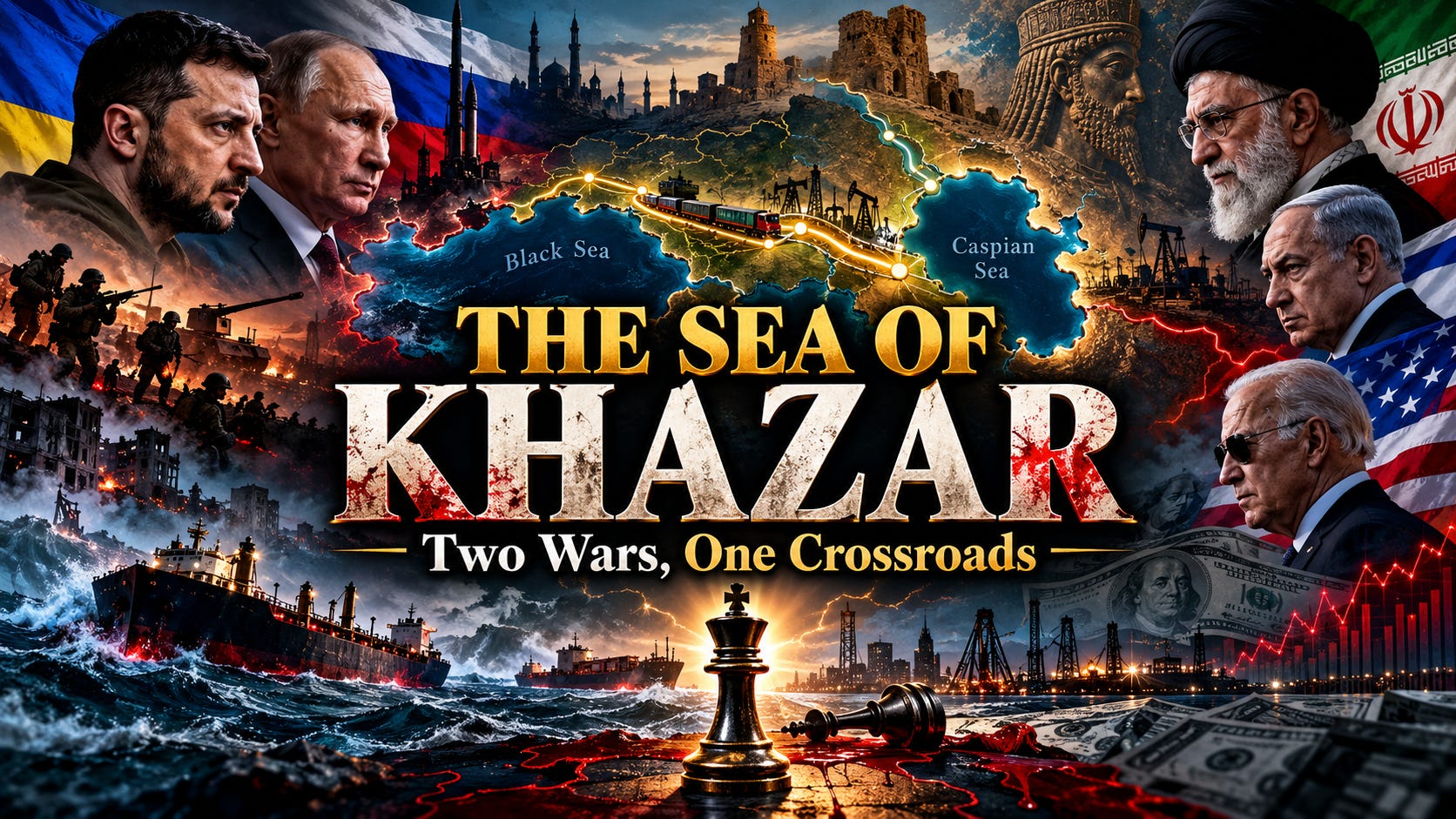
The Black Sea and the Caspian Sea are separated by land, but they have been connected through migration, commerce, military competition, and political alliances for centuries.
Today, Ukraine is fighting Russia on one side of this geography, while Iran has faced direct military attacks by the United States and Israel on the other. Russia connects both regions through its territory, military relationships, commercial ports, and energy infrastructure.
At the center of this investigation is a name familiar to generations of Iranians: دریای خزر — the Sea of Khazar.
The name originated in a medieval kingdom whose rulers adopted Judaism. This introduces an intriguing historical question about the relationship between Khazarian Jews and the modern state of Israel.
Yet the most revealing connection may not be genealogical. It may be that the same geographic corridors once contested by medieval empires are again becoming critical to the movement of military supplies, energy, money, and political influence.
To understand that possibility, we must investigate history, economics, geography, and contemporary military actions together, while distinguishing proven relationships from attractive but unsupported theories.
1. The Forgotten Khazar Kingdom
Between approximately the seventh and tenth centuries, the Khazar Khaganate controlled a significant political and commercial region stretching across parts of the northern Caucasus, the lower Volga, the northern Caspian, and areas near the Black Sea.
Its territory included areas associated with present-day southern Russia, parts of Ukraine, and the Caucasus.
The Khazars occupied a valuable position between the Byzantine Empire, the Islamic caliphates, and the commercial networks of northern Eurasia. Their political strength depended partly on military power and partly on their ability to regulate trade, collect taxes, and maintain relationships with surrounding powers.
A distinctive characteristic of this empire was the adoption of Judaism by its ruling dynasty, probably during the ninth century.
The kingdom’s wider population was religiously diverse, including Muslims, Christians, Jews, and followers of traditional beliefs. The extent of conversion remains disputed, but the existence of a Jewish Khazar ruling establishment is supported by medieval historical sources.
The Khazar example demonstrates that Judaism was not historically confined to communities descended exclusively from the ancient Israelites. Conversion and cultural exchange also contributed to the history of Jewish communities.
The Khazar kingdom eventually lost its political dominance, particularly after military campaigns by the Rus’ during the tenth century.
Yet the kingdom’s name survived.
In Persian, the Caspian Sea remained widely known as the Sea of Khazar.
The name endured long after the empire that inspired it disappeared.
2. Why the Persian Name Matters
The Caspian Sea was known by numerous names before and during the medieval period, including the Hyrcanian Sea, Sea of Gorgan, Sea of Tabarestan, and Sea of Mazandaran.
The name Khazar became prominent in Arabic geographical literature as Bahr al-Khazar, reflecting the influence of the Khazar people around the northern and western Caspian.
The designation subsequently became established in Persian as Daryā-ye Khazar.
Its continued use is an example of how geography preserves historical memories even when political boundaries, governments, and populations change.
But an important distinction must be preserved: the sea was named for the Khazar people, not specifically for Judaism. Their political identity existed before the conversion of their ruling elite.
It would therefore be inaccurate to treat the Persian name as evidence that the Caspian was once a religiously Jewish sea, or that the adoption of Judaism explains its geographical name.
The more significant historical observation is that the Khazars occupied a commercially valuable crossroads between powers that frequently competed for military and economic influence.
That historical circumstance invites comparison with the region today.
3. Were the Khazarian Jews the Ancestors of Modern Israeli Jews?
The possible relationship between Khazarian Jews and today’s Jewish populations has generated historical debate.
One influential theory, popularized by Arthur Koestler in The Thirteenth Tribe in 1976, proposed that Khazar converts contributed substantially to the ancestry of Ashkenazi Jews, whose communities developed across central and eastern Europe.
The theory deserves examination because Jewish populations have complex histories involving migration, conversion, community formation, and intermarriage.
However, historical plausibility must not be confused with demonstrated ancestry.
Modern genetic research generally identifies substantial Middle Eastern and European ancestral components in Ashkenazi Jewish populations. A major 2013 genome-wide investigation found no evidence supporting a predominantly Khazar origin. Research published in Cell in 2022 on medieval Jewish individuals from Erfurt, Germany, likewise identified ancestry consistent with the established Middle Eastern and European history of Ashkenazi communities.
These studies cannot rule out every possible Khazar contribution. They do not support the proposition that most Ashkenazi Jews descend from the Khazar kingdom.
Modern Israeli Jewish society is also not one homogeneous ancestral population. It includes Ashkenazi, Sephardi, Mizrahi, Ethiopian, and other Jewish communities with different historical backgrounds.
Consequently, describing Israeli Jews collectively as Khazarian Jews would be historically misleading.
There is a further distinction that matters for this investigation: even if particular modern individuals could demonstrate Khazar ancestry, that ancestry would not establish a continuing political organization or a common geopolitical agenda.
Political influence must be demonstrated through actual institutions, identifiable decision-makers, financial relationships, official agreements, and documented actions.
This distinction leads us to the more consequential modern question: What is Israel doing in the geographical region once associated with Khazaria, and why?
4. The Israeli Connection: From Ancient History to Contemporary Strategy
Israel’s involvement in the wider Caspian–Caucasus region can be examined through two major relationships: its security cooperation with Azerbaijan and its military confrontation with Iran.
Azerbaijan occupies a strategically valuable location on the western Caspian shore. It borders Iran and Russia and participates in transportation and energy networks linking Central Asia to Europe.
Israel and Azerbaijan have developed substantial security and commercial relationships, including defense cooperation and energy trade. Their relationship has strategic significance because Azerbaijan borders Iran, while Iran maintains its own relationships with Russia and Armenia.
This creates a complex regional environment involving overlapping partnerships rather than two simple opposing camps.
Israel’s interests in Azerbaijan do not demonstrate that its policies are driven by ancient Khazar ancestry. They can be understood through modern security concerns, commercial agreements, energy supplies, and regional diplomacy.
That is where we should follow the evidence.
Which companies supply military equipment? Which governments authorize agreements? Which energy firms benefit? Which trade routes become more attractive or vulnerable as alliances change?
These are questions that can produce verifiable findings.
The decisive modern development came in March 2026.
5. March 18, 2026: Israel Strikes the Sea of Khazar
On March 18, 2026, Israeli forces attacked targets at Bandar Anzali, an Iranian port on the Caspian Sea.
Israel said it struck Iranian naval assets and facilities. Subsequent reporting identified the port as an important part of maritime trade and military-related transportation between Iran and Russia.
This was a major geographical expansion of the confrontation.
Unlike the Persian Gulf, where American and allied naval forces have long maintained a significant presence, the Caspian is an enclosed sea bordered by Iran, Russia, Azerbaijan, Kazakhstan, and Turkmenistan.
Israel’s attack demonstrated that infrastructure associated with Russian–Iranian commerce in this inland maritime region was vulnerable to military action.
On March 25, The Wall Street Journal reported that the attack had targeted a supply route used to move ammunition, drones, and other military equipment between Russia and Iran.
The Royal United Services Institute subsequently assessed that the attack exposed vulnerabilities in Russia’s Caspian supply networks.
This is one of the strongest documented connections between the two wars.
Iranian-developed drone technology has supported Russia’s campaign against Ukraine. Russia and Iran have also expanded military and commercial cooperation. A military strike against their Caspian logistics network therefore has potential consequences beyond the Iranian battlefield.
The attack does not by itself establish that Israel acted primarily on Ukraine’s behalf. Israel had its own military objectives in confronting Iran.
Nevertheless, the overlapping effects are important.
An Israeli attack in Iran could disrupt networks associated with Russia’s war in Ukraine, even when the declared military objective concerns Israel’s conflict with Iran.
This is where apparently separate wars begin to intersect through actual infrastructure.
6. Russia’s Position Between the Two Wars
Russia possesses a geographical advantage shared by few other powers.
It has access to both the Black Sea and the Caspian Sea. Through its territory and transportation networks, Russia can connect northern Eurasia, the Caucasus, Central Asia, and Iran.
The war in Ukraine has made these routes strategically important.
Western sanctions have restricted Russia’s access to certain technologies, commercial markets, banking services, and transportation arrangements. Iran, itself subject to extensive sanctions, has developed systems for conducting trade outside some conventional Western financial and commercial channels.
Their partnership therefore reflects intersecting interests.
For Russia, Iran offers trade, military-related cooperation, access toward the Persian Gulf, and an alternative connection to southern Asian markets.
For Iran, Russia offers military technology, diplomatic support, commerce, and opportunities to reduce its economic isolation.
Their January 2025 strategic partnership treaty expanded cooperation in multiple areas, but it did not establish an automatic mutual-defense alliance.
This distinction helps explain why cooperation between the two governments should not be mistaken for unlimited loyalty.
Each government continues to pursue its own interests.
Russia’s relationship with Israel adds another layer of complexity. Moscow has historically maintained diplomatic and security channels with Israel while simultaneously expanding cooperation with Iran.
This creates a difficult balancing act, particularly when Israeli military operations damage infrastructure connected to Russian commercial interests.
An important question arises: How much disruption to Russian–Iranian trade will Moscow tolerate without directly confronting Israel?
The answer depends on observable Russian decisions, not assumptions about hidden loyalties.
7. Ukraine and Iran: Two Conflicts Connected by Military Technology
The relationship between Iran and Russia became especially consequential after Russia’s full-scale invasion of Ukraine in February 2022.
Iranian-designed Shahed unmanned aerial vehicles became an important part of Russian military operations. Russia subsequently expanded its ability to manufacture related systems domestically.
These weapons have been used in attacks affecting Ukrainian infrastructure and civilian communities.
The relationship has produced a striking technological connection.
Weapons associated with Iranian development and Russian adaptation are relevant to the wars in both Ukraine and the Middle East.
Meanwhile, Ukrainian experience defending against drone attacks has become valuable to countries facing similar threats.
In that sense, the military technologies, tactics, and defensive lessons of the conflicts have crossed geographical boundaries.
The Black Sea and Caspian therefore connect the wars not only through traditional shipping routes but through the movement of weapons, components, and battlefield knowledge.
This raises a legitimate investigative question: Which manufacturers, intermediaries, transportation companies, and procurement agencies have participated in these military supply chains?
Answering that question would reveal more about the material relationships between the wars than speculative claims about medieval ancestry.
8. Europe and the United States: Competing Economic Corridors
Europe’s relationship with Russia changed substantially after the invasion of Ukraine.
European countries sought to reduce dependence on Russian energy supplies while expanding alternative energy, transportation, and commercial arrangements.
The Caspian region consequently attracted additional strategic attention.
One important initiative is the Trans-Caspian Middle Corridor, connecting Central Asia through the Caspian, Azerbaijan, Georgia, and Türkiye toward European markets.
This route offers countries an alternative to transportation networks passing through Russia.
At the same time, Russia and Iran have pursued the International North–South Transport Corridor, a network intended to connect Russia through the Caspian region and Iran toward the Persian Gulf and India.
The two projects have different geographical orientations.
One strengthens east–west connectivity between Asia and Europe. The other strengthens north–south connectivity between Russia, Iran, and southern Asian markets.
Neither corridor is automatically a military project, and both can support legitimate civilian trade. Yet wartime sanctions, port attacks, and changing alliances can turn transportation decisions into instruments of geopolitical influence.
The United States has an important role through sanctions policy, security cooperation, military assistance, banking restrictions, and diplomatic relationships.
European governments have their own economic and security interests, which do not always align perfectly with American priorities.
The larger question is not whether one government controls the entire region. No evidence establishes that.
The question is how competing governments use infrastructure, financial restrictions, and military power to influence which commercial networks succeed.
9. Reading Between the Lines: What the Pattern Suggests
The historical Khazar kingdom and the modern Caspian conflicts are separated by more than a millennium.
But several structural similarities deserve examination.
The first is geography. The Khazars once occupied a position that allowed them to influence trade between larger competing political systems. Today’s Russia, Iran, Azerbaijan, Türkiye, and other regional states operate within an equally important, though technologically transformed, transportation environment.
The second is economic leverage. Medieval rulers collected tribute and duties from merchants. Modern states can influence commerce through port access, customs systems, sanctions, pipelines, military escorts, insurance rules, and banking networks.
The third is political flexibility. Khazar rulers navigated relations among powerful religious and political empires. Modern governments likewise maintain partnerships that can appear contradictory when viewed only through ideological labels.
The fourth is the relationship between conflict and alternative trade networks. Sanctions can redirect commerce. Military strikes can interrupt corridors. Companies may lose established markets while other intermediaries gain opportunities.
These patterns support a reasonable inference: control over access, transportation, and financial channels is an important component of the geopolitical competition surrounding the two wars.
But a pattern is not proof of coordination.
The wars have distinct immediate causes, histories, military objectives, and political decisions. Their overlapping economic consequences do not establish that a single organization planned both conflicts.
Nor does the historical fact of Jewish Khazar rulers establish a continuous Israeli or Jewish institutional role across the intervening centuries.
If there is an organized modern strategy connecting particular actors, it must be found in documented agreements, transactions, intelligence findings, government decisions, and military operations.
The March 2026 Caspian strike is especially important because it provides a concrete starting point for investigating such relationships.
10. Who Benefits, Who Pays, and Who Decides?
War alters the economic environment.
Defense manufacturers may receive additional procurement orders. Shipping companies may face higher risks but sometimes command higher freight rates. Energy exporters can benefit from price increases, although infrastructure destruction and sanctions can eliminate those gains.
Governments may gain short-term strategic leverage while their populations absorb long-term economic losses.
The effects are not uniform.
Russian energy companies face both commercial opportunities and severe constraints. Iranian transportation networks may obtain additional business through alternative corridors while also becoming military targets. European states invest in energy diversification but face higher security costs. American defense suppliers may see increased demand, while American taxpayers face the costs of military commitments.
Israel’s government may seek security benefits from weakening Iranian military infrastructure, but the long-term economic and regional consequences of wider confrontation can also be substantial.
Ukraine faces destruction, displacement, and the continuing burden of national defense. Iranian civilians experience the consequences of war, sanctions, and domestic political decisions. Russian civilians likewise experience economic and personal consequences resulting from their government’s military policies.
An investigation must distinguish a company receiving wartime revenue from evidence that the company helped initiate or prolong a war.
Profit can create incentives, but profit alone does not prove intent.
To investigate incentives meaningfully, we must identify the entities involved, the contracts signed, the payments received, and the decisions that produced those outcomes.
11. The Questions That Deserve Answers
The most revealing questions emerge where official military explanations intersect with commercial consequences.
Why was Bandar Anzali selected as an Israeli military target in March 2026, and what proportion of its traffic was military rather than civilian?
Which specific Russian and Iranian vessels, shipping operators, and logistics organizations used the affected facilities?
Did the attacks measurably disrupt transfers of weapons or components relevant to Ukraine, or were their consequences primarily related to Iran’s naval capabilities?
How did Russia respond through diplomacy, military assistance, commercial rerouting, or changes in its relationship with Israel?
Which businesses and government agencies are financing new Caspian infrastructure, and how have the wars changed projected revenues, transportation costs, and investment decisions?
What role does Azerbaijan’s cooperation with Israel play in the broader regional security environment, and how does Azerbaijan balance those relationships with its geographical proximity to Russia and Iran?
What evidence, if any, links descendants of historical Khazar Jewish communities to identifiable modern political organizations or state institutions? And how can such claims be tested without confusing ancestry, religious identity, nationality, and individual political responsibility?
These are investigative questions, not predetermined accusations.
They offer a way to move beyond public declarations and identify material consequences.
12. The Sea That Remembers
The Khazar Khaganate disappeared from the political map more than a thousand years ago.
Its Jewish ruling dynasty, its commercial institutions, and its system of regional power did not survive as an identifiable modern state.
Yet its name remains attached to the Caspian Sea in Persian.
Today that same sea connects Iran and Russia through routes that have acquired new strategic importance during two destructive conflicts.
Israeli aircraft have struck targets on its southern shore. Russian and Iranian cargo has moved through its waters. European and Asian governments have invested in transport networks around its coast. Military technology associated with Iran and Russia has affected the war in Ukraine.
These connections are measurable historical and contemporary realities.
Perhaps the deepest lesson is that empires disappear, ideologies change, religions travel, and political borders move, while geography continues to influence human choices.
The Caspian is not evidence of an unbroken Khazarian power structure.
It is evidence that a place can remain strategically important through radically different political eras.
The challenge is to determine whether today’s governments are using that geography to build lasting economic relationships or to extend the competition that has already devastated so many lives.
🩸 The Red Blood Perspective
The investigation begins with an ancient Jewish-led ruling dynasty and ends with a modern military strike against a Russian–Iranian logistics region.
The temptation is to connect those facts through a single uninterrupted historical narrative. But that would move beyond the available evidence.
A more consequential connection is already visible.
Modern powers are competing over infrastructure that determines how weapons, energy, goods, and financial resources move between Asia, Europe, and the Middle East.
Israel’s March 2026 attack at Bandar Anzali demonstrates how operations associated with one war can affect networks relevant to another.
The next task is therefore to identify who made the decisions, which organizations received the contracts, what cargo actually moved, and whose economic position changed.
The ancient Khazar kingdom supplies historical context. The modern commercial and military records must supply the proof.
The question is not simply who claims to control the region, but who exercises measurable control over its transportation, financing, military access, and economic future.
🌊❤️✨ The Ocean of Love and Positivity Perspective
Across the Black Sea, the Caspian, and the Middle East live millions of people whose languages, religions, and ancestral histories are different, yet whose daily hopes are remarkably similar.
They seek security for their families, freedom from unnecessary suffering, opportunities to work, and the dignity of building lives without fear.
The history of the Khazars reminds us that human identities have never been as simple or permanent as political narratives sometimes suggest.
A community can adopt a new religion. A kingdom can disappear. People can migrate, intermarry, establish new societies, and inherit traditions from multiple civilizations.
None of those histories makes present-day individuals collectively responsible for the actions of governments.
The same commercial routes that carry weapons can carry food, medicine, construction materials, knowledge, and economic opportunity.
The measure of humanity’s progress should not be how effectively we dominate a geographical crossroads, but how successfully we transform it into a place where civilizations cooperate rather than destroy one another.
The Sea of Khazar has witnessed the rise and fall of empires. Its future need not repeat their wars.
🩸🌊❤️✨ — Ocean of Love and Positivity
Blood connects us. The ocean unites us. Love guides us. Positivity illuminates our path.
Selected Research Sources
Encyclopaedia Iranica — Khazars: Historical geography, conversion, relations with Persia, and the Khazar state.
Encyclopaedia Iranica — Caspian Sea: Origins and historical use of the Persian name Daryā-ye Khazar.
Behar et al., Human Biology (2013) — No Evidence from Genome-Wide Data of a Khazar Origin for the Ashkenazi Jews.
Cell (2022) — Genome-wide data from medieval German Jews show that the Ashkenazi founder event pre-dated the 14th century.
Reuters, March 19, 2026 — Israeli military confirmation of attacks against Iranian naval targets in the Caspian.
The Wall Street Journal, March 25, 2026 — Investigation of the Russia–Iran supply corridor affected by Israeli strikes.
Royal United Services Institute (2026) — The Iran-Israel War Presents a Problem for Russia’s Military Supply Chains.
Carnegie Endowment for International Peace, January 2025 — Analysis of the Russia–Iran strategic partnership treaty.