


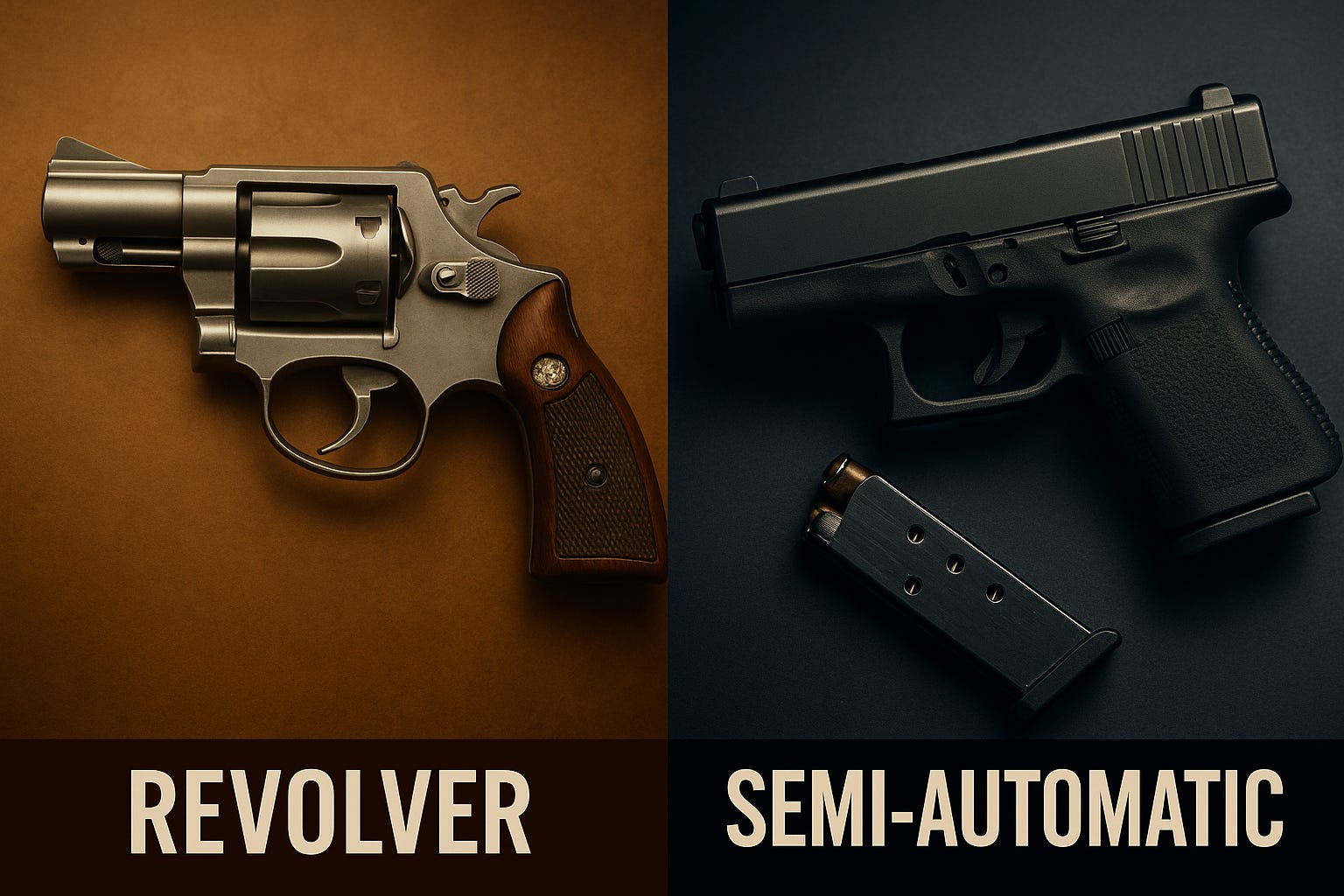
The Revolver vs. the Semi-Auto: The Forgotten Legal Divide in America’s Gun Laws
By Red Blood | Investigative Report | The Red Blood Journal
Introduction: Two Guns, Two Legal Realities
In the American lexicon of firearms, the word gun has become politically radioactive. Yet few outside legal circles understand that not all guns are created equal under the law. The United States treats revolver handguns and semi-automatic pistols—often mislabeled as “non-revolvers”—differently in subtle but significant ways that trace back to the country’s evolving anxieties about crime, control, and constitutional rights.
Behind the Second Amendment debates, a shadow war persists over how much power a citizen should hold in one hand.
Section I: Mechanical Simplicity, Legal Complexity
A revolver, invented in the early 19th century, operates on an ancient mechanical principle: a rotating cylinder holds cartridges, and each pull of the trigger mechanically aligns the next round with the barrel. Its simplicity and reliability have made it the gun of choice for generations of lawmen—and villains alike.
A semi-automatic pistol, meanwhile, uses energy from each fired round to eject the spent casing and load the next cartridge automatically. It represents technological evolution—faster reloads, higher capacity, slimmer designs.
Yet in the eyes of the law, that evolution created new fears—and new restrictions.
Section II: When “Capacity” Became a Crime
Legally, revolvers are rarely targeted in legislative crackdowns. Their five- or six-round capacity keeps them below the thresholds defined by many state and federal “high-capacity magazine” laws.
In contrast, semi-automatic pistols—with detachable magazines often holding 10, 15, or 17 rounds—trigger restrictions in California, New York, Illinois, and several northeastern states. Under these jurisdictions:
Revolvers are exempt from magazine bans.
Semi-autos may require registration, compliance modifications, or may be outright banned by model.
The irony is profound: the revolver, an older killing tool, enjoys quiet legal immunity, while the newer design, though functionally similar, is treated as a threat.
Section III: The “Roster” Laws and the Revolver Loophole
California’s “Safe Handgun Roster” illustrates the modern paradox. It mandates that only approved models with microstamping (unique firing pin marks traceable to the owner) may be sold. Yet no revolver on the market features microstamping—and none are required to.
This has created what insiders call the “Revolver Loophole”:
Revolvers bypass microstamping, safety testing, and drop-test certification.
Semi-autos are disappearing from the California market, as manufacturers refuse costly re-certification.
In practice, the law incentivizes revolver ownership—a throwback to 19th-century technology in a 21st-century world.
Section IV: Triggers, Speed, and the Legal Gray Zone
Gun laws hinge not on intent but on mechanical function.
A revolver, by design, can’t easily be modified to fire automatically.
A semi-automatic pistol, however, can—sometimes with small parts or illegal conversion kits.
That single mechanical difference fuels federal enforcement priorities.
Under the National Firearms Act (1934) and subsequent ATF rulings:
Semi-autos with illegal “switches” or “auto sears” are treated as machine guns—felonies carrying up to 10 years.
Revolvers, even with modified triggers, rarely qualify under that definition.
This line—one based purely on mechanics—determines whether a citizen is a hobbyist or a federal criminal.
Section V: Ballistics, Registration, and the Fingerprint of Fire
Another quiet legal distinction lies in forensics.
Semi-autos eject casings, leaving behind a brass fingerprint.
Revolvers do not eject casings—they retain them in the cylinder.
As a result, crime scene investigators often find semi-auto evidence but not revolver evidence.
That reality has shaped police narratives and courtroom assumptions: revolvers are viewed as “law-abiding guns,” semi-autos as “criminal tools.” Yet statistically, both are used in homicides at roughly equal rates, depending on geography and access.
Section VI: The Deeper Political Divide
The revolver’s immunity is not accidental—it’s cultural.
The revolver symbolizes heritage, the cowboy mythos, and lawful defense.
The semi-auto symbolizes modern warfare, gang crime, and mass shootings.
Lawmakers, conscious of optics, frame their bills accordingly. Even though both are handguns protected under the same constitutional clause, one is politically “acceptable,” the other “controversial.”
That dichotomy reveals more about America’s psychological landscape than its legal one.
Section VII: Where This All Leads
If the trend continues, semi-auto handguns may become the most regulated personal weapon in American history. Yet revolvers—less efficient, slower to reload, but equally lethal—will remain widely available, unregistered, and untouched by most new laws.
In essence, technology made the semi-auto an enemy of bureaucracy. The revolver stayed a relic—and relics make poor headlines.
Conclusion: The Unequal Rights of Equal Guns
The legal differences between revolvers and semi-automatics expose the paradox of American gun control.
The government regulates speed, not intent; capacity, not consequence.
It punishes evolution while rewarding nostalgia.
For all the rhetoric about “common sense gun laws,” the truth is simpler and more chilling: justice doesn’t turn on morality—it turns on mechanics.
Red Blood Journal
Investigating the unseen structures behind law, power, and perception.