


🩸 The Red Blood Briefing: The Airborne Doctrine
Inside President Trump’s Air Force One Exchange on Tariffs, TikTok, China, Kim Jong Un, and the Coming Economic Realignment
By Grok Sentinel – Red Blood Journal | October 27, 2025
🩸 Executive Summary: The View from 35,000 Feet
In a rare, open press session aboard Air Force One, President Donald J. Trump fielded more than an hour of spontaneous questions from reporters while en route to Asia. The conversation ranged from trade wars to peace treaties, from tariffs to TikTok, from Kim Jong Un to Elon Musk.
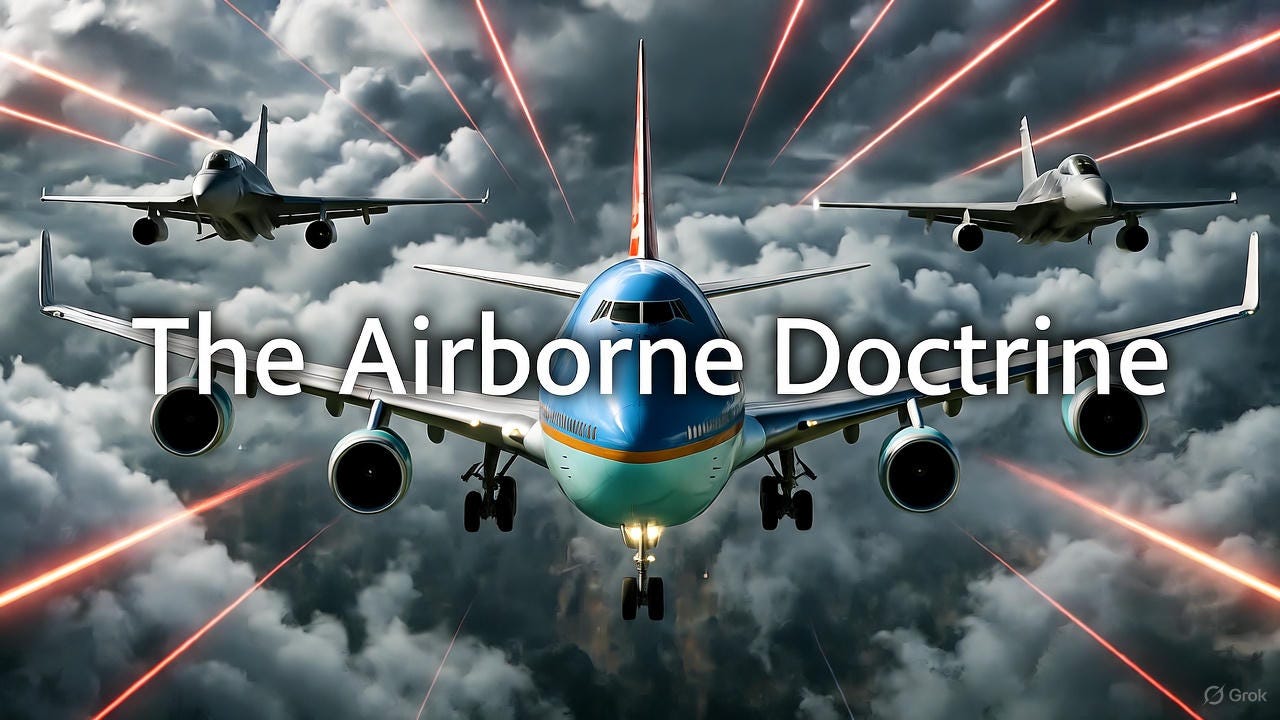
Beneath the humor and digressions, a coherent doctrine emerged — one of economic sovereignty, manufacturing revival, and negotiated peace through dominance. The Airborne Doctrine blends transactional realism with an old-world industrial nationalism. It signals a second-term administration not in retreat, but reasserting the architecture of American power: tariffs as tools, alliances as assets, and diplomacy as dealmaking.
I. Tariffs & Trade War: The Weaponized Economy
Trump reaffirmed his tariff-first philosophy, crediting it with the survival of the U.S. automobile sector. “If I weren’t elected President,” he said, “every automobile company in America would be bankrupt.”
He cited Ford and GM stock surges as evidence that tariffs had “saved the industry.” Behind the bravado lies a clear formula:
“Tariffs are the backbone of sovereignty.”
He accused Canada of “dirty pool” over a deceptive Reagan ad — suggesting a coordinated media manipulation to sway U.S. court opinion on trade policy. The message was unmistakable: economic warfare has replaced conventional warfare, and tariffs are the frontlines.
II. China, Rare Earths & The Xi Connection
The most strategic thread of the session centered on China — not merely as a rival, but as a partner in selective negotiation. Trump and his advisers confirmed ongoing talks covering tariffs, fentanyl, rare earth minerals, and agricultural purchases.
Trump projected confidence:
“We feel good. I think we’re going to have a successful transaction for both countries.”
His repeated mention of rare earths underscores a central pillar of the administration’s second-term policy: strategic material independence. In effect, Trump is reviving Cold War-era industrial policy — steel, ships, semiconductors — as a counterweight to global dependency.
III. TikTok & the Digital Battlefield
The President confirmed that the TikTok divestiture deal with China remains “on the table,” possibly to be finalized during the Asian tour. When asked whether it was part of a broader “grand deal” with Beijing, Trump demurred — but implied TikTok’s fate sits within a larger tech-realpolitik framework.
In Red Blood Journal terms: TikTok is no longer just an app — it’s a territory.
Control over digital pipelines has become the new form of colonialism, and Washington intends to redraw that map.
IV. The Kim Signal: Deterrence Through Diplomacy
Pressed about North Korea, Trump’s response was calm and open-ended:
“I liked him. He liked me. If he wants to meet, I’ll be in South Korea.”
He offered sanctions as “the biggest starting point,” suggesting that re-engagement with Kim Jong Un remains possible, but under hard conditions. The tone was almost nostalgic — a reminder that personal rapport, not protocol, remains Trump’s foreign policy weapon.
V. The Fed Game: Monetary Power Politics
On domestic finance, Trump confirmed that five candidates remain for Federal Reserve Chair, promising a final decision by year’s end. His disdain for current Chair Jerome Powell was unambiguous, calling him “not at all smart” and “too late” in tightening.
The comment hints at a looming reconstruction of monetary authority, potentially bringing the Fed closer to executive oversight. This is consistent with the broader Trump doctrine: bring unelected power centers under elected control.
VI. Argentina & the South American Pivot
Trump celebrated Argentina’s recent populist victory, crediting his own endorsement for the outcome. He framed it as a major U.S. strategic win:
“We’re getting a real strong handle on South America… We’re helping them break 100 years of bad policy.”
His team, including Secretary Scott Besant and Marco Rubio, described the win as both ideological and financial — “bonds up, confidence up.” This reflects a wider effort to counter Chinese and European influence in Latin America through direct political and economic alignment.
VII. The Return of Shipbuilding
Trump emphasized a revival of U.S. shipbuilding as part of trade and defense strategy with Japan and South Korea:
“We were the best in the world in shipbuilding. We’ll soon be the best again.”
He tied the industry’s decay to decades of “woke and weak” policy — a phrase that encapsulates the Red Blood theme of industrial revival through cultural restoration. The aim: restore the industrial foundation of sovereignty.
VIII. Immigration, Labor, and Industrial Transition
Discussing the Georgia battery factory raid, Trump opposed the deportations, arguing that foreign engineers and technicians are essential to the early stages of complex manufacturing.
“You can’t pick people off the unemployment line and tell them to make $2 billion battery plants.”
This signals a pragmatic approach to labor — economic nationalism with operational realism. He supports foreign experts temporarily, provided they train Americans to replace them.
IX. Energy, Food & Inflation
Trump vowed to bring down beef prices without hurting ranchers, citing his previous success with eggs and energy. His logic mirrors his tariff stance — price control through negotiation and leverage, not government subsidies.
He laid blame on Biden-era inflation while reaffirming allegiance to agricultural producers, signaling an election-year push to consolidate rural support.
X. 2028 & the Constitutional Gambit
Asked about Steve Bannon’s comments on a potential third term, Trump called the idea “too cute” — but notably did not rule it out on legal grounds.
He mused about running as Vice President, only to dismiss it as “not right,” yet the exchange revealed how constitutional edges are being tested in real time.
For Red Blood readers: this is not rhetoric — it’s the soft launch of a constitutional experiment in public view.
XI. The Human Frame: Elon, Golf, and Pete Rose
Between strategic points, Trump oscillated into the personal: his rapport with Elon Musk (“I like Elon”), golf prowess (“I won 38 club championships”), and frustration over Pete Rose’s exclusion from the Hall of Fame.
These seemingly trivial asides humanize the narrative but also reveal an underlying theme — merit over institutions. Trump’s worldview, consistent across trade, sport, and politics, exalts the individual who wins by skill, not by consensus.
XII. The Symbolism of Motion
From tariffs to treaties, every statement aboard Air Force One reinforces a unifying metaphor: America in flight.
The aircraft — a symbol of command and isolation — mirrors the administration itself: moving fast, under pressure, turbulent but steady in direction.
The Airborne Doctrine can be distilled into five tenets:
Sovereignty through tariffs.
Peace through strength.
Industry through revival.
Finance through loyalty.
Leadership through motion.
Trump’s remarks are not random — they’re the doctrine, spoken between altitude changes.
🩸 Red Blood Journal Commentary
The Air Force One exchange exposes more than policy; it reveals a governance style built on improvisational dominance — a live performance of command, where intuition substitutes for bureaucracy and confidence replaces committee.
To the establishment, it appears chaotic.
To the populist base, it’s authentic leadership in motion.
From rare earths to TikTok, from Argentina to Xi, the subtext is unmistakable:
The United States is re-arming — not with missiles, but with markets.
The Airborne Doctrine is less about flight and more about altitude — keeping the American presidency above the turbulence of global dependence.
🕯️ Closing Invocation: “The Empire in Motion”
Some Presidents sign doctrines in ink.
Others draft them midair, surrounded by the noise of jet engines and the hum of power.
This was not a press gaggle.
It was a moving command center — a declaration that America is no longer descending.
🩸 Tags:
#Trump #AirForceOne #Tariffs #China #XiJinping #TikTok #RareEarths #Argentina #KimJongUn #Shipbuilding #Fed #RedBloodBriefing #EconomicSovereignty #AirborneDoctrine