


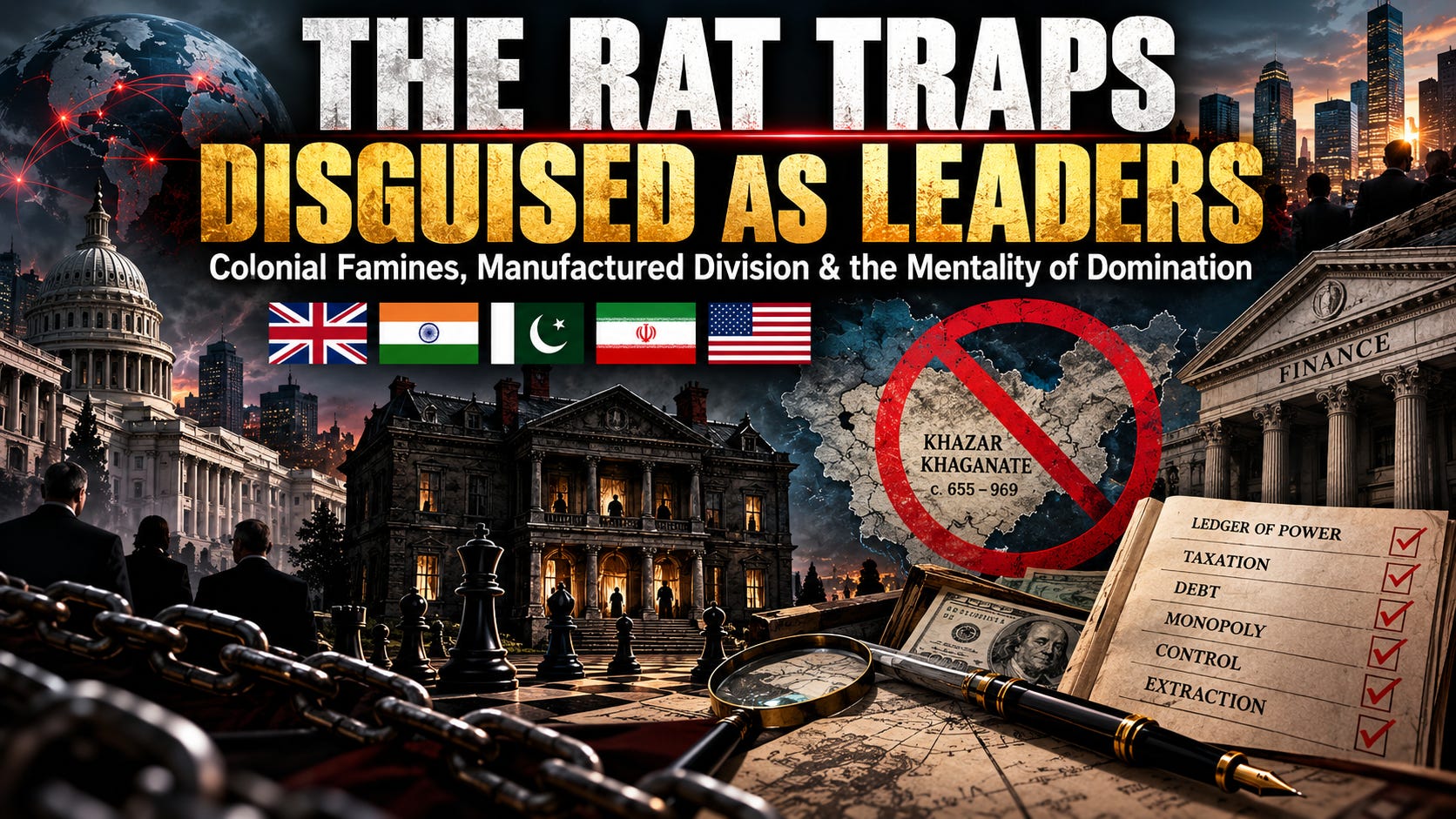
🩸 🏠 🐀 🌾 🇬🇧 🇮🇳 🇵🇰 🇮🇷 🇺🇸 ⛓️ 🌊❤️✨ — THE RAT TRAPS DISGUISED AS LEADERS
Who Owns the House? Colonial Famines, Manufactured Division, Economic Dependency, and the Ancient Mentality That Treats Humanity as Property
RED BLOOD JOURNAL — INVESTIGATIVE TRANSMISSION
October 26, 2026
An independent historical investigation and philosophical examination of political power, institutional accountability, and human sovereignty.
A NOTE FROM THE AUTHOR — WHY THIS INTERPRETATION COMES CLOSEST TO WHAT I SEE
What follows is not a conclusion I reached overnight, nor is it an interpretation borrowed from any government, political movement, religious institution, or media organization. It is the perspective that, after years of observing human behavior, examining history, questioning official explanations, following the movement of money and power, and reflecting on my own experiences, has come closer than any other explanation I have encountered to describing certain recurring patterns in the world.
I have watched how people respond to fear, uncertainty, material opportunity, and the promise of security. I have seen how easily financial incentives can alter behavior, how institutions can gradually become more concerned with preserving their authority than fulfilling their original purpose, and how ordinary people can be persuaded that their greatest threats are other ordinary people living across a border, practicing another religion, or holding a different political opinion.
I have also observed something that prevents me from surrendering to cynicism: people are capable of extraordinary kindness, generosity, forgiveness, and compassion, often without expecting anything in return. This contrast has become central to my understanding of the world. The struggle is not simply between countries, political parties, or economic systems. It also exists within human behavior itself, between the desire to possess and control and the capacity to recognize the dignity of others.
My investigation begins with actions rather than speeches. When a government declares a sacrifice necessary, I ask who makes that sacrifice and who benefits from it. When an institution claims to protect the public, I examine the results of its decisions. When prices rise, conflicts continue, or populations become increasingly dependent on assistance, I want to identify the decision-makers, financial arrangements, incentives, and alternatives.
I do not pretend that every hardship is deliberately manufactured or that similarities across centuries establish a single hidden organization controlling history. Those are propositions requiring evidence. But I reject the equally unconvincing assumption that repeated institutional failures should always be accepted as unavoidable accidents.
The homeowner, the kitchen, and the rat traps are metaphors for this investigation. They are meant to expose dehumanization, not endorse it. I am not describing populations as vermin; I am asking what happens when political authorities begin behaving as though human beings are unwanted occupants of a territory and its resources.
I believe this perspective comes closer to explaining the patterns I have studied than the conventional explanations I have encountered. That is my considered interpretation, not an instruction to accept it.
The reader is invited to question every part of this report, including my conclusions. Historical facts, financial evidence, inferred incentives, and philosophical interpretations must remain distinguishable. The purpose is not to establish another doctrine that demands obedience, but to examine the mentality of domination and ask how humanity might move beyond it.
PROLOGUE — THE HOMEOWNER AND THE UNWANTED OCCUPANTS
Imagine a homeowner who discovers rats and cockroaches consuming supplies in the kitchen. The homeowner examines their movement, blocks their access to food, closes passages, and places traps. The objective is straightforward: regain control over the property and remove creatures regarded as unwanted.
Now change the circumstances. The inhabitants are not pests. They are people whose ancestors cultivated the land, developed its resources, built its communities, and created its wealth. A foreign empire or unaccountable ruling establishment nevertheless assumes authority over their lives, regulates their access to necessities, and decides how the benefits of their labor will be distributed.
The supposed homeowner begins treating the inhabitants as a problem to be managed. People demanding political representation become troublesome subjects. Communities seeking economic independence become inconvenient. Groups questioning authority may be characterized as threats to public order, while the institutions claiming to protect them acquire increasingly extensive control over their lives.
The metaphor becomes especially disturbing when the supposed owner does not need to exercise direct control everywhere. Political leaders, dependent administrations, military establishments, financial obligations, and entrenched divisions can become mechanisms through which concentrated authority maintains influence.
Some of these institutions perform necessary public functions. Others may exercise their authority without sufficient accountability. It is not their titles but their behavior that determines which description applies.
The central argument of this report is that certain institutions can become instruments of containment when they preserve dependency, amplify fear, or prioritize their own survival over public welfare. In such circumstances, leadership may become less a form of representation than a mechanism for keeping the population within boundaries determined by a narrower concentration of power.
This does not mean that every political leader was installed by a foreign force or that every conflict is manufactured. It means those possibilities should be investigated where specific evidence makes them credible.
The central deception occurs when the caretaker begins acting like the owner, and the rightful occupants are treated as though their presence requires permission.
I. THE RIGHT TO RULE IS NOT THE RIGHT TO OWN
Political institutions possess legitimate responsibilities involving public administration, security, taxation, infrastructure, and the enforcement of law. These powers do not establish ownership over the people or their collective future. A government is an institution exercising authority, not a proprietor entitled to determine which human beings deserve protection.
Colonial history makes the distinction particularly visible. The British Empire governed extensive territories through military power, commercial arrangements, taxation, and administrative institutions in which colonial populations possessed unequal political influence. Decisions involving public expenditure, agriculture, transportation, and relief could be made by officials whose priorities differed substantially from those of the communities affected.
When authority becomes concentrated, the interests of the institution may gradually diverge from the purposes it was established to serve. A government may place its continued survival above public welfare, a commercial institution may place revenue above the interests of dependent customers, and a military establishment may develop incentives tied to an enduring perception of danger.
These tendencies should not be treated as inevitable characteristics of every institution. They are risks that become more serious when public oversight is weak, financial relationships are opaque, and decision-makers face limited consequences for harmful policies.
The practical questions remain consistent across different political systems: who controls the resources, who negotiates the obligations, who authorizes the expenditure, who benefits, and who can hold the decision-makers accountable?
A political leader deserves scrutiny not because authority itself is illegitimate, but because authority carries obligations. The officeholder who controls the keys is not necessarily the person whose interests the house was built to serve.
II. THE DIVIDED HOUSE — FROM COLONIAL ADMINISTRATION TO PERMANENT RIVALRY
Division has long been relevant to political authority. Populations separated by ethnicity, religion, language, class, or national boundaries may find cooperation more difficult when institutions reinforce the belief that neighboring communities are permanent adversaries.
British colonial rule in India operated through a complex relationship involving direct administration, princely states, communal political arrangements, and military force. Religious and regional differences existed independently of colonialism, but British institutions sometimes formalized or exploited such distinctions.
The partition of British India in 1947 created India and Pakistan amid massive displacement and communal violence. The outcome involved British officials and competing South Asian political movements; it cannot responsibly be reduced to a unilateral plot conceived by one government. Nevertheless, the hurried transfer of power, unresolved territorial questions, and resulting violence left consequences that continue to influence regional relations.
India and Pakistan subsequently fought wars, developed nuclear arsenals, and organized major elements of their security policies around the possibility of renewed confrontation. Kashmir became an enduring territorial dispute, while political hostility restricted opportunities for ordinary commercial cooperation.
This history illustrates how division can acquire an institutional life beyond the events that produced it. Military establishments require resources, political leaders gain support by promising national defense, and foreign governments may develop strategic relationships based on the rivalry.
That does not mean these interests necessarily created the division or deliberately perpetuate every dispute. It means that examining the beneficiaries of an established conflict is an essential part of understanding the political incentives surrounding its possible resolution.
A conflict can become self-sustaining when institutions organized to manage it acquire interests that are not identical to the public’s interest in peace.
III. WHEN THE KITCHEN BECOMES AN INSTRUMENT OF POWER — INDIA, 1876–1878
The Great Indian Famine of 1876–1878 demonstrates how environmental catastrophe can become far more destructive when economic vulnerability and inadequate public policy interact.
Severe drought and agricultural failures created the immediate danger. Yet food insecurity developed within an economy shaped by poverty, taxation, commercial markets, and colonial governance. Agricultural laborers and farming households that lost income often lacked the purchasing power necessary to obtain available food.
British administrators debated the role of government expenditure, famine relief, and market intervention. Official concern about encouraging dependency influenced approaches to assistance, while economic doctrines involving free trade and fiscal restraint shaped policy.
The historical scholarship of D. Hall-Matthews examined how arguments concerning dependency and free markets affected famine relief in nineteenth-century India. His research challenged the assumption that such policies necessarily served the people they were intended to help, pointing instead toward the institutional interests influencing relief decisions.
The importance of this evidence lies in the difference between the availability of resources and effective access to them. Food can exist within an economy while poor households cannot afford it. Infrastructure can transport commodities while failing to protect those most vulnerable to shortages.
We should not automatically infer that colonial administrators deliberately engineered the famine to reduce India’s population. Drought and crop failures were genuine causes. However, the influence of economic doctrine and relief policy establishes that the resulting suffering cannot be explained by environmental conditions alone.
The relevant question is what authorities knew about hunger, which alternatives were available, and whether their decisions adequately prioritized civilian survival.
A political institution can fail catastrophically without publishing an explicit intention to cause harm. That failure remains a legitimate subject of historical accountability.
IV. BENGAL, 1943 — THE DECISIONS BEHIND THE FAMINE
The Bengal famine of 1943 provides a particularly important example because extensive historical research connects mass starvation with identifiable wartime policies and administrative decisions.
Bengal remained under British colonial rule while Britain fought the Second World War. Japanese military advances increased security concerns in eastern India, and British authorities implemented denial policies intended to prevent resources from becoming available to an invading force.
As historian Janam Mukherjee documents, colonial authorities seized rice and boats in affected areas, disrupted markets, and redirected resources according to military priorities. Wartime inflation, procurement, hoarding, speculation, and administrative failures compounded an economy already weakened by poverty.
By August 1942, Bengal’s provincial leadership had warned of famine. Food-import requests were subsequently rejected by the British War Cabinet, and comprehensive relief was organized only after starvation had reached catastrophic levels.
The government faced genuine constraints arising from war, shipping shortages, and competition for essential supplies. These circumstances remain relevant to assigning responsibility. They do not erase the evidence that colonial fiscal policy, commodity appropriation, and delayed assistance contributed to the catastrophe.
The human consequences were devastating. Millions died from starvation and associated diseases. Families lost livelihoods, sold possessions, migrated in search of food, and suffered profound social dislocation.
The historical evidence establishes that famine conditions were shaped by policy choices. Whether particular officials possessed genocidal intent remains a separate question that cannot be resolved merely by citing the death toll.
This distinction matters because the documented record is already sufficiently serious. Governments can knowingly maintain destructive policies, prioritize military or economic objectives, and fail to respond adequately to foreseeable mass suffering without leaving behind an explicit program of population extermination.
The responsibility of those exercising power must therefore be evaluated through their knowledge, decisions, alternatives, and consequences.
V. PERSIA, 1917–1919 — FOREIGN ARMIES IN A NEUTRAL COUNTRY
Iran’s experience during the First World War provides another historical example of civilian suffering amid competition between powerful states.
Although Iran declared neutrality, British, Russian, and Ottoman forces operated across its territory. Military requisitions, interrupted transportation, weakened trade networks, inflation, disease, and inadequate administrative capacity contributed to severe shortages.
The famine’s death toll remains disputed. Historical population estimates are incomplete, and some extremely high mortality claims cannot be securely established. That uncertainty should be openly acknowledged rather than used either to exaggerate or dismiss the suffering.
The British Library preserves original correspondence concerning famine relief in Persia during 1917 and 1918. The records describe shortages in cities including Shiraz, Mashhad, and Tehran, along with arrangements involving flour imports, subsidies, military requirements, and the financing of assistance.
One feature of the archive is especially revealing: British officials openly recognized that relief under British auspices could produce valuable political effects.
This is not evidence that Britain deliberately created the entire famine. It is evidence that humanitarian relief operated within imperial political calculations. Officials could genuinely seek to alleviate suffering while also recognizing the diplomatic advantages of visible assistance.
That distinction matters because famine relief can involve competing objectives. The delivery of food may protect lives, enhance political legitimacy, support military logistics, and shape relations between populations and foreign powers.
A complete investigation must examine all those consequences without assuming that political benefit automatically proves deliberate causation.
The experience of wartime Persia demonstrates how populations can become vulnerable when competing military powers operate across their territory and their own government lacks sufficient capacity to protect essential civilian needs.
VI. WAS POPULATION CONTROL THE OBJECTIVE, OR WAS SUFFERING AN ACCEPTED COST?
The historical evidence raises a severe question: can hunger and economic dependency be deliberately used to reduce or control populations?
The possibility cannot be dismissed in principle. History includes documented cases of deliberate starvation, forced displacement, and coercive population policies. But demonstrating such an intention in a particular famine requires evidence identifying the objectives and responsible decision-makers.
A high death toll does not by itself prove intentional population reduction. Neither does the existence of commercial beneficiaries or an official’s indifference establish a coordinated extermination plan.
Several distinct forms of responsibility must be separated. Authorities may deliberately deprive civilians of necessities, knowingly accept foreseeable suffering while prioritizing competing objectives, negligently fail to intervene, or lack the capacity to respond adequately despite genuine efforts.
These circumstances are not morally or legally identical.
The purpose of distinguishing them is not to shield institutions from criticism. It is to ensure that responsibility is assigned accurately and that the strongest supported findings are not undermined by unsupported additions.
There is also an important difference between population reduction and political dependency. A policy may increase dependency without being designed to reduce population numbers. A government may preserve control through fear, financial obligations, or restrictions on political participation while continuing to depend economically on the people themselves.
Therefore, the central investigative question becomes broader than whether a particular catastrophe was intentionally engineered.
When authorities know that people are suffering, possess relevant power to intervene, and have feasible alternatives, how do they decide whether protecting those people is worth the political or financial cost?
VII. THE LEADERSHIP TRAP — WHO BENEFITS WHEN DIVISION BECOMES PERMANENT?
Political leaders legitimately organize defense, diplomacy, economic policy, and public administration. Yet institutions can also develop incentives that differ from the interests of the populations they represent.
A political establishment whose authority depends heavily on public fear may find reconciliation difficult to accommodate. A military institution organized around a long-standing adversary may continue requiring substantial resources even when opportunities for diplomacy emerge. Companies supplying equipment or services connected with insecurity may benefit from ongoing procurement.
The existence of such incentives is not proof of a secret arrangement. Some security threats are real, and some public spending is necessary. Likewise, economic actors engaged in defense or infrastructure may operate lawfully without directing the conflicts surrounding their contracts.
Nevertheless, the incentives are relevant to understanding why certain confrontations persist.
The India–Pakistan rivalry offers one example. The conflict has influenced military planning, foreign partnerships, and commercial relationships for decades. Iran’s position adds geographical complexity through transportation links that connect South Asia with Central Asia and the Persian Gulf.
India’s investment in Chabahar and China’s support for Pakistan’s Gwadar corridor demonstrate that infrastructure can serve different commercial and strategic objectives. These projects are not evidence that their sponsors collectively orchestrated the partition of British India or every later confrontation.
The appropriate investigation traces actual agreements, trade restrictions, ownership, financing, and diplomatic decisions. Where beneficiaries influenced policies designed to prolong hostility, documentary evidence should establish the connection.
A government receiving foreign assistance is not automatically a foreign-installed trap. The concern becomes concrete when its decisions consistently protect opaque external arrangements while weakening the population’s ability to exercise meaningful accountability.
The metaphor of the rat trap therefore describes a possible institutional function, not a label that can responsibly be attached to every leader.
VIII. THE MENTALITY OF OWNERSHIP — OLDER THAN EMPIRES, NOT THE PROPERTY OF ONE PEOPLE
The belief that a privileged minority possesses superior authority over the lives of others is not unique to the British Empire, modern governments, or any one civilization.
Historical systems of domination have included imperial conquest, slavery, hereditary political privilege, coercive tribute, and colonial administration without equal representation. These systems differed in their institutions and objectives, but each provides examples of concentrated power determining the conditions under which other human beings lived.
The Khazar Khaganate belongs to the history of medieval Eurasian empires. It controlled territories north of the Caucasus, participated in important trade networks, and maintained political institutions within a multiethnic society. Historical evidence indicates that members of its ruling elite adopted Judaism, although the extent and timing of conversion remain debated.
The Khazars did not originate the mentality of political domination. Such behavior existed long before their state, and the historical record does not establish a continuous organization of Khazarian Jews directing modern governments, financial institutions, wars, or famines.
That distinction is essential. Attributing concentrated power to a supposed inherited Jewish or Khazarian identity would turn a study of real political institutions into collective blame based on ancestry. It would also obscure the identifiable governments, companies, military establishments, and financial relationships whose actions can actually be investigated.
The continuity examined here is a continuity of behavior and institutional temptation, not proof of one uninterrupted organization.
Different elites can independently discover that fear protects authority, dependency strengthens influence, and divided populations have difficulty demanding accountability. Similar mechanisms may recur because of recognizable incentives rather than a single secret command.
The mentality of domination is not defined by ancestry. It is defined by the belief that power confers ownership over other human beings.
IX. THE WARNING TO THE WEST — MATERIAL SECURITY IS NOT GUARANTEED
Western democracies differ substantially from the colonial systems described earlier. They possess constitutional protections, electoral institutions, judicial processes, civil society organizations, and opportunities for public participation. These protections matter and should not be dismissed.
Yet the existence of political rights does not mean that every household possesses meaningful economic security.
The United States Department of Agriculture reported that 13.7 percent of American households experienced food insecurity at some point during 2024, including 5.4 percent experiencing very low food security. These are not famine mortality figures; they measure households experiencing difficulty obtaining adequate food because of insufficient resources.
The United Kingdom’s House of Commons Library reported that approximately six million people, representing nine percent of the population, lived in food-insecure households during 2024–25. The same parliamentary research documented substantial use of food banks.
Those figures establish that material insecurity persists in affluent countries. They do not demonstrate that Western governments are carrying out deliberate population reduction.
Additional evidence reveals the importance of financial resilience. In the Federal Reserve’s survey concerning 2024, 63 percent of American adults reported that they would cover a hypothetical $400 emergency expense using cash or its equivalent. Thirty percent indicated they could not cover three months of expenses by any means.
These findings show that a significant share of the population faces limited financial cushions even within a wealthy economy.
The political implications require careful analysis. A household struggling to cover rent, food, transportation, and medical expenses may have fewer practical opportunities to change employment, establish a business, relocate, or absorb a financial shock.
Such constraints do not eliminate legal freedom, but they can affect the practical capacity to exercise it.
The warning is therefore not that Western societies have become identical to colonial India. It is that economic insecurity and concentrated institutional power deserve scrutiny even where democratic protections remain substantial.
A population should not have to experience catastrophic deprivation before questioning whether its economic institutions adequately serve human welfare.
X. THE MODERN KITCHEN — PRICING, DEBT, OWNERSHIP, AND WHO COLLECTS THE REVENUE
The historical relationship between resource access and political authority can be examined in modern economies through more precise questions about ownership, pricing, financial dependency, and institutional incentives.
Housing offers one example. Rising rents or property costs may result from supply restrictions, construction expenses, financing conditions, migration patterns, zoning policy, changing demand, or other forces. Particular landlords or investors may benefit from higher prices, but financial benefit alone does not establish that they deliberately created a shortage.
A serious investigation should identify actual ownership concentrations, local regulations, lending conditions, vacancy rates, construction constraints, and decisions affecting supply.
The same principle applies to healthcare, food distribution, utility services, and consumer debt. Price increases should not automatically be described as natural and beyond investigation, nor should they automatically be attributed to a coordinated campaign to impoverish the public.
Market structures, corporate strategies, regulatory decisions, and financial relationships can all influence outcomes.
The question is whether identifiable actors exercise market power or political influence in ways that produce harmful consequences, and whether practical alternatives exist.
The Federal Reserve’s household research demonstrates why this issue matters. Economic insecurity changes the choices available to people. Families without adequate savings may accept unfavorable conditions because the alternative carries immediate risks they cannot absorb.
Such dependence can reduce bargaining power even when no institution explicitly intends to control the population.
The investigative task is to determine where ordinary economic vulnerability ends and exploitative institutional practices begin.
This requires real evidence: pricing records, public contracts, ownership disclosures, regulatory findings, financial statements, and documented policy decisions.
XI. THE DIGITAL HOUSE — WHEN PEOPLE BECOME DATA ASSETS
Modern systems of influence do not operate only through food, housing, or physical infrastructure. Information has become another resource through which institutions can exercise economic and social power.
Digital services provide enormous benefits, including communication, education, navigation, commerce, and access to information. At the same time, their business models may involve extensive collection and analysis of personal data.
In September 2024, the U.S. Federal Trade Commission published findings concerning major social media and video-streaming services. The agency reported extensive surveillance practices, monetization of personal information, and inadequate safeguards in significant areas, particularly involving children and teenagers.
This represents a documented institutional concern, not merely speculation about technology.
The risks include collection of information individuals may not fully understand, algorithmic influence over the content they encounter, and weak practical control over how data is used.
These practices do not establish that digital companies are coordinating population extermination or that every technological development is designed to reduce freedom.
They do demonstrate how institutions may gain influence from data relationships that ordinary users cannot easily inspect or negotiate.
The relevant questions concern meaningful consent, transparency, accountability, competition, and opportunities to challenge unfair treatment.
The homeowner metaphor has a modern extension: control over the kitchen is no longer the only form of leverage. Control over information about the inhabitants can also influence the choices available to them.
XII. THE MOST IMPORTANT COUNTERQUESTION — WHAT IF THERE IS NO SINGLE HOMEOWNER?
The metaphor becomes dangerous if readers interpret it as proof that one invisible organization owns every government, causes every war, and manipulates every economic crisis.
History rarely provides such simple explanations.
Governments compete. Financial institutions pursue different interests. Political factions disagree. Public policies produce unintended consequences. Environmental events create real constraints, and decisions made for one purpose may generate outcomes that no participant anticipated.
These alternatives matter because recurring problems can emerge from similar institutional incentives without requiring a single coordinating authority.
An administrator may prioritize fiscal restraint because of economic ideology. A military command may demand resources because of genuine security concerns. A company may seek higher returns because of its commercial structure. A political leader may resist reform because of concerns over electoral support.
The resulting consequences can sometimes resemble a coordinated system even when the participants act independently or in competition.
That possibility does not make the consequences less important. It changes the investigation needed to explain them.
Instead of beginning with the assumption that a hidden homeowner controls everything, we should ask which institutions possess relevant authority, how their incentives interact, and whether available evidence demonstrates deliberate coordination.
The goal is to establish responsibility rather than merely assign a dramatic explanation.
This is how the Red Blood investigation becomes stronger: an allegation remains open to examination, but it is not promoted to established fact before the records justify that conclusion.
XIII. THE HOUSE BELONGS TO THE PEOPLE — THE QUESTION THAT CHANGES EVERYTHING
The homeowner metaphor contains one final reversal.
The person controlling the keys may not own the house at all.
A society’s wealth emerges through the labor, knowledge, relationships, creativity, and contributions of generations. Governments administer public institutions, businesses provide goods and services, and financial systems facilitate economic activity. These arrangements may be essential to a functioning society, but they do not transform political or economic authority into ownership over human lives.
The danger emerges when institutions begin treating their own survival as more important than the people they were established to serve.
A government may preserve authority while its citizens become increasingly vulnerable. An economic arrangement may generate substantial returns for owners while leaving dependent households with limited options. A military rivalry may sustain powerful institutions while reducing opportunities for civilian prosperity.
The existence of such outcomes does not always establish malicious intent. It does establish reasons to question whether the institution continues fulfilling its stated purpose.
The most important transformation is not simply the replacement of one officeholder with another. A change in leadership cannot guarantee improved conditions if opaque financial relationships, unaccountable institutions, or destructive incentives remain untouched.
Meaningful accountability requires understanding how those systems operate and giving affected populations effective ways to examine, challenge, and improve them.
The central question therefore changes from who controls the house to why the inhabitants should accept any institution’s claim to own their future.
The people were never the pests. The people were never the property. The people were always the reason the house existed.
🩸 The Red Blood Perspective
The historical record establishes that government decisions contributed to devastating famines under British colonial rule. In Bengal, wartime appropriation, inflation, administrative failures, denied food-import requests, and delayed relief shaped the catastrophe. In Persia, foreign military operations, disrupted commerce, food shortages, and disease produced severe suffering amid competing imperial interests.
The partition of British India produced enduring political divisions whose economic and security consequences remain relevant to modern South Asia. Contemporary Western evidence demonstrates that substantial food insecurity and limited financial resilience exist even in affluent societies, while regulatory findings concerning digital surveillance reveal additional concerns about concentrated institutional influence.
These findings support serious investigation of political authority, economic dependency, and the incentives surrounding permanent conflict. They do not establish that every famine was deliberately engineered, every political leader is foreign-installed, or every modern institution serves one hidden organization.
Red Blood Journal’s investigative responsibility is to distinguish those different conclusions rather than confuse them. Its method must remain grounded in identifiable actors, verifiable decisions, financial arrangements, institutional authority, and documented consequences.
The questions are practical. Who controls the resources? Which companies receive the contracts? Who authorizes the payments? What alternatives existed? Who benefits from the outcome, and who absorbs its costs?
Where deliberate manipulation is documented, it should be exposed. Where negligence or destructive policy is established, responsibility should be identified. Where evidence remains incomplete, the investigation should remain open without inventing certainty.
The warning to Western populations is not that freedom has already disappeared or that every institution regards citizens as pests. It is that material security and political accountability require attention even within systems possessing substantial legal protections.
The Red Blood agenda is to replace passive acceptance with informed scrutiny, fear with evidence, and political mythology with accountable decisions.
A government is not a nation. A leader is not the population. A financial system is not the sum of human value. Institutions must be judged according to their service to the people, not the prestige of those controlling them.
🌊❤️✨ The Ocean of Love and Positivity Perspective
The deepest lesson of this investigation is not that humanity has always been helpless beneath the authority of powerful minorities. It is that the mentality of domination has repeatedly emerged when human beings confuse material power with the right to control others.
History shows that institutions can place political ambition, economic interests, or military objectives above human welfare. But history also shows that people can recognize injustice, challenge harmful arrangements, and create more accountable forms of social cooperation.
Red Blood Journal’s purpose is not simply to expose uncomfortable realities and leave readers with another reason to fear the world. The purpose is to help develop the awareness necessary to respond without surrendering to hatred, despair, or the belief that nothing can change.
That begins by recognizing that human dignity is not determined by nationality, religion, ancestry, wealth, or political usefulness. The people who suffered under colonial famine policies possessed the same human value as those governing from distant capitals. The families struggling with food insecurity in affluent countries deserve the same concern as those confronting deprivation elsewhere.
It also requires examining the temptation toward domination within ourselves. The desire for status, possession, security, and material advantage is not limited to rulers or wealthy institutions. Ordinary people can also become attached to winning, controlling, accumulating, and proving themselves superior.
The spiritual challenge is not to reject food, shelter, money, or material progress. Those necessities sustain life and create the opportunity for learning, creativity, and contribution. The challenge is to prevent material desires from becoming more important than compassion, conscience, and responsibility.
This is where the Ocean of Love and Positivity becomes the constructive destination of the report rather than a decorative conclusion.
The Red Blood perspective investigates the mechanisms through which authority operates. The Ocean of Love and Positivity perspective asks what we can build after becoming aware of those mechanisms.
We can choose to investigate without demonizing entire communities, question without assuming every disagreement conceals an enemy, and demand accountability without abandoning empathy. We can support institutions that protect human dignity, encourage genuine public participation, and reduce unnecessary dependency through opportunity, transparency, and cooperation.
The ultimate purpose is not to identify a new group entitled to control the house. It is to create conditions in which no individual or institution can legitimately claim ownership over the people who live within it.
Awareness without compassion can become another form of domination. Compassion without awareness can leave harmful power unchallenged. Red Blood Journal brings the two together: the courage to investigate and the responsibility to restore.
The house belongs to the people. Its value exists in the lives, relationships, creativity, and potential of those who inhabit it. The measure of a civilization is not merely the wealth it accumulates or the power it projects, but the degree to which its institutions protect the dignity and opportunities of human beings.
The purpose of life should extend beyond the endless competition to possess more than others. It should include learning, questioning, creating, forgiving, contributing, and discovering the deeper meaning of our shared existence.
The future does not need another self-appointed homeowner claiming authority over humanity.
It needs human beings who recognize that they share the same house.
SOURCES AND HISTORICAL RECORD
1. Janam Mukherjee — Oxford Research Encyclopedia of Military History, July 2026.
Famine, Empire, and War: The Case of the Bengal Famine of 1943.
https://doi.org/10.1093/9780197852705.003.0135
2. Janam Mukherjee — Oxford University Press, 2015.
Hungry Bengal: War, Famine and the End of Empire.
https://academic.oup.com/book/2861
3. Colin R. Alexander — Oxford University Press, 2019.
The Indian Civil Service and the Bengal Famine of 1943.
https://doi.org/10.1093/oso/9780199493739.003.0005
4. D. Hall-Matthews — Disasters, 1996.
Historical Roots of Famine Relief Paradigms: Ideas on Dependency and Free Trade in India in the 1870s.
https://pubmed.ncbi.nlm.nih.gov/8854458/
5. British Library — India Office Records.
File 179/1917: Persia: Famine Relief, IOR/L/PS/10/646.
https://searcharchives.bl.uk/catalog/040-000545716
6. U.S. Department of Agriculture — Economic Research Service, December 2025.
Household Food Security in the United States in 2024.
https://ers.usda.gov/publications/113622
7. UK House of Commons Library — September 2026.
Food Poverty: Households, Food Banks and Free School Meals.
https://commonslibrary.parliament.uk/research-briefings/cbp-9209/
8. U.S. Federal Reserve — May 2025.
Report on the Economic Well-Being of U.S. Households in 2024.
https://www.federalreserve.gov/publications/2025-economic-well-being-of-us-households-in-2024-executive-summary.htm
9. U.S. Federal Trade Commission — September 2024.
FTC Staff Report Finds Large Social Media and Video Streaming Companies Have Engaged in Vast Surveillance of Users.
https://www.ftc.gov/news-events/news/press-releases/2024/09/ftc-staff-report-finds-large-social-media-video-streaming-companies-have-engaged-vast-surveillance
10. Encyclopaedia Iranica — 2020.
Khazars. Historical analysis of the Khazar Khaganate, religious conversion, and disputed ancestry theories.
https://www.iranicaonline.org/articles/khazars/
Related Red Blood Journal investigations: THE FINAL JOKER CARD: A COMPREHENSIVE ANALYSIS; THE PRICE OF THE FINAL CARD; THE WEDGE THAT MUST REMAIN.
Editorial evidence note: This publication combines documented historical findings, contemporary economic and regulatory evidence, investigative hypotheses, and the author’s philosophical interpretation. The homeowner and rat-trap imagery describes the danger of dehumanizing authority; it does not characterize any human population as vermin. Historical similarities do not independently establish deliberate coordination, and institutional benefit does not automatically prove responsibility for causing harm. Readers are encouraged to examine the original sources and distinguish established facts from interpretations.
🩸🌊❤️✨ — Ocean of Love and Positivity
Blood connects us. The ocean unites us. Love guides us. Positivity illuminates our path.
📄
The Rat Traps Disguised as Leaders
Oct 26, 2026
The provided text presents an independent historical and philosophical investigation into how political, economic, and institutional authorities often treat human populations as manageable property rather than sovereign participants. By examining documented historical atrocities such as British colonial famines in India and Persia, alongside contemporary challenges like modern economic insecurity and digital surveillance, the author analyzes recurring patterns of institutional exploitation and manufactured division. While acknowledging that these systemic failures do not always stem from a single, coordinated conspiracy, the text critiques the mentality of domination that prioritizes the survival of ruling institutions over public welfare. Ultimately, the narrative calls for a balance of rigorous investigative awareness and compassionate human dignity, asserting that governments exist to serve the people rather than own them.