


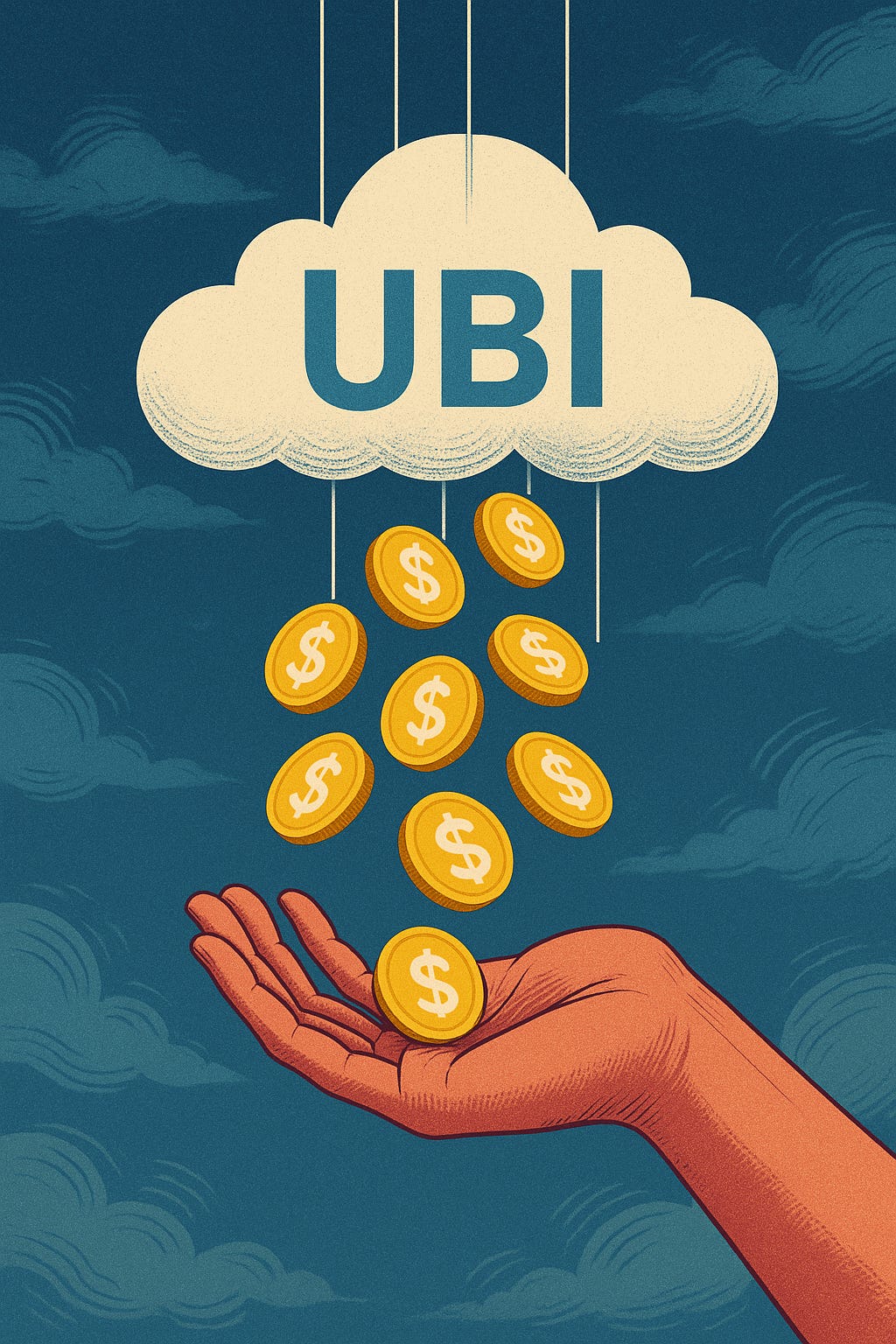
I. The Birth of a Benevolent Idea
Universal Basic Income — UBI — didn’t start in Silicon Valley. Its roots reach back to the 1500s, when political philosophers like Thomas More imagined a society where no one starved because the state provided for all.
Fast-forward to the 20th century: the concept resurfaces during economic crises. In the 1960s, even Milton Friedman, a free-market economist, proposed a “negative income tax.” Later, tech futurists like Elon Musk and Mark Zuckerberg reframed it for the AI age: “Automation will take the jobs, so government must take over the paychecks.”
At first glance, it sounded humane — a way to cushion workers displaced by machines. But from the start, it was never just about economics. It was about who controls the faucet that feeds every citizen.
II. The First Experiments: Free Money, Hidden Costs
The modern wave began quietly.
Finland (2017) tested a UBI pilot with 2,000 citizens. It lifted moods, but not employment.
Canada’s Ontario program (2018) was canceled mid-way — costs ballooned, data stayed buried.
U.S. cities like Stockton and San Francisco soon followed, backed by private foundations and tech philanthropists who wanted to “prove scalability.”
The results were predictable: people felt relief, yet the state grew its reach. The data collected — spending habits, mental-health metrics, even social-media behavior — became as valuable as the payouts themselves.
Behind every test was a deeper infrastructure trial: Could governments and corporations merge social welfare with digital surveillance?
III. Enter the Digital Dollar
When central banks joined the discussion, the tone shifted.
The Central Bank Digital Currency (CBDC) — a programmable, traceable form of national money — turned UBI from social policy into a technological weapon.
In public briefings, the IMF, World Bank, and Bank for International Settlements spoke of “financial inclusion.” Behind closed doors, they drafted the same framework:
Digital ID tied to biometric data.
Wallets controlled by the state or central bank.
Programmable features — spend limits, expiration dates, and behavioral conditions.
UBI would be the carrot; CBDC, the stick.
The two cannot exist apart — and that’s the quiet genius of the system.
IV. The Psychological Transition
By 2027, the narrative had shifted again:
“Work is optional. Creativity is the new economy.”
But as cash faded and CBDCs dominated, dependence deepened. The public cheered monthly deposits, unaware their financial autonomy had expired.
Speak against government policy? Your wallet “glitches.”
Buy too much fuel? You exceed your carbon quota.
Support a banned cause? Funds “flagged for review.”
It’s not science fiction; pilot programs in China, Nigeria, and the EU already test behavioral limits embedded into digital currencies. The architecture is real. The only question left is rollout speed.
V. The Pandemic Blueprint
The COVID-19 era normalized the mechanisms: mass payouts, digital tracking, restricted mobility. Citizens accepted government stipends as survival tools — the perfect rehearsal for permanent UBI.
Tech companies ran the back-end. Governments supplied legitimacy.
The result: a hybrid regime of algorithmic welfare, one that can calculate both your risk profile and your political value.
VI. The Coming Decade: Dependency as Policy
2025–2030 Forecast:
AI Displacement → Mass Unemployment
As autonomous logistics, service bots, and AI administration expand, governments will promote UBI as a safety net.CBDC Adoption → Digital Leash
Cash will quietly vanish. Nations will promise “efficiency,” “fraud prevention,” and “inclusion.” The real purpose: visibility and controllability.Behavioral Economics → Social Credit Overlay
Carbon allowances, “healthy food only” stipends, misinformation penalties — all programmable into your UBI wallet.Psychological Acclimation → Gratitude Economy
Citizens conditioned to thank the system that owns them. Freedom reduced to algorithmic permission.
VII. The Illusion of Compassion
The tragedy of UBI is not that it helps the poor — it’s that it redefines poverty as obedience.
By replacing jobs with stipends, society quietly replaces purpose with permission.
And the line between charity and control vanishes when every dollar can be turned off.
VIII. Red Blood’s Final Warning
In the next few years, UBI will be sold as salvation — an act of progress, compassion, and equality.
But history whispers a darker truth:
every empire that traded independence for comfort collapsed from the inside.
UBI isn’t just an income. It’s an interface between humanity and the machine.
And if the faucet is ever turned off, billions will realize they were never citizens — only subscribers.
🩸 Red Blood, 2025
“Freedom ends not with a bang, but with a deposit.”