


🩸 🇮🇷 💰 ⚙️ ♟️ ⛓️ 🌊❤️✨ — THE PERSIAN MAFIA
Who Owns Iran, Who Profits From Its Suffering, and Who Pays the Price?
Red Blood Journal | Investigative Analysis | October 29, 2026
Classification: Political Economy / Institutional Corruption / Financial Networks / Military-Industrial Interests / Human Consequences
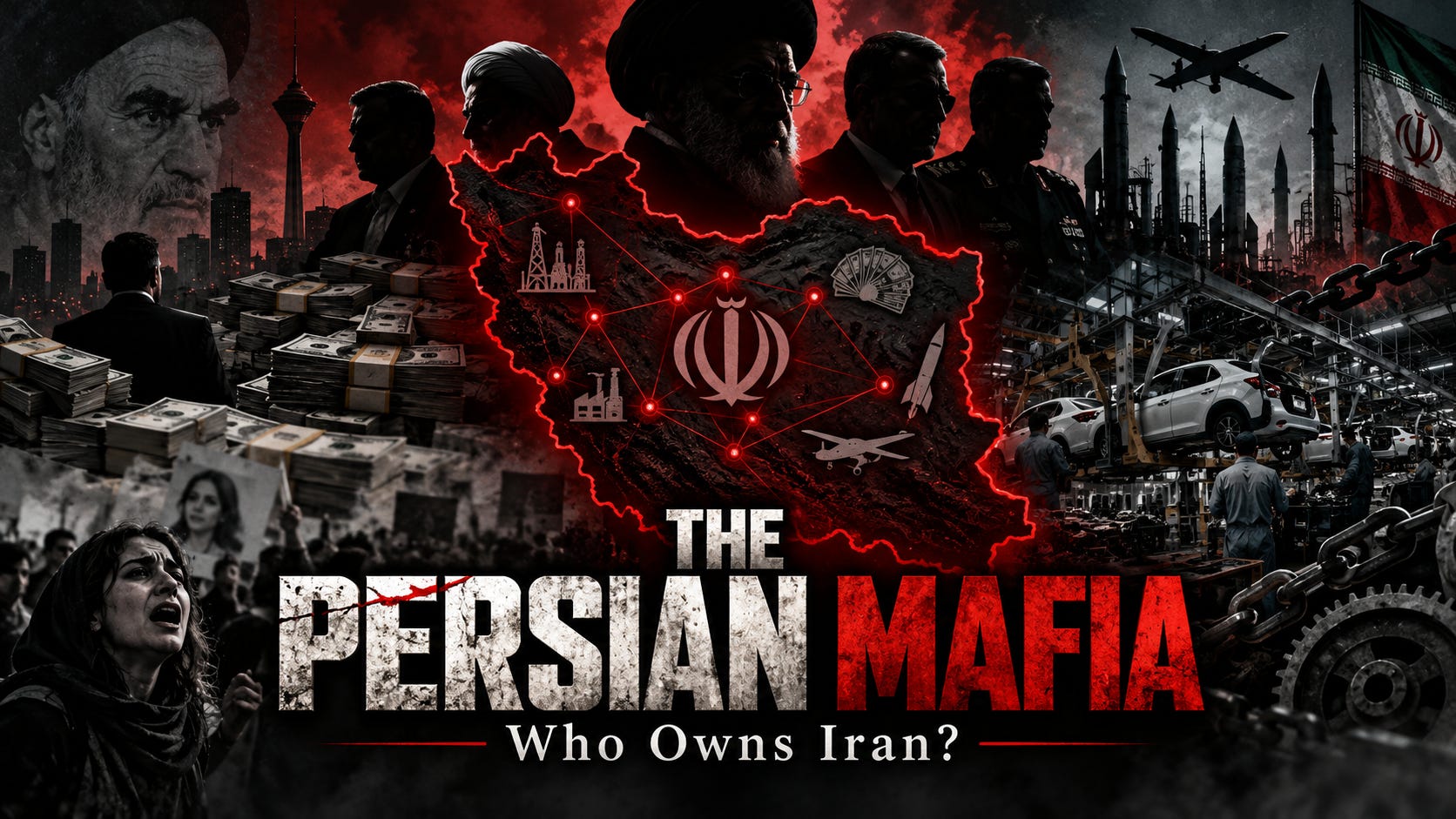
INTRODUCTION — A NATION RICH IN RESOURCES, A POPULATION TRAPPED IN POVERTY
Iran is a country of extraordinary natural resources, agricultural potential, industrial capabilities, educated citizens, and thousands of years of civilization. Yet millions of its people struggle with the rising costs of food, housing, transportation, healthcare, and the basic necessities of life. The contradiction deserves more than the familiar explanations of sanctions, inflation, poor management, and economic instability. Those factors matter, but they do not answer the most important question: Who makes the decisions that keep the population under financial pressure, and who benefits from the continuation of those conditions?
An Iranian-language investigative commentary recently brought together allegations concerning the Khamenei family, politically connected business holdings, the automobile industry, military manufacturing, agricultural distribution, pharmaceutical costs, and competing centers of political power. Although the commentary presents these matters as interconnected elements of a mafia-like system, several of its most consequential allegations remain unverified. Its significance lies in the questions it raises about the relationship between economic privilege, political protection, and the survival of entrenched institutions.
The term Persian Mafia in this report does not refer to the Persian people, Iranian ethnicity, or legitimate businesses operating in Iran. It describes the alleged networks of political influence, protected commercial interests, security institutions, and financial intermediaries that may use their positions to obtain advantages unavailable to ordinary citizens. The central concern is not nationality but conduct, ownership, financial benefit, institutional protection, and the human consequences of concentrated power.
This investigation examines a proposition that deserves serious consideration without being mistaken for an established conclusion: Iran’s economic suffering may be sustained not only by external pressure and administrative failure, but also by an internal structure in which certain individuals and institutions benefit from conditions that impoverish the wider population.
1. THE GOVERNMENT THAT MAY NOT CONTROL THE COUNTRY
A functioning government is expected to exercise authority over public institutions, regulate economic activity, enforce laws, and remain accountable for its decisions. In Iran, however, formal government structures operate alongside powerful religious, security, military, commercial, and political institutions whose influence extends beyond ordinary electoral accountability. Understanding the country’s economy therefore requires examining not only the president and cabinet, but also the institutions and networks capable of shaping decisions regardless of who occupies elected office.
The source commentary argues that competing cartels effectively govern important economic sectors, leaving elected officials with limited power to challenge them. Its examples include automotive manufacturing, food distribution, and other commercially protected industries. This is a sweeping claim, and it cannot be established merely by observing corruption or poor economic performance. Nevertheless, it raises an important structural question: When a policy repeatedly benefits an identifiable group while imposing measurable costs on the public, who possesses the authority to maintain that policy, and what prevents democratic or institutional correction?
If business networks obtain privileged access through political relationships, and political institutions depend on those businesses for financial resources, each side may develop an incentive to protect the other. Such relationships do not require every participant to belong to a secret organization or obey a single director. They can emerge through overlapping ownership, preferential contracting, appointments, legal exceptions, and shared interests. The result may resemble coordinated control even where no comprehensive conspiracy has been demonstrated.
This distinction matters because investigating an institutional network is more productive than assuming that every failure results from one hidden command center. The evidence must reveal which decisions were made, who approved them, how money moved, and which interests benefited.
2. THE KHAMENEI FAMILY AND THE QUESTION OF ECONOMIC OWNERSHIP
One of the commentary’s central subjects concerns Meysam Khamenei, a son of Ali Khamenei, and allegations about business relationships involving his family. The commentary names Mahmoud Loulachian, described as his father-in-law, and refers to alleged associations with companies or holdings including Farda Motors and the Golestan Group. These relationships are presented as possible examples of the intersection between political proximity and significant commercial interests.
Family relationships, however, do not themselves establish ownership, financial misconduct, hidden control, or criminal activity. Determining whether the alleged connections represent an abuse of influence requires corporate registration records, ownership disclosures, financial statements, transaction histories, and credible evidence of preferential treatment. It is necessary to distinguish direct ownership from indirect beneficial interests, business associations, and unsupported claims circulated through opposition media.
The same commentary discusses rumors of Meysam Khamenei’s illness or death, following reports of an explosion in Tehran’s Narmak neighborhood. It speculates about whether the events could be connected to an Israeli intelligence operation or internal rivalry. Those proposed connections are not established by the transcript, and the reported death itself must not be treated as confirmed on that basis. The timing of separate events cannot substitute for evidence linking them.
Nevertheless, allegations concerning politically connected business ownership deserve investigation independently of personal rumors. If senior political families hold significant economic interests, the important questions are whether those holdings are transparent, whether the enterprises benefit from government decisions, and whether comparable opportunities are available to competitors without political connections.
3. THE AUTOMOTIVE INDUSTRY — INDUSTRIAL DEVELOPMENT OR PROTECTED FINANCIAL SYSTEM?
Iran’s automobile industry provides one of the clearest starting points for examining the relationship between government policy, protected enterprises, and household financial burdens. Iran Khodro and Saipa occupy prominent positions in domestic vehicle manufacturing, while consumers have long faced concerns involving affordability, product quality, market competition, and access to imported alternatives.
The transcript portrays this industry as a protected financial network in which consumers are required to purchase expensive domestic vehicles while politically connected interests remain insulated from normal competitive pressures. It also questions the role of major parts suppliers and the circumstances surrounding control of Iran Khodro, including references to the Crouse group. These issues warrant investigation through actual shareholding structures, government decisions, regulatory approvals, and corporate governance records.
A particularly striking financial allegation concerns Saipa. The commentary cites reported losses of approximately 33 trillion tomans over six months and discusses a projected annual loss of roughly 70 trillion tomans. Dividing the latter figure by an assumed population of 90 million produces a hypothetical burden approaching 780,000 tomans per person. These figures are presented as claims from the source, not independently audited findings, and a company’s reported accounting loss is not automatically equivalent to a direct payment by every citizen.
The distinction does not eliminate the underlying economic question. Loss-making enterprises can impose public costs through government support, financial-system exposure, preferential credit, inflationary financing, and the opportunity cost of resources directed away from other needs. Whether those mechanisms apply in a particular case requires examining the company’s financial statements and identifying the institutions absorbing its losses.
The commentary contrasts these losses with potential investments in schools, hospitals, public transportation, and rural infrastructure. The exact comparisons depend on project costs and the accessibility of the funds involved, but the opportunity-cost question remains legitimate. When a society preserves an economically distressed industrial structure, it must ask what benefits justify its continued support and who receives those benefits.
4. THE MILITARY-INDUSTRIAL CONNECTION — THE MOST CONSEQUENTIAL ALLEGATION
The most serious industrial allegation in the source is that portions of Iran’s civilian automobile-manufacturing sector support military production, including missile and drone components. The commentary refers to statements by economist Farshad Momeni concerning the strategic relationship between automotive capabilities and Iran’s defense industries. It interprets those remarks as evidence that automobile factories operate partly as concealed military production facilities.
There is an important difference between the existence of dual-use industrial capabilities and proof that a particular civilian factory secretly manufactures weapons. Automotive manufacturing develops expertise in precision engineering, machining, metallurgy, electronics, logistics, and industrial management. Those capabilities can also support defense production. Personnel trained in civilian industry may subsequently work in military enterprises, while certain suppliers may legitimately or otherwise serve customers in both sectors.
None of those possibilities independently proves the commentary’s broader assertion that Iran’s major automakers are principally disguised missile or drone factories. Establishing such a claim would require evidence of particular contracts, production lines, components, customers, and payments. Without that evidence, the accusation remains a hypothesis rather than a demonstrated description of the industry.
The financial implications, if specific military relationships were verified, would be substantial. Public support for civilian production could indirectly support suppliers engaged in defense contracting, depending on how resources, personnel, and financing were allocated. The relevant investigative question is whether state industrial policy benefits military procurement networks and, if so, how those benefits are distributed.
There is also a dangerous implication in labeling entire civilian industries as military targets without adequate proof. Automobile factories employ civilians and produce goods used in everyday life. Even verified dual-use production does not automatically turn an entire industrial complex into a lawful military target. A responsible investigation must distinguish documented military functions from speculation and must consider the risks to civilian workers, surrounding communities, and essential infrastructure.
5. PRIVATIZATION — WHEN OWNERSHIP CHANGES BUT POWER REMAINS
Privatization is generally presented as a mechanism for introducing private investment, improving efficiency, and reducing government interference. Yet the transfer of shares does not necessarily produce independent ownership or genuine competition. A company may move from direct government ownership into the hands of investors whose financing, management, or commercial privileges remain closely connected to political institutions.
The transcript raises this concern through the controversy surrounding Iran Khodro and the Crouse group. It suggests that a transfer of managerial control might reflect arrangements made with the knowledge or participation of powerful authorities rather than an ordinary commercial transaction. That interpretation is not established by the transcript, but the underlying question can be investigated objectively.
A meaningful review would identify the actual shareholders before and after the transfer, the financing used to acquire control, the identities of beneficial owners, the approvals required, and any continuing commercial or government relationships. It would also examine whether the resulting ownership improved competition, financial transparency, operational efficiency, and consumer outcomes.
The decisive issue is not whether an enterprise is officially classified as public or private. It is whether its owners possess special advantages that protect them from accountability, transfer their risks to society, or prevent competing enterprises from entering the market.
6. THE FOOD MAFIA — WHEN BASIC SURVIVAL BECOMES A FINANCIAL OPPORTUNITY
The commentary moves from industrial manufacturing to something more immediate: bread. It describes a distressed baker who allegedly received flour containing material resembling animal feed and expressed anguish at the prospect of producing bread from it. The transcript does not provide laboratory findings, verified supplier records, or sufficient evidence to establish how the material entered the supply chain or whether deliberate adulteration occurred.
The allegation nevertheless raises serious questions about food quality, procurement, inspection, and distribution. If the account is authentic, investigators would need to identify the flour supplier, obtain representative samples, establish the nature of the alleged contamination, and determine whether the problem originated in processing, storage, transportation, or intentional substitution.
The source also describes consumers who believe that food prices are continually rearranged rather than meaningfully reduced. When one item becomes temporarily cheaper, another becomes more expensive, leaving household budgets under continuous pressure. Such experiences can arise from multiple economic forces, but they also justify examining market concentration, wholesale distribution, price-setting authority, and barriers to competition.
Agricultural producers may experience the opposite side of the same economic hardship. The commentary refers to fruit growers in Mazandaran struggling to sell abundant harvests while consumers face high retail prices. If documented, a substantial gap between farm-gate prices and retail prices could point to logistics costs, storage limitations, market inefficiency, bargaining imbalances, or excessive intermediary margins. Determining which explanation applies requires tracing produce from farm to wholesale market to retailer.
The central question is whether consumers and producers are both losing economic ground while particular intermediaries enjoy protected access to the market. Such a pattern would warrant close scrutiny, but it must be demonstrated through prices, contracts, margins, and ownership rather than assumed from hardship alone.
7. THE HEALTHCARE MAFIA — WHEN ILLNESS BECOMES AN ECONOMIC SENTENCE
The source includes an emotional account of Iranian families struggling to afford medicine and medical treatment. It describes older people dividing prescribed medication because they cannot afford the full amount, patients facing treatment costs beyond their means, and parents unable to secure adequate care for sick children. These statements capture an important human concern, although the specific examples and their prevalence have not been independently established through the transcript.
Healthcare markets deserve particular scrutiny because patients often cannot postpone essential purchases, negotiate effectively, or substitute ordinary alternatives for urgently needed treatment. When medicine becomes unaffordable, the consequences are not simply financial. They may include untreated illness, preventable complications, deteriorating quality of life, and the loss of confidence that society will protect people at their most vulnerable.
Investigating claims of pharmaceutical profiteering would require examining import licenses, domestic production, insurance reimbursement, currency allocations, supply shortages, wholesale margins, government purchasing arrangements, and connections between regulatory officials and commercial beneficiaries. Rising prices alone would not establish a cartel, but documented preferential access or market exclusion could provide evidence of abuse.
A society’s economic condition can be measured in national income and industrial output, but its moral condition is also visible in whether a sick person can obtain necessary treatment. When resources are allocated to protect privileged enterprises while essential healthcare becomes inaccessible, the public has a legitimate interest in understanding why those priorities prevail.
8. SANCTIONS — EXTERNAL PRESSURE AND INTERNAL BENEFICIARIES
International sanctions have significant consequences for Iran’s economy, including restrictions affecting trade, finance, investment, access to technology, and the cost of conducting ordinary commercial transactions. It would be inaccurate to dismiss these consequences or claim that domestic actors alone explain the country’s economic difficulties. Yet acknowledging the damage caused by sanctions should not prevent investigation into whether certain individuals and businesses profit from the restricted environment.
When ordinary channels of international trade become difficult or unavailable, specialized intermediaries may gain importance. Businesses with privileged access to foreign currency, shipping arrangements, import permissions, or financial networks may obtain advantages over competitors. The resulting concentration of commercial opportunity can create incentives to preserve arrangements that benefit a limited number of participants.
This leads to a difficult but necessary question: Could particular interests benefit from the continuation of restrictions even while the overall population suffers from them? The answer cannot be assumed. Some businesses may profit from specific distortions while still experiencing substantial losses from the wider sanctions environment. Others may have little influence over foreign policy despite benefiting commercially from particular conditions.
The investigation must therefore distinguish the causes of sanctions, the decisions maintaining them, the mechanisms used to navigate them, and the measurable benefits received by particular businesses. The objective is to identify actual beneficiaries without confusing financial advantage with proof of political coordination.
9. THE WAR ECONOMY — WHO GAINS WHEN PEACE REMAINS OUT OF REACH?
The commentary connects Iran’s internal economic struggles with the political interests of military institutions and foreign leaders. It discusses Israeli electoral politics, Benjamin Netanyahu’s political position, American diplomatic contacts, and speculation about whether renewed military confrontation might change the incentives facing political leaders.
These are significant subjects, but they require careful separation. A politician may gain public support during an external crisis without having caused that crisis for electoral advantage. Defense contractors may receive additional business during military escalation without having directed the decisions that produced the conflict. Political leaders may use national-security arguments to defend controversial policies without every security concern being fabricated.
The existence of incentives is a starting point for investigation, not proof of deliberate orchestration. Establishing improper influence requires evidence connecting economic or political benefit to actual decisions, communications, financial arrangements, or coordinated conduct.
Nevertheless, prolonged confrontation can reshape institutions in ways that deserve attention. Emergency spending may increase, secrecy may expand, oversight may weaken, and national-security arguments may be used to justify policies that would otherwise face greater resistance. A country already struggling with inflation, industrial inefficiency, and restricted trade may experience additional pressure as resources shift toward military priorities.
The critical question is whether prolonged confrontation creates beneficiaries powerful enough to resist peaceful alternatives, and whether their influence can be demonstrated. The greatest human cost is borne not by an abstract state or military institution, but by families who live with insecurity, shortages, economic uncertainty, and the possibility of war.
10. THE PROTECTION SYSTEM — WHO HOLDS THE POWERFUL ACCOUNTABLE?
Economic privilege cannot be understood without considering the institutions responsible for regulating business, investigating misconduct, enforcing laws, and protecting citizens. If those institutions operate independently, even powerful companies and public officials can face scrutiny. When oversight is compromised, however, financial misconduct may persist because the mechanisms intended to restrain it are ineffective or selectively applied.
The source depicts a system in which powerful actors are protected while ordinary citizens face increasingly severe consequences for challenging authority. It concludes with testimony attributed to the mother of Siavash Mahmoudi, who describes alleged surveillance, intimidation, and restrictions surrounding visits to her son’s grave. These allegations require verification, but they introduce an essential human-rights dimension to the broader discussion of institutional power.
A government that treats peaceful remembrance or demands for accountability as a security concern raises questions extending beyond economic management. The ability of families to mourn, citizens to speak, journalists to investigate, and courts to examine allegations is central to determining whether politically connected interests can be held responsible for their conduct.
Financial accountability and human rights are therefore not separate issues. Where independent investigation is restricted, economic misconduct becomes harder to expose. Where citizens fear retaliation, evidence may remain hidden. Where legal institutions lack independence, formal rules may exist without providing effective protection against powerful interests.
11. THE COST OF THE SYSTEM — THE PEOPLE PAY AT EVERY STAGE
The most important feature of the alleged network is not the wealth of any individual participant, but the possibility that ordinary people absorb costs throughout the entire economic system. A family may pay an inflated price for a vehicle, face rising food costs, encounter shortages or expensive medication, and experience reduced employment opportunities in an economy shaped by restricted trade and protected enterprises.
These hardships do not automatically share one cause. However, where government decisions repeatedly shield particular businesses from losses, restrict competition, or direct scarce resources toward privileged interests, the combined public burden becomes an appropriate subject for investigation.
The source commentary presents Iranian citizens as paying repeatedly for an economic structure from which they receive diminishing benefits. Their purchases sustain enterprises that may operate inefficiently, public resources may support institutions lacking sufficient accountability, and the decline in purchasing power makes ordinary life increasingly difficult.
An accurate assessment would distinguish the measurable costs of sanctions, inflation, exchange-rate instability, fiscal policy, market concentration, corruption, and industrial inefficiency. It would then identify whether particular beneficiaries gained from specific policies and whether those policies were maintained despite credible alternatives.
The ultimate financial question is not merely how much money Iran possesses or loses. It is how the country’s resources are allocated, who makes those decisions, who receives preferential treatment, and what those choices mean for the lives of its citizens.
12. REGIME CHANGE DOES NOT NECESSARILY MEAN SYSTEM CHANGE
One of the most important implications of this investigation extends beyond the present political leadership. If political authority changes but the underlying ownership networks, monopolies, financial intermediaries, and institutional privileges remain intact, ordinary citizens may experience little meaningful improvement.
A new president can inherit the same economic structure. A new political movement can depend on existing financing networks. Businesses previously aligned with one leadership group may reposition themselves within another. Without transparent ownership, competitive markets, independent financial oversight, and enforceable accountability, political transformation may simply change the individuals presiding over an established system.
This possibility does not mean every opposition movement is compromised or every business relationship is corrupt. It means that political transition should be judged by observable institutional changes rather than public promises or the identities of new leaders.
Real economic reform would require examining beneficial ownership, public procurement, preferential currency allocation, market concentration, corporate subsidies, financial disclosure, and the independence of institutions responsible for enforcing the law. These are practical measures through which an alleged network of privilege could be identified, evaluated, and, where misconduct is established, dismantled through lawful processes.
The strongest protection against the return of entrenched financial influence is not the replacement of one powerful group with another. It is the creation of institutions that prevent any group from acquiring unchecked authority over public resources.
13. THE UNANSWERED QUESTION — IS THIS CORRUPTION, OR IS IT THE SYSTEM ITSELF?
The transcript offers a unifying explanation for a wide range of economic and political grievances: that Iran is governed, at least in significant part, through overlapping networks whose survival depends on maintaining access to money, markets, political protection, and institutional power.
That explanation is a hypothesis requiring rigorous examination. Corruption can be widespread without being centrally coordinated. Policies can produce harmful outcomes without having been designed for those outcomes. Businesses can benefit from political arrangements without controlling the government. Conversely, repeated patterns of preferential treatment, overlapping ownership, concealed financial relationships, and deliberate obstruction of accountability can reveal something more serious than isolated misconduct.
The difference must be established through evidence. Investigators should look for recurring decision-makers, common beneficial owners, unexplained transfers, preferential contracts, regulatory exceptions, coordinated pricing arrangements, and financial relationships that connect apparently separate sectors.
If those connections are demonstrated, the investigation could reveal a self-reinforcing political-economic structure whose beneficiaries possess incentives to resist meaningful reform. If the connections are not demonstrated, the broader theory must be revised rather than protected from contradictory evidence.
The central principle is simple: following money and power requires the willingness to challenge both official explanations and attractive alternative narratives.
🩸 THE RED BLOOD PERSPECTIVE — THE ACTIONS, THE MONEY, AND THE BENEFICIARIES
The Red Blood Perspective begins with observable conduct rather than declarations of intention. If an enterprise repeatedly loses money while receiving public protection, its financing and ownership deserve scrutiny. If consumer prices remain elevated under restrictions that favor domestic producers, the beneficiaries of those restrictions should be identified. If politically connected individuals possess significant business interests, the origins of their advantages and their relationships with public decisions should be examined.
The investigation should not stop at the Islamic Republic’s public statements, nor should it accept opposition allegations simply because they are critical of the government. Both official narratives and competing accounts must face the same examination of documents, financial relationships, chronology, incentives, and consequences.
The allegations about the Khamenei family, the automotive industry, military production, agricultural distribution, and healthcare do not yet establish one coordinated criminal organization. What they provide is an investigative framework: a series of possible relationships whose validity can be tested through corporate records, procurement information, financial statements, independent reporting, and firsthand evidence.
The most dangerous system is not necessarily one that openly announces its control. It may be one in which harmful arrangements become normalized, responsibility is dispersed, beneficiaries remain difficult to identify, and the population is repeatedly told that its suffering is unavoidable.
For Red Blood Journal, the decisive question is not who claims to love Iran, defend its sovereignty, or protect its people. It is who makes the decisions, who receives the benefits, what those decisions cost society, and whether the people responsible can be held accountable.
A political system should ultimately be evaluated by what it does to human beings, not by the language it uses to justify itself.
🌊❤️✨ THE OCEAN OF LOVE AND POSITIVITY PERSPECTIVE — THE SYSTEM WE ALLOW TO LIVE WITHIN US
There is another dimension to this investigation that cannot be measured in corporate shares, public expenditures, or commercial contracts. A system of exploitation does not survive through financial transactions alone. It also depends on the choices of human beings who place personal advantage above conscience, accept injustice when it benefits them, or convince themselves that responsibility belongs to someone else.
The desire for wealth, position, security, and recognition is part of the human experience. These desires are not inherently evil. They become destructive when the pursuit of material advantage overcomes concern for other people’s suffering. A person who knows that a decision will harm thousands of families but proceeds because the decision brings financial reward has crossed a boundary that cannot be explained away by professional duty or institutional loyalty.
This is where the Red Blood Journal philosophy of the physical vehicle and the spiritual driver becomes relevant. The body seeks comfort, pleasure, protection, and possession. The conscious inner self possesses the capacity to recognize compassion, restraint, responsibility, and love. When desire controls the driver, wealth can become more important than dignity, power more important than truth, and institutional survival more important than the people an institution exists to serve.
Yet the same moral choice exists for those who oppose corruption. Hatred, revenge, humiliation, and the desire to dominate can reproduce the very patterns they seek to destroy. Replacing corrupt officials with people driven by vengeance does not necessarily establish justice. Replacing one privileged financial network with another does not liberate society. True transformation requires not only institutional reform but also a change in the values guiding those institutions.
Accountability should be firm, impartial, and grounded in evidence. Those responsible for proven abuses should face appropriate legal consequences, while innocent families, employees, and ordinary citizens must not inherit collective guilt. Financial transparency, equal treatment under the law, protection of human rights, and fair economic opportunity should replace secrecy, favoritism, and fear.
Iran’s greatest wealth has never been confined to its oil, minerals, agricultural land, or industrial infrastructure. It also resides in the intelligence, creativity, compassion, and dignity of its people. A society organized around human flourishing would not treat ordinary survival as a privilege to be distributed by those who hold power.
The Ocean of Love and Positivity asks each person to consider a question that applies equally to government officials, business owners, workers, journalists, and citizens: When an opportunity for personal gain conflicts with another person’s well-being, which voice within us makes the final decision?
The answer determines whether we become another participant in the machinery of exploitation or part of the human transformation capable of ending it.
CONCLUSION — FOLLOW THE MONEY, BUT NEVER LOSE SIGHT OF THE HUMAN BEING
The Iranian commentary that prompted this investigation presents a disturbing picture of political influence, protected industries, financial privilege, economic hardship, and institutional repression. Some of its allegations may prove significant, others may be overstated, and some may ultimately remain unsupported. A serious investigation must preserve those distinctions rather than transform suspicion into certainty.
The broader question, however, is too important to dismiss. When a resource-rich nation struggles to provide affordable necessities while particular enterprises and institutions retain extraordinary privileges, its people deserve clear explanations backed by evidence. They deserve to know who owns major economic assets, how public resources are distributed, why certain businesses receive protection, and whether political relationships influence commercial opportunities.
Iran’s future cannot be measured solely by whether one government falls or another rises. It must also be measured by whether the institutions that govern economic life become transparent, accountable, competitive, and responsive to human needs.
The objective is not simply to discover whether a Persian Mafia exists as one unified organization. It is to determine whether interconnected systems of privilege, protection, and economic extraction exist, how they operate, who benefits, and what would be required to replace them with institutions that serve the population.
A country is not truly liberated when the names of its rulers change while the machinery of exploitation remains untouched. Liberation begins when power becomes accountable, resources serve the people, and human dignity is no longer subordinate to the pursuit of wealth.
🩸🌊❤️✨ — Ocean of Love and Positivity
Blood connects us. The ocean unites us. Love guides us. Positivity illuminates our path.
💰
The Persian Mafia: Wealth, Power, and Corruption in Iran
Oct 29, 2026
The provided text examines allegations of widespread institutional corruption, economic privilege, and political protectionism in Iran, often framed as a “Persian Mafia” network. It investigates how powerful cartels, military-industrial interests, and politically connected families may benefit from industries like automotive manufacturing, agriculture, and healthcare while the general population struggles with severe financial hardship. Furthermore, the analysis questions whether external sanctions and internal governance failures alone account for the nation’s struggles, or if systemic exploitation is deliberately sustained by those in power. Ultimately, the sources argue that genuine reform requires rigorous evidence, strict financial transparency, and a fundamental shift toward institutional accountability rather than merely changing the ruling political figures.