


The Midnight Casino: Elites vs. the Independent Investor
This investigative report by Red Blood exposes the growing perception of insider trading among U.S. congressional elites, exemplified by the Pelosi portfolio’s uncanny stock market success, enabled by legal loopholes and spousal trading. It critiques the transformation of Washington into a “congressional casino” where lawmakers exploit pre-legislative insights for personal gain, undermining democratic principles. Contrasting this, the report draws on Donald Trump’s self-made financial strategies to offer a counter-elite blueprint for working Americans with modest savings. It advocates investing in tangible assets like farmland and energy ETFs, leveraging political instability for entry points, using productive debt, and building micro-empires through skills and platforms. Highlighting a new class war, it provides a “Red Blood Playbook” for small investors to counter elite advantages using open-source tools, community financing, and AI-driven analysis. The report predicts a decentralized financial revolution, empowering those who adapt over those who rely on connections.

1. The Congressional Casino
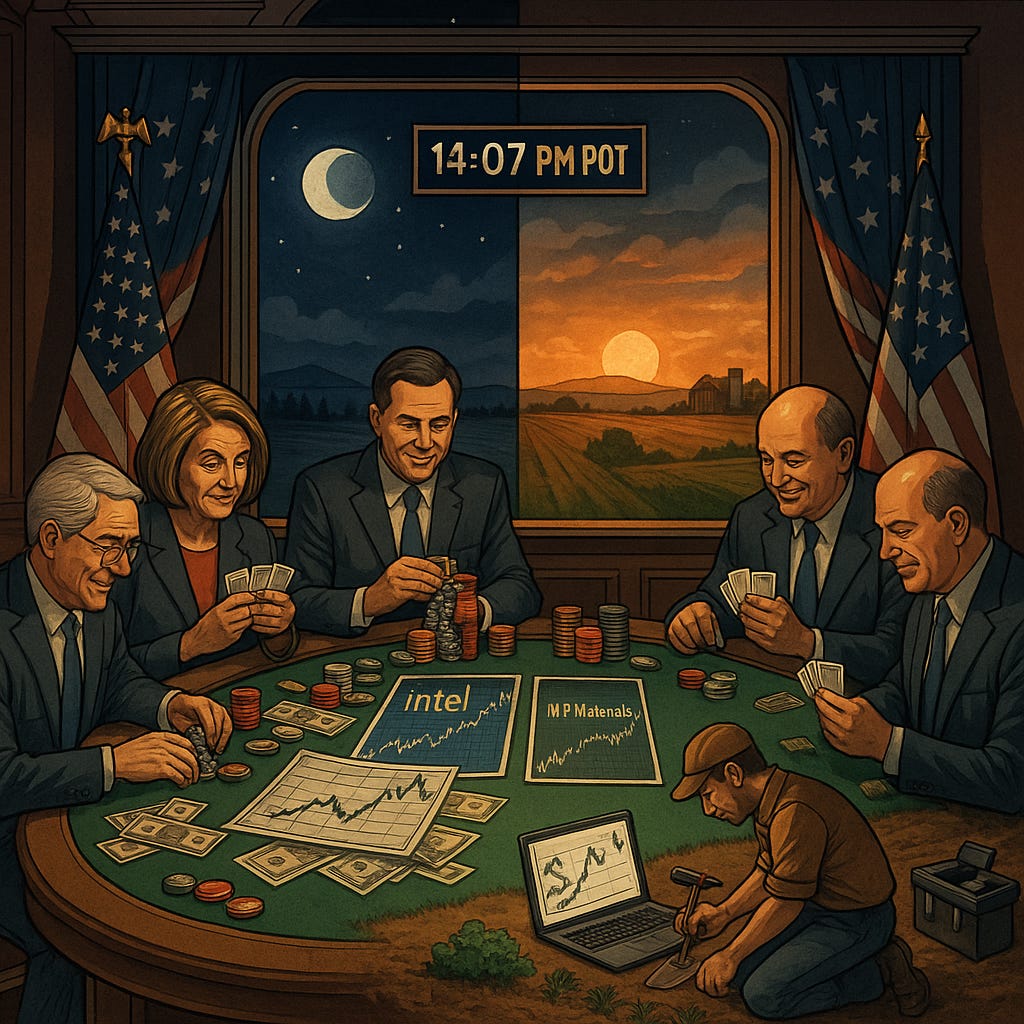
Washington, D.C. was never meant to be a stock exchange — but that’s exactly what it has become.
Every few weeks, another headline confirms what millions already sense: the political elite are insider traders wearing flag pins.
The Pelosi portfolio is now shorthand for corruption: miraculous returns, “lucky” timing, and uncanny precision in predicting government-funded winners.
Members of Congress, sworn to serve the people, are quietly serving themselves through pre-legislative insight — using upcoming bills, defense contracts, or regulatory shifts to enrich their personal accounts before you ever see the news.
This is not a market anymore.
It’s a casino where the dealers write the rules and never lose a hand.
2. The Elite’s Toolkit of Corruption
Here’s how the game is played:
Insider Intelligence:
Lawmakers sit on committees that control defense budgets, biotech approvals, or semiconductor subsidies.
Before public announcements, they reposition their portfolios — or have “blind trusts” do it for them.Legal Loopholes:
The STOCK Act (2012) was supposed to stop insider trading in Congress. Instead, it became a fig leaf.
Members delay reporting trades up to 45 days, long enough to profit, reshuffle, and refile. Fines are laughable — $200 for crimes that would send a normal investor to prison.Shell Spouses and Silent Partners:
Many now trade through spouses or “family investment vehicles.”
The moves are hidden but the profits are clear: from defense contractors to tech firms, the trail always leads back to Capitol Hill.
This is not democracy. It’s feudal capitalism, where the crown is replaced by committee power and the serfs pay through inflation, taxes, and lost opportunity.
3. Trump’s Revenge Blueprint: Competing Without Connections
Love him or hate him, Donald Trump’s financial playbook was never about being invited to the table — it was about building his own.
For working Americans with modest savings, there are ways to apply that “counter-elite” mindset without billions in real estate or access to senators.
Here’s how:
A. Play Real, Not Rigged
Avoid Wall Street hype stocks and D.C.-funded darlings.
Focus on tangible, real-economy assets:
Farmland (even fractional ownership via REITs)
Energy infrastructure ETFs
Small-cap industrials that thrive on domestic reshoring
The elite speculate. The independent investor owns what people need to survive.
B. Leverage Political Chaos
Every time D.C. fights, markets tremble.
While the elite sell fear, buy stability.
Example: When Congress stalls defense budgets, aerospace suppliers and energy firms dip — that’s the entry point for long-term holders.
C. Think Debt, Not Desperation
Trump didn’t “save” — he leveraged.
For small investors, that means using productive debt (real estate loans, small-business credit) instead of consumer debt.
Borrow to build, not to buy.
D. Build the Micro-Empire
The biggest act of rebellion is ownership:
Own a skill (learn coding, logistics, solar, or repair trades).
Own a platform (a blog, Substack, or local service site).
Own a network (local partnerships that bypass corporate middlemen).
Trump fought the establishment by turning his name into a brand.
You can do the same — even on a smaller scale — by turning your effort into equity.
4. The New Class War: Workers vs. the Connected
The rich aren’t smarter; they’re closer to the faucet.
When the government prints, funds, or legislates, they drink first.
Everyone else gets the diluted leftovers — higher prices, shrinking savings, and a sense of despair.
But the political system’s greatest fear is financial independence at the bottom.
That’s why regulation crushes small lenders, zoning blocks micro-enterprise, and Wall Street dominates retirement funds.
The antidote isn’t waiting for fairness — it’s strategy.
5. The Red Blood Playbook
Goal
The Elite’s Method
The People’s Countermove
Insider Access
Lobbying, closed committees
Open-source research, tracking government contracts, reading filings (EDGAR, FedWatch, DoD procurement data)
Unlimited Credit
Fed liquidity, cheap leverage
Community banks, credit unions, SBA microloans — small-scale replication
Narrative Control
Media funding & distraction
Independent journalism, Substack, citizen media
Asset Monopoly
Institutional real estate
Cooperative buying, local property syndicates, REIT alternatives
AI Advantage
Algorithmic trading
Using AI tools for personal data analysis, portfolio alerts, and market tracking
6. The Ironic Revolution
The irony is simple:
The same system built to enrich the powerful now provides tools that empower the awake.
Cheap AI analysis, public trading data, tokenized real assets, and decentralized finance all let small investors act faster, smarter, and freer than any senator’s “blind trust.”
The next revolution won’t be televised.
It will be automated, decentralized, and owned by the people who refuse to bow.
Red Blood’s Closing Line
“They bet on access. We bet on adaptation.
The old elite built empires on control — the new patriots will build theirs on intelligence.”