


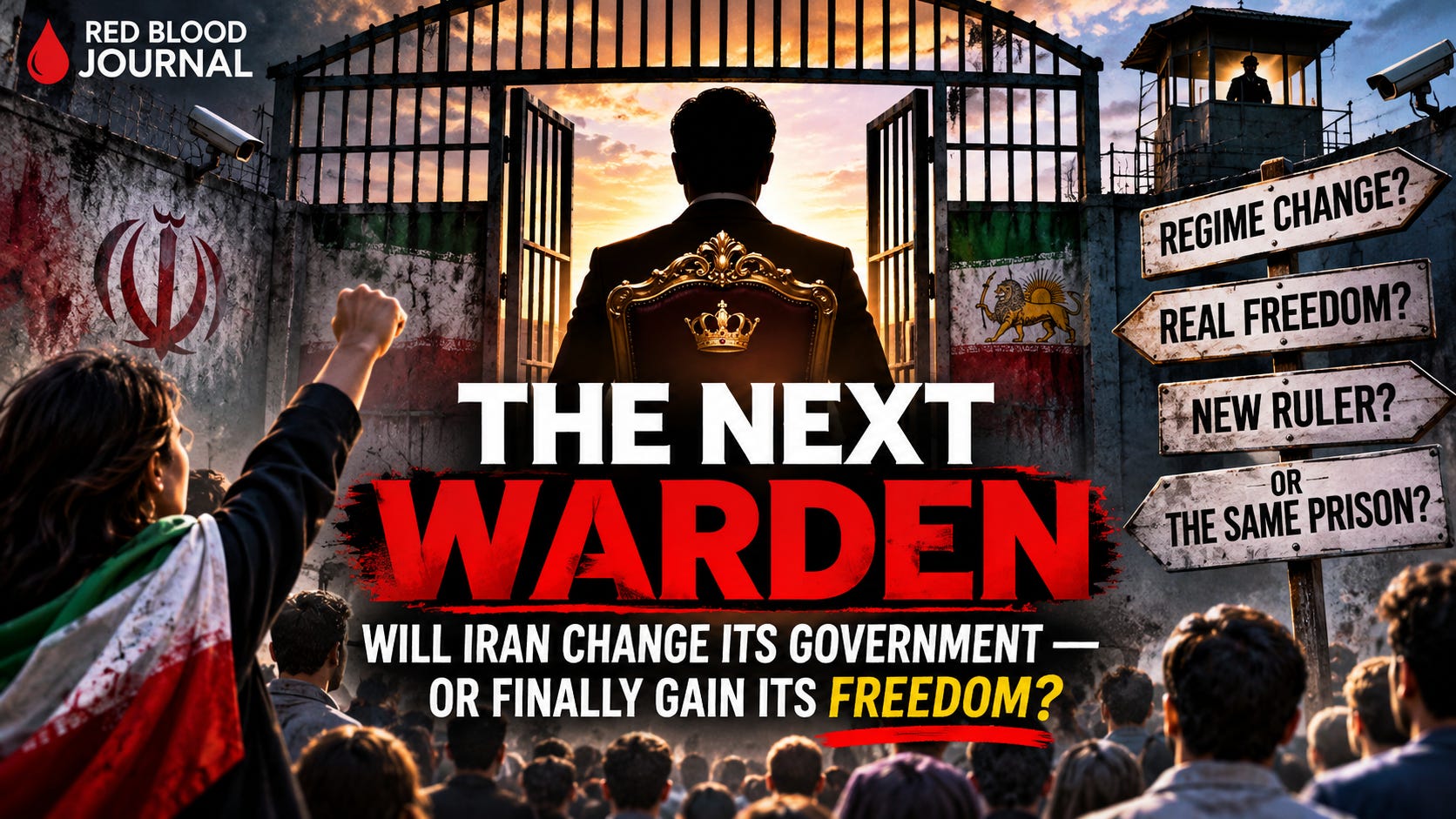
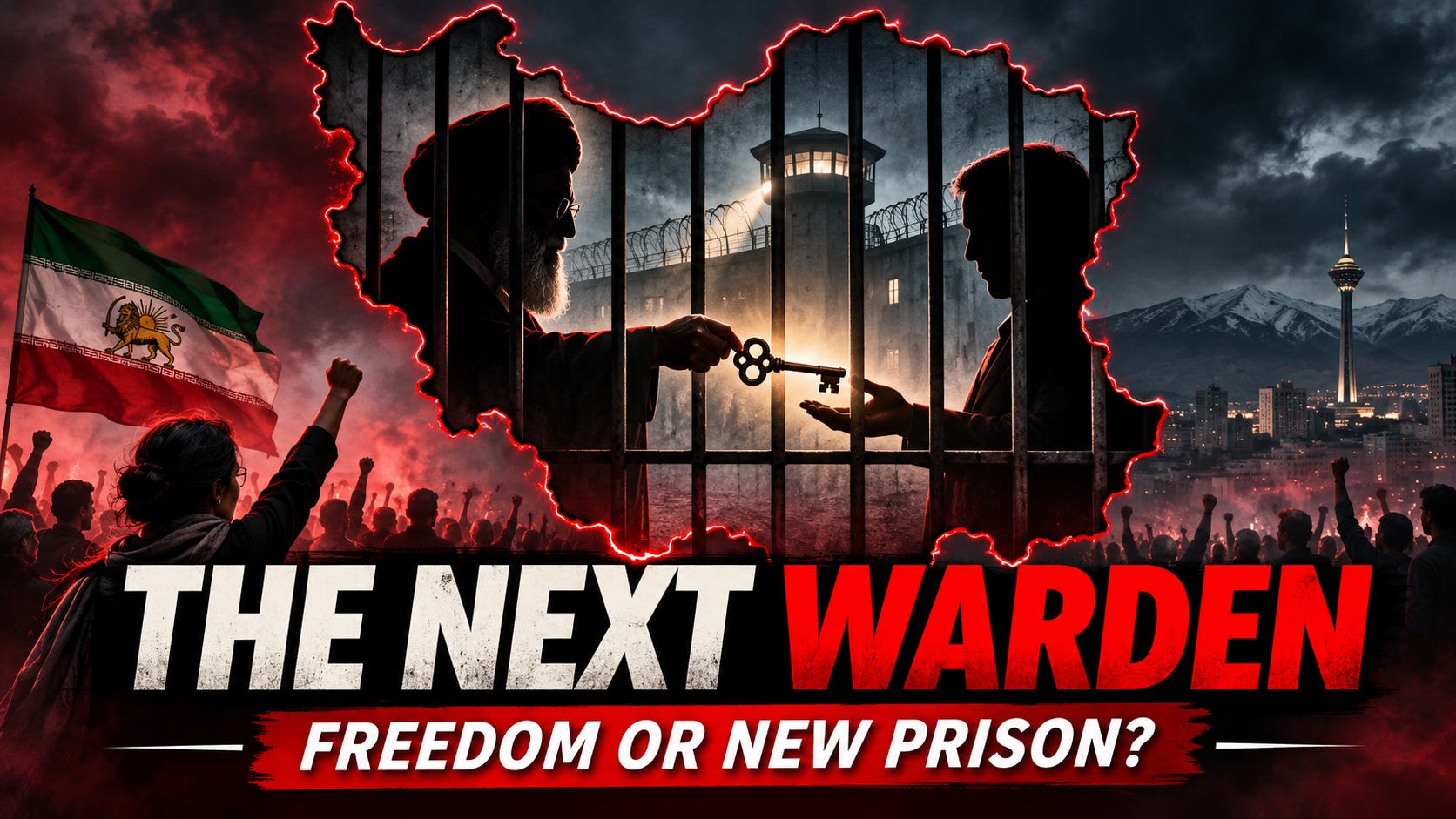
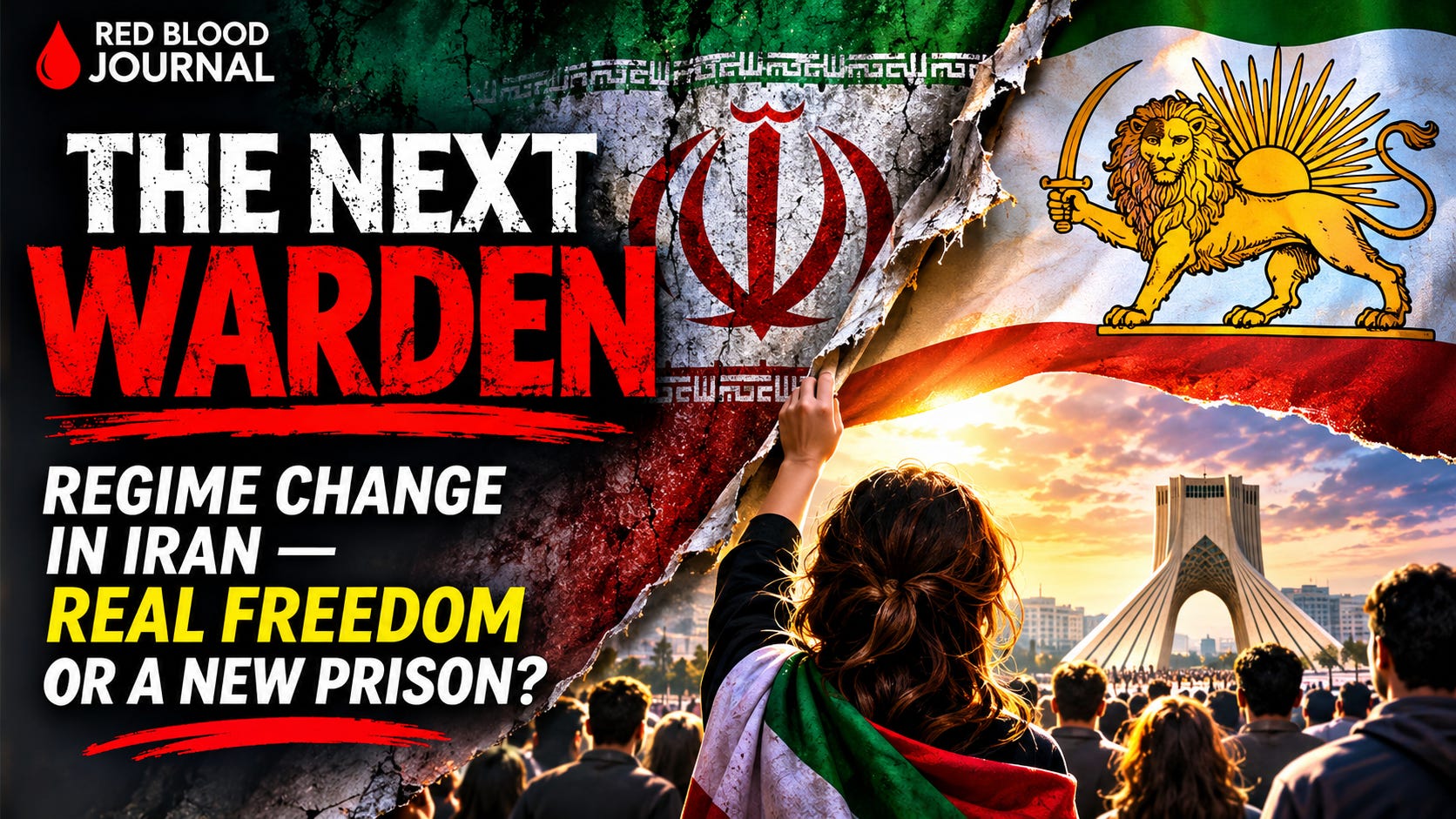
🩸 THE NEXT WARDEN
Will Iran Change Its Government — or Finally Gain Its Freedom?
When the prison doors open, who will hold the keys?
By Red Blood | RedBloodJournal.com
I. THE QUESTION NOBODY WANTS TO ASK
Imagine a nation imprisoned for nearly half a century. Its people have suffered political repression, economic hardship, censorship, executions, exile, and the destruction of countless dreams. Generations have grown up imagining the day when the rulers responsible for their suffering finally disappear.
Then, one morning, the old government collapses.
The prisons open, the political prisoners emerge, the streets fill with celebration, and millions of people declare that their country has finally been liberated. Flags return, exiles come home, and a new leader stands before the nation promising justice, prosperity, national dignity, and freedom.
But while everyone celebrates, almost nobody notices that the prison itself remains standing. The surveillance systems still operate, the security institutions still possess enormous power, the national wealth remains concentrated, and the machinery capable of silencing dissent has not necessarily disappeared.
Only the person holding the keys has changed.
This is the danger of the next warden: a country can remove its rulers without dismantling the structures that allowed those rulers to dominate it.
For Iran, this is not merely a philosophical question. It may become the most important political question facing the country in any future transition.
The issue is not simply whether the Islamic Republic should remain or be replaced. The deeper issue is whether replacing it would produce a political system fundamentally different from the one Iranians have endured.
A revolution may replace the people occupying positions of authority. Genuine liberation must also change the relationship between authority and the individual.
II. IRAN HAS ALREADY EXPERIENCED A GREAT PROMISE
The 1979 Iranian Revolution was presented by its supporters as a historic liberation from monarchy, repression, foreign interference, and political inequality. Its revolutionary coalition brought together religious movements, secular intellectuals, nationalists, leftists, students, and ordinary citizens who did not necessarily agree about the country they wanted to build.
They shared opposition to the existing political order, but opposition to one government was not the same as agreement about its replacement.
That distinction would prove enormously consequential.
Following the monarchy’s collapse, Iran adopted a new political structure. The Islamic Republic combined elected institutions with powerful religious oversight bodies, ultimately concentrating extensive authority in the office of the Supreme Leader.
The Constitution of the Islamic Republic assigns the leadership significant powers over the armed forces, senior judicial appointments, national policy, and other central institutions. The Guardian Council also exercises authority over legislation and elections.
These arrangements demonstrate how a political system may contain elections while limiting the authority of elected representatives through institutions that are not directly answerable to ordinary voters.
Historical constitutional documents and subsequent political developments make this concentration of authority a matter of record, not merely an accusation.
The revolution that promised liberation created a system in which many of the original revolution’s participants, and later generations, would themselves face political exclusion or repression.
That history does not prove that every future Iranian revolution must fail. It does, however, establish why the design of institutions matters as much as the popularity or intentions of those who initially take power.
Iran’s next political transformation must confront a lesson from 1979: removing an unwanted government does not automatically establish a government that can be held accountable.
III. THE PERSON IS NOT THE SYSTEM
Today, much of Iran’s political discussion revolves around individuals. Supporters of Reza Pahlavi view him as a potential figure of national unity and a possible leader in a transition away from the Islamic Republic. Other opposition movements favor a republican future, decentralized government, or different political arrangements.
These disagreements are significant, but they can also distract from a more fundamental examination of political power.
What happens if any of these individuals, parties, or movements succeeds?
Who controls the military? Who appoints judges? Who owns or administers state assets? Who oversees intelligence agencies? Who can declare a national emergency? Who investigates corruption involving the highest officials?
Most importantly, what happens when the new government begins doing precisely what its supporters once condemned in the previous government?
A leader may arrive with honorable intentions and a sincere desire to serve the nation. That possibility deserves consideration. Yet good intentions are not an enforceable constitutional safeguard.
Likewise, the existence of abuses under a previous government does not establish that its successor will behave in the same way. These are separate claims requiring separate evidence.
A constitutional monarchy with genuinely limited powers, an accountable parliamentary republic, or another democratic arrangement could potentially protect political freedoms. Conversely, any of these arrangements could become authoritarian if their institutions allow power to escape meaningful scrutiny.
The essential distinction is not simply monarchy versus republic. It is limited, accountable authority versus authority that answers primarily to itself.
A country that depends on finding the perfect ruler has not fully solved the problem of political domination.
It has merely made its future dependent on the ruler’s character.
IV. THE DANGER OF THE SAVIOR
Political suffering creates an understandable desire for rescue. When people have endured decades of repression, the appearance of a credible alternative can generate extraordinary enthusiasm.
A political figure may become more than a representative of a movement. That person may become a symbol of dignity, historical restoration, national unity, and the hope of a better life.
There is nothing inherently illegitimate about political leadership or public admiration. Successful democratic movements frequently need capable leaders who can coordinate complicated political transitions.
The danger begins when admiration becomes exemption from criticism.
When supporters believe that questioning their preferred leader amounts to betraying the nation, political loyalty starts replacing independent judgment. When a movement insists that its leader alone represents the people, it risks reproducing the exclusionary thinking it claims to oppose.
A person can support Reza Pahlavi while demanding clear constitutional limits on his authority. Another can support a republic while insisting that republican politicians face the same restrictions. Neither position requires surrendering political judgment to a personality or movement.
The real test of leadership is not how a leader treats supporters who applaud. It is how that leader treats citizens who disagree.
An opposition leader who promises freedom must be prepared to protect the freedom of people who oppose that leader personally.
Otherwise, the struggle is not necessarily against authoritarianism as a principle. It may become a struggle over who gets to exercise authority.
V. THE FOREIGN HAND — HELP, INFLUENCE, OR OWNERSHIP?
Iran’s political future does not exist in isolation. Its geography, natural resources, population, trade relationships, military capabilities, and regional importance give outside governments substantial reasons to care about its political direction.
The United States, Russia, China, European countries, Israel, and neighboring states have different strategic interests involving Iran. Some may prefer a weaker Iranian state, some a more cooperative one, and others a stable government that protects existing economic or security relationships.
These interests should be examined without assuming that every foreign relationship is evidence of a hidden agreement.
Foreign assistance can sometimes help a country recover economically, rebuild institutions, or defend itself. Foreign influence can also create dependencies when political support, financing, security guarantees, and economic access are exchanged for commitments that do not serve the population.
The investigation must therefore focus on observable transactions rather than presumed conspiracies.
If foreign governments support a future Iranian leadership, the public should be able to ask what that support involves. Are there financial agreements, military commitments, reconstruction contracts, sanctions arrangements, resource concessions, or conditions affecting Iran’s independent decision-making?
A future government should not automatically be condemned because it cooperates with the outside world. Nor should cooperation be accepted without scrutiny simply because it is presented as the price of liberation.
National sovereignty does not require international isolation. It requires that decisions affecting the nation remain subject to legitimate domestic institutions and public accountability.
Iran should not have to exchange domestic domination for foreign dependency in order to escape its present condition.
VI. FOLLOW THE MONEY, NOT THE FLAG
One of the greatest mistakes in political analysis is assuming that control of a country begins and ends with its formal government.
Political authority depends partly on control over economic resources.
Iran’s state-linked enterprises, energy sector, banking arrangements, foundations, commercial networks, and security-related economic institutions raise questions that any serious transition would need to address.
A future change of leadership could leave important financial networks intact. Existing institutions might retain ownership, management, access to contracts, or influence over national development even after the symbols of government change.
Alternatively, a rushed transfer of assets could replace one concentration of wealth with another.
Imagine the Islamic Republic disappearing, only for valuable public assets to be transferred to politically connected investors at prices and under conditions the population cannot examine.
Would that constitute liberation?
What if the new authorities promise economic modernization while citizens discover that the nation’s resources have become concentrated in the hands of a different politically protected class?
These are hypothetical risks, not established predictions about any particular opposition movement.
Yet the questions are essential because political transitions often involve decisions about assets, debt, privatization, public spending, and institutional control that may shape the country for generations.
The public should be able to follow the money through transparent government budgets, independently audited accounts, enforceable conflict-of-interest rules, competitive procurement, and meaningful public scrutiny of major asset transfers.
A new flag cannot substitute for financial accountability.
VII. WHO CONTROLS THE MEN WITH GUNS?
The military and security institutions present one of the most difficult challenges in any political transition.
A government may collapse while its armed forces, intelligence agencies, police organizations, prisons, and internal security networks remain operational.
Those institutions cannot simply be ignored. They possess personnel, infrastructure, intelligence, weapons, and the practical ability to enforce or undermine political decisions.
A successful transition must protect the population while preventing the security sector from becoming an independent center of political power.
The answer is not indiscriminate revenge against everyone who served under a previous administration. Individuals have different responsibilities, and allegations of wrongdoing require evidence, independent investigation, and due process.
At the same time, institutional continuity cannot justify impunity for serious abuses.
Security forces should ultimately answer to lawful civilian authority, independent courts, transparent budgets, and enforceable standards of conduct.
A new Iranian government that controls the same coercive machinery without independent oversight would face an enormous temptation to use that machinery against its own opponents.
The next warden does not need to invent a new prison if the old one is handed over fully operational.
VIII. THE REVOLUTION MUST NOT BECOME ANOTHER PURGE
People who have suffered imprisonment, torture, execution, exile, and political persecution understandably demand justice.
Their demands should not be dismissed in the name of national reconciliation. A political transition that ignores victims may preserve the resentment and mistrust that helped sustain conflict in the first place.
But justice and revenge are not identical.
A new government could repeat the abuses of its predecessor if political affiliation becomes sufficient grounds for punishment, if collective guilt replaces individual responsibility, or if courts operate primarily to satisfy public anger.
The United Nations’ approach to transitional justice emphasizes truth-seeking, accountability, reparations, institutional reform, and preventing future abuses.
For Iran, that suggests a difficult but necessary distinction. Individuals credibly implicated in grave crimes must be subject to independent legal processes. Citizens who merely held different political beliefs must retain their rights, even when those beliefs are deeply unpopular.
The surviving families of victims deserve truth and meaningful remedies. The accused deserve due process. The public deserves institutions capable of delivering justice without political interference.
A country cannot build a durable rule of law by making lawful treatment conditional on whether someone belongs to the victorious side.
The objective should be to end the machinery of arbitrary punishment, not simply redirect it toward a different population.
IX. A REFERENDUM IS NOT ENOUGH
Political movements frequently propose a national referendum as the ultimate solution to disputes about a country’s future.
A genuine, inclusive referendum can provide an important expression of public consent. But voting alone does not guarantee freedom.
Who determines the questions? Who writes the proposed constitution? Who controls television, digital platforms, and public debate during the campaign? Who qualifies to vote, and how are citizens inside and outside the country represented? Who supervises the count and resolves disputes?
A referendum conducted under intimidation, unequal access to information, or a predetermined political framework may confer only limited legitimacy.
Even a genuinely competitive vote cannot by itself ensure that future governments will respect constitutional boundaries.
International research on constitutional transitions emphasizes public participation, inclusive negotiation, independent institutions, and clear limitations on coercive power.
Iran therefore needs more than an opportunity to select a new national figure or form of government.
It needs a process in which citizens can freely discuss the rules governing whoever wins.
Those rules should be understandable before the public is asked to approve them.
Most importantly, fundamental individual rights should not depend entirely on the temporary preferences of a political majority. Democratic government requires both public participation and protections against the arbitrary exercise of authority.
X. THE SEVEN TESTS OF GENUINE LIBERATION
Rather than judging a political transition solely through promises, personalities, or celebrations, Red Blood Journal proposes seven practical tests for evaluating whether authority has actually become accountable.
Test One — Can citizens peacefully remove their government? A meaningful political system must offer lawful methods of replacing leaders without requiring another revolution, military intervention, or widespread violence.
Test Two — Can citizens openly criticize the most powerful person in the country? Freedom of expression becomes meaningful when it protects criticism that the government considers unfair, embarrassing, or politically threatening.
Test Three — Can independent courts rule against the government? A judiciary must be able to investigate powerful officials, enforce constitutional rights, and decide cases without punishment or political interference.
Test Four — Can the public follow government money? Budgets, contracts, significant public assets, and conflicts of interest must be exposed to independent scrutiny rather than controlled through politically protected networks.
Test Five — Can the military and intelligence services be held accountable? Armed institutions must operate under law, with civilian oversight and protections against their use as instruments of political intimidation.
Test Six — Can political minorities exercise the same rights as the majority? Religious freedom, freedom from religious compulsion, equality before the law, due process, and freedom of association must protect people regardless of whether they support the governing movement.
Test Seven — Can the constitutional system restrain even its most popular leader? A leader’s popularity should not create an unlimited right to remain in office, silence opposition, control the courts, or rewrite constitutional rules for personal advantage.
These tests do not require Iranians to agree in advance about every future policy or the precise structure of their political institutions.
They require something more basic: agreement that nobody should possess the unquestionable right to rule everyone else.
XI. THE MOST DANGEROUS DAY MAY BE THE DAY AFTER VICTORY
A revolution’s most emotionally powerful moment may also be one of its most institutionally vulnerable.
People celebrate the end of the previous order while the organizations responsible for building the next one are still negotiating authority.
During that period, emergencies can become convenient justifications for concentrating power. Public demands for stability may be used to postpone elections, restrict journalism, limit protests, or extend temporary leadership arrangements.
Some emergency measures may genuinely be necessary to prevent violence and maintain essential services. The issue is whether those measures are lawful, proportionate, independently supervised, limited in duration, and open to challenge.
Iran could face serious practical difficulties during a future transition, including economic disruption, institutional fragmentation, regional tensions, competing political claims, and the challenge of maintaining essential public services.
Ignoring those dangers would be irresponsible.
But using those dangers to justify indefinite emergency government could reproduce the very structures that a transition was supposed to replace.
A credible transition needs a publicly understood legal framework, clear interim responsibilities, enforceable limits, institutional continuity where appropriate, and a legitimate path toward permanent representative government.
The first duty of a transitional authority should be to make its own extraordinary power temporary and accountable.
XII. WHAT IF THE NEW WARDEN IS SOMEONE WE LOVE?
Here lies the most uncomfortable part of this investigation.
It is relatively easy to demand accountability from a government we oppose. It is considerably harder to demand the same accountability from leaders we admire.
An individual may spend decades opposing the Islamic Republic, defending political prisoners, promoting women’s rights, criticizing executions, and demanding national sovereignty. That record can deserve recognition without granting the person permanent immunity from criticism.
A future Iranian leader could be personally generous, intelligent, patriotic, and capable of governing effectively. None of those qualities eliminates the need for constitutional limits.
The same applies to parties, revolutionary organizations, royal families, military leaders, reformist movements, and diaspora coalitions.
Political loyalty becomes dangerous when it requires citizens to abandon the standards they previously demanded from their opponents.
If freedom depends on the goodness of a particular ruler, citizens remain vulnerable to that ruler’s successors, advisers, institutional allies, and future changes in character or circumstance.
The purpose of a free political system is not to assume that every future leader will be virtuous.
It is to create lawful ways of preventing and correcting abuses even when leaders are not.
A society that can peacefully challenge its favorite leader has achieved something deeper than replacing its least favorite ruler.
It has begun to place public authority beneath the law.
XIII. THE SOVEREIGNTY THAT BEGINS WITH THE INDIVIDUAL
Iranian sovereignty is often discussed through borders, territory, military strength, natural resources, and freedom from foreign interference.
These elements matter, but they do not exhaust the meaning of sovereignty.
A country can possess internationally recognized borders and a powerful military while its citizens remain unable to influence the institutions that govern them.
National independence and individual liberty are related, but they are not identical.
The central challenge is to create institutions through which citizens can exercise political rights, protect themselves from arbitrary authority, participate in public decisions, and hold officials responsible.
This does not mean every individual can disregard laws or public responsibilities. Living together requires enforceable rules, legitimate institutions, and respect for the rights of others.
Personal sovereignty is not immunity from responsibility. It is the ability to live with dignity under laws that apply equally, protect fundamental rights, and can be challenged through legitimate procedures.
Iran should not have to choose between a powerful nation and free citizens.
Its future should seek both.
🩸 THE RED BLOOD PERSPECTIVE
The Question Is Not Who Takes Power — It Is What Power Can Still Do
Iran’s constitutional history demonstrates that revolutionary change can replace a political order without establishing a durable system of limited government. The 1979 revolution removed the monarchy, but the constitutional system that followed placed extensive authority in institutions insulated from direct electoral control.
This is documented history. It does not establish that a particular present-day opposition figure intends to establish another dictatorship, nor does it prove that every future transition will reproduce the same outcome.
The next investigation must therefore focus on observable actions and enforceable commitments. Which political organizations publish detailed transition plans? Which accept independent judicial oversight? Which explain how security institutions and public assets would be managed? Which recognize the rights of their critics? Which promise a lawful mechanism through which they themselves could eventually be removed?
The answers matter more than slogans, historical identities, personal popularity, or claims of patriotic devotion.
A future Iranian government must be evaluated not simply by how different it looks from the Islamic Republic, but by how differently it distributes authority, protects rights, and responds to wrongdoing.
The ultimate measure of liberation is not whether the old warden has disappeared. It is whether any future warden can still lock the population inside the same political prison.
🌊❤️✨ THE OCEAN OF LOVE AND POSITIVITY PERSPECTIVE
Freedom Without Another Enemy
A nation emerging from prolonged suffering may be tempted to define itself through the people it defeated. Its memories contain wounds, its families carry grief, and its citizens naturally desire recognition for everything they have endured.
But a future built entirely around defeating enemies can remain emotionally imprisoned by the past.
A deeper transformation begins when people refuse to reproduce the cruelty they experienced. That does not require forgetting injustice, excusing abuse, or abandoning the search for truth. It requires recognizing that justice and human dignity must survive even when anger is justified.
Iranians do not all share one religion, political identity, historical interpretation, or vision of government. They should not have to become identical in order to belong to the same nation.
The freedom of a monarchist is inseparable from the freedom of a republican to disagree. The freedom of a religious citizen must coexist with the freedom of someone who rejects religion. The dignity of those who suffered under the Islamic Republic must be protected without denying the humanity of people whose political beliefs differ.
This is where national healing becomes possible: not through compulsory agreement, but through the recognition that disagreement does not cancel our shared humanity.
The most meaningful political victory would not be a country where everyone finally obeys the same leader.
It would be a country where no individual needs to surrender conscience, dignity, or lawful freedom in order to live among fellow citizens.
The prison disappears when human beings no longer need a warden to tell them who they are allowed to become.
XIV. THE FINAL QUESTION
Imagine that the Islamic Republic has disappeared and Iran has entered a new political era. The national flag may have changed. The constitution may have been rewritten. The streets may carry new names, the prisons may have different administrators, and the person addressing the nation may be someone millions once celebrated as a symbol of liberation.
Now imagine an ordinary Iranian citizen standing peacefully before that new government and saying: “I disagree with you. I want to investigate your finances, criticize your policies, organize against your administration, and vote to remove you from office.”
What happens next?
If the answer is surveillance, intimidation, imprisonment, or accusations of national betrayal, then the transformation remains dangerously incomplete.
If the answer is legal protection, public debate, an impartial judiciary, and a genuine opportunity to replace those in power, then Iran will have achieved something far more important than the defeat of one political faction.
It will have begun to transform the relationship between the government and the governed.
And that is the question every Iranian political movement should be asked before receiving the nation’s trust:
Are you preparing to give the people their country back, or are you preparing to become its next warden?
Research and Source Notes
This report is an editorial investigation and institutional analysis, not a prediction that any named opposition leader will become authoritarian. Its central metaphor is informed by the political arguments in the supplied Persian-language transcript. Historical and constitutional context has been checked against the following sources:
Iran Data Portal, Syracuse University: Constitutions and Constitutional Debates — https://irandataportal.syr.edu/constitutions-and-constitutional-debates/
Encyclopaedia Iranica: Constitution of the Islamic Republic — https://www.iranicaonline.org/articles/constitution-of-the-islamic-republic/
Constitute Project: Constitution of Iran, revised 1989 — https://www.constituteproject.org/constitution/Iran_1989
International IDEA: Constitutional Governance and Rule of Law — https://www.idea.int/theme/constitution-building
International IDEA: Security Sector Reform in Constitutional Transitions — https://www.idea.int/publications/catalogue/security-sector-reform-constitutional-transitions
United Nations: Transitional Justice — https://www.un.org/ruleoflaw/en/thematic-areas/human-rights/transitional-justice-2
The proposed seven tests are Red Blood Journal’s editorial framework, not a formal internationally adopted index.
🩸🌊❤️✨ — Ocean of Love and Positivity
Blood connects us. The ocean unites us. Love guides us. Positivity illuminates our path.
RedBloodJournal.com
🔑
Iran’s Next Warden and the Illusion of Liberation
Nov 4, 2026
The provided text examines the critical danger that Iran’s potential political transition could merely replace current rulers without dismantling the underlying systems of oppression. Drawing lessons from the unfulfilled promises of the 1979 revolution, the analysis emphasizes that true liberation requires limited, accountable authority rather than a reliance on popular leaders or new flags. It argues that a successful democratic future depends on transparent financial institutions, civilian-controlled security forces, and strict constitutional safeguards protecting individual freedoms and dissent. Ultimately, the sources propose that the true measure of freedom is whether any future leader remains legally bound by the people they serve.