


RED BLOOD JOURNAL | SCIENCE, PSYCHOLOGY & HUMAN SOVEREIGNTY | OCTOBER 30, 2026
🩸 THE NEW LIE DETECTOR: WHEN ARTIFICIAL INTELLIGENCE CLAIMS TO READ THE HUMAN MIND
From the Polygraph to Brainwave Recognition, Eye Tracking, and AI — Are We Discovering Truth or Building a More Sophisticated Instrument of Psychological Authority?
A follow-up investigation to The Lie Detector That Detects Belief
Introduction: The Machine That Once Measured Fear Now Wants to Examine the Mind
For generations, the polygraph represented humanity’s attempt to turn honesty into something measurable. An examiner connected a person to an instrument, asked questions, observed changes in breathing, perspiration, and cardiovascular activity, and interpreted those reactions as possible evidence of deception. The procedure acquired an extraordinary reputation, even though the machine could not directly identify a lie.
Scientific criticism eventually exposed a fundamental limitation. The polygraph measured physiological reactions that could arise from fear, anticipation, emotional conflict, or numerous other causes. An innocent person could experience extraordinary anxiety, while someone concealing information might remain relatively calm. The machine could record those reactions without knowing what produced them.
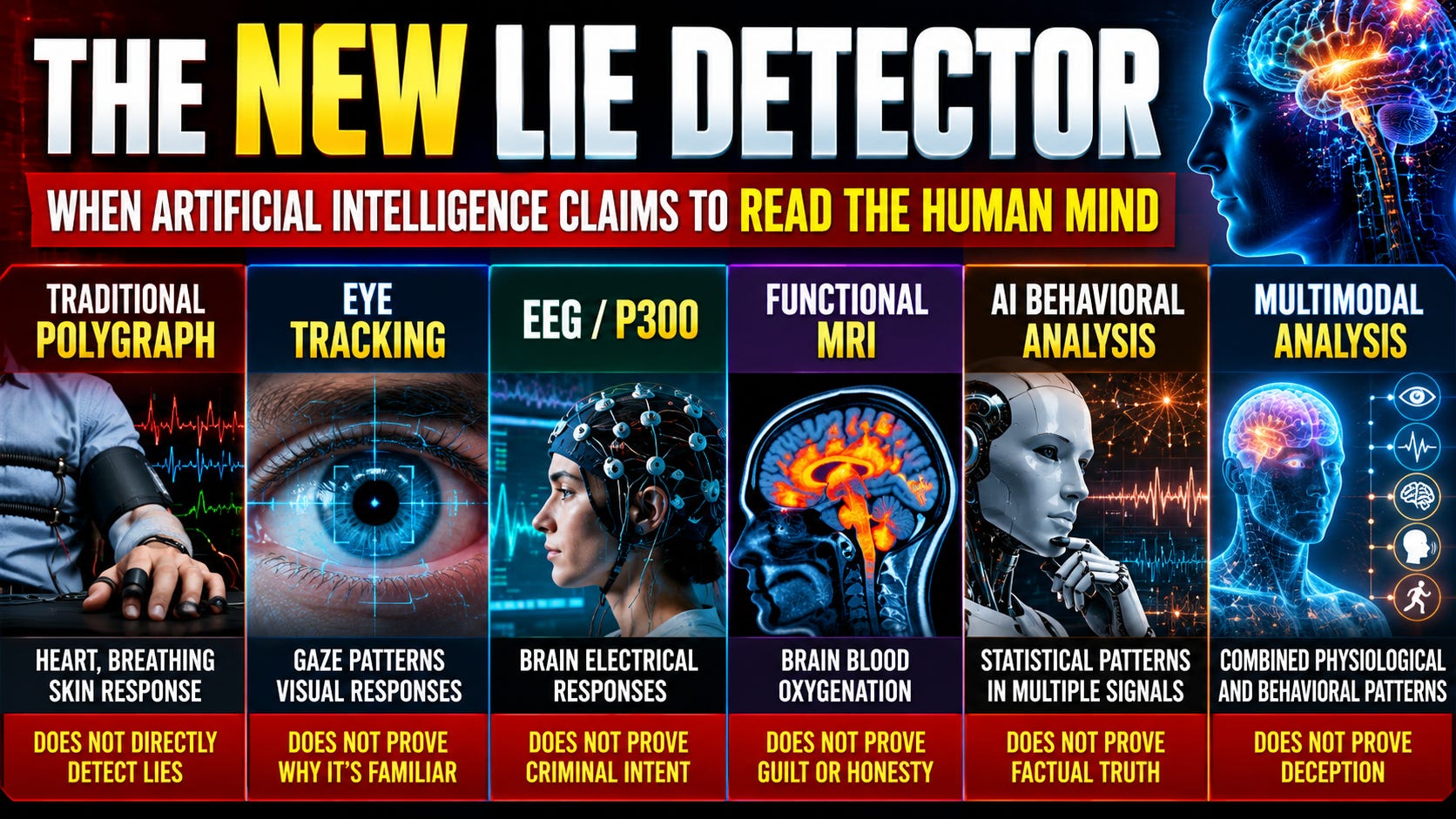
Now a new generation of technology promises to move beyond these limitations. Researchers are studying artificial intelligence, eye-tracking systems, electroencephalography, functional magnetic resonance imaging, voice analysis, facial movements, and combinations of physiological measurements. These technologies do not all pursue the same objective, but they share an ambition: to extract information about human thought and behavior from signals that individuals may not consciously control.
The transition is significant. The traditional polygraph examined the body’s responses to questioning. Some emerging systems attempt to identify whether the brain recognizes specific information. Others search for statistical patterns associated with cognitive effort or deceptive behavior. Artificial intelligence promises to combine these signals into automated assessments that could reduce dependence on human examiners.
But an important question remains unresolved. If technology becomes better at measuring what happens inside the human body, does that necessarily make it better at establishing what is true?
This investigation examines the scientific discoveries, the limitations of emerging methods, and the consequences of introducing increasingly sophisticated systems into criminal investigations, employment screening, national security, and personal privacy.
1. The First Scientific Revolution: From Emotional Reactions to Concealed Knowledge
The traditional comparison-question polygraph rests partly on the assumption that deception produces physiological responses distinguishable from those generated by other questions. The problem is that human emotions do not follow such simple boundaries. Fear can arise from innocence, and deception can occur without obvious distress.
A different approach, known as the Concealed Information Test, attempts to determine whether an individual recognizes particular details associated with an event. Instead of simply asking whether a person committed an act, researchers examine the responses produced when the person encounters information that may already exist in memory.
This shift is scientifically important because recognition can sometimes generate measurable patterns even without a conventional verbal confession. The objective is no longer necessarily to detect the emotional experience of lying, but to identify evidence that a particular stimulus is familiar or meaningful.
Yet the distinction creates a new difficulty. A witness may recognize information without being responsible for an event. An innocent individual may have encountered the details through media coverage, conversations, investigative questioning, or accidental exposure.
Therefore, concealed knowledge is not equivalent to culpability, and recognition is not proof of wrongdoing. Any legitimate forensic application must distinguish between possessing information and being responsible for the event associated with it.
This is the foundation upon which some of the most promising new technologies are being developed.
2. Eye Tracking: The 2026 Experiment That Challenges Traditional Polygraph Testing
In June 2026, researchers published a study in Scientific Reports comparing an eye-tracking approach with traditional polygraph measurements under the same experimental conditions. The study examined whether patterns of eye movement could help identify recognition of concealed information during a simulated-crime investigation.
The researchers applied machine-learning classification to features extracted from eye movements. The best-performing method correctly classified 37 of the study’s 39 participants, producing an overall accuracy of approximately 94.9%. The conventional polygraph procedure correctly classified 30 of 34 participants whose examinations produced usable conclusions, an accuracy of approximately 88.2%. Five polygraph examinations were excluded from that calculation.
Published June 3, 2026 — Experimental classification results
Eye tracking + machine learning
94.9%
37 of 39 classified correctly
Traditional polygraph
88.2%
30 of 34 conclusive examinations classified correctly
Small simulated-crime experiment. The results are not directly equivalent because five polygraph recordings were excluded and do not establish accuracy in ordinary criminal investigations.
These findings are encouraging, but they should not be mistaken for proof that the technology can identify 95% of lies in real life. The participants were involved in a controlled experimental scenario, the number of subjects was small, and the researchers knew the underlying conditions against which predictions could be evaluated.
Real investigations present substantially greater uncertainty. Investigators may not know precisely which information has been encountered by a suspect, whether memories are accurate, or how exposure to evidence has affected recognition.
The study therefore represents a promising development in experimental credibility assessment, not the arrival of a scientifically infallible lie detector.
3. Brainwave Recognition: Can Electrical Signals Reveal Hidden Memories?
Another major research direction involves electroencephalography, commonly known as EEG. This technology records electrical activity from the brain using electrodes placed on the scalp. Researchers examine patterns of brain responses to particular stimuli, including the P300 component, which is associated with the processing of meaningful or recognized information.
In September 2025, the International Journal of Psychophysiology published a meta-analysis examining 54 experimental studies involving P300 responses in Concealed Information Tests. The researchers found a substantial overall recognition-related effect, supporting the potential usefulness of this technique for identifying information present in memory. They also emphasized that results depend on the experimental design and that validation in real forensic populations remains necessary.
This development deserves careful attention because it moves closer to examining neurological processes rather than relying exclusively on peripheral physiological activity.
But recording a brainwave is not equivalent to reading a person’s thoughts. EEG does not supply an investigator with unrestricted access to memories, beliefs, intentions, or private experiences. The P300 response is interpreted within a structured experiment involving known stimuli and statistical analysis.
An examiner may be able to identify evidence that a stimulus is meaningful to a subject under particular conditions. That does not establish why the stimulus is meaningful, whether the associated memory is accurate, or whether the person acted unlawfully.
The distinction between recognition and guilt remains as important in brainwave analysis as it is in eye tracking.
4. Functional MRI: Looking Inside the Brain Without Discovering Absolute Truth
Functional magnetic resonance imaging, or fMRI, provides another potential source of information. Rather than measuring the brain’s electrical activity directly, it observes changes in blood oxygenation associated with neural activity.
Researchers have used fMRI to investigate brain regions associated with decision-making, cognitive control, response inhibition, and experimental deception. In carefully designed studies, some patterns differ between instructed truthful and deceptive responses.
The challenge is translating those patterns into reliable judgments about real individuals.
An individual may engage cognitive-control processes while telling a lie, but similar processes also occur during truthful recall, difficult reasoning, emotional regulation, and ordinary decision-making. Brain activity is not uniquely labeled according to moral categories such as honesty and dishonesty.
There is also a problem of context. Participants instructed to lie about a harmless event in a laboratory are not necessarily neurologically or psychologically comparable to people facing criminal prosecution, professional dismissal, or severe personal consequences.
The newest technology therefore confronts a familiar limitation: it may observe genuine biological activity without establishing the meaning that an institution wishes to assign to that activity.
5. Artificial Intelligence: A More Powerful Interpreter or a More Convincing Illusion?
Artificial intelligence introduces a different kind of change. Instead of depending entirely upon a human examiner to interpret physiological patterns, machine-learning systems can process large quantities of measurements and identify statistical relationships that may not be obvious to human observers.
Some researchers combine information from multiple sources, including breathing, cardiovascular activity, skin conductivity, facial movements, eye behavior, and brain activity. These systems are often described as multimodal approaches because they analyze more than one type of signal.
A 2026 scoping review examining 80 research papers across major deception-detection technologies reported promising results for multimodal approaches while emphasizing major unresolved concerns involving reliability, forensic validity, transparency, and mental privacy. The review concluded that no single technology currently provides sufficient reliability to function independently as forensic evidence.
This finding exposes a fundamental limitation of machine learning. An algorithm can become exceptionally effective at recognizing patterns in its training data without proving that those patterns are uniquely associated with deception.
If a system learns characteristics associated with anxiety, it may classify anxious people as deceptive. If it learns patterns associated with cognitive effort, it may mistake complex truthful responses for dishonesty. If its training data contains systematic biases, the resulting predictions may reproduce those biases in a form that appears mathematically objective.
The central concern is not that artificial intelligence cannot contribute to investigations. Properly validated algorithms may offer useful assistance. The concern is treating an algorithmic prediction as evidence of truth without independently establishing what the model actually detects.
A digital confidence score is not a substitute for proof.
6. The Psychological Problem Has Not Disappeared
The preceding Red Blood Journal investigation, The Lie Detector That Detects Belief, examined the possibility that the traditional polygraph derives part of its practical influence from the subject’s belief in the machine’s capabilities.
That principle remains relevant to emerging technologies. A person may be intimidated by a conventional polygraph because they believe physiological sensors can expose dishonesty. Another person may feel even greater pressure when confronted with an apparatus described as capable of identifying hidden memories or analyzing brain activity.
The technology has changed, but the psychological mechanism may remain similar. People react not only to what a machine measures but also to what they believe the machine knows.
The National Research Council recognized this distinction in its landmark investigation of polygraph testing. Its assessment found that the potential value of polygraph examinations in encouraging disclosures or deterring misconduct was separate from their scientific accuracy. It also warned that excessive confidence in such testing could create a false sense of security.
The unanswered research question is whether newer technologies will improve the quality of evidence or merely increase the psychological authority of the examination. Both effects could occur simultaneously, and neither should be presumed without independent investigation.
7. The Next Frontier: Voice Analysis, Facial Recognition, and Remote Behavioral Monitoring
Some emerging technologies attempt to identify deception without the physical equipment traditionally associated with polygraph testing. Researchers have investigated vocal characteristics, facial expressions, body movements, thermal imaging, and the combination of visual and acoustic measurements.
These techniques could eventually make some forms of behavioral assessment less physically intrusive and easier to deploy. However, their scientific limitations remain substantial.
A facial expression is not a reliable confession. A change in voice does not necessarily demonstrate dishonesty. Behavioral patterns vary with culture, disability, personality, circumstances, and individual communication styles.
The possibility of remote analysis also introduces questions that extend beyond scientific accuracy. If an organization can evaluate people through cameras or microphones, who determines when such assessments are permissible? Who controls the recordings? Can the individual challenge the conclusions or refuse the examination without suffering unrelated consequences?
These concerns are particularly important when technology moves from voluntary laboratory participation toward employment assessments, security investigations, or widespread surveillance.
Scientific capability and ethical permission are separate matters. Even a system that demonstrates meaningful predictive value requires rules governing consent, transparency, proportionality, and accountability.
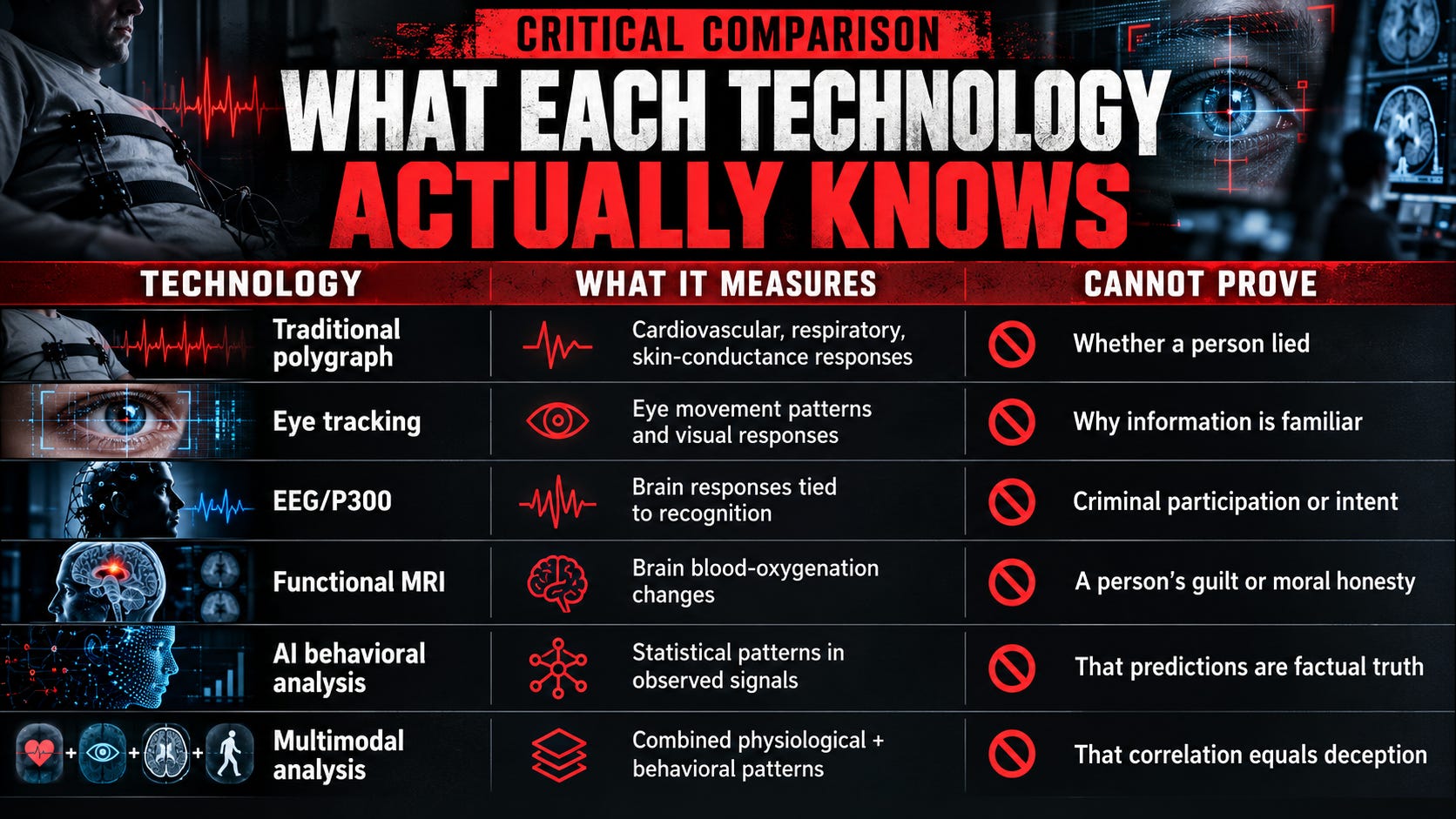
8. The Critical Comparison: What Each Technology Actually Knows
Technology
What it measures
What it cannot independently prove
Traditional polygraph
Cardiovascular, respiratory, and skin-conductance responses
Whether a person lied
Eye tracking
Patterns of eye movement and visual responses
Why information is familiar
EEG/P300
Electrical brain responses associated with recognition
Criminal participation or intent
Functional MRI
Brain blood-oxygenation changes
A person’s guilt or moral honesty
AI behavioral analysis
Statistical relationships among observed signals
That its predictions are factual truth
Multimodal analysis
Combined physiological and behavioral patterns
That correlation establishes deception
The comparison reveals a consistent scientific principle. Every technology measures something real, but the measurement and the conclusion are not identical.
When investigators understand this distinction, technology can potentially contribute useful evidence. When they ignore it, scientific instrumentation can become a source of unjustified certainty.
9. The Future of Lie Detection: Three Possible Directions
The continued development of deception-detection technologies suggests three possible futures, none of which is predetermined.
The first is a future of improved scientific accountability. Researchers could develop more reliable recognition-based methods, establish transparent accuracy standards, test systems independently in realistic populations, and prohibit high-stakes conclusions unsupported by corroborating evidence. Under such conditions, technology could contribute to investigations without becoming the sole basis for determining guilt.
The second is a future of institutional overconfidence. Agencies could adopt increasingly sophisticated equipment because it appears objective and technologically advanced, even before its predictive capabilities have been sufficiently validated. In this scenario, more elaborate systems might reproduce the weaknesses of traditional polygraph examinations while making their limitations harder for ordinary citizens to recognize.
The third is a future of expanding behavioral surveillance. As sensing equipment becomes smaller and automated analysis becomes more accessible, institutions may encounter opportunities to evaluate physiological or behavioral signals outside conventional examination rooms. Whether these capabilities become widespread would depend on technical progress, cost, law, public acceptance, and institutional decisions.
The third scenario is a possibility requiring scrutiny, not evidence that universal remote lie detection is currently operational or scientifically reliable.
Each future raises the same question: will technological advancement strengthen human rights and investigative accuracy, or will it expand institutional power faster than mechanisms of accountability can develop?
10. The Most Important Scientific Question: Can a Machine Know What Truth Is?
The word truth describes whether a claim corresponds to reality. A machine, however, does not establish that correspondence simply by recording a biological reaction.
A brain can recognize false information. A person can sincerely believe a mistaken memory. Someone may knowingly provide an accurate statement while experiencing great emotional discomfort. Another individual may repeat false information without realizing that it is false.
These possibilities demonstrate why truthfulness, belief, memory, and factual accuracy must remain separate scientific concepts.
A reliable investigative process must therefore examine not only what a person believes or recognizes but also whether the relevant facts can be independently established.
This distinction becomes more consequential as artificial intelligence develops. Even a computational system that predicts mental or behavioral states with impressive experimental accuracy cannot automatically establish historical events, intentions, responsibility, or moral character.
The challenge is not simply to build a stronger machine. It is to define precisely what the machine is supposed to determine and establish scientifically whether its measurements justify that conclusion.
🩸 The Red Blood Perspective — When the Machine Becomes the Judge
The evolution of lie-detection technology raises questions about the concentration of institutional power. A traditional polygraph examiner interprets bodily signals. A new generation of systems may introduce complex algorithms capable of examining additional physiological and neurological information.
These developments can offer legitimate investigative opportunities. They can also create new forms of dependence on technical experts, proprietary systems, and institutional decisions that ordinary individuals may struggle to challenge.
Red Blood Journal’s investigative approach is to examine actions, incentives, ownership, financial relationships, and consequences rather than accept either technological marketing or accusations of manipulation without evidence.
Who owns the systems and their data? Who profits from their adoption? Who determines accuracy standards? Who can independently audit algorithmic decisions? What happens when a prediction is incorrect, and who bears the cost?
These questions are especially important when an individual faces potential loss of employment, liberty, reputation, or access to opportunities.
The emergence of new technology does not itself establish a deliberate agenda of psychological control. Nevertheless, the potential for institutional misuse is a legitimate subject of investigation. Scientific limitations, commercial incentives, regulatory gaps, and human consequences must be examined together.
The danger is not that technology might eventually become better at identifying concealed information. The danger is allowing institutional confidence to outrun scientific evidence.
A society that values justice cannot surrender the distinction between suspicion and proof merely because suspicion is generated by an expensive machine.
🌊❤️✨ The Ocean of Love and Positivity Perspective — Consciousness Is Greater Than Its Measurements
Humanity continues to explore the brain, the body, memory, and consciousness through increasingly sophisticated scientific instruments. These discoveries can deepen our understanding of ourselves and reveal connections that earlier generations could scarcely imagine.
Yet every new measurement should also remind us of the difference between observing a human process and understanding the whole human being.
A brainwave is not a moral identity. An anxious response is not guilt. Recognition is not wrongdoing, and a computational judgment is not a complete description of a person’s character.
The Ocean of Love and Positivity Perspective invites us to pursue knowledge without surrendering compassion. Scientific advancement should help humanity become more thoughtful, more responsible, and more capable of protecting dignity rather than simply more efficient at classifying individuals.
There is also a personal lesson. We frequently attempt to determine whether others are honest while overlooking the more difficult examination of our own motivations. We search for instruments capable of exposing deception in strangers but may fail to recognize how desire, fear, pride, and attachment influence our own judgments.
Perhaps the most meaningful examination is not the one conducted by an institution but the one a person conducts privately through conscience.
Are we truthful when dishonesty would benefit us? Are we willing to acknowledge mistakes when doing so threatens our reputation? Can we question our own assumptions with the same determination we apply to the claims of others?
A machine may become increasingly sophisticated at analyzing our physiological responses. It cannot replace the human responsibility to seek truth, act with integrity, and treat others with dignity.
The greatest advancement will not be a machine that claims to know everything hidden inside the human mind. It will be a humanity wise enough to understand what such a machine cannot know.
Research References
1. National Research Council. (2003). The Polygraph and Lie Detection. National Academies Press. Full report
2. Celniak, W., and colleagues. (2026). Evaluating Eye-Tracking as a Method for Deception Detection Against the Polygraph as Deployed in Practice. Scientific Reports, published June 3, 2026. Original research
3. Knappe, J., Ullsperger, M., and Kirschner, H. (2025). Decoding Deception with the P300: A Meta-Analysis of the Concealed Information Test. International Journal of Psychophysiology. Research abstract
4. Deception Detection Technologies: Current Advances and Forensic Challenges. (2026). Scoping review of 80 published studies. Full research review
Research note: Laboratory accuracy figures are not established real-world accuracy rates. The scenarios concerning future institutional practices are editorial analysis, not claims that such systems are universally deployed.
🩸🌊❤️✨ — Ocean of Love and Positivity
Blood connects us. The ocean unites us. Love guides us. Positivity illuminates our path.
📊
The Evolution of Lie Detection Technologies
Oct 30, 2026
Traditional lie detection has evolved from the standard polygraph to advanced methods utilizing eye tracking, brainwave recognition, functional MRI, and artificial intelligence. Although these modern techniques can measure real physiological and neurological signals with impressive experimental precision, they only record physical reactions or familiarity rather than absolute truth or moral guilt. Furthermore, relying on these technological instruments risks creating unjustified institutional certainty and overlooking the complex nuances of human behavior. Ultimately, while algorithmic predictions and sensory tools offer new investigative insights, they cannot replace human judgment, accountability, and the fundamental right to due process.