


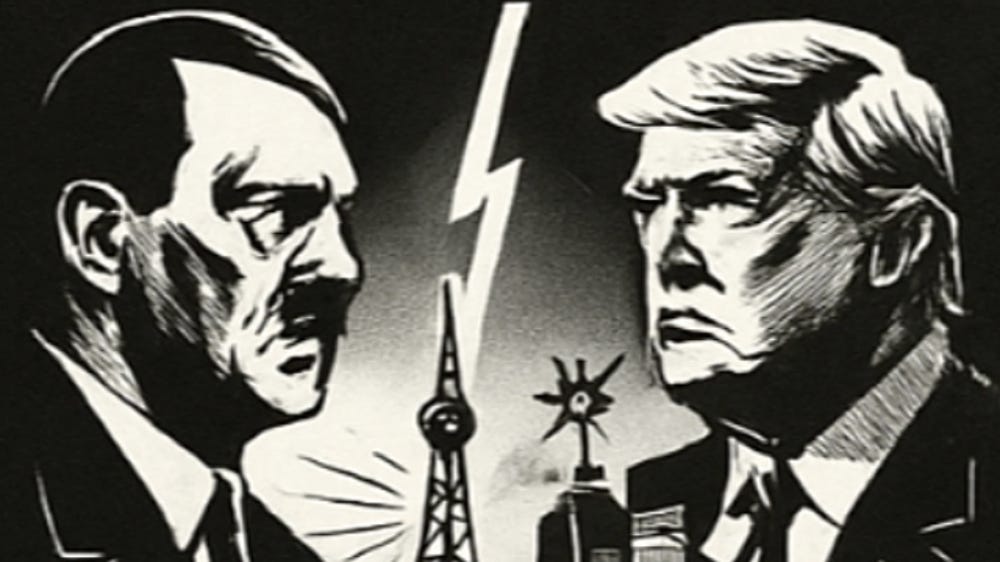
THE MANUFACTURED MIRROR: How Power Turns Leaders into Monsters—and History into a Weapon
By Red Blood | The Red Blood Journal
Introduction: The Echo Chamber of History
Every generation is taught who to worship and who to despise. The heroes and villains of history are rarely chosen by objective truth—they are appointed by whoever holds the pen and the printing press. Today, in the era of hypermedia and instant outrage, former and present U.S. President Donald J. Trump has become the centerpiece of a narrative war. He has been sculpted into a caricature of evil—compared endlessly to Adolf Hitler, even as the context, motives, and societal conditions are vastly different. Yet the deeper truth lies not in the comparison itself, but in the process that makes such comparisons inevitable.
Propaganda didn’t die with the fall of the Third Reich—it evolved, adapted, and went digital. And the machinery of perception remains as potent as ever.
I. The Nazi Specter Returns
In the 1930s, Germany was a nation crippled by humiliation and debt. Inflation devoured savings, unemployment ravaged families, and despair was the national currency. Into this chaos stepped Adolf Hitler, a man who promised to restore national pride and economic sovereignty. His methods were monstrous, but his rise reveals a pattern that still resonates: when people are stripped of hope and crushed by elite mismanagement, demagogues find easy purchase.
Fast-forward nearly a century. In the ashes of industrial decline and endless foreign wars, Trump’s message—“Make America Great Again”—spoke to similar desperation. He too positioned himself against “globalists,” “elites,” and a corrupt establishment. The media, echoing the past, portrayed him not merely as a political opponent but as an existential threat to civilization itself.
The irony? In both eras, fear was the real fuel of power.
II. The Economics of Defiance
Few remember that Hitler’s early political success was built upon an economic rebellion—he rejected the international banking system, issuing debt-free currency and reviving German industry within years. It’s a fact historians often downplay, preferring to focus on his later crimes rather than the mechanics of his rise. But it serves as a stark reminder: economic independence is the ultimate threat to global financial powers.
Trump’s rhetoric, too, targeted global finance—from the Federal Reserve to foreign trade dependency. He spoke of “draining the swamp,” but behind the scenes, that swamp extended deep into the arteries of Wall Street and the transnational systems of control. Those who manipulate currencies, loans, and interest rates manipulate nations—and they never forgive defiance.
III. Control Through Narrative
“The victors write the history.”
It’s one of the oldest truths in civilization—and one of the least examined. After World War II, Allied narratives became gospel, enshrined in textbooks, museums, and film. The horrors of Nazism, though undeniable, became the eternal moral benchmark—ensuring that no dissenting interpretation of global power could ever stand without being labeled “Hitlerian.”
Today, that same mechanism thrives in digital form. Tech monopolies, media conglomerates, and intelligence-linked networks shape the modern Overton window. Once labeled “disinformation,” any inconvenient truth can be erased, throttled, or ridiculed. Dissenters become demons; questions become crimes.
In that sense, the propaganda model of 1930s Germany did not vanish—it globalized.
IV. Selective Memory: The Silenced Dead
The Holocaust is rightly remembered as one of humanity’s darkest atrocities. Yet the near-total erasure of other mass deaths—such as the 60 million souls who perished under Joseph Stalin’s communist regime—reveals how selective our compassion has become. Where are the global museums for them? Where are the daily documentaries, the endless moral lessons?
Communism, a system responsible for more deaths than fascism, enjoys ideological rehabilitation in academia and the media. Meanwhile, questioning Western policy is equated with neo-fascism. It’s not about truth—it’s about utility. The story that serves power survives; the one that threatens it is buried.
V. The Modern Echo
Trump, like Hitler in postwar media, has been mythologized into a symbol of absolute evil. But such total demonization reveals less about the man and more about the machinery producing it. When the press transforms a political figure into a mythic monster, nuance dies—and with it, democracy itself.
De-platforming, censorship, and algorithmic isolation have replaced state propaganda departments. Instead of newspapers with swastikas, we have social feeds with algorithms tuned for outrage. The method has changed; the mission has not.
VI. Beyond Hero and Monster
To study these parallels is not to equate deeds—it is to study mechanisms of control. Every empire constructs its villains. Every financial order manufactures its saviors and its scapegoats. And every society that forgets this truth is doomed to relive its own propaganda in endless repetition.
The Red Blood Journal stands to remind:
History is not just written by the victors—it’s weaponized by them.
propaganda — media manipulation — historical parallels — political psychology — information control
truth and power — narrative warfare — censorship — ideological control — global finance — mass perception
The Red Blood Journal — investigative journalism — conspiratorial analysis — historical insight — critical thinking