


🩸 RED BLOOD JOURNAL | INVESTIGATIVE REPORT | OCTOBER 30, 2026
THE LIE DETECTOR THAT DETECTS BELIEF
The Polygraph, Psychological Control, and the Illusion of Scientific Certainty
What if the greatest power of the lie detector is not its ability to discover deception, but its ability to convince people that deception cannot remain hidden?
Introduction: When the Machine Becomes the Authority
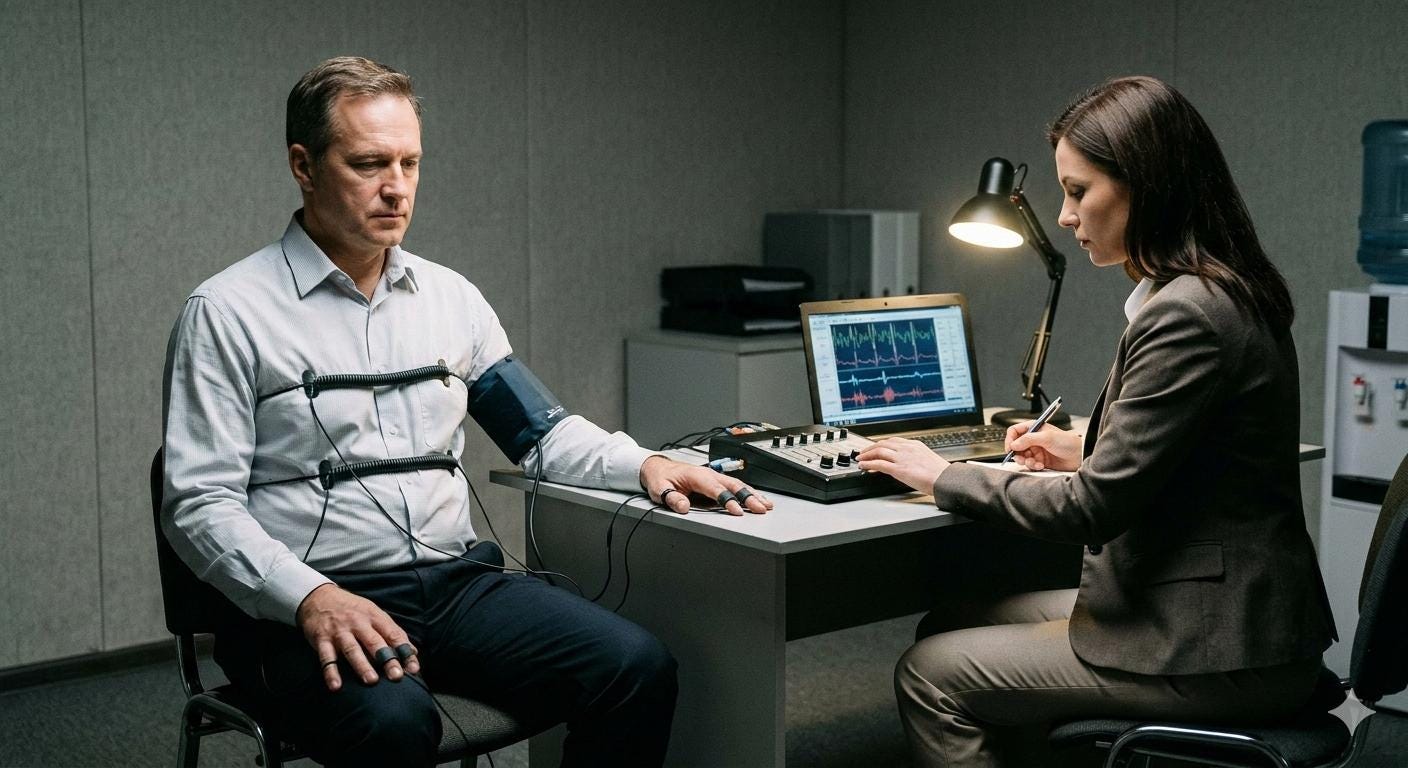
For more than a century, the polygraph has occupied an unusual position between science, psychology, law enforcement, and institutional authority. Its machinery creates an appearance of precision. Sensors monitor physiological activity, instruments record fluctuations, and an examiner studies the resulting measurements to determine whether someone may be concealing the truth.
Yet there is a fundamental contradiction at the center of this process. The machine does not measure honesty. It does not observe memories, detect criminal intentions, or establish whether a statement corresponds to reality. It records physiological changes that may accompany fear, anxiety, anticipation, emotional conflict, and other human responses.
Nevertheless, the examination is commonly presented as a test of truthfulness. The subject enters a room knowing that an authority figure will interpret bodily reactions as evidence of possible deception. That knowledge can itself influence the reactions being measured.
This leads to the central argument of this Red Blood Journal investigation: The polygraph is not merely a physiological assessment. It is also a psychological encounter in which belief, fear, suggestion, and institutional authority may influence both the examination and its consequences.
The scientific question is whether these influences can be reliably separated from actual deception. The ethical question is what happens when institutions treat an uncertain interpretation as established truth.
1. The Instrument That Cannot Measure a Lie
A polygraph records several physiological signals, commonly including cardiovascular activity, breathing patterns, and changes in skin conductivity associated with perspiration. Examiners evaluate those signals while asking questions selected according to the examination’s methodology.
The underlying assumption is that deceptive answers may generate characteristic physiological responses. But there is no uniquely identifiable physiological signature that proves a person is lying. An innocent person may experience fear of wrongful accusation, while a deceptive individual may experience comparatively little emotional disturbance.
The American Psychological Association, in its October 14, 2025 review of polygraph research, concluded that scientific evidence does not support the reliability and validity of conventional polygraph examinations for many forensic, legal, and employment purposes. Its analysis emphasizes that physiological changes associated with deception can also occur for reasons unrelated to dishonesty.
This exposes the central conceptual problem. The instrument measures bodily activity, while the examiner attempts to infer psychological meaning from it. The result is not a direct observation of truth but an interpretation built upon assumptions about human behavior.
A medical thermometer measures temperature. A speedometer measures speed. A polygraph measures physiological reactions but is popularly described as measuring something else: honesty. That difference deserves far greater public attention.
2. The Examination Begins Before the Machine Records Anything
The psychological influence of a polygraph examination begins before the formal questioning. The subject encounters an examiner, is introduced to the equipment, and receives explanations about what the examination is expected to reveal.
These interactions establish expectations about the machine’s capabilities and the potential consequences of its findings. An individual who believes that deception will inevitably be exposed may experience intense emotional pressure, even before answering a consequential question.
This is especially important because physiological responses are partly dependent on expectations, perceived threats, and emotional significance. The subject is not merely responding to the content of each question. They may also be responding to the authority of the examiner, the possibility of punishment, and the fear that an involuntary bodily reaction will be misinterpreted.
The National Research Council’s 2003 investigation, The Polygraph and Lie Detection, explicitly distinguished between the validity of polygraph measurements and the separate potential usefulness of examinations for obtaining disclosures or deterring misconduct. It recognized that confidence in a detection technique can influence behavior regardless of whether that technique accurately identifies deception.
The implication is profound. A machine can influence a person’s behavior because of what the person believes it can do, rather than because of what it actually demonstrates.
3. The Scientific Experiment That Exposes the Psychological Mechanism
One of the strongest pieces of evidence comes from a psychological research approach known as the bogus pipeline. In these experiments, participants are led to believe that equipment can detect concealed information or dishonest responses, even though the apparatus does not possess the claimed detection capability.
In a 1978 study published in the Journal of Personality and Social Psychology, researchers Barbara Quigley-Fernandez and James T. Tedeschi compared admissions made under different questioning conditions. Participants exposed to the supposed detection procedure confessed more frequently than participants responding through ordinary written questions or face-to-face interviews.
The importance of this finding is not that every individual becomes truthful when confronted with a machine. Nor does it establish that conventional polygraphs are entirely ineffective. Instead, it demonstrates that belief in detection can alter disclosure behavior even when actual detection is absent.
A further study published in Polygraph & Forensic Credibility Assessment in 2017 found that participants questioned with apparatus described as lie-detection equipment disclosed cheating by another participant more frequently than those in the control condition.
These experiments reveal a critical separation between two different processes: detecting dishonesty and persuading someone that dishonesty can be detected. The first requires valid measurement. The second can operate through expectations and psychological influence.
This distinction challenges the popular assumption that an admission obtained during a polygraph examination necessarily validates the machine’s accuracy.
4. Why an Innocent Person Can Fail While a Deceptive Person Passes
Consider two individuals undergoing separate examinations. The first is innocent but deeply afraid that an erroneous result could destroy a career, damage family relationships, or lead to criminal suspicion. The second is deceptive but experiences comparatively little emotional conflict about the falsehood.
The innocent person’s fear may generate significant physiological responses. The deceptive person may produce weaker reactions. Depending on the questions, examination technique, and interpretation, the results could favor the deceptive individual while raising suspicion about the innocent one.
This hypothetical example illustrates a scientifically recognized weakness. Physiological arousal does not correspond uniquely to dishonesty, and emotional reactions vary substantially between individuals.
The National Research Council concluded that polygraph testing has some ability to distinguish deceptive from nondeceptive individuals under certain conditions, but its accuracy is substantially below perfection. The committee also warned that screening programs could generate serious consequences through both false accusations and missed security threats.
The possibility of deceptive individuals passing does not demonstrate a universally reliable technique for defeating the examination. It demonstrates that the relationship between deception and measured physiological reactions is uncertain.
When individuals are classified according to these reactions, the resulting labels can carry consequences far beyond what the scientific evidence justifies.
5. From Measurement to Psychological Pressure: The Danger of False Confessions
The consequences become especially serious when polygraph examinations are incorporated into criminal interrogations.
A study published on March 8, 2026, in Legal and Criminological Psychology, investigated polygraph use in 56 cases involving individuals who falsely confessed and were subsequently exonerated. Researchers found that, among 36 cases in which examiner decisions were reported, only eight decisions were accurate. In nearly every case examined, suspects were told their examinations indicated deception, including situations involving inconclusive or exculpatory results.
The researchers described a process they called the Polygraph Self-Incrimination Ploy, in which suspects were led to believe that their own bodily responses had incriminated them.
This finding requires careful interpretation. The study examined a selected group of wrongful-conviction and false-confession cases, not a representative sample of all polygraph examinations. Its findings cannot establish the overall frequency of misconduct or erroneous interpretation throughout law enforcement.
Nevertheless, the documented cases establish that polygraph-related interrogation practices can contribute to grave miscarriages of justice.
A person may begin an examination believing that truthfulness is sufficient protection. If the examiner subsequently announces a deceptive result, that person may confront a frightening psychological dilemma: whether to maintain their account or question their own ability to resist an apparently authoritative scientific conclusion.
The danger is not limited to deliberate dishonesty by examiners. It also arises when uncertain physiological interpretations are presented with more confidence than the evidence warrants.
6. Why Institutions Continue Using an Imperfect Instrument
If the polygraph cannot reliably establish truth, why does it remain in use by government agencies, law enforcement organizations, and security institutions?
One answer is that the institutional purposes of an examination may extend beyond accurate detection. Polygraph procedures may be used to encourage disclosures, discourage prohibited behavior, investigate inconsistencies, or support broader personnel-screening processes.
These potential benefits must be evaluated separately from the scientific validity of the test itself. A technique that encourages disclosure is not necessarily accurate at identifying deception. Likewise, an instrument that deters some wrongdoing may still incorrectly classify innocent people.
The National Research Council recognized this distinction while concluding that the accuracy of polygraph testing was insufficient to justify heavy reliance upon it in federal employee security screening. The committee also found insufficient direct scientific evidence establishing the examination’s field effectiveness in producing truthful admissions.
This raises an institutional question that extends beyond the polygraph. When an investigative instrument influences behavior through its perceived authority, how should society evaluate its success?
Should success mean that subjects disclose more information, that misconduct is deterred, or that the system accurately distinguishes truth from falsehood?
These outcomes are not interchangeable. A procedure can produce admissions without reliably separating accurate admissions from false ones. It can deter misconduct while also causing innocent individuals to experience fear and unjust suspicion.
An institution must therefore account for the costs of false conclusions rather than measuring success solely through disclosures or deterrence.
7. The Machinery of Belief: When Appearance Becomes Evidence
The polygraph offers a revealing example of how technological appearance can affect human judgment. Its sensors, recorded waveforms, structured procedures, and professional terminology create an atmosphere of scientific authority.
The instrument is real. The physiological measurements are real. The questions and reactions are real. What remains uncertain is the inference that those reactions establish dishonesty.
This is a critical distinction because people often associate technical complexity with reliability. A procedure that employs specialized equipment can appear more objective than a human judgment, even when its conclusion depends substantially on interpretation.
The National Research Council’s analysis demonstrates why such assumptions require scrutiny. The committee examined the physiological theory, experimental evidence, countermeasures, examiner judgment, and the practical consequences of applying the technology in high-stakes settings. Its conclusions did not support treating polygraph results as definitive proof.
The broader lesson is not that technology is inherently deceptive. Technology can produce exceptionally valuable evidence when its measurements are valid, its limitations understood, and its conclusions appropriately constrained.
The problem arises when an institution moves from measuring something observable to asserting knowledge about something the measurement cannot directly establish.
In the case of the polygraph, that movement transforms physiological fluctuations into judgments about personal honesty.
8. The Questions That Every Government and Institution Should Answer
If a person’s employment, reputation, liberty, or security clearance may be influenced by polygraph testing, several questions deserve transparent answers.
First, how accurately does the specific examination identify deception in the population for which it is being used? Results from controlled laboratory experiments cannot automatically establish effectiveness in real criminal investigations or national-security screening.
Second, how frequently are innocent subjects incorrectly classified as deceptive, and what procedures exist to correct those errors? A system that offers no meaningful opportunity to challenge its conclusions risks allowing technical uncertainty to become institutional injustice.
Third, what role does psychological pressure play in generating admissions, and how are those admissions independently verified? An admission should be evaluated against corroborating facts rather than treated as automatically reliable because it followed an apparently unfavorable examination.
Fourth, what incentives influence the examiner and the employing institution? A system must distinguish the legitimate pursuit of evidence from pressure to obtain admissions, validate existing suspicions, or achieve administrative targets.
Finally, is the public accurately informed about what the machine measures, what it cannot measure, and how its findings should be interpreted?
These are not arguments for abandoning every investigative technique involving physiological measurement. They are requirements for scientific accountability and responsible institutional power.
🩸 The Red Blood Perspective — When Authority Controls the Meaning of Truth
The polygraph reveals a troubling vulnerability in the relationship between citizens and institutions. A government or employer can possess equipment that produces genuine measurements, assign interpretive authority to trained officials, and then use the resulting conclusions to influence decisions affecting individuals’ lives.
The underlying measurements may be accurate while the conclusions drawn from them remain uncertain. If this distinction is concealed or misunderstood, the appearance of scientific objectivity can protect decisions from legitimate scrutiny.
Red Blood Journal’s responsibility is to follow observable actions and consequences rather than presume hidden intentions. The existence of flawed testing does not prove that every institution knowingly exploits its limitations. Nor does evidence of psychological influence establish a coordinated system of manipulation. Such allegations require independent documentation.
What the evidence does demonstrate is that people can be influenced by belief in an instrument’s authority, and that erroneous or misleading polygraph interpretations have contributed to documented cases of injustice.
The deeper problem is therefore not merely whether a person can deceive a polygraph. It is whether an institution can mistakenly, carelessly, or deliberately transform an uncertain measurement into a declaration of truth.
A society committed to justice must never confuse the authority to make a judgment with the evidence required to justify it.
🌊❤️✨ The Ocean of Love and Positivity Perspective — Truth Does Not Need Fear to Exist
Humanity has spent centuries creating instruments to measure and classify the world. These technologies have expanded our understanding of nature, improved medicine, and revealed realities that were previously invisible. Yet the existence of an instrument does not eliminate the need for wisdom, compassion, or moral responsibility.
The polygraph reminds us that fear and truth are not the same thing. An innocent person can tremble before an accusation. A guilty person can remain calm. A truthful person may struggle to express themselves, while a dishonest person may speak with extraordinary confidence.
The Ocean of Love and Positivity invites us to recognize the humanity behind these reactions rather than reduce individuals to measurements or labels. Genuine truth-seeking requires patience, humility, independent evidence, and a willingness to correct mistakes.
There is also an inward lesson. A person who understands their own fears and emotional reactions may become less vulnerable to mistaking anxiety for guilt or confidence for honesty. Self-awareness is not a technique for deceiving others; it is a means of distinguishing an emotional experience from the reality that experience is presumed to represent.
A compassionate society should seek truth without humiliating the innocent, protect the vulnerable without excusing wrongdoing, and hold authority accountable without abandoning the possibility of justice.
The greatest achievement would not be a machine that frightens everyone into submission. It would be a society in which honesty is cultivated through conscience, responsibility, and mutual respect.
The machine can record the body’s reactions. It cannot determine the worth of the human being connected to it.
Research and references
National Research Council. (2003). The Polygraph and Lie Detection. National Academies Press.
American Psychological Association. (2025). Do “Lie Detectors” Work? What Psychological Science Says About Polygraphs.
Quigley-Fernandez, B., and Tedeschi, J. T. (1978). The Bogus Pipeline as Lie Detector: Two Validity Studies. Journal of Personality and Social Psychology, 36(3), 247–256.
A Study of the Bogus Pipeline Effect and Its Implications for Polygraph Testing. Polygraph & Forensic Credibility Assessment (2017).
Denkinger and colleagues. (2026). Polygraph Testing Abuses in National Registry of Exonerations False Confession Cases. Legal and Criminological Psychology.
Editorial distinction: Research findings are attributed to their sources. The Red Blood and Ocean of Love and Positivity sections represent editorial interpretation rather than additional scientific conclusions.
🩸🌊❤️✨ — Ocean of Love and Positivity
Blood connects us. The ocean unites us. Love guides us. Positivity illuminates our path.
📈
The Illusion of Scientific Certainty
Oct 30, 2026
The provided sources examine how the polygraph functions primarily as a psychological encounter rather than a reliable scientific instrument for measuring truth. While the machine records physiological changes like breathing and perspiration, it cannot actually detect lies or separate anxiety from deception. This false appearance of scientific certainty allows institutions to use the polygraph as a tool for intimidation, which can lead to false confessions and serious miscarriages of justice. Furthermore, research demonstrates that individuals often modify their behavior simply because they believe the apparatus possesses detection capabilities, regardless of its actual validity. Ultimately, relying on these flawed assessments mistakes an emotional reaction for concrete evidence, raising critical ethical questions about institutional accountability and justice.