


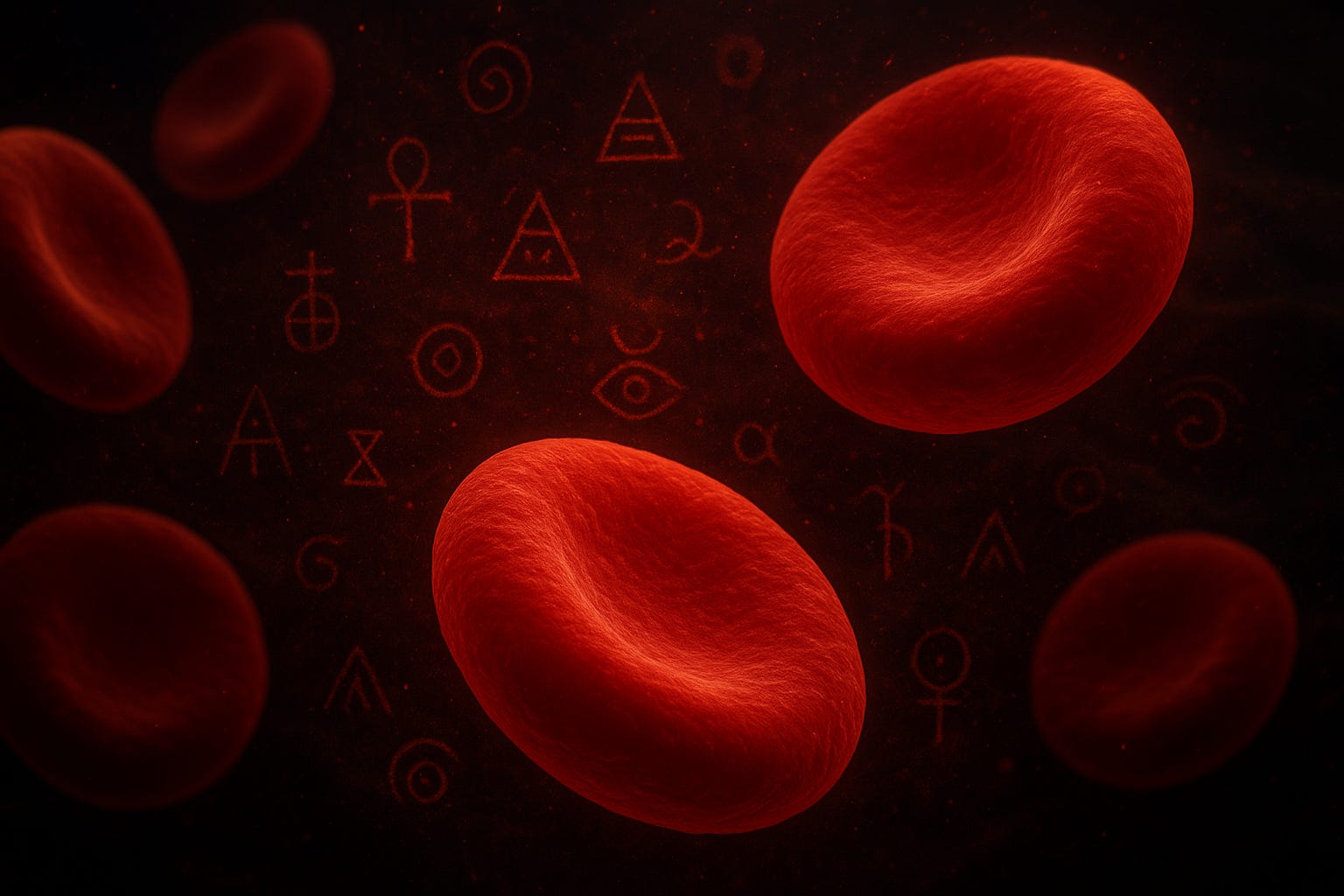
🩸 The History of the Red Blood Type
A Red Blood Journal Feature — “The Anatomy of Identity” Series
I. The Discovery of Blood Groups
The classification of blood into different “types” is a modern scientific development, but the fascination with blood as a marker of life and identity goes back to the dawn of civilization.
In 1901, Austrian physician Karl Landsteiner discovered that when the blood of different people was mixed, sometimes it clumped (agglutinated) and sometimes it didn’t. This led him to identify the ABO system — Type A, B, AB, and O — which remains the foundation of transfusion medicine today.
By 1940, Landsteiner and Alexander Wiener discovered another critical factor in blood compatibility — the Rhesus (Rh) factor, named after the rhesus monkey. The presence (+) or absence (–) of this protein created the familiar labels such as A+, O–, etc.
II. The Genetic Trail of Red Blood
The red color of blood comes from hemoglobin, a molecule built around iron — a metal that literally rusts red in the presence of oxygen. This iron-based chemistry has been evolution’s universal choice for carrying life’s most essential element: oxygen.
The ABO and Rh genes are ancient. The O type is believed to be the oldest, dominant in early humans and still the most common worldwide. Types A and B arose through mutations as populations adapted to environmental and microbial pressures over tens of thousands of years.
Some genetic anthropologists use the distribution of blood types as a kind of biological map of human migration — tracing how tribes diverged and mixed, how isolation preserved certain bloodlines, and how global travel recombined them again.
III. The Mystery of Rh-Negative
The Rh-negative blood type — found in only about 15% of the global population — has inspired entire subcultures of myth and speculation.
Some ancient DNA researchers suggest Rh– may have emerged in Cro-Magnon populations in Europe roughly 30,000 years ago, while others frame it as a genetic anomaly — a deletion of the Rh gene’s protein-coding segment.
But popular and esoteric theories go further:
Some claim Rh– blood is the mark of non-Neanderthal ancestry, or even “off-world” genetics, a remnant of an ancient hybridization.
Others see it as symbolic of spiritual autonomy — “those whose blood does not mix with the beast of the Earth.”
In certain occult and royal genealogies, Rh– is associated with “blue blood”, the divine right to rule, and the notion of a “separate lineage” guarding primordial wisdom.
While science rejects the alien interpretation, it’s undeniable that the mystique of Rh– persists precisely because blood is both biological and metaphysical — a fusion of matter and meaning.
IV. Blood as Identity and Power
Throughout history, bloodlines have defined kingdoms, caste systems, and even religions. The phrase “pure blood” has been both a badge of honor and a weapon of exclusion.
In ancient Egypt, blood was seen as the seat of the Ka, the life-essence. In Christianity, the Blood of Christ symbolized redemption. In modern medicine, it symbolizes life itself — transfused, stored, and commodified.
Yet in the age of data and DNA, blood has become the ultimate biometric — a key to identity, ancestry, and surveillance. The once-mystical lifeblood is now a code, reducible to digits in a genome database.
V. From Sacred Substance to Digital Code
The evolution of “blood type” mirrors humanity’s transition from spiritual being to biological machine.
Once, blood linked us to the gods.
Then, to our tribe and kin.
Now, to an algorithm and an insurance rate.
In this sense, the history of red blood is also the story of how life’s sacred signature became a barcode — the digitization of the divine.
🩸 Closing Reflection
Every drop of blood is a microcosm of humanity’s paradox: unity through diversity, divinity through flesh.
The red river that runs through all of us is both a record of our evolution and a prophecy of our convergence — a universal ink written in iron and oxygen, pulsing with the memory of every ancestor who ever lived.