


🩸 THE FORGOTTEN ALLIANCE
When Russia Saved the Union — and the World Wasn’t Told
A Red Blood Journal Historical Exposé
INTRODUCTION – THE ERASED CHAPTER
It is perhaps the most astonishing story almost no American has ever heard.
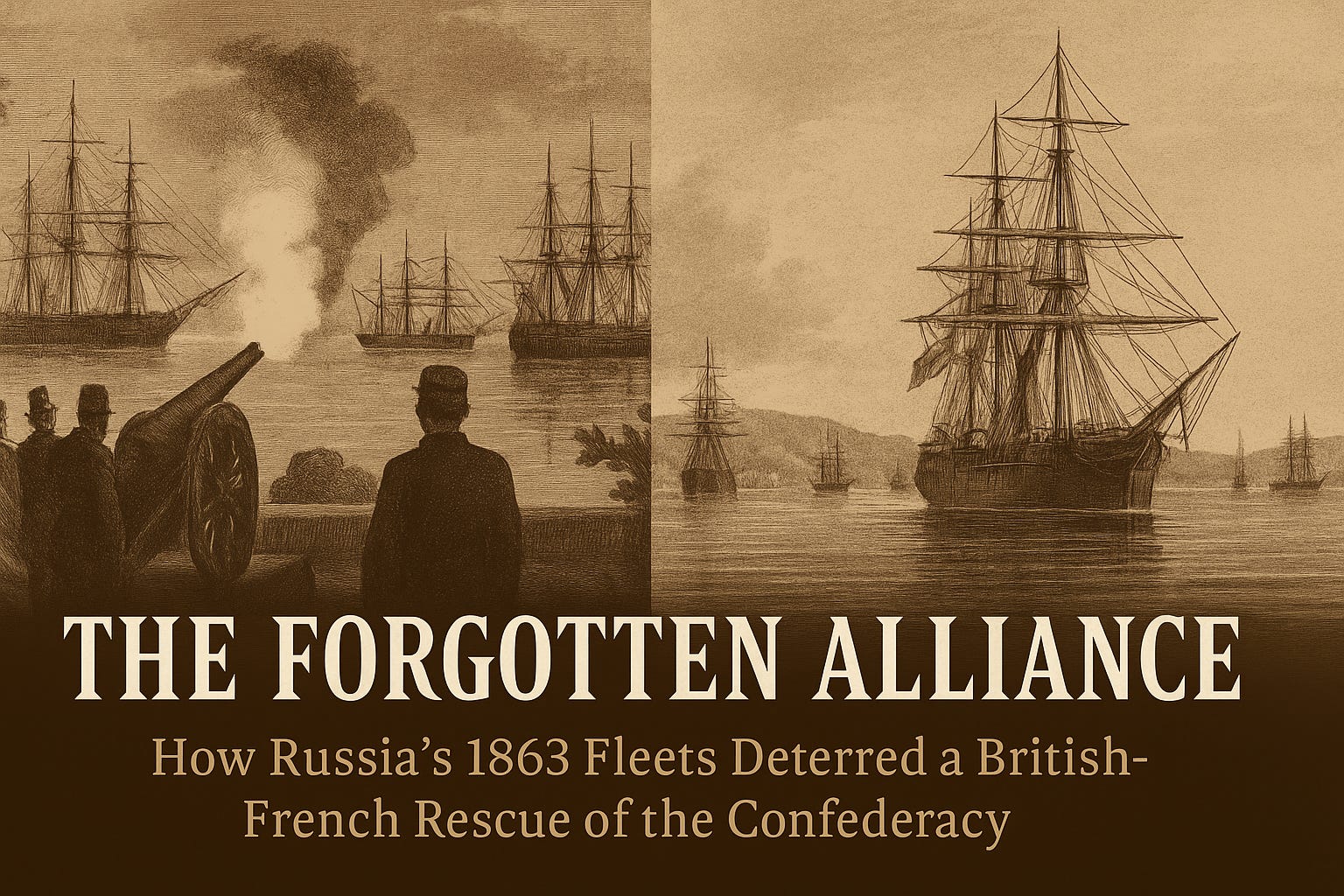
In the autumn of 1863, with the Union bleeding and Britain and France preparing to recognize the Confederacy, two Russian fleets suddenly appeared—one in New York Harbor, the other in San Francisco Bay.
Their arrival, under sealed orders from Tsar Alexander II, wasn’t ceremonial—it was a silent but unmistakable declaration to London and Paris:
If you intervene against Lincoln’s Union, you will be at war with Russia.
That single move may have altered world history. Without it, America might never have survived the Civil War intact. The United States could easily have become another Canada—a polite dominion under British influence—or, worse, a fractured continent of quarrelling republics resembling the politically torn and economically plundered nations of South America.
But this alliance—the only true foreign military support Lincoln ever received—was buried, erased, and deliberately forgotten.
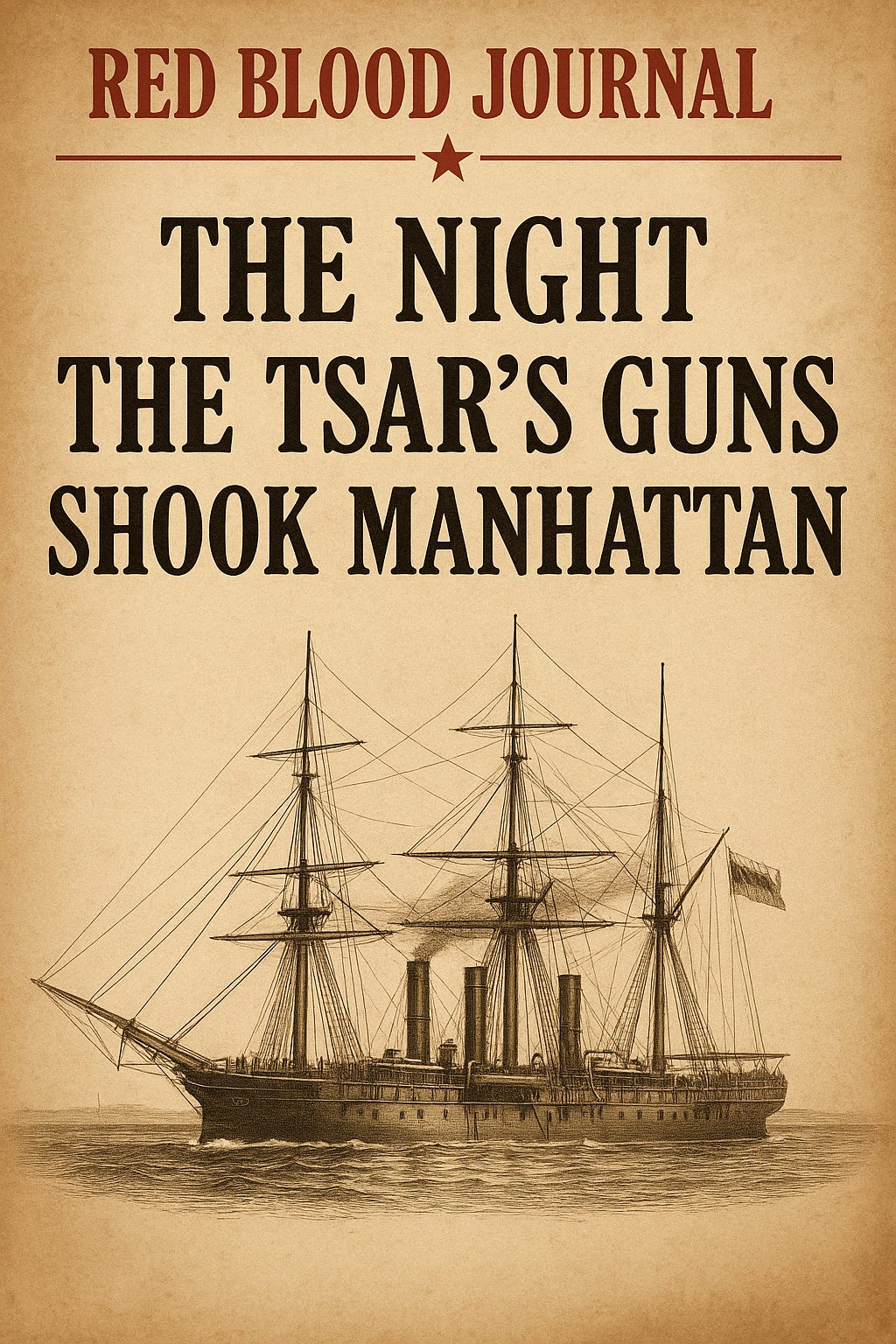
PART I – THE NIGHT THE TSAR’S GUNS SHOOK MANHATTAN
September 24, 1863. The air over New York still hung heavy with the smoke of the draft riots. Gettysburg had bled the North white, Chickamauga was a disaster, and public morale lay in ashes.
Then, as dusk fell, watchers at the Battery saw a wall of masts rise on the horizon. A foreign fleet—bristling with cannon—sailed up the Hudson. The Aleksandr Nevsky led the line, followed by the Peresvyet, the Varyag, and more. Fifty-one guns thundered a salute that shook lower Manhattan.
Harper’s Weekly devoted half an issue to the spectacle. City Hall hosted the officers; Delmonico’s catered a ball of twelve thousand oysters and a thousand pounds of steak; and ordinary New Yorkers wept as Russian sailors donated their own pay to feed the poor in the slums.
Across the continent, Admiral Popov’s Pacific Squadron slipped through the Golden Gate on October 12. When fire swept San Francisco’s docks, Russian sailors joined the bucket lines—some dying in the flames. They were buried with honors on Mare Island. Popov promised the governor:
“Should a Southern cruiser appear, we shall clear for action.”
Both fleets carried sealed orders: if Britain or France struck, they were to join the Union Navy in combat.
It was a chess move worthy of genius—and the first crack in the wall of empire.
PART II – THANKSGIVING FOR THE TSAR
While the Russian squadrons anchored on both coasts, Britain’s Laird Rams—ironclad behemoths secretly built for the Confederacy—prepared to steam out of Liverpool.
U.S. ambassador Charles Francis Adams confronted Lord Russell:
“If those ships leave port, this means war.”
Shaken, the British cabinet seized the vessels. Within weeks, the invasion plan collapsed.
Navy Secretary Gideon Welles wrote in his diary:
“God bless the Russians.”
On October 3, 1863, Lincoln proclaimed a new national holiday—Thanksgiving. The timing is no coincidence. Seward’s text acknowledged that “foreign powers were invited to aggression” yet peace had been miraculously preserved. The reason stood visible in two harbors.
Harper’s Weekly even proposed a formal U.S.–Russian alliance, arguing that together the two nations could checkmate any Anglo-French scheme. The idea electrified Washington.
Three years later, when assassins struck at Tsar Alexander II, Congress sent a solidarity mission aboard the revolutionary ironclad Miantonomoh. Europe trembled at its arrival. Napoleon III promised to withdraw his troops from Mexico—ending a French challenge to the Monroe Doctrine.
For a moment, the world saw what true reciprocity between republic and empire could look like.
Russia's Participation in the U.S. Civil War
PART III – CASSIUS CLAY CARRIES RUSSIA
Behind this friendship stood one man: Cassius Marcellus Clay of Kentucky—abolitionist, duelist, and U.S. ambassador to St. Petersburg. Clay’s mission: convince Russia that Lincoln would never yield, and convince Lincoln that Russia was the friend he could trust.
In Tsar Alexander’s glittering halls, Clay met Prince Gorchakov, a statesman of rare steel. Clay presented the works of Henry Carey, the Philadelphia economist who championed the American System—tariffs, infrastructure, national credit. Russia, seeking to free 23 million serfs and industrialize, saw a blueprint for emancipation with prosperity.
The result: a diplomatic note declaring the preservation of the Union “essential to the equilibrium of the world.”
Clay later wrote his own epitaph:
“I did more than any man to overthrow slavery. I carried Russia with us.”
In 1862–63, as Britain toyed with intervention, the Tsar privately informed both London and Paris:
“If you recognize the Confederacy, it will be a casus belli for Russia.”
Hence the fleets. Hence the deterrent.
Gorchakov’s credo—no foreign interference, equality of nations, peace as default—still echoes in modern diplomacy.
Even Russian officers contributed on the ground. Colonel Charles d’Arnaud, an intelligence agent of the Tsar’s service, advised General Frémont on Western operations. His reconnaissance foresaw Confederate moves and saved the Mississippi campaign.
PART IV – THE RUSSIANS WHO LAUNCHED GRANT — AND WHY WE FORGOT
Autumn 1861. Colonel d’Arnaud rides through enemy lines, wounded, to warn a little-known brigadier at Cairo, Illinois:
“Move now, or the Confederates will seize Paducah.”
That brigadier was Ulysses S. Grant.
He obeyed—and reached Paducah six hours before the rebels. The decision changed the war. It opened the Tennessee and Cumberland Rivers, led to Fort Donelson, and propelled Grant to command of all Union armies.
The same Russian officer had earlier pushed Frémont to rush-build the Eads gunboats, the “Pook Turtles” that gave the North naval supremacy on the western rivers.
A fine Russian hand, indeed, helped shape America’s greatest general.
Another was John Basil Turchin, a Don Cossack turned Union brigadier. Veteran of the Crimean War, Turchin brought hard realism to America’s conflict—refusing to return escaped slaves, leading daring assaults from Huntsville to Chickamauga to Missionary Ridge. Lincoln personally promoted him after a court-martial for “fighting too hard.” His wife Nadine Turchin chronicled the campaigns—the only woman to publish an eyewitness Civil War military history.
These Russians fought not as mercenaries but as men of principle—believing in freedom through strength and industrial progress over aristocratic decay.
The Erasure
So why did this story vanish?
Because after 1905, the narrative had to change.
George Kennan Sr. popularized Siberia’s prisons, turning sympathy to outrage.
Theodore Roosevelt, aping British geopolitics, took Japan’s side against Russia.
Then came the Cold War, which demanded a villain.
By Gettysburg’s 150th anniversary, not a single major U.S. historian mentioned that America once owed its survival to Russia. The silence was the point. The special relationship with Britain had replaced the older, inconvenient truth.
Yet the record stands: Lincoln had one true friend in the world—Tsar Alexander II.
The Forgotten Choice
Had the Tsar not intervened, the map of the Americas might look like this:
Scenario A: A “Northern Dominion” beholden to Britain, industrially stunted, politically deferential—another Canada.
Scenario B: A mosaic of regional republics—Atlantic, Confederate, Great Lakes, Western—each prey to foreign creditors and coups. A continental mirror of the fragmented, impoverished South America of the late 19th century.
Instead, a single industrial republic survived, ready to rise. And that survival owed as much to Russian steel and will as to American blood and grit.
EPILOGUE – GETTING RIGHT WITH LINCOLN
Every generation is asked a question: Are we still right with Lincoln?
To answer honestly, we must restore what was deliberately cut from the record—that when the world turned its back, Russia stood with us.
“Who was our friend when the world was our foe.” — Oliver Wendell Holmes
Call to Action
If this truth startled you, that’s good.
History’s silences are never accidental.
Hit 👍 or 👎, share this with one line and the tag #ForgottenAlliance, and become part of the Silent Majority that won’t stay silent.
Because remembering who stood beside us once may determine who stands with us next.