


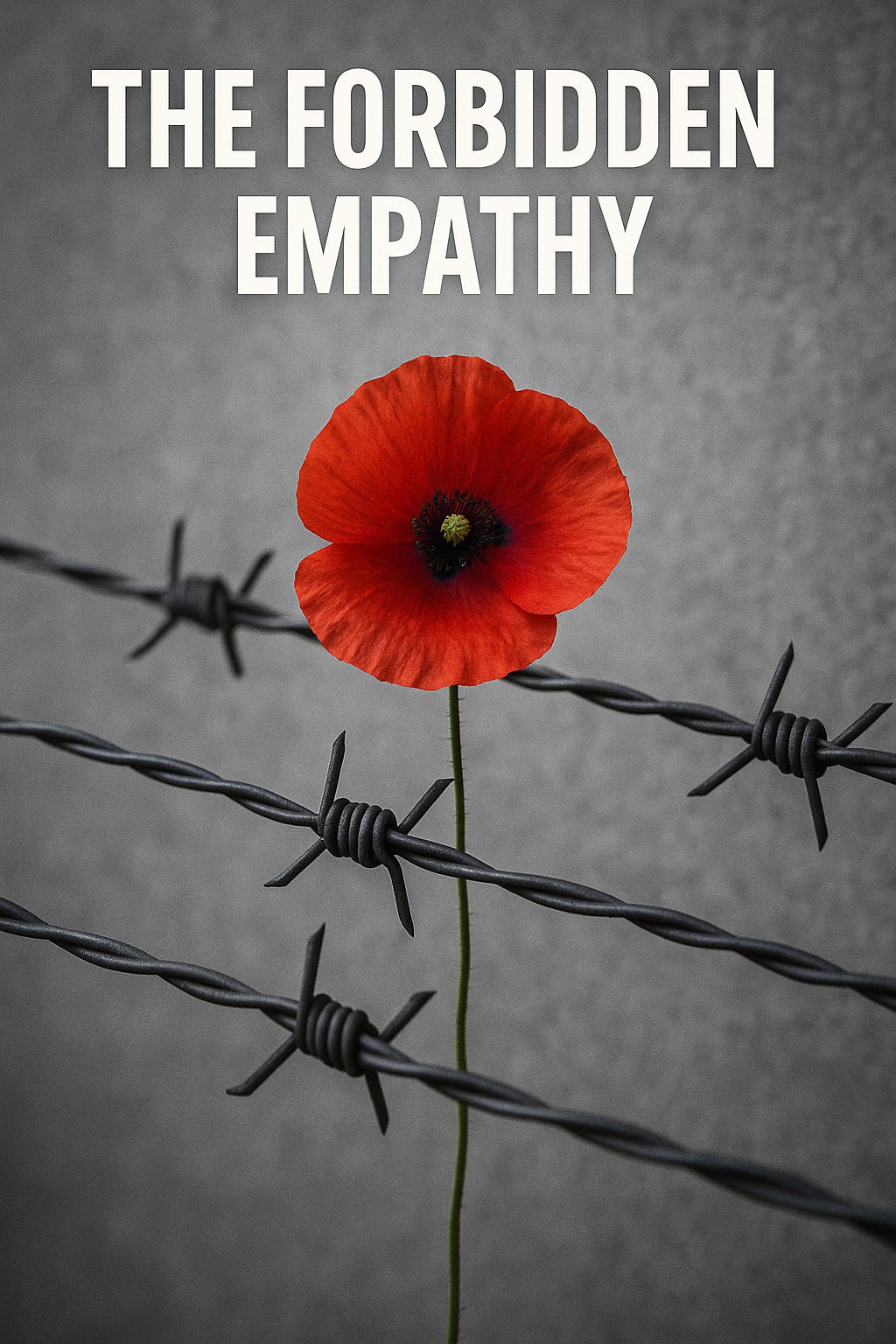
“The Forbidden Empathy: How Power Shapes Whose Suffering We’re Allowed to See”
By Red Blood | The Red Blood Journal
Introduction: The Silence That Speaks Too Loud
In every era, there are people whose suffering is broadcast to the world—and others whose agony is muted, distorted, or forbidden to acknowledge. The difference rarely lies in the scale of pain, but in the political usefulness of that pain. This is the cruel calculus of narrative control—the invisible hand not of the market, but of perception. In our modern world, the Palestinians have become the ultimate case study of what happens when empathy itself is censored.
Narrative Engineering: The Architects of Perception
The so-called “free press” of the West often prides itself on objectivity, yet its coverage is filtered through economic interests, geopolitical alliances, and cultural taboos. The world’s most powerful governments and their media proxies dictate not only what is true, but what may be felt.
Certain tragedies are sanctified, others sanitized. One civilian death may dominate headlines for weeks, while another is buried beneath euphemisms like “collateral damage” or “self-defense.” The hierarchy of grief is carefully maintained.
Behind this engineering are layers of influence—political lobbies, intelligence agencies, think tanks, and corporate conglomerates that share one objective: preserve the system’s legitimacy by controlling its moral vocabulary. Words like occupation, resistance, or genocide are not just political—they’re treated like contraband.
The Psychology of Forbidden Thought
When people are told what they can’t say, they begin to fear what they think. The power structure understands this intimately. It’s not enough to silence journalists; the true victory is to colonize the public’s imagination—to make the average citizen afraid of even asking the wrong question.
This is how “forbidden thoughts” are created. Not through official bans, but through cultural conditioning: peer pressure, job insecurity, and fear of social exile. The goal is to make empathy selective—to teach people to feel guilt for caring about the wrong victims.
De-Humanization as Policy
History shows that before bombs fall, metaphors fall first. The language of domination always begins by stripping a people of individuality, culture, and dignity.
Palestinians are not portrayed as human beings with names and dreams, but as faceless masses—numbers, targets, “risks.” Their homes become “structures.” Their children become “casualties.” Their stories are footnotes.
The forbidden empathy extends to those who dare to speak for them. Writers, professors, artists, and journalists who question the official narrative are branded as extremists or anti-something. The label sticks, and with it comes digital erasure, career destruction, or worse.
The Machine That Manufactures Silence
The modern information sphere—dominated by tech monopolies and intelligence-linked media networks—has perfected the science of “perception management.”
Algorithms decide visibility. Bank accounts vanish. Posts disappear. Voices that deviate from the consensus are quietly buried, not banned. This subtle form of censorship is more powerful than old-fashioned book burning, because it pretends to be voluntary.
Even humanitarian organizations are subject to geopolitical influence. Funding strings, trade agreements, and “security cooperation” dictate which crises are highlighted and which are ignored. When the system itself feeds on global conflict, truth becomes a threat to its metabolism.
The Parallel: Controlled Ecosystems
If one wanted a metaphor—not an insult, but a scientific comparison—it would be to see how in ecological systems, populations can be managed or culled to protect certain “interests.” A group fenced in, controlled, deprived of autonomy, and studied as a behavioral experiment mirrors how governments treat certain populations under occupation or sanctions. The world becomes a laboratory of obedience.
This is not unique to Palestine—it’s a prototype. Once you normalize control over one group, it becomes easier to apply it to others. Surveillance, censorship, propaganda—these tools, once perfected, are exported everywhere.
Breaking the Spell
Every empire depends on consent—either explicit or coerced. But consent collapses the moment people begin to question why they’re forbidden to think certain thoughts.
The forbidden empathy is the Achilles’ heel of propaganda. When ordinary people begin to see the censored victims as human again, the edifice of lies trembles.
The task, then, is simple yet revolutionary: to remember what we are not supposed to remember. To speak the forbidden truth even when the microphones are off. To see humanity where power demands blindness.
Substack Tags
#RedBloodJournal #NarrativeControl #ForbiddenEmpathy #MediaCensorship #Palestine #InformationWarfare #Propaganda #TruthSuppressed #Journalism #GlobalPower