


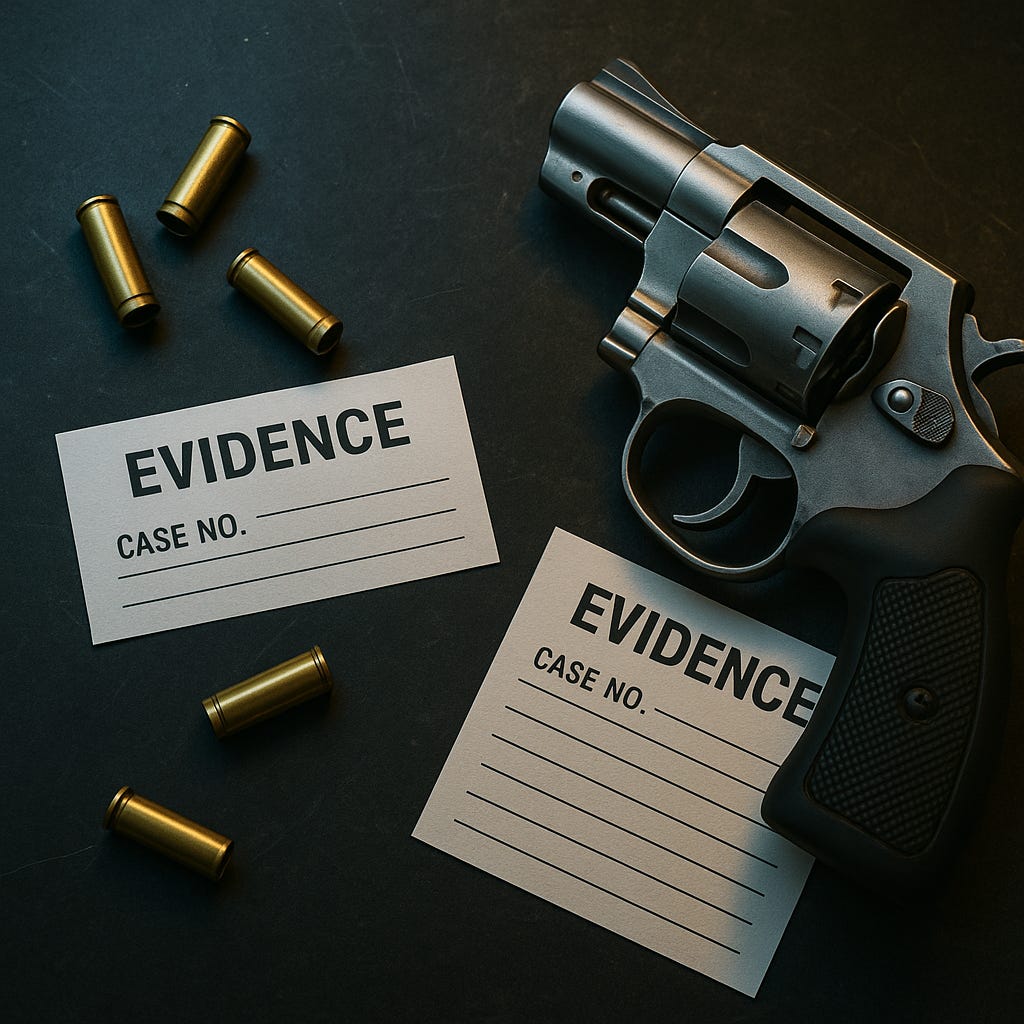
The Fingerprint of Fire: How Ballistics Bias Shapes Justice in America
By Red Blood | Investigative Report | The Red Blood Journal
Introduction: The Invisible Hand of the Brass
Every bullet fired tells a story. But in American law enforcement, that story is written differently depending on the gun that fired it.
Semi-automatic pistols scatter metallic breadcrumbs across the scene — gleaming brass casings that speak to investigators long after the smoke clears. Revolvers, by contrast, swallow their secrets, locking each spent round inside a steel cylinder.
This quiet mechanical difference has produced one of the most misunderstood — and consequential — divides in modern forensics and criminal justice: the ballistic bias.
I. The Birth of Ballistics as a Legal Weapon
Forensic ballistics emerged in the early 20th century, a time when revolvers dominated the American landscape. Early criminologists like Calvin Goddard and Philip Gravelle pioneered the comparison microscope, matching bullet striations to specific barrels.
But with the post-war rise of the semi-automatic, the science evolved — and so did its assumptions.
Semi-automatics, which eject casings with each shot, offered investigators an abundance of evidence:
Spent shells showing extractor and ejector marks,
Firing-pin impressions,
Breechface patterns unique to each firearm.
This abundance transformed forensics into a form of mechanical fingerprinting. Police learned to “read” a crime scene not by witnesses, but by brass.
Revolvers, on the other hand, gave nothing. They left no casings, no micro-traceable residue — a forensic blind spot that soon became a legal and cultural distinction.
II. The Case of the Vanishing Casings
Imagine two shootings.
In one, a semi-auto Glock spits ten brass casings into the gutter.
In the other, a .38 Special revolver fires six rounds, and the shooter pockets the weapon — no casings, no trace.
When officers arrive, the visual difference dictates the investigative path.
In the first case, detectives collect casings, enter them into the NIBIN (National Integrated Ballistic Information Network), and potentially link the weapon to previous crimes.
In the second, they’re left with wounds, bullets (if retrievable), and guesses.
That absence — not of guilt, but of evidence — has made revolvers statistically “cleaner.” Many police departments subconsciously associate them with legitimate self-defense, while semi-autos, prolific in street crimes, are stigmatized as the hallmark of the underworld.
III. How Ballistics Became a Branding Tool
Over decades, these investigative biases hardened into courtroom myth. Prosecutors began calling semi-automatics “crime guns.” Media echoed the language. Even manufacturers leaned into the divide: revolvers for “responsible owners,” semi-autos for “tactical users.”
But the data tells another story. According to FBI Uniform Crime Reports and CDC mortality data, handgun homicides split nearly evenly between revolvers and semi-autos in most regions. In rural and Southern states, revolvers remain common in both homicides and suicides. In urban areas, semi-autos dominate because of sheer availability — not inherent criminality.
Yet juries hear otherwise.
Prosecutors routinely use ballistic evidence — or its absence — as rhetorical ammunition:
“The defendant’s semi-automatic left casings all over the scene — a sign of intent.”
“The lack of evidence from the revolver shows he acted carefully and responsibly.”
The gun’s behavior becomes the shooter’s morality.
IV. Registration, Traceability, and the Mirage of Forensic Certainty
In the United States, there is no federal gun registry. Instead, law enforcement depends on traceability — serial numbers, sales records, and ballistic signatures.
Semi-automatics, by virtue of their ejected casings, create traceable micro-patterns that feed massive databases. This allows agencies to map gun-crime networks, but also builds a digital shadow registry, effectively tracking weapons by ballistic signature rather than by owner name.
Revolvers fall outside that net. With no casings to enter into NIBIN, and fewer marks on recovered bullets, they exist largely off-grid — invisible in the data-driven age of law enforcement.
Privacy advocates hail this as protection for gun owners. Prosecutors decry it as obstruction.
Either way, the revolver’s silence has made it the last analogue weapon in a digital system of surveillance.
V. The Science Under Scrutiny
Ballistic matching is not infallible.
A 2016 President’s Council of Advisors on Science and Technology (PCAST) report found that traditional firearm-identification methods lack standardized error rates. A 2018 study by the Houston Forensic Science Center revealed that examiners disagreed on bullet matches up to 30% of the time under blind conditions.
Yet in courtrooms, ballistic “matches” are presented with near-DNA authority. And because semi-autos leave more evidence, they produce more “matches” — some of them wrong.
Thus, the same technology that is supposed to deliver justice may disproportionately implicate semi-auto owners while leaving revolver owners statistically less vulnerable to forensic error.
VI. The Deep State of Data
Federal agencies like the ATF now rely on the NIBIN network to cross-reference shootings nationwide. As of 2025, the database holds millions of ballistic images. But only one class of weapons feeds it: semi-automatics.
This imbalance has warped the digital map of American gun crime. Analysts see dense clusters of “gun violence” in cities — not because there are more criminals, but because semi-auto brass litters those streets while revolvers stay silent in both senses.
The database reflects not the totality of violence, but the totality of evidence. It’s a self-fulfilling prophecy of criminalization through visibility.
VII. The Moral of the Metal
The revolver’s silence has become its protection.
The semi-auto’s noise — both literal and evidentiary — has become its curse.
America’s justice system, built on evidence, rewards the weapon that hides its trace and punishes the one that leaves it. What began as mechanical design has evolved into moral code, shaping police biases, prosecutorial tactics, and public policy.
When brass speaks, justice listens — but sometimes it listens too loudly.
Conclusion: Justice in the Age of Forensic Illusion
Ballistics was meant to illuminate truth, yet it has created a two-tier system of justice based not on conduct but on cartridge ejection.
The revolver is the weapon of invisibility — romanticized, untraceable, almost innocent.
The semi-auto is the weapon of exposure — over-represented in databases, in courtrooms, and in media outrage.
Both fire the same lead, destroy the same flesh, end the same lives.
Only one leaves its fingerprints behind.
And in America, sometimes the only difference between guilt and innocence is the sound of brass hitting pavement.
The Red Blood Journal
Where silence and sound both stand trial.