


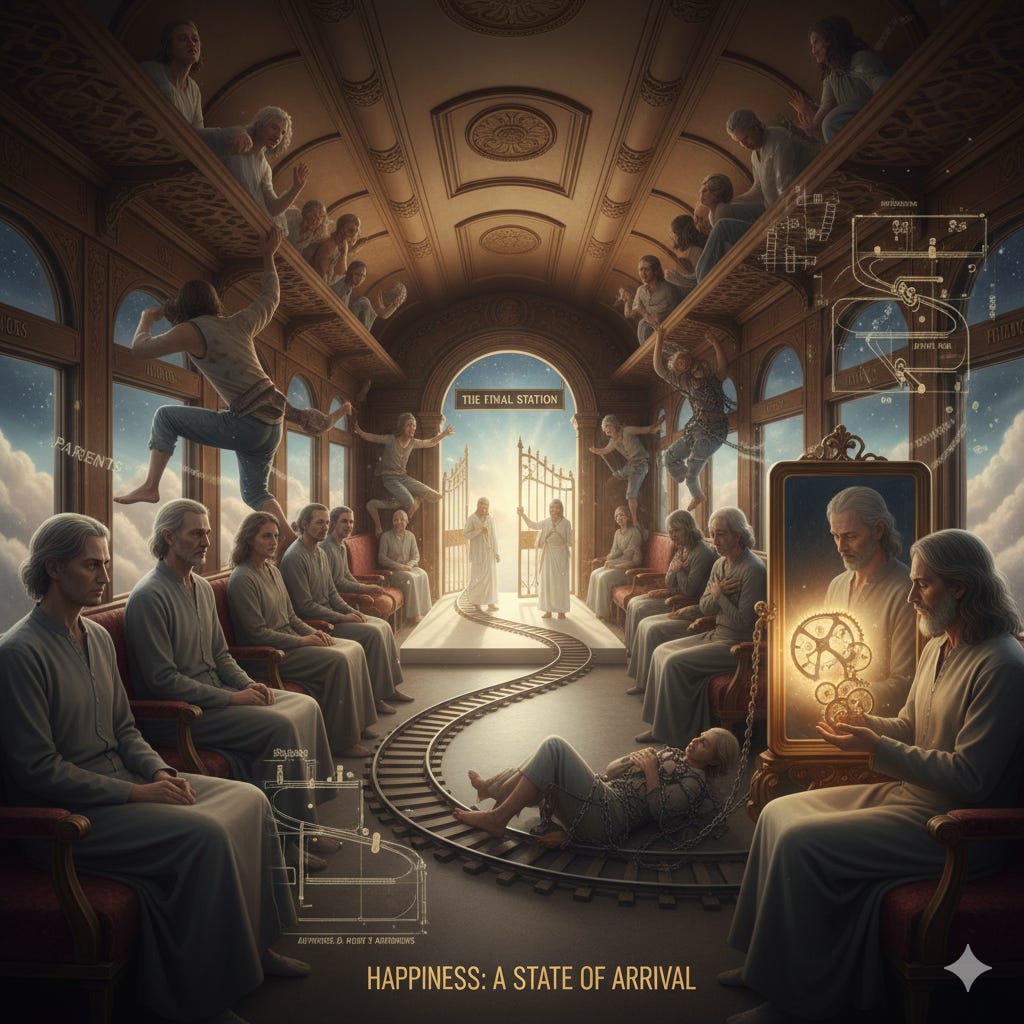
🩸The Finality of the Track: A Meditation on the Self’s Station
We are all subjects of the iron decree of the track. The carriage lurches forward, and we, the temporary passengers, are assigned our stations—our endings, our moments of final disembarkation. This forward momentum is not merely travel; it is the relentless clock of existence.
Observe the passengers: some wait in dull, passive obedience, accepting the dictated stop as inevitable. Others, driven by a panicked desire for control, attempt to jump the line, seeking an unassigned station, hoping to seize an exit that is not yet theirs. And then there are those who sit frozen, consumed by a futile, anxious wish that their stop be forever overlooked, that the train of time would simply stall for their comfort. They are all defined by the station they fear or anticipate, yet none can alter the core mechanism: the train moves.
While on this journey, a profound and common bewilderment settles over the collective. Some are content in their spiritual somnambulism, following the conductor’s commands, trading free will for routine. Others confuse rebellion with insight, seeking a fleeting, destructive thrill in non-compliance, mistaking negative friction for personal freedom. But the most vital passenger is the skeptic, the one who questions the route itself, seeking the root mechanism—the inner logic of the track.
The illusion, often cherished until the very last mile, is that this journey is about the company we keep: the parents, siblings, friends, and strangers who share our carriage. We invest our core identity in these ephemeral relationships. Yet, when their assigned station is called, they exit, and the truth reveals itself: their identity is irrelevant to your own destiny. They are temporary scenery. The only metric that matters at their departure, and consequently, at yours, is their state of inner congruence.
External frameworks—be they societal mandate or formal religion—serve as guides to the track, offering a map of the landscape. But these guides are often a form of sustained anesthesia; they keep the traveler calm but fail to provide the actual means of exit. They are the drug that maintains the high of direction without delivering the sober truth of the destination. They fail to show how to disembark, suggesting the act of following is the end, when in fact, genuine, unassailable happiness is the solitary key.
The final confrontation is unavoidable. Everyone must step onto the platform of their station, whether ready or not. The distinction is brutal but simple: Those who alight in self-possession—happy, reconciled, and true to their inner architecture—are ready for the “next train,” the progression to whatever lies beyond. But those who disembark fragmented, unwilling to be happy, or dedicated to their own misery, are cursed to circle back. They must re-board the same train, repeating the cycle of bewilderment until they achieve the singular insight: the journey’s success is measured only by the quality of the self you bring to the end.
The highest form of spiritual discipline, therefore, is not prayer or ritual, but unflinching self-honesty. Turn inward, and address that interior self not as a distant ideal, but as your most intimate friend—the one who knows every error, every lie, and every deliberate detour. When you cease lying to this inner witness, when the mask of self-deception is finally discarded, that is the moment the next station is truly revealed, and happiness becomes not a destination, but a state of arrival.