


🩸 🇮🇷 🇵🇰 ☢️ 🃏 🗺️ 💰 ⚔️ 🌊❤️✨ — THE FINAL JOKER CARD: A COMPREHENSIVE ANALYSIS
When a Government Fights to Survive, Who Pays the Price? Iran, Pakistan, Nuclear Secrets, Hidden Financial Networks, and the Economics of Permanent Conflict
RED BLOOD JOURNAL — INVESTIGATIVE TRANSMISSION
October 26, 2026 | Geopolitics / Nuclear Proliferation / Economic Power / National Sovereignty
Accompanying Video: The Final Joker Card — A Comprehensive Analysis
Runtime: Approximately 38 minutes, 32 seconds
PROLOGUE — WHEN THE NATION BECOMES A BARGAINING CHIP
What happens when a government finds itself cornered, its military capabilities weakened, its economy isolated, and its political future threatened by adversaries determined to change the balance of power?
Under ordinary circumstances, political leadership might seek public support, negotiate alliances, reorganize the economy, or pursue diplomatic settlements. But what happens when those options no longer appear sufficient?
History reveals a troubling possibility. A leadership facing an existential crisis may begin treating the nation’s resources not as an inheritance to be protected, but as assets available for exchange.
Oil revenues become instruments of clandestine financing. Infrastructure becomes collateral for strategic agreements. Commercial corridors become sources of geopolitical leverage. Even national territory may enter the discussion as something that could be traded for an extraordinary military advantage.
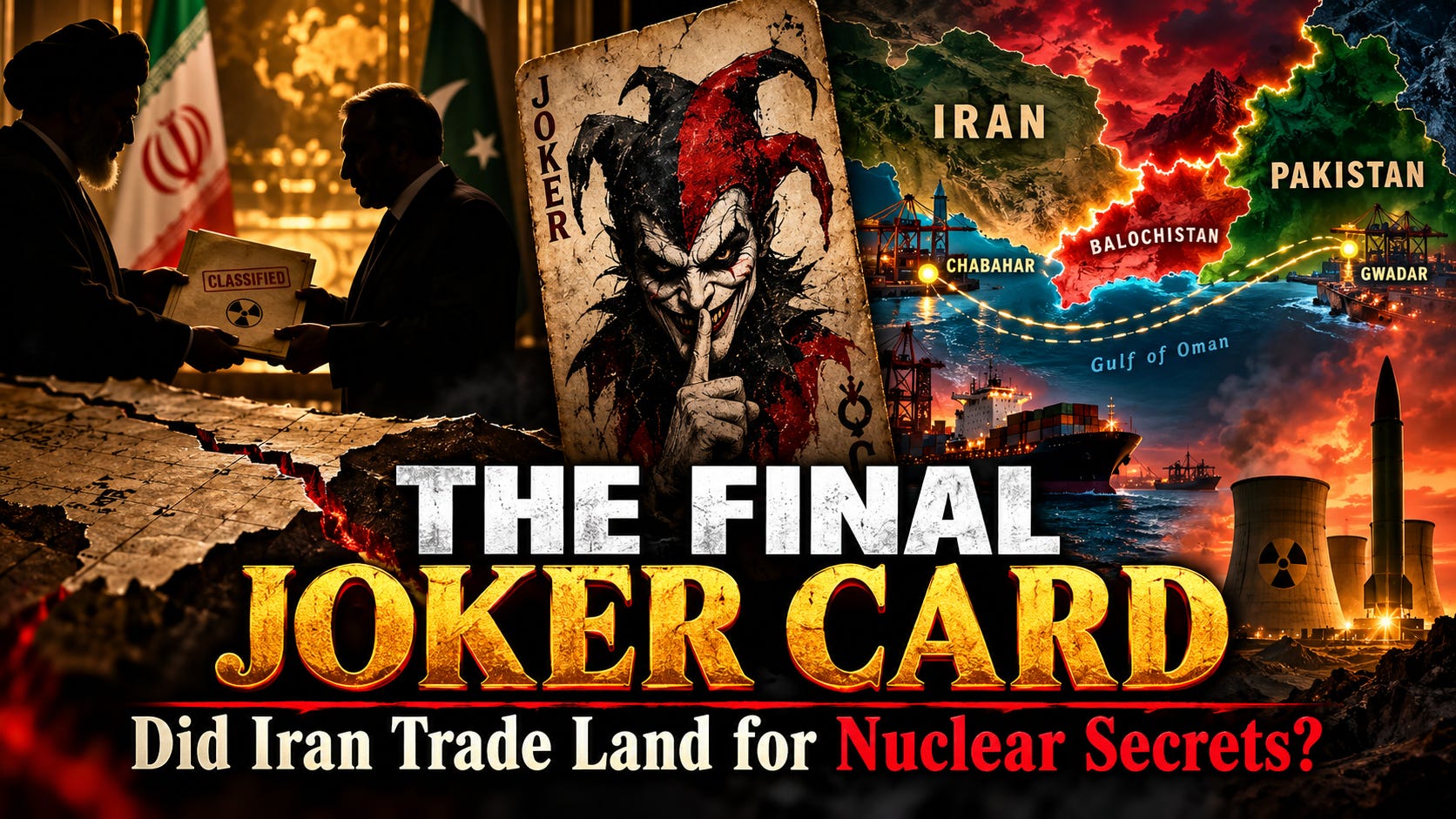
This investigation begins with precisely such an allegation: that Iranian authorities secretly transferred coastal territory to Pakistan in exchange for nuclear-enrichment technology.
The accusation remains unverified. Yet it points toward a documented historical relationship involving Iran, Pakistan, and one of the most consequential nuclear proliferation networks of the twentieth century.
The central question is not simply whether Iran obtained nuclear technology from Pakistan. Historical investigations have established that sensitive technology reached Iran through Pakistani-linked procurement networks.
The more consequential question is what Iranian authorities may have exchanged to obtain that technology, whether additional agreements remain undisclosed, and whether a threatened political leadership could regard nuclear capability as its ultimate insurance policy.
But behind the nuclear question lies something still more important.
Are the survival of a government and the survival of a nation necessarily the same thing?
I. THE ALLEGED TERRITORIAL BARGAIN — LAND FOR NUCLEAR TECHNOLOGY
The investigation begins with allegations attributed to Ali Akbar Omid Mehr, a former Iranian Foreign Ministry official whose accounts of Iranian–Pakistani nuclear relationships were discussed in a Persian-language political interview.
According to the interview, Iranian officials allegedly transferred a portion of coastal territory near Pakistan in exchange for access to uranium-enrichment technology. The speakers refer to approximately twelve kilometers of coastline, while another passage introduces an eight-hundred-meter measurement associated with the alleged arrangement.
This discrepancy creates an immediate evidentiary problem.
Twelve kilometers of coastline and an eight-hundred-meter strip are not equivalent geographical descriptions. Without an authenticated location, boundary survey, or agreement, investigators cannot determine whether the speakers referred to the same area, different measurements of a particular tract, or an inaccurate account of another transaction.
The more fundamental problem concerns the absence of independently authenticated evidence establishing that sovereignty was transferred.
A territorial change is not merely a diplomatic announcement. It creates administrative consequences. Military patrol responsibilities may change, customs jurisdiction may shift, property rights may require adjustment, and official maps and governmental records may need to reflect the new arrangement.
Even if a government attempted to conceal the diplomatic understanding behind such a transaction, the practical transfer of territorial control could leave evidence.
Historical satellite imagery, border-administration records, cadastral surveys, port concessions, and diplomatic correspondence might provide important clues.
Without such evidence, the allegation cannot responsibly be described as a confirmed territorial sale.
Yet its significance should not be dismissed simply because the original testimony is incomplete.
The accusation raises a legitimate investigative question: if a political leadership believes a strategic capability is essential to its survival, what is it prepared to exchange to obtain that capability?
II. THE HISTORICAL CONNECTION THAT IS DOCUMENTED
The allegations become more consequential when placed alongside the documented history of Abdul Qadeer Khan, the Pakistani nuclear scientist associated with an extensive international procurement and proliferation network.
During the 1980s and 1990s, Iran pursued centrifuge technology to support uranium enrichment. Pakistan, meanwhile, had developed sophisticated nuclear capabilities through a program closely associated with Khan.
International investigations subsequently established that Iran acquired centrifuge-related technology through the Khan network.
In 1987, Iran received an offer involving technical drawings, equipment, components, and information connected with centrifuge production. Further transactions occurred during the 1990s, including procurement linked to Pakistani centrifuge designs.
This history is not dependent on the disputed territorial allegation. It forms part of the documented international record examined by nuclear investigators and research organizations.
But an important distinction must be preserved.
Obtaining centrifuge designs is not the same as possessing a nuclear weapon. Acquiring specialized equipment does not establish the ability to produce a deployable bomb. Nor does the involvement of a Pakistani scientist automatically demonstrate that the Pakistani government formally authorized every transaction.
Pakistan publicly demonstrated its nuclear-weapons capability through tests conducted in May 1998. Iran has developed extensive nuclear capabilities, but it has not been publicly verified as possessing an operational nuclear weapon.
These distinctions prevent an important historical fact from being transformed into a much broader allegation that the available evidence does not establish.
The documented transfers prove that sensitive nuclear technology moved through clandestine channels. They do not prove that Pakistan delivered a completed nuclear weapon to Iran or received Iranian territory in exchange.
Nevertheless, the established relationship provides a foundation for investigating the possibility of additional financial or strategic arrangements.
III. THE TECHNOLOGY BEHIND THE TRANSACTION
The importance of the Khan network becomes clearer when examining the technology involved.
Uranium enrichment requires sophisticated equipment capable of separating uranium isotopes. Gas centrifuges perform that separation by rotating uranium compounds at extremely high speeds under carefully controlled conditions.
The process demands specialized materials, precision engineering, reliable components, and extensive technical knowledge.
These requirements help explain why procurement networks became so important to countries attempting to develop enrichment capabilities while facing restrictions on access to foreign technology.
A government could acquire drawings and technical information but still encounter considerable difficulties manufacturing reliable equipment, operating large numbers of centrifuges, and maintaining the necessary infrastructure.
The materials and expertise needed to support enrichment also do not, by themselves, establish that a country has manufactured a nuclear weapon.
The distinction between nuclear knowledge, industrial capability, weapons development, and operational deployment is essential to understanding the Iranian case.
It also explains the strategic value of clandestine technical networks.
A transaction might involve far more than the purchase of a particular machine. It could provide access to engineering expertise, suppliers, technical documentation, and commercial relationships that become valuable over many years.
This raises an important historical question.
If Iranian officials gained access to an international network capable of transferring sensitive technology, who financed those transactions, and which institutions ultimately controlled the resulting knowledge?
IV. FOLLOW THE MONEY — THE ALLEGED FINANCIAL EXCHANGE
The original Persian-language interview advances another allegation: that Iranian oil revenues contributed to Pakistan’s nuclear development.
Its speakers suggest that Iran may have functioned not merely as a purchaser of nuclear technology, but as a financial supporter expecting access to the capabilities developed through Pakistani expertise.
If accurate, such an arrangement would suggest a relationship involving reciprocal strategic interests rather than isolated equipment purchases.
Pakistan could have benefited from financial assistance, while Iran could have sought technological expertise that was difficult to acquire openly.
But plausible incentives are not proof that the alleged financing occurred.
A complete investigation would require documentary evidence identifying specific payments, the institutions involved, the dates of transactions, the recipients, and the technologies or services provided in return.
This distinction becomes particularly important because clandestine international financial systems can make transactions difficult to reconstruct.
The audio discussion explores methods associated with opaque commercial activity, including intermediaries, front companies, concealed ownership arrangements, informal financial networks, and maritime trade practices that can obscure the movement of goods and money.
Such methods illustrate how difficult financial investigations can become.
Their existence, however, does not establish that they were used to finance the particular Iranian–Pakistani arrangement alleged in the interview.
The question remains one of evidence.
Which revenues were transferred? Through what institutions? Who authorized the payments? What did the recipients provide? And where did the proceeds ultimately go?
These questions are more valuable than assuming that an alleged financial arrangement must have occurred because a mechanism for concealing transactions exists.
V. THE OPPORTUNITY COST OF POLITICAL SURVIVAL
The financial investigation leads to an issue with consequences far beyond nuclear technology.
National revenues represent resources that could support public investment, infrastructure, education, healthcare, industry, and economic development.
When substantial government expenditure is directed toward military capabilities or concealed strategic projects, those resources are unavailable for other purposes.
Every government must make difficult decisions about national security and public spending. Military investment can sometimes protect the population against genuine threats.
But those decisions require accountability because the people bearing the costs are not necessarily those receiving the immediate political benefits.
If public money is diverted into undisclosed arrangements intended primarily to preserve political leadership, the distinction between national security and regime security becomes unavoidable.
Iran’s petroleum wealth has the potential to finance substantial economic development. Decisions concerning its allocation therefore carry consequences for ordinary households and future generations.
The central problem is not merely that money may be spent on military technology.
It is whether the public can determine how much was spent, who approved the expenditure, which organizations benefited, and whether the resulting capabilities genuinely improved national security.
The consequences of opaque financial decisions may persist regardless of whether the specific territorial allegation is ultimately verified.
VI. GWADAR AND CHABAHAR — THE GEOGRAPHY OF ECONOMIC POWER
The investigation then moves from financial networks to the physical geography of the Gulf of Oman.
Two ports stand at the center of this discussion: Gwadar in Pakistan and Chabahar in Iran.
Gwadar forms an important part of the China–Pakistan Economic Corridor, commonly called CPEC. The corridor is intended to improve commercial connectivity through transportation infrastructure, energy projects, and logistics networks linking China and Pakistan.
Chabahar, located in Iran, offers another strategically significant connection between the Indian Ocean and regional markets.
India has supported development associated with Chabahar as part of efforts to improve trade access to Afghanistan and Central Asia without relying on transit through Pakistan.
These are not simply competing shipping terminals.
Ports can become the foundations of wider transportation systems involving railways, highways, warehouses, manufacturing facilities, energy infrastructure, and commercial investment.
Once businesses build their supply chains around such systems, their economic decisions may remain linked to those routes for decades.
The audio offers a useful comparison to competing technological ecosystems.
Different operating systems can attract developers, businesses, and users into networks that become increasingly valuable as participation expands. Likewise, transportation corridors can attract investment and commercial activity that reinforces their long-term importance.
The comparison is imperfect, but it helps illustrate how infrastructure can generate influence without the direct occupation of foreign territory.
VII. THE VALUE OF IRAN’S INDEPENDENT GEOGRAPHY
Iran occupies a potentially advantageous position connecting the Persian Gulf, the Gulf of Oman, Central Asia, the Caucasus, and markets farther north.
The country’s long-term economic possibilities are therefore not confined to oil production or domestic consumption.
Transportation, manufacturing, logistics, tourism, regional trade, and industrial development could all benefit from improved access to international markets.
This makes the question of sovereignty especially important.
If territory, port concessions, transportation rights, or other strategic assets were transferred under unfavorable arrangements, the consequences could extend far beyond the original transaction.
A government might receive an immediate financial or military advantage while reducing opportunities available to future generations.
But the existence of competition between Gwadar and Chabahar does not establish that Iran secretly transferred land to Pakistan.
The ports’ importance is documented. The alleged territorial transaction remains unverified.
The investigative connection lies in understanding why coastal geography can be valuable enough to influence negotiations among governments and international investors.
The critical question is not simply whether a country controls a port on a map. It is who controls its development, financing, operating arrangements, and long-term commercial revenues.
VIII. BALOCHISTAN — BETWEEN GLOBAL AMBITIONS AND LOCAL GRIEVANCES
Between these strategic economic interests lies Balochistan, a region spanning areas of Iran and Pakistan with a complicated history of political grievances, economic inequality, resource disputes, and armed conflict.
The audio discusses reports of attacks associated with the Baloch Liberation Army, disruptions affecting commercial transportation, and instability involving routes connected with Gwadar and the Iran–Pakistan border.
The Baloch Liberation Army has carried out violent attacks, including attacks against civilians and infrastructure.
Regional insecurity can increase the cost of transportation, discourage commercial investment, interrupt supply chains, and complicate infrastructure development.
From the perspective of international competition, such disruptions can affect the economic prospects of projects involving China, Pakistan, Iran, and other regional actors.
But it would be a serious analytical error to assume that every local conflict exists because a foreign intelligence service created it.
Balochistan has longstanding political, economic, and historical grievances that cannot be explained solely through contemporary competition over ports.
The region’s communities have experienced disputes involving resource development, political representation, economic opportunities, and their relationships with central governments.
Those grievances require consideration independently of the strategic interests of outside powers.
Foreign actors may benefit from particular outcomes without having organized them.
The region’s tragedy lies partly in the intersection between local grievances and larger geopolitical competition.
While governments and investors calculate strategic advantages, ordinary families confront the consequences of instability.
Their concerns include security, employment, infrastructure, education, political representation, and the opportunity to benefit from economic development in their own communities.
IX. WHY A THREATENED LEADERSHIP SEEKS THE ULTIMATE DETERRENT
The investigation returns to the nuclear question through the concept of deterrence.
A government possessing a credible nuclear retaliatory capability may be able to discourage an adversary from attempting an attack that threatens its survival.
But effective deterrence involves more than the possession of dangerous technology.
An adversary must believe that the capability exists, that it could be delivered, and that the relevant command structure could authorize its use even under severe pressure.
These requirements help explain why nuclear capabilities occupy such an important position in strategic calculations.
They also clarify the distinction between technical knowledge and operational military power.
A country may possess advanced nuclear expertise without having a deployable weapon. It may possess powerful conventional missiles without having nuclear warheads. It may maintain uncertain capabilities without providing sufficient evidence for an adversary to know exactly what exists.
The audio presents the idea that strategic uncertainty itself may influence foreign decision-making.
That possibility is relevant to Iran, whose nuclear activities have been the subject of decades of international scrutiny and diplomatic confrontation.
However, uncertainty must not be treated as proof of an undisclosed weapon.
The absence of complete information creates questions, not automatic confirmation of the most dramatic explanation.
X. THE DEAD HAND — WHEN COMMAND STRUCTURES FRACTURE
The next issue concerns military authority during a national crisis.
The original Persian-language interview alleges that Iranian military structures have adopted decentralized arrangements allowing regional commanders to operate if communication with central leadership is disrupted.
Its speakers compare the alleged structure to the Soviet and Russian system popularly known as Dead Hand.
The comparison requires considerable caution.
Russia’s reported system concerns continuity of strategic nuclear command and retaliation. A regional command structure capable of acting under emergency conditions is not automatically equivalent to an automated nuclear retaliatory mechanism.
No authenticated evidence presented in the source establishes that Iran possesses a comparable nuclear-launch system.
Nevertheless, the wider concern is serious.
Military organizations depend on reliable command, control, communications, and accurate information.
If central authority becomes fragmented, regional commanders may face contradictory instructions, disrupted communications, uncertainty about legitimate authority, and rapidly changing military conditions.
In such circumstances, miscalculation becomes a danger.
A commander who incorrectly interprets an interruption in communications as evidence of a larger attack could make decisions whose consequences extend beyond the local area.
The danger would not necessarily require nuclear weapons. Conventional missiles, drones, armed organizations, and other military capabilities can create substantial risks when coordinated authority breaks down.
The original interview’s particular allegations remain unverified, but the broader problem of military continuity and escalation deserves attention.
XI. THE ECONOMY OF PERMANENT CONFLICT
A further question emerges.
If prolonged confrontation damages economic development, why do systems of hostility sometimes persist for decades?
One possible explanation involves the uneven distribution of costs and benefits.
Economic sanctions can restrict ordinary trade while increasing opportunities for certain intermediaries able to operate through more complicated or opaque channels.
Political instability may increase demand for surveillance, weapons, protective infrastructure, and military services.
Disruptions to energy transportation may influence commodity prices and alter market opportunities for competing suppliers.
Under these conditions, some organizations or individuals can gain financially even while the broader population experiences economic hardship.
This creates an important investigative distinction.
Profiting from conflict is not the same as having caused the conflict.
A financial beneficiary may have an incentive to preserve particular arrangements, but demonstrating deliberate manipulation requires evidence connecting that beneficiary to decisions or activities responsible for the outcome.
The presence of defense contracts does not prove that a war was manufactured to create them. Increased intermediary profits do not establish that sanctions were designed exclusively to enrich intermediaries.
At the same time, these possibilities should not be ignored merely because establishing deliberate coordination is difficult.
A serious investigation follows public contracts, ownership structures, financial relationships, political decisions, and measurable economic outcomes.
It asks who receives revenue, who exercises control, and who bears the consequences.
In the economy of permanent conflict, the greatest burden may fall on people who have little influence over the decisions producing the instability.
XII. THE FINANCIAL COST OF THE NEXT POLITICAL TRANSITION
The audio then considers the obligations that may survive a government.
Political leadership can change while economic contracts, public debts, commercial concessions, damaged infrastructure, and unresolved international claims continue affecting the population.
A country emerging from prolonged confrontation may need to rebuild electrical networks, transportation systems, industrial facilities, hospitals, housing, and other essential infrastructure.
Reconstruction requires resources.
Those resources may come from domestic revenues, international investment, government borrowing, or agreements with foreign institutions.
Such arrangements can support recovery when negotiated transparently and managed responsibly.
But they can also create long-term obligations that restrict future economic decisions.
The original interview raises speculative concerns about compensation claims and the possibility of reconstruction debts associated with regional military conflict.
Those concerns do not establish that particular compensation agreements have already been negotiated.
They do, however, identify a meaningful issue: the financial consequences of a government’s decisions can continue after that government is gone.
A political transition therefore involves more than replacing leaders.
It also involves evaluating public obligations, reviewing major contracts, restoring accountable institutions, and deciding how national resources should support reconstruction.
The objective should not simply be to preserve the formal existence of the state.
It should be to restore the ability of its people to determine the country’s future.
XIII. THREE POSSIBILITIES FOR THE FINAL JOKER CARD
The investigation eventually returns to its original question.
What might constitute the final strategic card available to a government facing an existential threat?
The audio develops three possibilities.
The first is a concealed physical capability, such as a nuclear weapon. This is also the possibility requiring the strongest technical and physical evidence. Historical access to nuclear technology does not establish possession of a functional weapon today.
The second possibility is a strategic relationship with another government capable of offering protection. A secret security guarantee, if one existed, could influence the political calculations of the governments involved. But the historical nuclear relationship with Pakistan does not establish that such a guarantee exists.
The third possibility is strategic ambiguity.
A government may attempt to influence adversaries through uncertainty concerning its actual capabilities or intentions.
In this interpretation, the final card need not be a demonstrable weapon. It might be the perception that a capability exists, that additional technological options remain available, or that foreign relationships could produce unexpected consequences.
Such ambiguity may complicate an adversary’s calculations, but it can also create dangerous misunderstandings.
These possibilities are not equally evidenced, and none should be accepted simply because it provides a compelling explanation.
The strongest conclusion remains conditional.
Iran’s historical access to Pakistani-linked nuclear technology is documented. A secret territorial exchange is not established. A current Pakistani nuclear guarantee is not demonstrated. The existence of an undisclosed Iranian weapon cannot be inferred from the historical procurement record alone.
The final joker card may be a capability, a political arrangement, a perception, or something that does not exist at all.
XIV. THE NATION IS NOT THE REGIME
This brings us to the investigation’s defining distinction.
A government is not identical to the nation it governs.
Governments occupy political authority for particular periods. Nations consist of people, territory, cultural history, resources, institutions, and generations whose interests extend far beyond the tenure of any leadership.
The security of a government and the security of a nation may overlap.
But they are not automatically interchangeable.
A leadership may preserve its authority through military expenditure, restrictive economic arrangements, foreign agreements, or political measures whose broader consequences are borne by the population.
The fact that a government survives does not establish that its citizens have become safer, freer, or more prosperous.
Nor should national sovereignty be reduced to the continued recognition of territorial borders.
Sovereignty also involves the ability of people to determine how their resources are used, how their institutions operate, and what obligations may be imposed on future generations.
A country can retain its borders while accepting financial commitments that severely restrict its future options.
It can also strengthen its sovereignty through transparent international cooperation, responsible investment, and accountable economic development.
The distinction is not between isolation and engagement.
It is between arrangements that serve the public interest and arrangements whose benefits remain concentrated among those holding power.
XV. WHEN THE MAP BECOMES A FINANCIAL LEDGER
The final metaphor of the audio turns the investigation toward the maps we take for granted.
We often think of national borders as permanent representations of history, identity, and sovereignty.
But governments negotiate territorial agreements, commercial concessions, resource rights, military arrangements, and long-term leases.
Such transactions are not inherently illegitimate. Their legal basis, purpose, and public accountability determine their character.
The concern arises when national assets are treated primarily as instruments for protecting temporary political authority without meaningful oversight.
If a government were willing to exchange sovereign territory for military technology, the resulting transaction would demand scrutiny not only as a geopolitical event but as a question of legitimate authority.
Who had the right to approve it? Who benefited? Who assumed the cost? Were the people affected consulted? What obligations were imposed upon future generations?
The allegation involving Iran and Pakistan remains unresolved because the required documentary evidence has not been established.
Yet the broader question survives regardless of that allegation’s eventual outcome.
What happens when governments begin treating their national inheritance as negotiable property available to finance their own survival?
And how much of a country’s future can be committed without the meaningful consent of the people who will inherit the consequences?
🩸 The Red Blood Perspective
The historical relationship between Iran and the A.Q. Khan proliferation network is documented. It establishes that sensitive centrifuge-related technology reached Iran through Pakistani-linked channels. It does not establish that Pakistan transferred an assembled nuclear weapon, that Iranian territory was secretly ceded in exchange, or that a present-day nuclear security guarantee exists.
These distinctions are essential because an investigation must be capable of distinguishing documented actions from allegations and strategic speculation. The proper method is to examine border records, financial transactions, procurement histories, commercial agreements, military documentation, and identifiable decisions. Plausible motives and economic beneficiaries can guide the inquiry, but they do not substitute for proof.
The most important question may ultimately concern the relationship between political survival and public cost. When national resources are committed in the name of security, who actually receives the protection? Who controls the transaction? Who benefits financially? And who inherits its consequences?
The value of investigating the final joker card lies not in assuming that a secret weapon or agreement must exist, but in identifying what the record can establish about the use of national wealth and sovereignty.
Follow the actions. Follow the money. Examine the agreements. Identify the decision-makers. Measure the consequences. And never confuse the survival of those holding authority with the long-term security of the people they govern.
🌊❤️✨ The Ocean of Love and Positivity Perspective
Beyond the calculations of military strategists, investors, political leaders, and international powers are ordinary human beings seeking safety, dignity, opportunity, and a meaningful future.
Iranian families, Pakistani communities, and the people of Balochistan are not pieces on a geopolitical chessboard. Their lives cannot be reduced to transportation routes, resource deposits, military positions, or bargaining advantages.
Scientific knowledge, advanced technology, ports, railways, and international commercial relationships have the potential to improve human well-being. They can strengthen healthcare, education, industry, communication, and economic opportunity when guided by responsible institutions and constructive purposes.
The deeper challenge is not to eliminate material progress, but to prevent material ambition from becoming more important than human dignity.
When political survival becomes the supreme objective, the people may be asked to sacrifice opportunities they never agreed to surrender.
When economic growth becomes detached from compassion, the benefits may accumulate among those already holding power while vulnerable communities carry the costs.
True national strength requires more than the ability to threaten destruction. It requires institutions worthy of public trust, opportunities shared across society, peaceful relationships with neighboring populations, and the capacity to build a future without permanent fear.
The purpose of investigating hidden power should not be to replace one form of division with another. It should be to uncover the decisions that affect human lives and encourage greater transparency, responsibility, and understanding.
We are more than the political systems under which we live. Our humanity extends beyond borders, governments, religious differences, and economic interests.
The nation is not the regime. The people are not bargaining chips. The future is not the private property of those holding power.
The greatest security a society can create is a future in which human life, dignity, and shared prosperity are treated as more valuable than any final card.
SOURCE RECORD AND EVIDENCE LIMITATIONS
This report is adapted from the approximately 38-minute, 32-second NotebookLM audio discussion transcribed as The Final Joker Card: A Comprehensive Analysis, supplied for this publication. The recording discusses Red Blood Journal’s earlier investigation and the underlying Persian-language interview.
The audio cites historical research associated with the International Atomic Energy Agency, Iran Watch, the Carnegie Endowment for International Peace, the Arms Control Association, and the U.S. Congressional Research Service.
The historical account of the A.Q. Khan network and Iranian centrifuge procurement has an established documentary basis. The alleged territorial transfer, alleged financing of Pakistan’s nuclear-weapons program, and claimed contemporary secret nuclear arrangements remain unverified in the material provided.
Some mechanisms and scenarios discussed in the audio are illustrative explanations rather than independently established actions by specific governments. This written adaptation preserves those distinctions.
Primary production source: The Final Joker Card A Comprehensive Analysis.txt, final NotebookLM transcript, approximately 00:00–38:32.
🩸🌊❤️✨ — Ocean of Love and Positivity
Blood connects us. The ocean unites us. Love guides us. Positivity illuminates our path.