


🩸 🇮🇷 🇵🇰 ☢️ 🗺️ ♟️ 🃏 🌍 ⛓️ 🌊❤️✨ — THE FINAL JOKER CARD
Did Iran Trade Its Sovereignty for Pakistan’s Nuclear Secrets? The Hidden Bargains, the Balochistan Corridor, and the Last Insurance Policy of a Regime Fighting for Survival
RED BLOOD JOURNAL — INVESTIGATIVE TRANSMISSION
October 25, 2026 | Geopolitics, National Sovereignty, Nuclear Proliferation, and the Economics of Power
PROLOGUE — WHEN SURVIVAL BECOMES MORE IMPORTANT THAN THE NATION
What is the last card a government plays when conventional military power weakens, economic isolation deepens, political legitimacy deteriorates, and foreign adversaries begin calculating how to end its rule?
For most governments, survival depends on maintaining some combination of public support, economic stability, political alliances, and military strength. But history also offers another possibility: when leaders come to regard their own survival as inseparable from national security, they may seek extraordinary capabilities and accept extraordinary costs.
Iran’s nuclear history raises precisely this question.
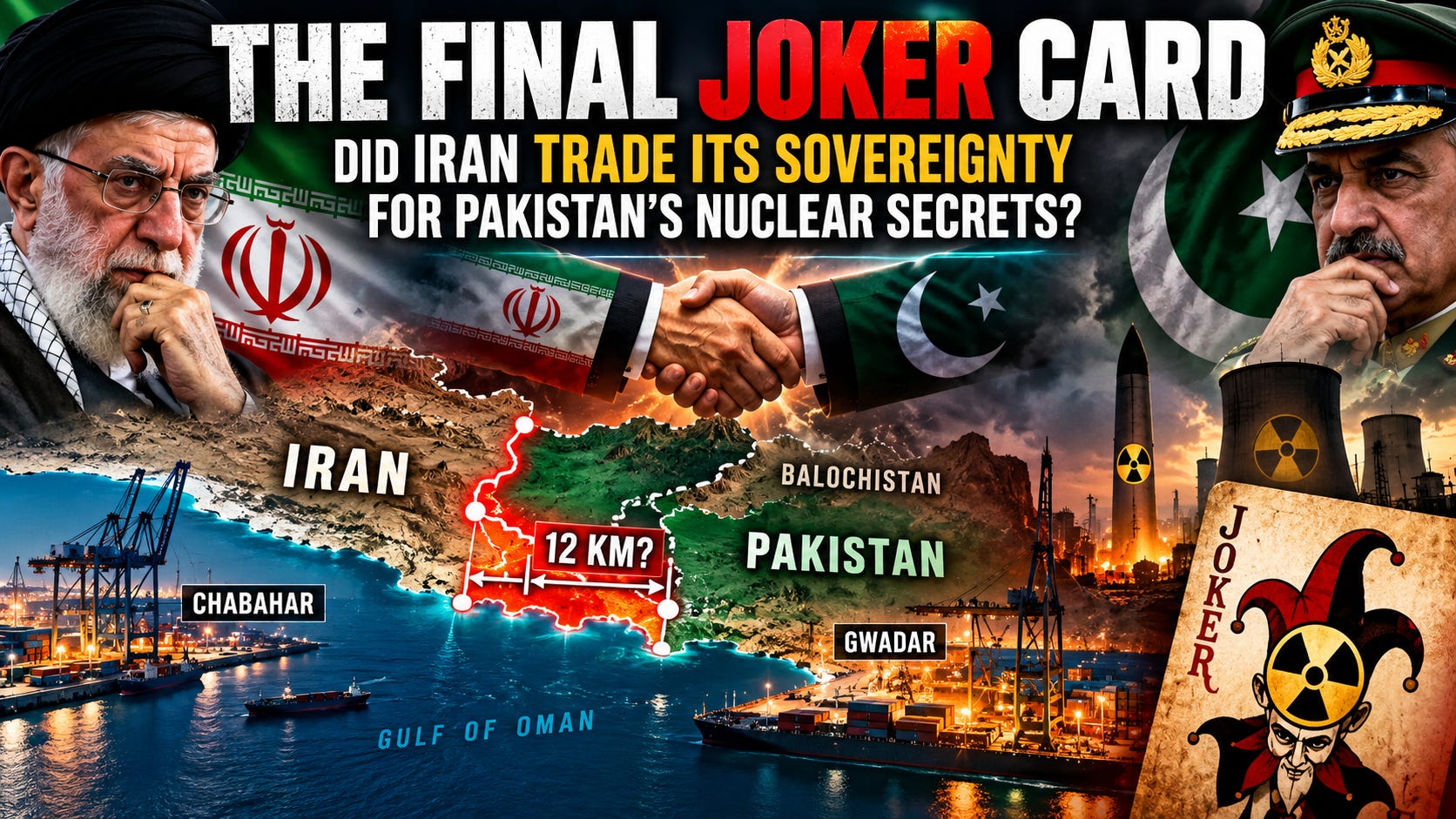
A remarkable allegation contained in a Persian-language political interview suggests that Iranian authorities secretly transferred a portion of Iranian coastal territory to Pakistan in exchange for nuclear-enrichment technology. The interview attributes the allegation to Ali Akbar Omid Mehr, a former Iranian Foreign Ministry official who publicly discussed sensitive relationships involving Iran and Pakistan.
If the allegation were substantiated, it would represent far more than a clandestine technology transaction. It would raise the possibility that national territory was treated as a bargaining instrument in the pursuit of political and military security.
The accusation has not been established by authenticated territorial records or agreements. Yet the broader historical foundation is real: Iran acquired sensitive nuclear technology through a proliferation network operated by Pakistani nuclear scientist Abdul Qadeer Khan.
The distinction between these two facts is essential. Nuclear cooperation is documented; the alleged territorial exchange remains unverified.
But this investigation does not end with the historical allegations. It follows the geography, money, military incentives, and strategic corridors connecting Iran and Pakistan, and asks whether an older nuclear relationship could have implications for the final phase of a modern geopolitical confrontation.
The central question is unsettling: Could Pakistan’s nuclear technology, or the strategic protection associated with a nuclear-armed neighbor, constitute the final joker card of an Iranian leadership determined to survive?
I. THE TERRITORY THAT MAY HAVE BEEN EXCHANGED
The interview begins its most significant historical allegation by referring to Ali Akbar Omid Mehr and his accounts of Iranian–Pakistani nuclear dealings during the late twentieth century.
According to the discussion, a portion of Iranian territory near the Pakistan border was allegedly transferred through an undisclosed arrangement in return for access to uranium-enrichment technology.
The speakers refer to approximately twelve kilometers of coastal territory, although the exact dimensions become inconsistent during the discussion. Another passage mentions an eight-hundred-meter measurement in connection with the same alleged transaction.
This inconsistency prevents the precise territory from being identified.
There is no authenticated transfer agreement presented, no historical survey demonstrating a corresponding change in the international boundary, and no publicly established legal instrument showing that Iranian sovereignty was transferred to Pakistan as payment for nuclear technology.
Nevertheless, the allegation is specific enough to invite investigation. It names a former diplomat, places the alleged transaction within a recognizable historical period, and connects it to a real technological relationship.
An investigation should therefore begin with the questions that an authenticated territorial claim must answer. What land was involved? Who authorized the arrangement? When did it occur? Was it a permanent transfer of sovereignty, a temporary concession, a commercial lease, or a disputed adjustment in boundary administration?
These distinctions are critical because a coastline measured in kilometers is not the same as an area measured in square kilometers. Nor is commercial access to a port equivalent to ownership of national territory.
If the claim is accurate, there should be consequences discoverable in administrative records, diplomatic communications, surveys, financing arrangements, or testimony from the officials involved.
If such evidence cannot be found, the allegation must remain unresolved rather than becoming accepted history through repetition.
II. THE PAKISTANI NUCLEAR CONNECTION WAS NOT IMAGINARY
To understand why this allegation deserves examination, we must return to the 1980s, when Iran sought to develop its centrifuge-enrichment capabilities.
Pakistan had already advanced substantially in nuclear technology through a program associated with Abdul Qadeer Khan. Khan’s international procurement and proliferation network eventually became one of the most consequential clandestine sources of nuclear technology in modern history.
Iran’s relationship with that network is documented.
According to historical investigations and International Atomic Energy Agency reporting, Iran received an offer in 1987 involving centrifuge-related technology, equipment, drawings, and specifications. Additional transactions occurred during the 1990s, including the acquisition of components and designs associated with Pakistani centrifuge technology.
Iran Watch’s historical research documents the 1987 offer and subsequent procurement activities. The International Atomic Energy Agency examined these transactions as part of its efforts to reconstruct the origins and development of Iran’s enrichment program.
These findings establish that sensitive technology reached Iran through foreign procurement channels connected to the Khan network.
They do not establish that Pakistan transferred an assembled nuclear weapon to Iran. They also do not demonstrate that every transaction was formally authorized by the Pakistani government.
That difference matters because nuclear enrichment technology, weapons-design knowledge, weaponized nuclear material, and a deployable nuclear bomb are separate capabilities.
Pakistan publicly conducted nuclear weapons tests in May 1998. Iran, despite its extensive nuclear development, has not been publicly verified as possessing an operational nuclear weapon.
The relationship between Iranian procurement networks and Pakistani nuclear expertise therefore offers a documented foundation for examining historical cooperation without making unsupported claims about a completed Iranian weapon.
And it raises the next question: if nuclear-related equipment and expertise were purchased through clandestine channels, what exactly was exchanged in return?
III. FOLLOW THE MONEY — WHO PAID FOR PAKISTAN’S NUCLEAR DEVELOPMENT?
One of the interview’s most consequential allegations concerns Iranian financial support for Pakistan’s nuclear ambitions.
The speakers attribute to Omid Mehr claims that Iranian oil revenues were used to support Pakistani nuclear activities and that cooperation between Iranian officials and Pakistani specialists went beyond ordinary procurement.
In this interpretation, Iran was not simply a purchaser. It was allegedly a financial participant expecting access to the capabilities produced through that investment.
The possible strategic incentives are understandable. Pakistan could have benefited from external financial resources, while Iran could have sought nuclear expertise, technical materials, and relationships otherwise difficult to obtain openly.
But identifying plausible incentives does not establish that the claimed financing took place.
Historical evidence of centrifuge-related purchases cannot automatically be expanded into proof that Iranian authorities financed Pakistan’s nuclear weapons program as a whole.
That broader allegation would require banking records, procurement contracts, government correspondence, identifiable financial intermediaries, or corroborated testimony establishing who paid whom, when, and for what purpose.
The importance of the question extends beyond the nuclear program.
Governments often use national revenues to purchase military equipment, intelligence capabilities, foreign assistance, and political influence. Such expenditures become especially controversial when public resources are concealed from independent oversight.
In a country with substantial energy wealth, the allocation of petroleum revenue is therefore central to understanding the relationship between state security and public welfare.
How much wealth was directed toward strategic survival? Who controlled the expenditures? Which individuals or networks profited? And what economic opportunities were sacrificed?
These questions remain important even if the alleged exchange of territory is never proven.
IV. GWADAR AND CHABAHAR — TWO PORTS, TWO STRATEGIC FUTURES
Geography makes the allegations particularly interesting.
Along the Gulf of Oman, two ports occupy positions of considerable strategic significance: Gwadar in Pakistan and Chabahar in Iran.
Gwadar forms an important maritime component of the China–Pakistan Economic Corridor, a network intended to strengthen commercial connections between Pakistan and China.
Chabahar provides Iran with a potential gateway connecting the Indian Ocean to Afghanistan, Central Asia, and wider Eurasian trade networks. Its location outside the Strait of Hormuz adds to its commercial and strategic importance.
Both ports occupy a region in which maritime access, road connections, rail infrastructure, energy shipments, and foreign investment can influence national development.
The interview emphasizes the strategic rivalry surrounding these locations and connects instability in Balochistan with larger economic competition.
Yet these ports also reflect different political and commercial relationships. China’s role in Gwadar is widely documented, while Chabahar has attracted particular attention through India’s efforts to establish regional transport connections.
Iran consequently occupies a geographical position from which it could participate in multiple international commercial networks rather than depend entirely on one geopolitical bloc.
This raises a fundamental national-development question.
Would Iran benefit more from functioning as an independent commercial bridge among competing economies, or from becoming strategically dependent on foreign powers seeking control over its routes and resources?
If Iranian coastal territory had actually been transferred to Pakistan, establishing its location would be indispensable to understanding the alleged transaction’s strategic value.
But no conclusion about territorial surrender can be drawn from port competition alone.
The significance of Chabahar and Gwadar is real. The supposed secret exchange of land remains an allegation requiring separate proof.
V. BALOCHISTAN — WHERE LOCAL CONFLICT MEETS GLOBAL COMPETITION
The Persian interview opens with reports of armed activity in Balochistan, disruptions affecting the Rimdan border crossing, difficulties involving commercial transportation, and attacks associated with the Baloch Liberation Army.
The speakers describe interruptions to fuel shipments and trade traffic, including trucks allegedly stranded near border crossings.
They interpret these developments as part of a broader struggle involving Pakistan, Iran, China, and the United States.
The argument is that destabilizing transportation routes can undermine major infrastructure projects, restrict commercial exchanges, and alter the strategic calculations of governments dependent on those routes.
There is an economic logic to that proposition. Transportation corridors generate revenue and create relationships among ports, producers, importers, shipping companies, construction firms, and governments.
Disruption can affect all of them.
However, Balochistan’s conflicts cannot be understood exclusively through competition among foreign powers. The region has longstanding grievances involving political representation, economic development, resource distribution, and relations with central governments.
The Baloch Liberation Army has carried out violent attacks against Pakistani security forces and civilian targets. Claims about the scale of particular operations, foreign sponsorship, or control over strategic routes require independent reporting and corroboration.
A foreign government benefiting indirectly from instability does not prove that it organized the instability.
The more useful question is who gains and loses access to the region’s infrastructure as conditions change.
China has invested in infrastructure connected with CPEC. Pakistan has an interest in protecting its territorial integrity and commercial development. Iran depends on secure eastern-border trade and has its own security concerns. Local communities have an interest in safety, employment, political rights, and access to economic opportunities.
The resulting conflict involves interests that overlap without necessarily being coordinated.
Understanding those interests is essential before attempting to connect Balochistan’s violence to an alleged secret nuclear arrangement.
VI. WHY NUCLEAR DETERRENCE BECOMES ATTRACTIVE TO A THREATENED GOVERNMENT
Nuclear weapons fundamentally change certain military calculations.
A country possessing credible nuclear retaliation capabilities may be able to discourage adversaries from attempting attacks that threaten its survival.
But the relationship between possessing nuclear weapons and ensuring political survival is neither automatic nor absolute.
Deterrence requires credible capabilities, functioning command structures, political communication, and the belief among adversaries that an unacceptable retaliatory cost could follow an attack.
Iran’s leadership has spent decades navigating confrontations involving sanctions, military threats, regional conflicts, and disputes over its nuclear program.
Against that background, the strategic attraction of nuclear capabilities can be understood even without assuming that Iran has decided to build a weapon or possesses one.
This is where the allegation involving Pakistan becomes especially consequential.
If Iranian authorities historically sought technology through Pakistani networks, could elements of those relationships have survived in some form? Could accumulated technical knowledge provide a pathway for rebuilding capabilities? Might foreign strategic relationships influence calculations made during an existential crisis?
These are legitimate questions, but the evidence examined here does not establish a present-day secret nuclear arrangement.
Pakistan’s possession of nuclear weapons does not imply a willingness to transfer them. Historical proliferation activity does not prove renewed cooperation. Nor does Iran’s nuclear expertise establish that a usable nuclear weapon exists.
The central distinction remains between what leaders might want, what technology makes theoretically possible, and what evidence demonstrates has actually occurred.
A government might seek a final deterrent. That does not mean it has obtained one.
VII. THE DEAD HAND — WHAT HAPPENS IF CENTRAL AUTHORITY COLLAPSES?
The interview introduces another dramatic allegation concerning military command and control.
Its speakers claim that Iran has established a decentralized arrangement dividing military authority among regional structures capable of operating if communication with the central leadership is interrupted.
They compare this alleged system to the Soviet and Russian concept commonly called Dead Hand.
Such comparisons can be misleading without clear technical distinctions.
Continuity-of-command planning is common in military organizations. Allowing local commanders to act under defined emergency conditions does not necessarily create an automated retaliatory system.
Russia’s reported Dead Hand arrangements concern strategic nuclear command. Iran has not been publicly established as possessing a comparable nuclear retaliation system.
The transcript does not provide authenticated military orders or technical documents substantiating its claims about an Iranian equivalent.
Nevertheless, the discussion raises a real strategic concern: what happens when command authority becomes fragmented during a severe national crisis?
If central institutions are damaged, regional commanders may face incomplete information, competing instructions, or rapidly changing circumstances.
Such situations can create risks of unauthorized military action, escalation, and prolonged insecurity.
The danger is not limited to nuclear weapons.
A fragmented command system involving missiles, conventional weapons, paramilitary units, and local security organizations could complicate efforts to end hostilities or establish political stability.
The interview’s allegations remain unverified, but the underlying issue of command continuity deserves attention because it affects both military security and the protection of civilians.
VIII. THE CORRIDOR GAME — WHO CONTROLS IRAN’S GEOGRAPHY?
Beyond the nuclear allegations, the interview develops a broader interpretation of global power.
It links the conflict over Iran to competing economic corridors, energy routes, maritime access, and the strategic interests of China, Russia, India, Europe, Israel, and the United States.
Its argument is that geography has become an increasingly important instrument of economic competition.
The China–Pakistan Economic Corridor offers China and Pakistan infrastructure connections through southwestern Pakistan.
The proposed India–Middle East–Europe Economic Corridor represents another commercial vision involving transportation and economic integration.
Iran’s own transport potential includes connections between the Persian Gulf, Gulf of Oman, Central Asia, the Caucasus, and markets farther north.
These systems differ in their development, financing, political obstacles, and commercial prospects. They should not automatically be portrayed as mutually exclusive or as elements of a single hidden master plan.
But their economic importance is substantial.
Trade corridors determine where ports expand, where factories are constructed, which countries collect transit revenues, and which regions attract investment.
They can create financial dependencies lasting for generations.
Iran’s geography gives it the opportunity to become a major commercial connection between regions. Yet that potential depends on political stability, infrastructure development, international trade access, and investment conditions.
It is therefore possible for competing governments and companies to have strong interests in Iran’s future without those interests proving a coordinated conspiracy.
The appropriate investigative method is to identify contracts, ownership structures, financing arrangements, and policy decisions.
Who controls the infrastructure? Who earns the revenue? Who carries the financial risk? Which communities receive the benefits? And who loses when access is disrupted?
These questions are more revealing than generalized accusations because they can be tested against records and measurable outcomes.
IX. THE ECONOMY OF PERMANENT CONFLICT
The interview advances a particularly troubling interpretation of Iran’s international isolation.
Its speakers suggest that certain external interests may benefit from a weakened Iranian state that continues to generate regional tension without developing into an independent economic power.
This is a hypothesis about incentives and outcomes, not established evidence of a coordinated plan.
Nevertheless, prolonged confrontation can produce identifiable beneficiaries.
Sanctions sometimes create profitable opportunities for intermediaries operating through complex commercial networks. Military insecurity generates spending on weapons, logistics, surveillance, and protective infrastructure. Energy disruptions can alter commodity prices and redirect trade.
At the same time, these developments create costs for ordinary populations, commercial businesses, and governments alike.
Sanctions also have stated foreign-policy and security objectives; not every economic benefit arising from a sanction establishes that the policy was designed to create that benefit.
To establish deliberate manipulation, investigators would need evidence connecting decisions to the particular economic interests alleged to have influenced them.
Still, the imbalance between those who make strategic decisions and those who bear their consequences deserves serious examination.
Iranian families do not determine the terms of every military confrontation. Pakistani workers do not control the strategic rivalry surrounding Gwadar. Residents of Balochistan cannot individually resolve disputes among governments and multinational investors.
Yet their livelihoods may be profoundly affected.
This is the deeper economic issue: decisions made in the name of national security can produce benefits concentrated among relatively small groups while distributing the resulting costs across entire populations.
Following the money remains essential, but following the consequences is equally important.
X. THE HIDDEN COST OF THE NEXT POLITICAL TRANSITION
The Persian interview eventually turns toward Iran’s future and the possibility that the country could emerge from prolonged confrontation burdened by new financial obligations.
Its speakers discuss reconstruction, compensation claims, foreign financing, and the possibility that major powers could influence Iran’s post-conflict economic arrangements.
These concerns should not be treated as proof that such agreements have already been negotiated.
Yet they identify a problem extending far beyond the question of who governs Tehran.
Any major political transition could leave unresolved obligations involving public debt, energy contracts, reconstruction financing, infrastructure ownership, military agreements, and compensation for wartime damage.
The terms of these arrangements could influence Iran’s economic opportunities for decades.
That makes national sovereignty more than the preservation of territorial borders.
Sovereignty also involves the ability of a population to determine how national resources are used, who may enter into binding agreements, and how public institutions remain accountable.
A government can retain formal control of its borders while accepting arrangements that limit future economic choices.
Conversely, international investment and commercial cooperation can strengthen national prosperity when agreements are transparent, mutually beneficial, and subject to effective oversight.
The essential distinction is between cooperation that serves a country’s people and dependency that primarily protects the interests of those controlling the negotiation.
If any historical transaction involving territory and nuclear technology were proven, it would have to be examined against this broader standard of public accountability.
XI. THE FINAL JOKER CARD — A WEAPON, A GUARANTEE, OR AN ILLUSION?
We now return to the central question.
Could the historical nuclear connection with Pakistan represent the final strategic reserve available to Iranian leaders?
There are several possibilities.
One is that the historical transactions were essentially procurement arrangements that transferred equipment and knowledge but created no enduring strategic guarantee.
Another is that individuals and networks developed relationships whose full extent has never been disclosed.
A third is that the perception of undisclosed capabilities continues to influence geopolitical calculations even where no corresponding operational capability has been demonstrated.
These possibilities must not be confused with one another.
A nuclear weapon is a physical capability requiring specialized material, technical infrastructure, and effective military control. A security guarantee is a political commitment whose credibility depends on the parties involved. Strategic ambiguity is an attempt to influence an adversary’s calculations without disclosing the full extent of a capability.
Each can affect decisions differently.
None should be assumed to exist without evidence.
The extraordinary allegation of Iranian territory being transferred to Pakistan is especially important because it suggests a possible exchange involving sovereignty itself.
But its seriousness is precisely why proof must come before conclusion.
A historical relationship with the Khan network is not evidence of a contemporary nuclear alliance. A nuclear-armed Pakistan is not proof of an Iranian emergency weapons reserve. And an accusation about a secret border arrangement cannot establish that any such transaction was completed.
The final joker card might be a hidden capability, a foreign political relationship, accumulated technical knowledge, or simply a belief among adversaries that undisclosed options remain available.
It is also possible that no such card exists.
The evidence must determine which explanation survives scrutiny.
XII. THE MOST IMPORTANT DISTINCTION — THE NATION IS NOT THE REGIME
A government may argue that protecting itself is necessary to protect the country. Sometimes the security of political institutions and national stability are closely connected.
But their interests can also diverge.
A political leadership may seek expensive military capabilities while citizens confront declining purchasing power, weak infrastructure, economic isolation, or limited public services.
A government may enter long-term strategic agreements that preserve its immediate position while restricting future economic decisions.
It may describe such measures as necessary sacrifices.
The democratic question is whether the population has meaningful opportunities to examine those sacrifices, debate their necessity, and hold decision-makers accountable.
National sovereignty cannot be reduced to the survival of whichever administration controls state institutions at a particular moment.
It includes the rights and long-term interests of the people who inherit the consequences.
Iran’s land, energy resources, cultural heritage, commercial potential, and future opportunities extend beyond any government or political movement.
They belong to the continuity of the nation.
The same principle applies to Pakistan and every other country involved in regional competition.
This is why the allegation at the center of the interview remains so important even before it has been proven.
It forces us to examine the boundary between protecting a state and protecting those who govern it.
And it demands that investigations into national security ask not only what was achieved, but what was exchanged to achieve it.
🩸 The Red Blood Perspective
The documented relationship between Iran and the A.Q. Khan proliferation network establishes an important historical fact: Iranian nuclear development involved clandestine access to sensitive technology supplied through Pakistani-linked channels. International investigations provide a substantial record of those activities, including transactions beginning in 1987 and continuing into the 1990s.
The allegation that Iranian territory was exchanged for nuclear expertise remains unverified. The dimensions and location described in the Persian interview are inconsistent, and no authenticated transfer agreement or independent border record has been established in the material examined.
That uncertainty should direct the investigation, not end it. The next steps are to identify the precise territory, verify the diplomatic testimony, trace the alleged financing, and examine the historical administrative record for evidence of territorial or commercial concessions. Any claim of continuing nuclear cooperation must be tested separately against contemporary evidence.
The broader geopolitical argument also requires discipline. The strategic importance of Gwadar, Chabahar, Balochistan, energy routes, and international trade corridors is real. But competing interests and indirect economic benefits do not alone demonstrate a coordinated secret operation.
The questions worth pursuing are those that leave observable traces: agreements, financial transfers, construction contracts, ownership records, military orders, changes in territorial administration, and identifiable decision-makers.
The final joker card remains an unanswered question: Has the pursuit of political survival ever led Iran’s rulers to exchange national sovereignty for a strategic capability, and could any part of that historical relationship still matter today?
The answer must come from evidence, not from the dramatic appeal of the theory.
🌊❤️✨ The Ocean of Love and Positivity Perspective
For decades, the relationship between nations has too often been described through the language of military superiority, strategic pressure, ideological conflict, and economic leverage.
Yet behind every border and every proposed trade corridor are people seeking safety, meaningful work, education, opportunity, and dignity.
The people of Iran and Pakistan have far more to gain from peaceful commercial development and transparent cooperation than from being placed in permanent confrontation. The communities of Balochistan deserve the opportunity to benefit from the economic importance of their region rather than experience that importance primarily through insecurity and violence.
Knowledge itself is not the enemy. Nuclear science, engineering, transportation infrastructure, and energy development can serve human progress when governed responsibly and directed toward constructive purposes.
The decisive question is what those capabilities are being used to protect.
Military security matters, but it cannot replace the social foundations of a flourishing country. Sustainable national strength also depends on accountable institutions, economic opportunities, public trust, and peaceful relationships with neighboring peoples.
No generation should inherit obligations negotiated without regard for its future. No country’s people should be treated as property belonging to a temporary political leadership. And no national resource should be regarded as expendable merely because its sacrifice might protect those currently holding power.
The greatest security any nation can achieve is not simply possessing a weapon that frightens its adversaries. It is building a society whose people have sufficient freedom, prosperity, dignity, and mutual trust to shape their future without permanent fear.
The nation is larger than its government. Humanity is larger than its conflicts. And the future belongs not to those who hold the strongest cards, but to those who recognize that human life is more valuable than the game itself.
REFERENCES AND HISTORICAL RECORD
Primary interview: Persian-language transcript supplied for this investigation, including the discussion of Ali Akbar Omid Mehr, alleged Iranian–Pakistani nuclear arrangements, Balochistan, military command, commercial corridors, and regional reconstruction.
International Atomic Energy Agency: Implementation of the NPT Safeguards Agreement in the Islamic Republic of Iran, September 2, 2005, GOV/2005/67. Historical examination of Iran’s centrifuge procurement and the 1987 offer involving foreign intermediaries.
Iran Watch: A History of Iran’s Nuclear Program. Historical account of nuclear development and procurement through the A.Q. Khan network.
Carnegie Endowment for International Peace: A.Q. Khan Nuclear Chronology. Historical chronology of the proliferation network and its international connections.
Arms Control Association: Timeline of Nuclear Diplomacy With Iran. Chronological background concerning Iran’s nuclear development and international responses.
U.S. Congressional Research Service: Historical assessments of Iran’s nuclear program, including clandestine procurement and the Khan network.
These sources support the historical account of nuclear procurement. They do not independently establish the alleged transfer of Iranian territory, the claimed financing of Pakistan’s entire nuclear weapons program, or a current secret nuclear-weapons arrangement.
🩸🌊❤️✨ — Ocean of Love and Positivity
Blood connects us. The ocean unites us. Love guides us. Positivity illuminates our path.