


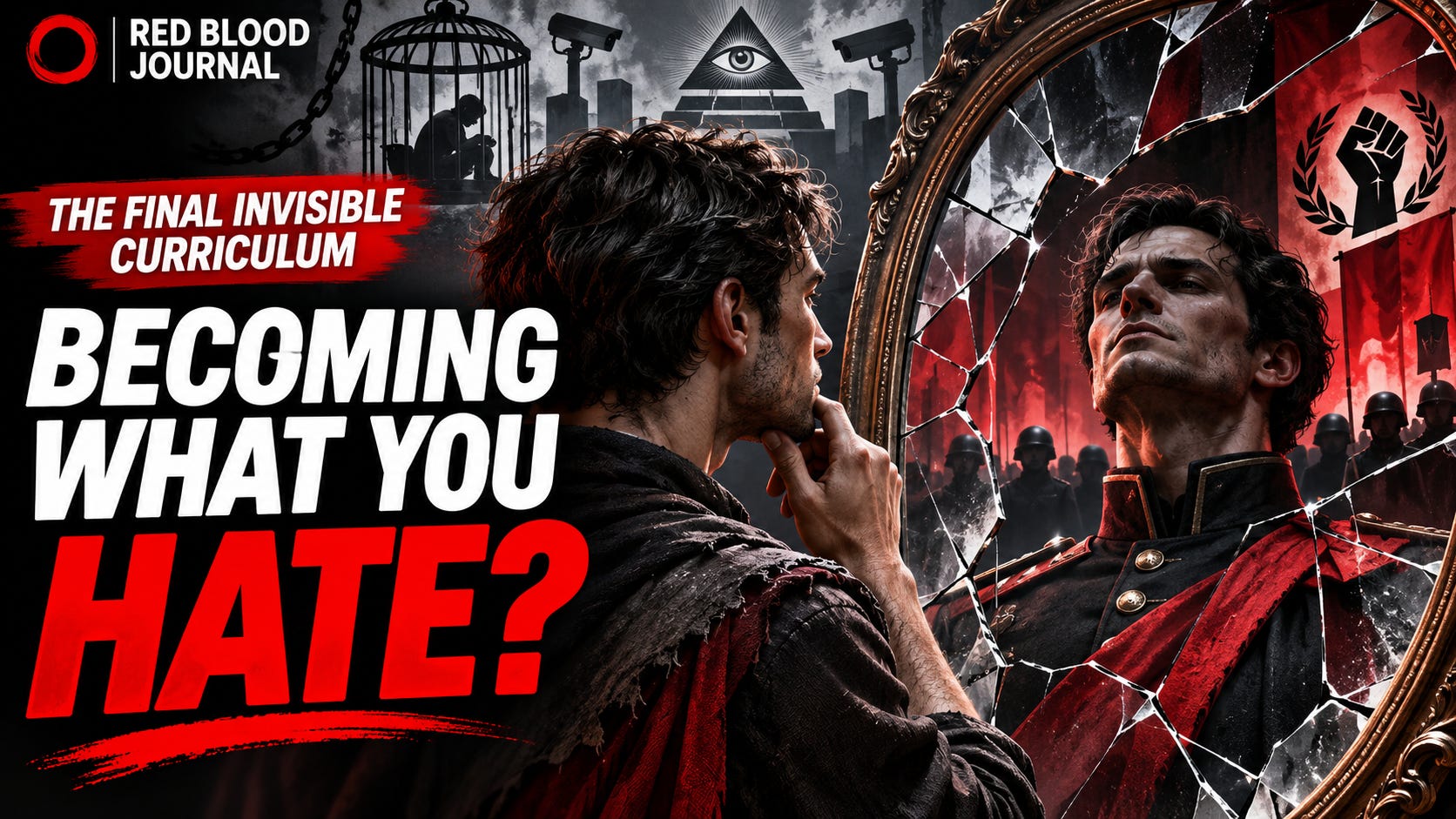
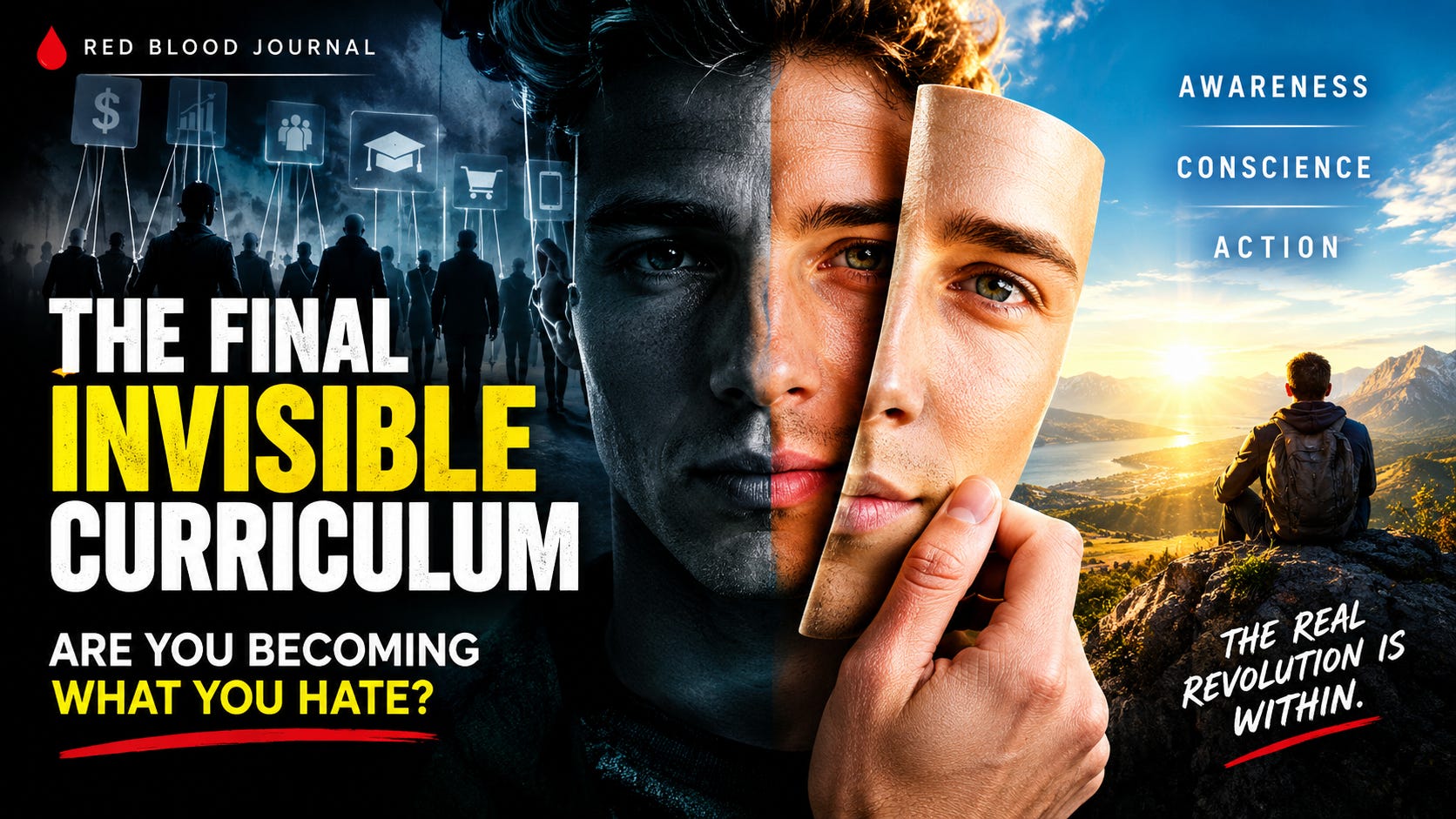
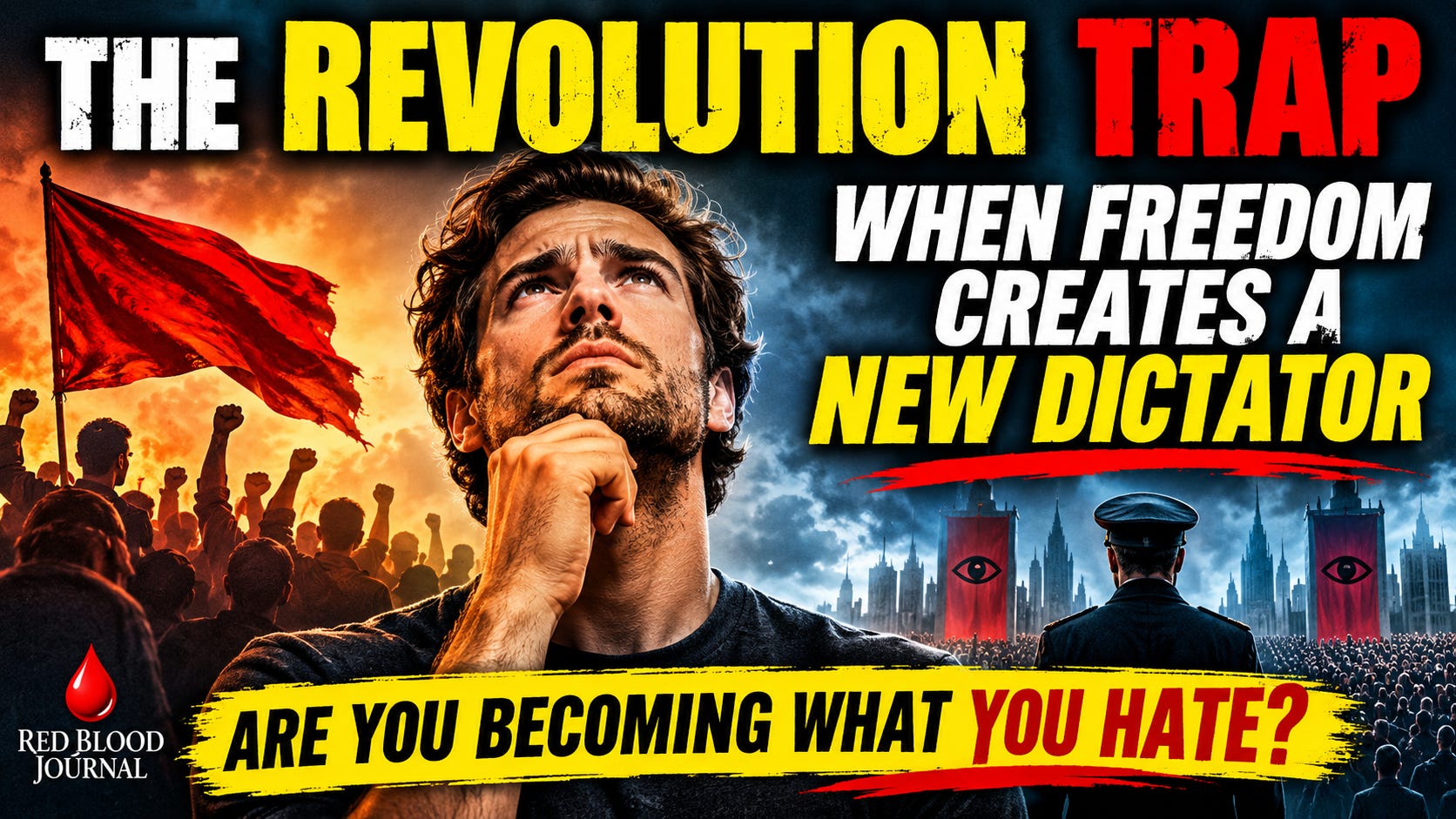
Two Paths to Freedom, One Forgotten Question: What Kind of Human Being Will You Become?
🩸 THE FINAL INVISIBLE CURRICULUM — WHAT IF YOUR REVOLUTION TURNS YOU INTO THE VERY THING YOU FOUGHT?
Two Paths to Freedom, One Forgotten Question: What Kind of Human Being Will You Become?
Red Blood Journal | November 4, 2026
By Red Blood
I. THE REVOLUTION THAT FORGOT ITS PURPOSE
Throughout human history, people have struggled against systems of authority, economic exploitation, political domination, religious coercion, and social conditioning. Revolutions have overthrown kings, governments have replaced empires, and new ideologies have promised to liberate humanity from the failures of their predecessors. Yet one disturbing question continues to follow these transformations: Why do so many movements that begin by opposing domination eventually develop their own mechanisms of control?
Perhaps the problem is deeper than the institutions themselves. Perhaps a revolution can change the identity of the ruler without changing the mentality of those who seek to rule. A person may spend years studying manipulation, understanding power, rejecting propaganda, and preparing to confront injustice, only to discover that the desire to defeat the oppressor has gradually become a desire to possess the oppressor’s power.
The danger is not limited to governments or revolutionary movements. It exists wherever individuals measure liberation primarily by their ability to control circumstances, influence others, accumulate resources, or defeat opponents. The person who once demanded freedom may eventually become someone who fears allowing others to exercise it.
This is the central question of our investigation: What happens when the pursuit of freedom becomes another invisible curriculum, teaching people to become more sophisticated participants in the very system they hoped to escape?
To examine that question, we compare two competing philosophies presented in a discussion titled The Invisible Curriculums with the philosophy of Red Blood Journal. Although all three perspectives criticize external conditioning, they offer different accounts of what freedom requires and what should happen after a human being becomes conscious of the forces shaping their life.
The objective is not to declare an ideological winner. It is to determine whether any philosophy of liberation can succeed without answering the question that should come before the struggle for power: What is freedom ultimately for?
II. THE FIRST INVISIBLE CURRICULUM: LEARNING TO WANT WHAT THE SYSTEM REWARDS
One of the most effective forms of social influence does not require constant threats, physical restraint, or direct censorship. It operates through habits, expectations, incentives, and definitions of success that become so familiar that people rarely examine their origins.
From childhood, individuals encounter systems of evaluation. Schools reward measurable performance, employers assess productivity, markets assign prices, social institutions confer status, and digital platforms transform attention into numerical indicators. These measurements can serve legitimate purposes, but difficulties arise when they begin determining a person’s entire sense of identity and worth.
The first philosophy presented in The Invisible Curriculums argues that external control becomes especially effective when people internalize the system’s standards and begin enforcing them upon themselves. Instead of continuously ordering individuals to pursue wealth, recognition, prestige, or consumption, institutions can reward those pursuits until they appear to be natural definitions of a successful life.
Consider a person who spends decades working to acquire a larger home, a more expensive vehicle, a prestigious title, and public recognition. None of those achievements is inherently wrong. The question is whether the person consciously chose them or simply inherited a definition of success that was never seriously examined.
A person may eventually achieve every goal that society encouraged while remaining uncertain about the purpose of those achievements. They may possess nearly everything they once wanted without understanding why they wanted it.
This is where the invisible curriculum becomes especially powerful. It does not merely influence what we do. It can influence what we believe we should desire.
However, there is an important distinction between identifying widespread conditioning and proving deliberate coordination. The fact that institutions reward particular behaviors does not establish that all those institutions are following a unified plan. Some incentives emerge through competition, established traditions, institutional convenience, or ordinary human behavior rather than centralized direction.
The existence of conditioning deserves investigation. Claims about who designed it, who benefits, and whether particular outcomes were intentional require evidence.
III. THE INWARD REVOLUTION: ESCAPING THE NEED FOR APPROVAL
The first manifesto proposes that genuine liberation begins when individuals stop allowing external rewards to determine their personal worth.
Under this philosophy, a person who no longer depends upon prestige, public approval, material excess, or social comparison becomes less vulnerable to manipulation through those incentives. When identity is no longer tied entirely to a salary, profession, social position, or political label, the individual gains greater freedom to make independent choices.
This is a powerful observation. Someone who does not need constant approval may find it easier to speak truthfully. Someone who can distinguish genuine needs from socially manufactured desires may become less vulnerable to manipulative advertising. Someone whose self-worth survives professional failure may make decisions guided by conscience rather than fear of embarrassment.
Yet the first manifesto introduces a weakness when it implies that internal independence can make an individual effectively untouchable by the outside world.
Inner freedom does not eliminate physical vulnerability, economic dependence, legal obligations, illness, or the consequences of institutional coercion. A person may reject materialism while still needing food, housing, medicine, transportation, and safety. They may possess extraordinary emotional independence while living under conditions that severely limit their practical choices.
A person can become less psychologically dependent upon a system without becoming materially independent of it.
This distinction matters because personal liberation should not become an excuse to ignore the circumstances affecting other people. Inner peace may help someone survive injustice, but it does not automatically remove the injustice.
The inward revolution therefore offers an important beginning, but it does not necessarily provide a complete destination.
IV. THE SECOND INVISIBLE CURRICULUM: THE REVOLUTIONARY WHO BECOMES A WEAPON
The second manifesto challenges the idea that inward independence is sufficient. It argues that self-examination can become another form of confinement if individuals withdraw into their private consciousness while leaving existing structures of power untouched.
Its criticism deserves attention. Awareness that produces no change in behavior can become a form of intellectual entertainment. A person may understand exploitation, discuss corruption, criticize manipulation, and describe social injustice without accepting any personal responsibility for the consequences of their own choices.
The second manifesto therefore proposes a different model: integrate inner mastery with practical competence and decisive external action. Its ideal individual is not merely someone who understands the world, but someone capable of building institutions, developing technology, managing resources, exercising influence, and confronting power.
At its strongest, this argument recognizes an essential truth: knowledge becomes socially meaningful when it informs decisions and behavior.
However, the manifesto moves into more dangerous philosophical territory when it describes inner awakening as something to be transformed into a weapon against existing structures. Its language emphasizes confrontation, insurgency, and the capacity to exercise formidable power.
The problem is not practical competence or resistance to injustice. The problem is the possibility of treating power itself as evidence of liberation.
A person may become extraordinarily capable at understanding economic systems, influencing political outcomes, developing technologies, and acquiring wealth while remaining motivated by greed, resentment, vanity, or domination.
A sophisticated understanding of control does not automatically produce a moral objection to using control.
This creates a profound contradiction. If the revolutionary’s ultimate achievement is acquiring the ability to dominate the institutions that once dominated them, the revolution may have changed the owner of the machinery without changing its purpose.
The former prisoner becomes the new warden.
V. THE SAME PRISON WITH A DIFFERENT WARDEN
History offers repeated reasons to question the assumption that overthrowing a powerful institution necessarily produces a more humane replacement.
The French Revolution challenged hereditary privilege and absolute monarchy but eventually passed through the Reign of Terror and the rise of Napoleon. The Russian Revolution promised liberation from autocratic rule and class exploitation, yet the Soviet political system subsequently developed extensive mechanisms of repression and centralized control.
These histories are complex, and neither case proves that all revolutions are destined to reproduce oppression. They do demonstrate that opposing an abusive system does not automatically equip its opponents to govern more ethically.
The essential problem involves incentives, institutional safeguards, accountability, and human character. Individuals who once demanded freedom may justify restricting it after acquiring authority. They may explain that extraordinary measures are necessary to defend the revolution, protect society, preserve stability, or prevent enemies from returning.
Such explanations cannot be accepted or rejected merely because of who offers them. They must be examined against observable actions, legal constraints, measurable consequences, and the rights of those affected.
A movement that promises freedom but refuses criticism should concern us. A leader who condemns concentrated power but removes independent oversight after gaining office should concern us. An institution that claims to protect humanity while denying individuals meaningful accountability should concern us.
The relevant question is not simply whether the new leadership possesses better intentions than the previous leadership. It is whether the new arrangement provides stronger protections against abuse.
Changing the person who holds power is not the same as changing the conditions that allow power to become abusive.
This is where both inward awareness and outward action must be subjected to a deeper ethical examination.
VI. THE RED BLOOD PERSPECTIVE: WHAT IF THE REAL REVOLUTION IS THE HUMAN BEING?
Red Blood Journal begins with a different question. Rather than asking who controls the world or how individuals can acquire enough power to challenge those controllers, it asks what human beings become when their attention is consumed by the external world.
From childhood onward, people acquire identities through nationality, religion, profession, political affiliation, financial status, education, and countless other classifications. These labels can help organize human relationships and communicate useful information, but they become dangerous when people mistake the labels for the entirety of who they are.
A person may identify so completely with a political movement that disagreement feels like a personal attack. Another may identify with wealth so strongly that financial loss feels like the destruction of the self. Someone else may become attached to professional authority and begin treating those without comparable credentials as less valuable human beings.
Red Blood Journal challenges this process because it can separate individuals from their conscience and from one another.
Its central message is not that governments, corporations, political movements, and economic institutions are irrelevant. These institutions affect human lives and deserve serious investigation. The question is whether examining external systems alone can resolve the human motivations that repeatedly reproduce exploitation, domination, and division.
The Red Blood approach places personal sovereignty at the beginning of meaningful transformation. It asks individuals to examine their desires, recognize their fears, understand their conditioning, and accept responsibility for how they treat other people.
Yet personal sovereignty does not mean freedom from responsibility. It means becoming capable of making conscious choices while recognizing the consequences those choices may impose upon others.
This distinction separates Red Blood from a philosophy of detachment and from a philosophy centered on confrontation.
The objective is neither to escape the world nor to conquer it. The objective is to participate in the world without surrendering conscience.
VII. THE QUESTION NEITHER REVOLUTION CAN AFFORD TO IGNORE
Imagine that a person studies every major instrument of political and economic influence. They learn how propaganda works, how financial incentives shape behavior, how technology can concentrate information, how institutions protect themselves, and how public opinion can be manipulated.
Eventually, they acquire sufficient resources and influence to challenge those institutions successfully.
What happens next?
If they use their knowledge to deceive competitors, suppress critics, exploit workers, accumulate privileges, or demand unquestioning loyalty, their previous struggle against domination has not made them fundamentally different from those they opposed.
The instruments may have changed hands, but the underlying mentality remains.
Now imagine another person who spends decades studying consciousness, developing emotional balance, rejecting material excess, and discovering an inner sense of peace. They understand suffering but refuse to intervene when intervention is reasonably possible, claiming that external circumstances no longer concern them.
Their awareness may be genuine, but it remains disconnected from responsibility.
These examples expose the weaknesses of both extremes.
Inner awareness without ethical action can become withdrawal. External action without ethical self-examination can become another expression of domination.
A more complete philosophy requires both, but it also requires something that competence and awareness alone cannot guarantee: a standard by which our choices can be judged.
That standard must include truthfulness, human dignity, compassion, accountability, and respect for the freedom of others.
Otherwise, the most disciplined revolutionary may become an efficient oppressor, while the most peaceful observer becomes a comfortable spectator.
VIII. THE THIRD PATH: AWARENESS, CONSCIENCE, AND ACTION
The opposition between looking inward and acting outward may itself be misleading.
Human life is not divided into two separate worlds in which personal awareness has no effect on society and social institutions have no influence on consciousness. Our beliefs shape our choices, our choices affect other people, and the institutions we create influence the next generation’s beliefs.
A meaningful approach to liberation therefore requires three interconnected stages.
The first stage is awareness. Individuals must recognize the forces shaping their desires, assumptions, fears, and definitions of success. This requires questioning political narratives, commercial incentives, social expectations, inherited beliefs, and even our own intuition. Neither official expertise nor private intuition should receive automatic authority; both can be tested against evidence and experience.
The second stage is conscience. Recognizing manipulation is insufficient if we do not examine our own willingness to manipulate. We must question whether our ambitions serve genuine human needs or merely reproduce our desire for recognition, superiority, revenge, or control. The more influence we acquire, the more important this examination becomes.
The third stage is action. Understanding must eventually influence conduct. This may involve resisting exploitation, supporting transparent institutions, demanding accountability, protecting civil liberties, helping vulnerable people, developing ethical businesses, or simply refusing to mistreat those over whom we exercise authority.
Not everyone must become a political activist or public revolutionary. A teacher, parent, employee, business owner, public official, engineer, or neighbor can practice meaningful responsibility within their own sphere of influence.
The significance of an action is not determined solely by its publicity, scale, or confrontation with authority. Small decisions can have lasting consequences when they become part of how people consistently treat one another.
The third path does not reject inner development or external engagement. It connects them through conscience.
IX. THE POWER TRAP: WHO BENEFITS WHEN WE LEARN TO FIGHT BUT NOT TO LOVE?
There is a troubling possibility worth examining. A society organized around competition may be perfectly capable of absorbing individuals who believe they have escaped its conditioning, provided they continue measuring success through superiority, accumulation, and victory.
A person may reject conventional employment only to become obsessed with entrepreneurial status. Another may abandon mainstream political narratives while developing an unquestioning allegiance to alternative commentators. Someone may reject consumer culture yet begin purchasing expensive products intended to demonstrate spiritual advancement or personal independence.
Even rebellion can acquire a market value.
This does not require a single organization secretly directing every development. It can emerge from recognizable commercial incentives, social competition, psychological needs, and the ability of institutions to adapt to changing consumer preferences.
If independence becomes another product, individuals may purchase the appearance of liberation while continuing to measure their lives through the same external standards.
The danger becomes greater when people begin identifying themselves as awakened, superior, or uniquely immune to manipulation. Such beliefs can discourage self-criticism and make individuals vulnerable to new forms of influence.
A person who believes they cannot be manipulated may become less likely to recognize manipulation when it occurs.
Red Blood Journal must apply this warning to itself as well. No publication, philosophy, movement, or community should be considered immune to the contradictions it identifies elsewhere.
If we criticize unquestioning obedience, we must welcome critical examination of our own claims. If we condemn dehumanization, we cannot justify dehumanizing ideological opponents. If we defend personal sovereignty, we must respect the ability of readers to disagree.
The purpose of questioning a system should not be to recruit followers into a new system that cannot be questioned.
X. HOW DO WE KNOW WHETHER WE ARE ACTUALLY BECOMING FREE?
Philosophical liberation becomes difficult to evaluate when it is defined entirely through private feelings or abstract declarations. A person may claim to be awakened, independent, compassionate, or morally transformed without demonstrating those qualities through observable conduct.
A practical approach should examine the relationship between stated values and actual behavior.
If someone claims to have escaped the worship of money, how do they behave when financial incentives conflict with their principles? If they claim to value truth, how do they respond when evidence contradicts a cherished belief? If they oppose censorship, do they also defend the right of peaceful opponents to express unpopular views?
If an individual condemns exploitation, do they apply that concern to workers, customers, family members, and strangers? If they celebrate human unity, do they preserve the dignity of people from different nations, religions, social classes, and political backgrounds?
These questions do not produce a perfect scientific measurement of consciousness. They provide something more useful for everyday ethical evaluation: an opportunity to compare declarations with conduct.
The same standard should apply to institutions.
Governments should be evaluated through their decisions, use of public resources, legal safeguards, treatment of citizens, and accountability. Corporations should be examined through ownership structures, compensation practices, pricing mechanisms, working conditions, consumer treatment, and environmental consequences.
Institutions should not be condemned merely because they possess power, nor trusted merely because they describe themselves as benevolent. Their claims should be compared with evidence, incentives, and outcomes.
The goal is not to abandon critical thinking in favor of love, nor to abandon compassion in favor of suspicion. It is to ensure that our search for truth does not destroy the humanity that makes truth worth pursuing.
XI. THE FINAL INVISIBLE CURRICULUM MAY BE OUR OWN
There is one possibility more unsettling than discovering that society has conditioned our desires.
What if we recognize that conditioning, reject it publicly, and then unconsciously construct a new version inside ourselves?
We may replace the need to be wealthy with the need to appear spiritually superior. We may exchange obedience to political authority for obedience to an alternative movement. We may abandon conventional status symbols while becoming attached to the identity of being more informed than everyone else.
The invisible curriculum survives because its deepest mechanism may not be a particular institution. It may be the human tendency to seek security through identification, comparison, superiority, and control.
This does not mean institutional power is imaginary or that individuals are responsible for every hardship imposed upon them. Economic structures, laws, coercion, discrimination, and unequal access to resources create real constraints that cannot be eliminated through personal reflection alone.
It means that changing external circumstances and examining internal motivations are complementary responsibilities.
A society needs protections against abuses of power. Individuals also need enough self-awareness to recognize when their own behavior begins moving toward the abuses they once condemned.
Without institutional accountability, conscience can be overwhelmed by concentrated power. Without conscience, institutions can be captured by individuals who learn to manipulate their safeguards.
Neither responsibility can replace the other.
XII. WHAT HAPPENS AFTER WE WIN?
Perhaps the most revealing question for any movement promising liberation is not how it intends to defeat its opponents, but what happens after it succeeds.
Will it tolerate disagreement? Will it protect the rights of minorities and dissenters? Will it distribute authority through accountable institutions? Will it permit independent scrutiny of its decisions? Will its leaders accept the same legal and ethical standards they demanded of their predecessors?
And beyond institutional arrangements, will its supporters continue seeing their opponents as human beings?
A victory that depends upon permanent enemies risks making conflict a permanent requirement of the new order. A movement that derives its identity entirely from defeating an adversary may struggle to explain its purpose when that adversary disappears.
Red Blood Journal proposes a different destination.
The purpose of awakening is not to prove that we are superior to those who remain conditioned. The purpose of recognizing injustice is not to acquire permission to practice injustice against others. The purpose of understanding human weakness is not to exploit it more effectively.
The objective is to become capable of choosing differently.
That choice may require courage, disagreement, sacrifice, civic participation, legal resistance, ethical business practices, or direct assistance to people in need. It may also require admitting that our own beliefs were mistaken.
Freedom is not the absence of all influence or dependence. Human beings live through relationships and shared institutions. A more realistic freedom involves the capacity to examine influences, exercise meaningful choices, respect others’ rights, and participate in shaping the conditions of our common life.
The revolutionary who cannot stop seeking enemies remains dependent upon conflict. The detached observer who refuses responsibility remains dependent upon others to maintain the world in which detachment is possible.
The person who combines awareness, conscience, and responsible action has a stronger foundation for meaningful independence.
🩸 THE RED BLOOD PERSPECTIVE
The strongest systems of control may not be those that conceal their existence, but those whose incentives and definitions of success become embedded in everyday life. Understanding those systems requires following observable decisions, ownership, money flows, institutional protections, and the material consequences experienced by ordinary people.
Yet understanding external systems is only half the investigation. We must also examine why human beings repeatedly reproduce the practices they claim to oppose. Corruption cannot be meaningfully challenged by replacing one unaccountable authority with another. Exploitation cannot be defeated by granting new exploiters greater power. Freedom cannot be established through a movement that demands obedience while claiming to oppose domination.
The challenge is to build institutions that limit abuses of authority while developing the personal responsibility necessary to use freedom ethically. This requires evidence rather than unquestioning belief, accountability rather than loyalty to personalities, and an understanding that the moral legitimacy of our actions does not come automatically from the injustices we oppose.
A revolution has not succeeded merely because the oppressed have acquired power. It succeeds to the extent that the conditions allowing oppression are reduced rather than reproduced.
🌊❤️✨ THE OCEAN OF LOVE AND POSITIVITY PERSPECTIVE
There is something profoundly human about the desire to become free. Yet freedom loses part of its meaning when we seek it only for ourselves, or when achieving it requires us to deny the humanity of others.
Looking inward should not separate us from the suffering of the world. It should make us more capable of recognizing that suffering without allowing hatred, fear, or resentment to determine our response. Understanding our own imperfections can help us recognize the possibility of change in others, even when we must firmly oppose harmful behavior.
Love does not require submission to injustice, and compassion does not require abandoning accountability. A person can resist exploitation while refusing to become an exploiter. A community can defend its rights while respecting the dignity of outsiders. A society can protect itself without making hatred the foundation of its identity.
Perhaps the greatest achievement is not becoming powerful enough to control everyone who once controlled us, but becoming wise enough to understand why control should never have been the ultimate purpose.
We do not need to wait until we have defeated every external injustice before practicing the humanity we hope to see in the world. Every conscious decision offers an opportunity to bring our values into our conduct.
The invisible curriculum teaches us to measure ourselves against other people. The inward revolution teaches us to question that measurement. The outward revolution teaches us that understanding must produce action.
The Ocean of Love and Positivity asks one final question: Can we make those actions an expression of conscience rather than another struggle for superiority?
That is where the next revolution begins.
FINAL THOUGHT: WHO WILL YOU BECOME?
Imagine reaching the end of your life after spending decades studying governments, exposing manipulation, acquiring wealth, challenging institutions, defending your beliefs, and struggling to become independent of other people’s control.
Perhaps you achieved extraordinary success. Perhaps you defeated powerful opponents. Perhaps you acquired everything the world once told you was valuable.
But suppose that, at the very end, you discover that you never seriously examined the person who wanted those victories.
Would you consider yourself free?
Now imagine a different life in which your awareness helped you become more truthful, more responsible, more compassionate, and more capable of improving the lives of others. Perhaps you never ruled an institution, accumulated a fortune, or defeated a powerful adversary. Yet your choices consistently reflected the values you claimed to believe.
Which life would represent the greater victory?
This is not an argument against achievement, ambition, political engagement, or material security. It is a challenge to examine the purpose behind them.
The final invisible curriculum is the belief that becoming powerful, successful, awakened, or victorious automatically makes us better human beings.
It does not.
What matters is what we become, what we do with what we learn, and how our choices affect the people whose lives intersect with ours.
The world may continue teaching us what to desire, whom to fear, what to purchase, and what success should look like. We may not be able to control every lesson offered to us, but we can become more conscious of which lessons we accept and which ones we pass on.
And perhaps that is where genuine freedom begins: not when we finally control the world, but when we stop allowing the desire to control it to determine who we are.
The real revolution is not the replacement of one master with another. It is the transformation of the human being who no longer wishes to become a master.
🩸🌊❤️✨ — Ocean of Love and Positivity
Blood connects us. The ocean unites us. Love guides us. Positivity illuminates our path.
SOURCE AND EDITORIAL NOTE
This essay was developed through a philosophical comparison of Red Blood Journal’s established editorial principles and the user-provided transcript titled 8260 — THE INVISIBLE CURRICULUMS. The transcript discusses two contrasting approaches to freedom: an inward revolution based on independence from external validation and a counterargument favoring integrated self-mastery and decisive external action.
The historical examples and institutional analysis are included as broader interpretive context. The philosophical positions are analyzed rather than treated as empirically proven theories. The transcript’s descriptions of anonymous manifestos and their origins have not been independently authenticated.
Publication classification: Philosophical analysis and social commentary.
📖
The Anatomy of Freedom and the Final Invisible Curriculum
Nov 4, 2026
The provided texts investigate how various philosophies of liberation and revolution frequently fail by merely replacing existing power structures with new forms of control rather than transforming human behavior. The sources contrast two common approaches—withdrawing into inner awareness versus pursuing outward power—arguing that both remain flawed when driven by a desire for superiority and dominance. True freedom requires a third path that bridges self-examination, ethical conscience, and responsible action to prevent individuals from unconsciously adopting the oppressive behaviors they once fought. Ultimately, the writing asserts that the true revolution is not about conquering external systems or becoming powerful, but about transforming the individual so they no longer wish to master others.