


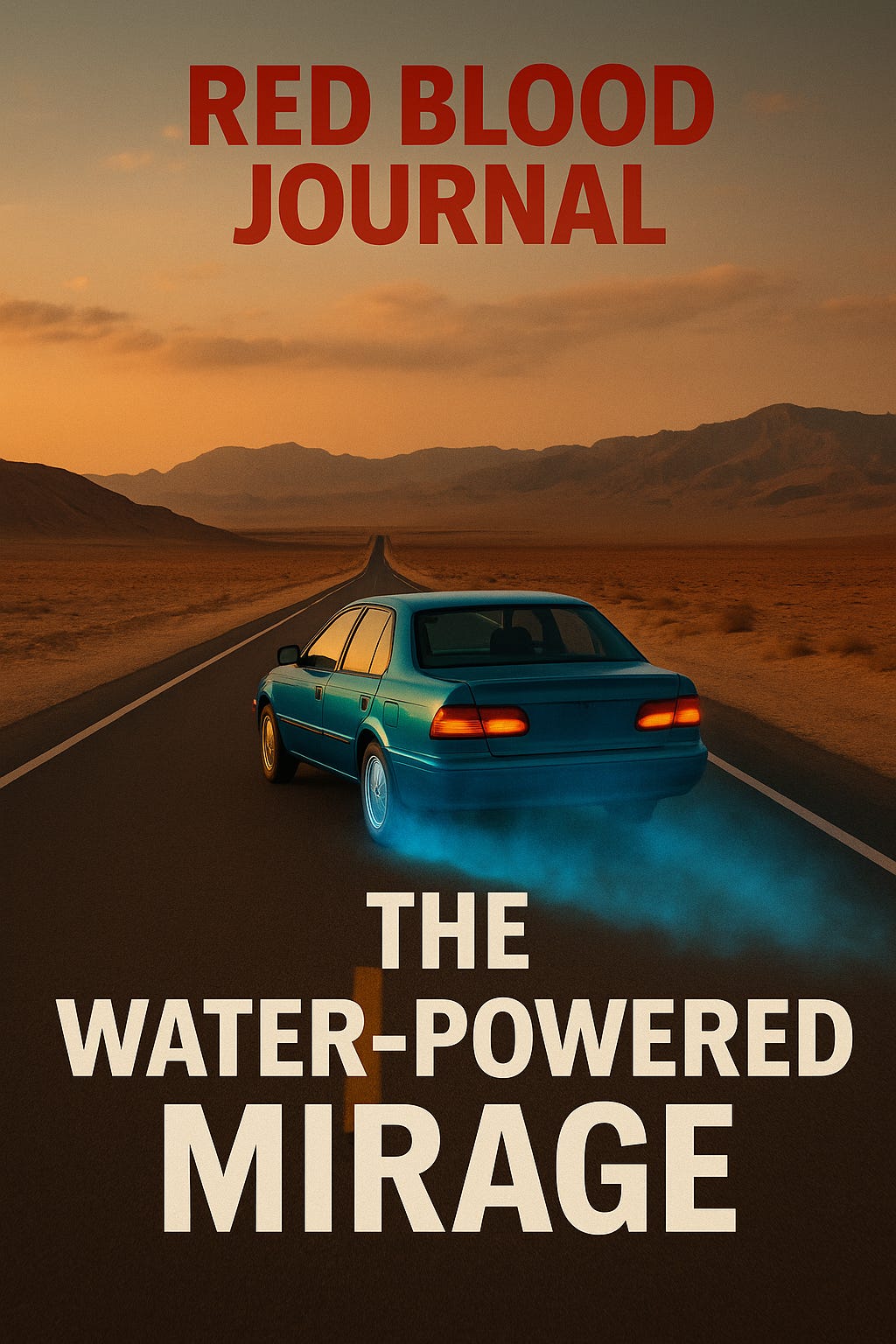
Iran’s “Water-Powered Car”: Miracle Energy or Media Mirage?
Red Blood Journal Investigative Feature
By Red Blood | October 2025
Introduction: The Claim That Defies the Engine
An Iranian inventor has shaken headlines with a claim as bold as it is unbelievable: a car that runs purely on water.
Dr. Alaeddin Qassemi, the scientist behind the project, insists his prototype can travel 900 kilometers on just 60 liters of water—no gasoline, no batteries, no pollution.
He says the system splits water into hydrogen and oxygen, burns the hydrogen to power the engine, and emits nothing but harmless vapor. The invention, he claims, can be installed on any regular vehicle “without changing its structure,” and could revolutionize Iran’s energy future.
But when science meets spectacle, questions start to boil.
A Man, A Machine, and a Promise
Dr. Qassemi first appeared in Iranian media around 2019, promoting what he described as “the world’s first Iranian water-fuelled engine system.” He promised that it would be commercialized within six months.
Local press outlets ran with the story, describing a “national innovation” that would free Iran from dependence on fossil fuels and global oil markets.
The idea was intoxicating: an Iranian-made breakthrough that could flip the global energy order. Some outlets even quoted Qassemi claiming that a single liter of water could produce “96 megajoules of energy”—three times more than gasoline.
No wonder it went viral. A car fueled by tap water sounded like a technological miracle wrapped in patriotic pride.
When Science Pushes Back
Yet when independent scientists examined the idea, they found problems that couldn’t be explained away by enthusiasm.
Splitting water into hydrogen and oxygen requires a large input of energy, often through electrolysis. The hydrogen produced can later be burned or used in a fuel cell—but the total energy returned is always less than what was required to split the water in the first place.
That’s not a conspiracy or an oil-industry cover-up. It’s basic thermodynamics.
You can’t get more energy out of water than you put in.
And without an external power source—solar panels, a high-capacity battery, or an electric grid connection—the process would yield a net energy loss.
In simple terms: water isn’t a fuel; it’s the ash left over after hydrogen has already burned.
Between Innovation and Illusion
Some inventors have claimed to improve efficiency by using catalysts or “hydrogen-on-demand” systems that supplement, rather than replace, gasoline. These can increase combustion efficiency but never eliminate the need for external energy.
That’s where Qassemi’s claim starts to look suspicious.
If his car really runs solely on water, where does the initial energy come from?
If it’s not from fuel or electricity, it would imply the creation of energy from nothing—an impossibility under known physical laws.
When journalists and independent engineers tried to verify Qassemi’s system, no public demonstration or detailed documentation surfaced. There were no peer-reviewed studies, no independent lab results, and no commercial prototypes.
In fact, some Iranian technology observers labeled the claim “a national embarrassment,” warning that the lack of evidence could damage Iran’s scientific reputation.
Why Such Stories Thrive
So why do these claims persist? Because they sell hope.
A car that runs on water speaks to powerful desires: energy freedom, economic independence, and the dream of escaping corporate or political control of fuel.
It also taps into a deep distrust of institutions—governments, oil companies, and scientific elites—who are often accused of hiding “free energy” technologies.
Inside Iran, where sanctions and fuel shortages have shaped daily life, Qassemi’s promise sounded like salvation.
For ordinary citizens, the story wasn’t just about physics—it was about pride and possibility.
But hope without proof can be dangerous. History is filled with “miracle engines” that ended in disappointment—or fraud. Investors lose money. Public trust in real science erodes. And genuine innovation gets buried under false prophets of perpetual motion.
Following the Trail: What Happened After 2019
Qassemi’s promised commercialization never materialized.
No factory lines, no government announcements, no working fleets.
Iranian news agencies that once covered his breakthrough quietly moved on.
His company’s public records are sparse, and no follow-up patents or engineering blueprints have been published. Some local technology blogs accused him of exaggeration or misrepresentation, though no formal legal action has been reported.
The silence speaks volumes.
A Larger Pattern: The Myth of “Free Energy”
From Stanley Meyer’s “water car” in the 1990s to fringe inventors across Asia and the Middle East, the promise of limitless fuel keeps resurfacing—usually just as the world faces another energy crisis.
The formula rarely changes:
a maverick scientist, a simple household resource, and a claim that “big energy” wants to suppress the truth.
Yet every time, the same brick wall appears: the laws of physics don’t budge for anyone.
What the Red Blood Journal Found
After tracing available documents, interviews, and archived media:
There is no verifiable test proving that Qassemi’s car can run exclusively on water.
No third-party validation exists, despite early claims of official certification.
No commercial production has followed the 2019 announcement.
Energy calculations show the claim contradicts known scientific principles.
In short: this story appears to be another addition to the long list of “water-fuel myths”—a blend of patriotic optimism, pseudoscience, and media repetition.
The Real Story Behind the Story
The real investigation here isn’t just about whether one Iranian car runs on water.
It’s about why people keep believing such claims.
Because beneath the fantasy of free energy lies a deeper truth: humanity’s desperate longing for liberation from the systems that control fuel, money, and power.
And in nations struggling under sanctions, scarcity, or corruption, that longing becomes fertile ground for miracle stories.
Whether Qassemi was a dreamer, a showman, or a fraud, he captured something real: our hunger to believe that someone, somewhere, has found the key to freedom.
Conclusion: The Engine of Imagination
The “water-powered car” may never exist as science, but it endures as symbol.
It represents the rebellion of imagination against the empire of limitation.
It speaks to the same spirit that once believed humans could fly, split the atom, or light the world from the sun.
But unlike those revolutions, this one remains chained by physics—and by the truth that some ideas, no matter how beautiful, simply don’t run.
#Iran #EnergyFraud #HydrogenCar #ScienceHoax #InvestigativeJournalism #RedBloodJournal #InnovationMyth #Pseudoscience #Thermodynamics #MediaManipulation
If it were revealed, they’d kill him.