


🩸 🇮🇷 🇺🇸 💰 ⚔️ ⛓️ 🌊❤️✨ — THE ECONOMY OF PERMANENT CONFLICT
Iran, America, Sanctions, Corruption, and the Financial Interests That Survive War
RED BLOOD JOURNAL — Investigative Report | October 23, 2026
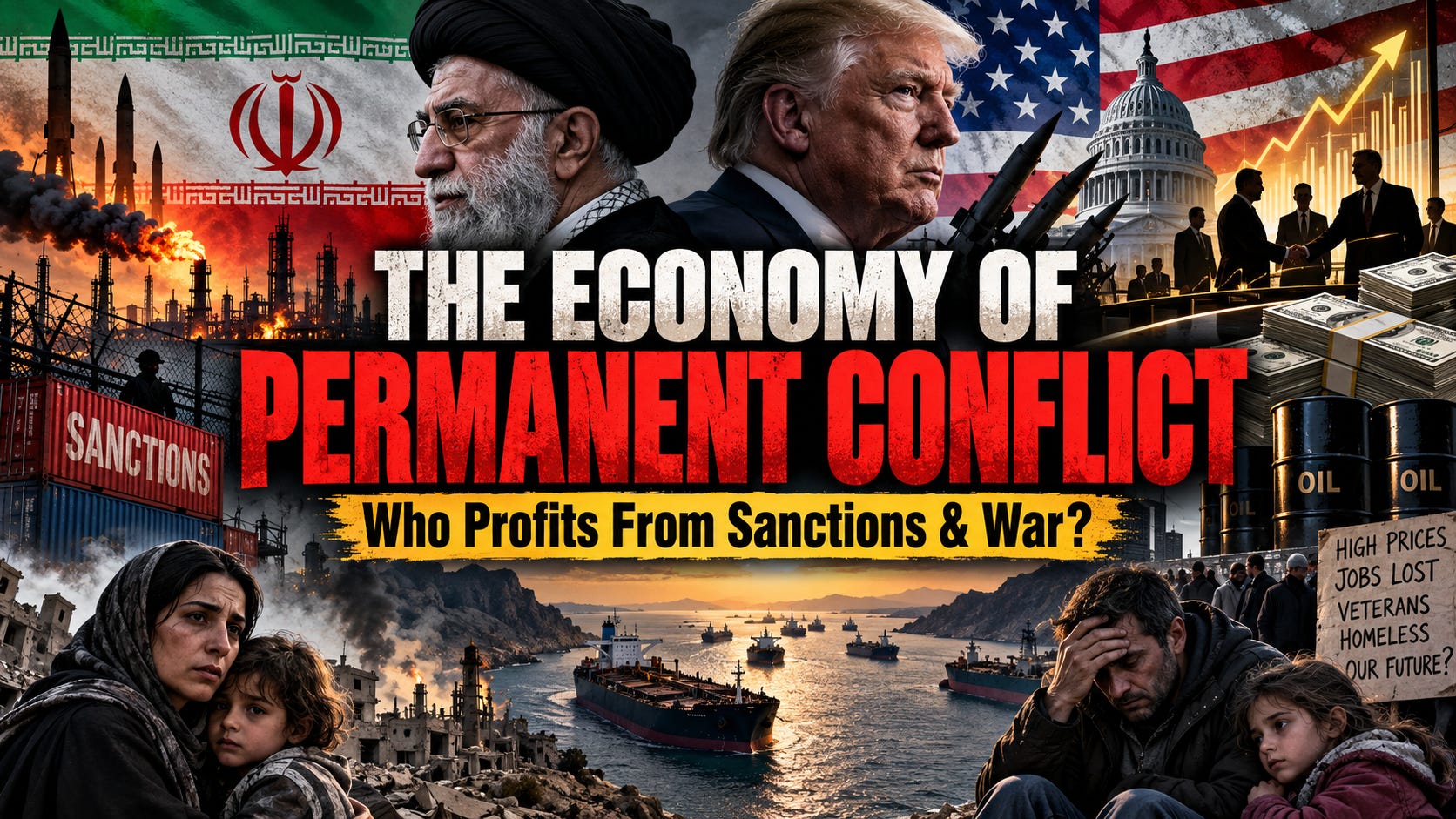
THE QUESTION NOBODY SHOULD STOP ASKING
WHAT IF SANCTIONS AND WAR IMPOSE THEIR GREATEST COSTS ON ORDINARY PEOPLE WHILE CREATING PROFITABLE OPPORTUNITIES FOR THOSE BEST POSITIONED TO CONTROL MONEY, TRADE, AND GOVERNMENT CONTRACTS?
The interview featuring Amir Farshad Ebrahimi raises questions extending far beyond the Iranian officials, business families, and financial relationships discussed in the conversation. It describes allegations of a political economy in which government positions, private wealth, family connections, and judicial influence overlap. Officials come and go, political factions compete, and investigations are announced, yet some of the financial relationships associated with power appear capable of surviving changes in leadership.
The United States operates under a different constitutional and judicial system, with stronger public disclosure mechanisms and established avenues for independent prosecution. Nevertheless, documented American corruption cases demonstrate that political authority can also be converted into private financial benefits. The comparison is not that the two governments are identical, but that both confront the danger of public decisions being influenced by private financial incentives.
The 2026 conflict involving Iran makes this comparison particularly relevant. Governments describe war in terms of national security, deterrence, sovereignty, and strategic necessity. Those considerations may be genuine, but they do not eliminate the financial consequences. Every military operation requires spending, every disrupted shipping route changes prices, and every economic restriction alters who can participate in trade.
The central question is therefore not simply who fights, or even who wins militarily. It is who receives the money generated by the conflict, who gains control over restricted commercial opportunities, and who bears the economic losses.
THE IRANIAN INTERVIEW: FOLLOWING THE RELATIONSHIPS
The interview discusses allegations concerning Ahmad Donyamali, including purported corruption cases involving municipal transactions, public resources, and unresolved judicial proceedings. It refers to alleged financial amounts of 18,000 billion, 10,000 billion, and 12,000 billion tomans, as well as a claimed aggregate of 68,000 billion tomans. The speakers also discuss Fatemeh Donyamali’s reported British company connections and speculate about political protection involving Mohammad Bagher Ghalibaf and Mojtaba Khamenei.
These are allegations made during the interview, not independently established findings. The transcripts contain automated transcription errors, and the judicial records, financial statements, beneficial ownership information, and case dispositions necessary to verify the claims have not been provided. The alleged aggregate cannot responsibly be presented as confirmed stolen money without reconciling the individual transactions and determining whether the figures overlap.
The discussion then broadens to the Modallal family’s alleged influence over essential food imports and agricultural distribution, and to Hossein Mohammad Pourzarandi’s reported roles across financial institutions, public organizations, commercial activities, and government-connected enterprises. The speakers suggest that the concentration of economic influence can become so significant that government authorities themselves may depend upon the businesses they are expected to regulate.
Whether every allegation is accurate remains an open question. But the underlying concern is economically important: when access to imports, public contracts, foreign currency, or distribution networks is concentrated, those controlling the access can acquire influence that ordinary market participants do not possess.
The interview also claims that wealth originating within Iran can travel through international investments, businesses, and property holdings, potentially financing political influence beyond Iran’s borders. Establishing such a connection would require actual transaction records and proof of beneficial ownership. Nevertheless, the question deserves investigation because control over financial flows does not necessarily end at a national border.
THE AMERICAN MIRROR: WHEN PUBLIC AUTHORITY BECOMES PRIVATE WEALTH
Corruption involving personal relationships, government authority, and outside financial interests is not exclusive to Iran. The American justice system has established examples through criminal investigations and convictions.
Former United States Senator Robert Menendez was sentenced in January 2025 to eleven years in prison following his conviction for bribery, foreign-agent, and obstruction-related offenses. Federal prosecutors documented a scheme involving cash, gold, a luxury automobile, mortgage-related benefits, private business relationships, and official actions benefiting associates and foreign interests.
The case demonstrates how access to influential political office can be exchanged for private advantages. It also demonstrates an essential institutional distinction: investigators brought charges, a jury returned convictions, and a federal court imposed sentences. The existence of corruption does not mean every part of the institution is compromised; effective accountability is part of the evidence as well.
A second American comparison involves the enormous volume of money moving through federal defense procurement. The Government Accountability Office reported approximately $10.8 billion in confirmed Department of Defense fraud for fiscal years 2017 through 2024. The agency warned that the full exposure remains unknown and identified persistent weaknesses in fraud prevention and financial management.
These findings do not establish that American defense companies are inherently corrupt. They demonstrate that the movement of public money on a massive scale creates opportunities for fraud when independent oversight is insufficient.
The similarities between the Iranian allegations and documented American cases concern the mechanisms by which private interests can seek preferential treatment. The differences concern the specific evidence, legal processes, institutional independence, and outcomes. Those distinctions matter because an investigation must determine not only whether corruption is alleged, but whether it is proved and what consequences follow.
THE SANCTIONS PARADOX: RESTRICTION CAN CREATE PRIVILEGE
Economic sanctions are intended to restrict resources and activities identified as threats by the governments imposing them. American sanctions against Iran have targeted oil revenue, financial transactions, designated individuals, shipping networks, and other economic channels associated with Iranian state policy.
Their effects, however, reach beyond the intended targets. When ordinary banking becomes difficult and major international companies withdraw, legal commercial activity can become more expensive or inaccessible. Smaller businesses may lack the relationships, legal resources, or financial reserves necessary to continue operating.
Restricted access creates another economic phenomenon. When fewer organizations can complete transactions, the remaining participants may gain bargaining power. Traders willing to handle sanctioned or high-risk commerce may demand larger discounts or fees, while businesses possessing privileged access to scarce foreign currency or imports may obtain advantages over competitors.
American government assessments have documented methods used to disguise Iranian oil transactions, including opaque ownership arrangements, vessel movements intended to conceal cargo origins, and complicated payment networks. These methods carry considerable legal and financial risks, but they also demonstrate how restrictions can redirect economic activity toward specialized intermediaries.
An Iranian exporter may receive less money for its product because the purchaser demands a discount. A foreign buyer may benefit from acquiring that product below prevailing international prices. Intermediaries may receive compensation for arranging transportation, payments, and delivery. Meanwhile, ordinary manufacturers and merchants unable to use such networks may lose access to essential trade.
The consequence is a potentially unequal distribution of economic opportunity. Sanctions can weaken the broader economy without necessarily eliminating the commercial advantages enjoyed by every politically connected participant.
This does not prove that particular individuals named in the Iranian interview profit from sanctions. That connection requires a verified trail of payments, contracts, ownership records, and commercial relationships.
THE WAR ECONOMY: WHEN DESTRUCTION BECOMES DEMAND
Military conflict generates immediate requirements for missiles, defensive interceptors, aircraft maintenance, communications equipment, replacement components, logistics, and ammunition. Governments purchase this equipment from private and public-sector suppliers, often under conditions of heightened urgency.
In July 2026, Lockheed Martin and RTX raised their financial forecasts amid increased demand associated with military procurement and replenishment. Lockheed Martin reported approximately $230.4 billion in outstanding orders, while RTX reported $289 billion across its businesses. RTX’s backlog included $170 billion in commercial aerospace and $119 billion in defense business.
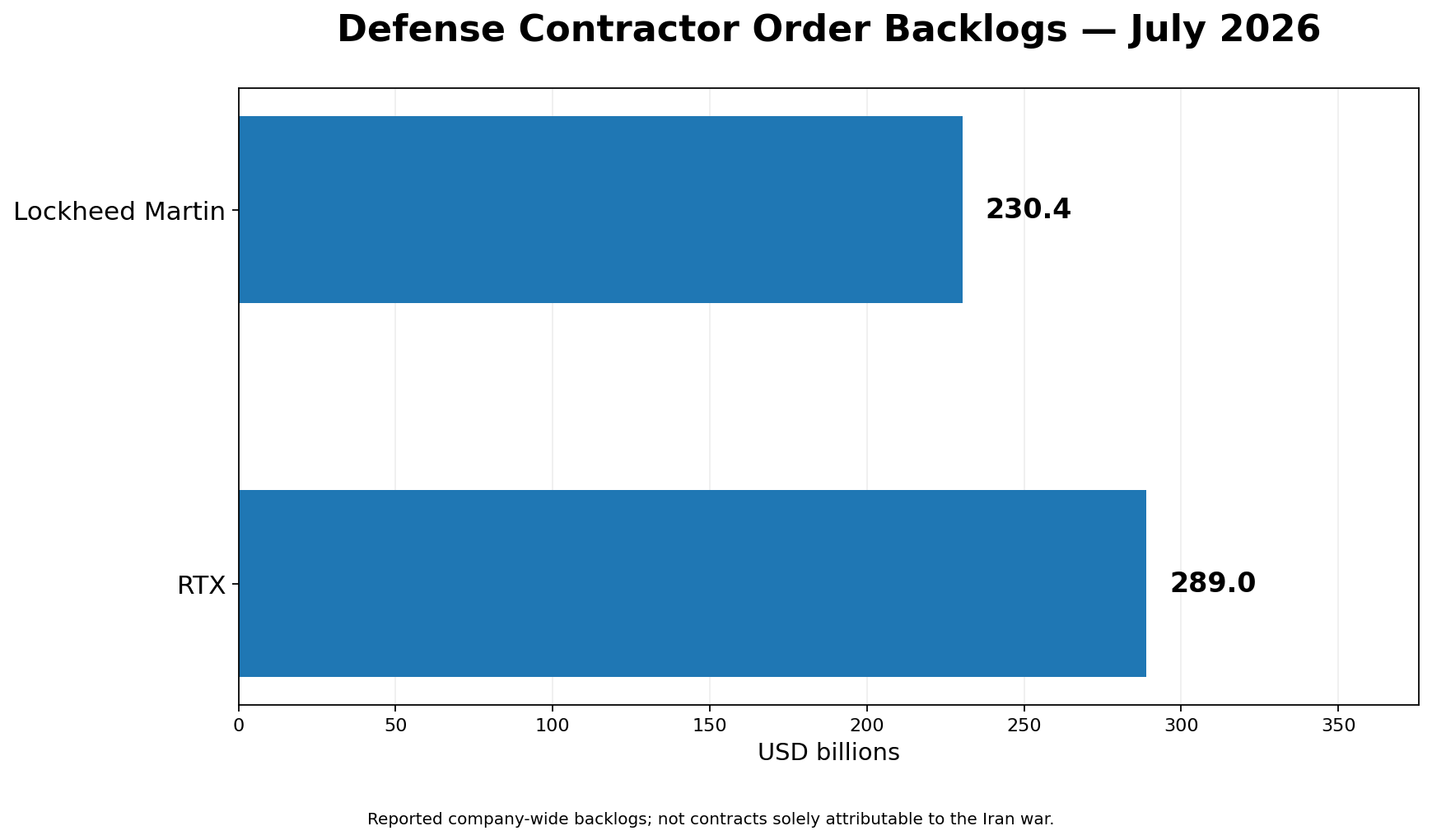
DEFENSE CONTRACTOR ORDER BACKLOGS
These numbers represent company-wide orders accumulated across multiple customers and programs, not revenue derived exclusively from the Iran conflict. That distinction is essential. The figures demonstrate the scale of expected business activity, but they cannot be used to calculate how much profit either company earned specifically because of the war.
The economic mechanism remains clear. Military operations consume equipment, governments allocate funds to replace it, and manufacturers receive additional commercial opportunities. Some of those revenues support necessary defense capabilities and employment; others may result in additional corporate earnings.
The question for public accountability is not whether receiving a defense contract constitutes wrongdoing. It is whether the contracts were competitively awarded, fairly priced, adequately supervised, and free from improper influence.
A company can legitimately profit from supplying national defense needs. Corruption occurs when procurement decisions are improperly manipulated for private benefit.
THE STRAIT OF HORMUZ: A GLOBAL ECONOMIC PRESSURE POINT
The financial consequences of the conflict extend well beyond the defense industry. International energy markets depend upon shipping routes that connect producing countries with refiners and consumers around the world. The Strait of Hormuz is among the most important of those routes.
According to the United States Energy Information Administration, average daily oil flows through the strait declined from approximately 21.6 million barrels in the fourth quarter of 2025 to 4.9 million barrels in the second quarter of 2026.
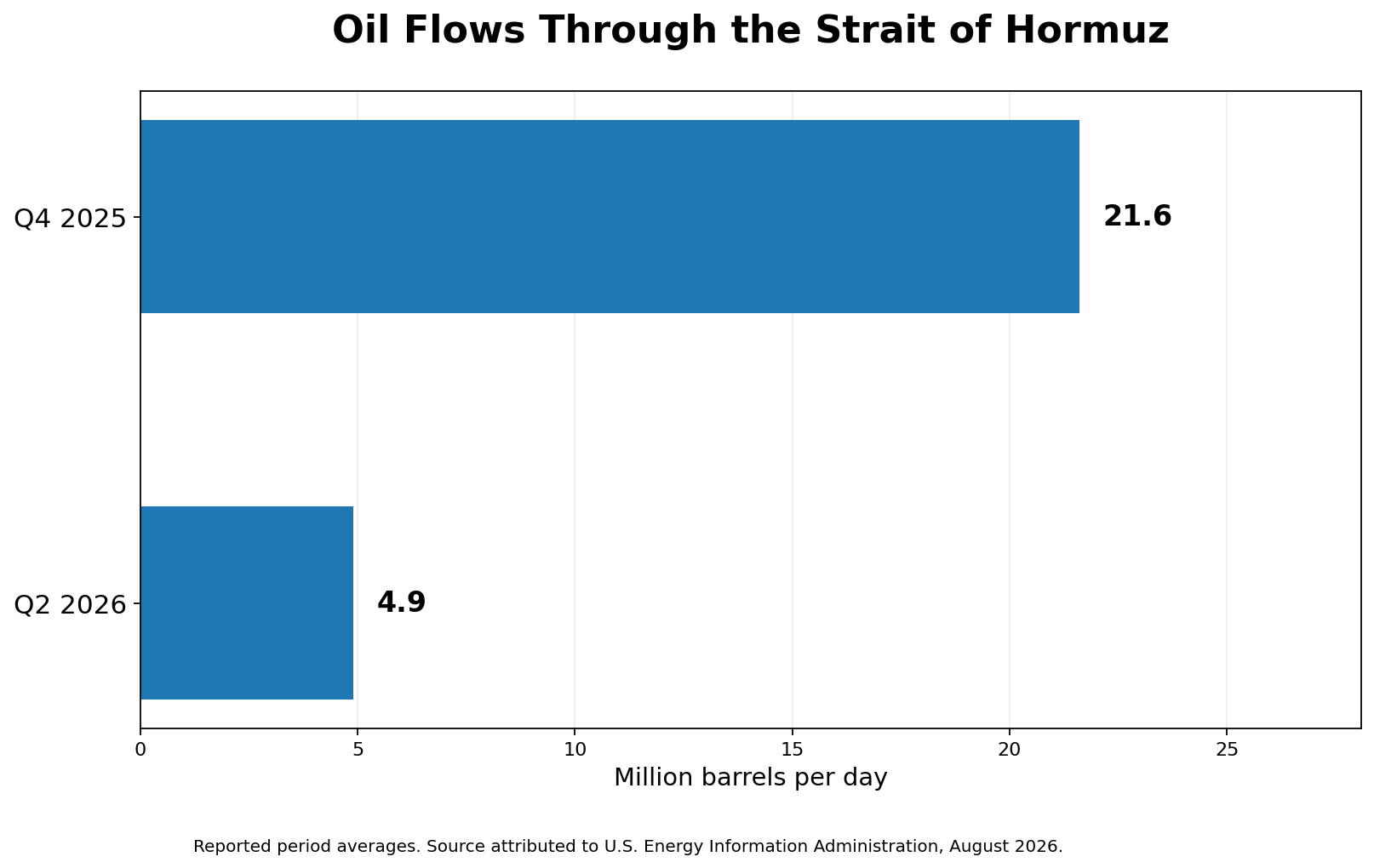
OIL FLOWS THROUGH THE STRAIT OF HORMUZ
The reduction illustrates the scale of the disruption. When shipping becomes dangerous or restricted, transport costs increase, insurers reassess risk, buyers seek alternative supplies, and refiners may face difficulty obtaining the crude oil they require.
The Energy Information Administration documented substantial volatility in oil prices during the second quarter of 2026, including periods when Brent crude exceeded $100 per barrel. It also reported that disruptions encouraged international buyers to seek alternative petroleum supplies, increasing American refinery margins and exports.
On October 23, Brent crude settled at approximately $116.72 per barrel amid renewed regional supply concerns. Higher prices create opportunities for producers able to maintain output, but they also increase expenses for consumers and businesses that depend on petroleum products.
Oil producers outside disrupted regions may receive greater revenue for each barrel sold. Refineries with favorable access to supplies may enjoy improved margins. Shipping providers operating on alternative routes may receive additional business. Yet exporters unable to transport their products can lose substantial revenue even when world prices rise.
Thus the same event may generate financial gains for certain energy businesses while damaging the economies of the countries closest to the conflict.
WHO BENEFITS FROM SANCTIONS AND WAR?
The beneficiaries are not a single organization or nationality. They occupy different positions within the economic system.
Some defense manufacturers receive additional orders as governments expand or replenish military inventories. Certain oil producers benefit from higher international prices. Some refiners obtain improved margins, while others suffer from expensive feedstocks. Specialized traders and shipping intermediaries may receive additional compensation for handling restricted or difficult commerce.
On the Iranian side, individuals or enterprises possessing privileged access to imports, foreign currency, government purchasing, or international payment channels may be better positioned than ordinary competitors. The interview alleges that politically connected commercial families occupy important positions within such economic networks, although the precise financial benefits and alleged misconduct require independent proof.
Some foreign buyers may also gain from the discounts associated with sanctioned Iranian oil. This creates a complicated situation in which Iranian sellers can lose part of the market value of their exports while selected purchasers and intermediaries capture portions of the difference.
Meanwhile, the American government may gain diplomatic or strategic leverage through sanctions. That is not the same as private financial profit. Sanctions can also impose costs on American businesses, weaken international commercial relationships, and require substantial enforcement resources.
The resulting picture is not one in which every powerful participant profits. It is one in which costs and opportunities are distributed unequally.
WHO LOSES? THE PEOPLE WHO FINANCE THE CONSEQUENCES
For American households, war can appear first as a higher gasoline price, followed by increased expenses for transportation, groceries, deliveries, utilities, and other necessities. Energy costs enter nearly every stage of the supply chain, from agricultural production to commercial shipping.
Taxpayers also carry the burden of financing military operations and replacing depleted equipment. When those expenditures are financed through borrowing, interest costs can extend into future years. The full economic burden includes more than the Pentagon’s direct spending: it includes higher consumer prices, disrupted investment, insurance costs, and economic uncertainty.
For Iranian households, the pressures are often more severe. Sanctions, currency depreciation, restricted trade, domestic economic mismanagement, damaged infrastructure, and conflict-related disruption can combine to reduce purchasing power and employment. Families earning local-currency wages may struggle to preserve their standard of living while essential imports become more expensive.
A wealthy person holding foreign property or financial assets may be better insulated from domestic inflation than a worker dependent entirely on local wages. The interview’s discussion of overseas wealth is relevant to precisely this inequality, although foreign ownership alone is not proof of corruption.
Small businesses in both countries also face difficult conditions. Iranian enterprises may encounter restrictions on banking and imports, while American transportation companies, retailers, manufacturers, and service providers confront higher operating expenses and uncertain demand.
The burden ultimately travels through the economy to people who had no direct role in choosing the policies or initiating the conflict.
WHEN ECONOMIC ADVANTAGE BECOMES POLITICAL INFLUENCE
A more difficult question emerges when financial beneficiaries also possess political influence. Businesses naturally seek stable regulations, access to markets, and predictable government decisions. But economic incentives can create conflicts when those who stand to gain from a policy also influence the officials making it.
In Iran, the interview alleges that private commercial relationships and state-connected institutions have become sufficiently intertwined to protect certain individuals from ordinary accountability. In the United States, documented bribery cases demonstrate that private interests have at times successfully purchased access to public decisions.
Wartime procurement and sanctions enforcement create particularly sensitive environments because governments may invoke urgency, confidentiality, and national security to justify restrictions on ordinary commercial procedures.
Sometimes secrecy is legitimate. Sometimes rapid purchasing is necessary. But the justification for those exceptions must remain subject to independent scrutiny, because reduced transparency can make misconduct harder to detect.
A credible investigation must therefore identify actual contracts, beneficial owners, pricing arrangements, political relationships, and legal decisions. Broad accusations about hidden financial power are insufficient without evidence connecting specific individuals to specific transactions.
DO THE TWO SIDES BENEFIT FROM THE SAME CONFLICT?
The existence of profitable opportunities on opposing sides of a conflict creates an uncomfortable economic reality. A business can earn money supplying weapons to one country while an unrelated company earns money arranging restricted trade for another. Both may gain revenue from conditions that impose serious losses upon the public.
That does not establish that the businesses secretly cooperate or that governments deliberately sustain the conflict to enrich them.
Parallel incentives are not proof of coordination. To establish a common financial arrangement, an investigation would need documentary evidence of shared ownership, coordinated decisions, concealed payments, common intermediaries, or communications demonstrating intent.
Nevertheless, the absence of proven coordination does not eliminate the financial incentives themselves. The incentives are real enough to warrant examination, particularly when policies continue to produce concentrated commercial opportunities alongside widespread public costs.
The question should therefore remain focused on observable actions: who signed the contracts, who received the payments, who approved the transactions, what oversight existed, and what consequences followed.
THE REAL MEASURE OF ACCOUNTABILITY
An effective investigation must go beyond identifying corporations whose revenues increased or government officials whose relatives own businesses abroad. Neither condition automatically establishes corruption.
The decisive issue is whether public authority was used unlawfully or improperly to confer private financial advantages.
For the Iranian allegations, this requires obtaining judicial documents, government contract records, company registrations, ownership disclosures, and verified evidence of financial transfers. For the United States, it requires examining procurement decisions, fraud findings, conflict-of-interest disclosures, political contributions, and government audit results.
For sanctions, the most important task is tracing the value of transactions from the original seller through intermediaries to the final purchaser. Differences between sale prices, discounts, shipping charges, commissions, and actual receipts may reveal where economic advantages accumulate.
For war-related spending, contract values must be distinguished from corporate revenue, profit, and actual payments. Without those distinctions, even accurate numbers can produce misleading conclusions.
The goal is not to assume corruption wherever money changes hands. It is to identify where private gain and public duty intersect, and whether the resulting decisions withstand independent examination.
🩸 The Red Blood Perspective
The Iranian interview alleges a system in which politically connected individuals, family wealth, government institutions, and unresolved corruption cases overlap. Documented American cases demonstrate that public officials can also exchange political influence for private benefits, while federal audits identify substantial weaknesses in the management of defense-related public money.
Sanctions can limit ordinary economic participation while increasing the value of specialized access to trade and financial channels. War can increase orders for defense equipment, alter energy prices, and expand commercial opportunities for certain producers and intermediaries. None of those outcomes independently proves that beneficiaries engineered the conflict, but each provides a concrete financial relationship that can be investigated.
The central distinction is between those who control economic decisions, those who receive the resulting payments, and those who bear the costs.
The evidence does not establish that American and Iranian financial interests jointly created the conflict. It does establish that economic suffering and commercial gain can coexist, even on opposite sides of a war.
The proper response is to follow the money through verifiable records, not to substitute suspicion for proof or official assurances for accountability.
🌊❤️✨ The Ocean of Love and Positivity Perspective
War and sanctions are often discussed through the language of borders, governments, armies, and strategic objectives. Yet their consequences reach ordinary human lives, including families struggling to afford food, workers facing uncertain employment, and communities forced to divert resources from education, health, and development.
Recognizing the economic incentives surrounding conflict does not require assuming that every public official, soldier, business owner, or investor acts from greed. It requires acknowledging that institutions should be designed to prevent private interests from overriding the well-being of the people they serve.
Independent auditing, transparent government purchasing, protection of humanitarian commerce, fair enforcement of corruption laws, and credible opportunities for peaceful resolution can reduce the risk of unaccountable enrichment.
An Iranian family and an American family should not have to bear avoidable economic suffering while influential interests escape meaningful scrutiny.
A peaceful future cannot be built solely by changing the faces of those holding office. It also requires institutions that make public resources accountable to the public and that place human dignity above personal enrichment.
The measure of progress is not how much money an economy can generate through conflict, but how effectively it can preserve life, opportunity, fairness, and human well-being without requiring conflict.
🩸🌊❤️✨ — Ocean of Love and Positivity
Blood connects us. The ocean unites us. Love guides us. Positivity illuminates our path.
📊
The Economy of Permanent Conflict
Oct 23, 2026
The provided investigative report examines the complex political economy of war and sanctions, exploring how global conflicts and economic restrictions consistently impose heavy financial burdens on ordinary citizens while generating lucrative opportunities for well-positioned intermediaries, defense contractors, and politically connected elites. It analyzes allegations of corruption within Iran’s ruling network alongside documented American examples of defense procurement fraud and political bribery, demonstrating that both nations struggle with the conversion of public authority into private wealth. Furthermore, the text explains how economic sanctions inadvertently create privileged commercial advantages for those willing to navigate high-risk trade networks, driving up costs for everyday consumers. Ultimately, the sources emphasize that while these parallel financial gains do not prove active coordination between opposing sides, they underscore the urgent need for independent oversight, transparent governance, and rigorous accountability to ensure human well-being prevails over personal enrichment.