


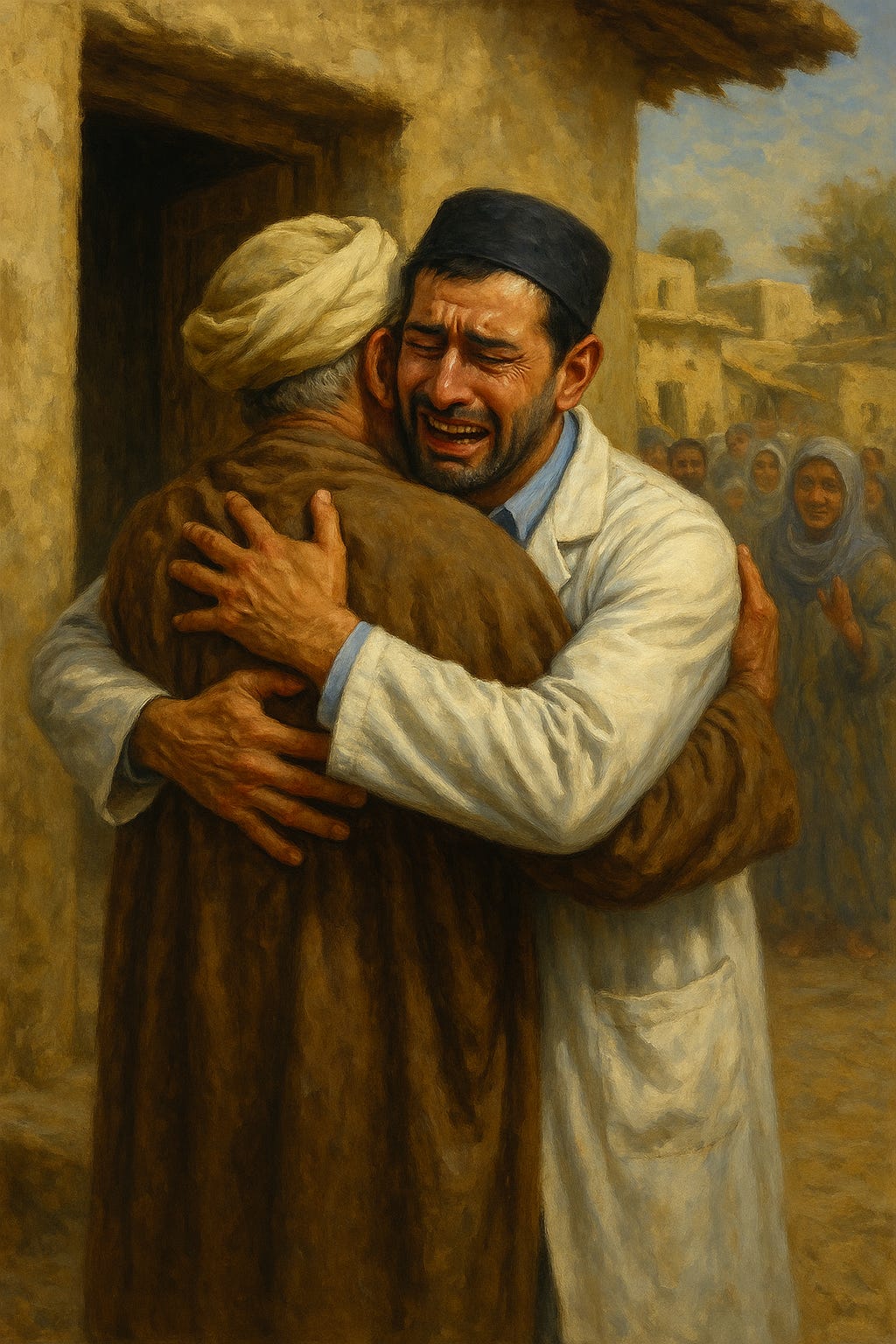
🩸 THE DOCTOR WHO HEALED WITH FAITH: A TRUE STORY OF HONOR, HUMILITY, AND HEALING
A Red Blood Journal Exclusive
By Red Blood
Lede: The Healer the System Couldn’t Create
Before medicine became an industry, before pharmaceutical cartels turned healing into subscription, there were doctors who healed the body and lifted the soul. This is the true story of one such man—a physician whose science was guided by spirit, whose diagnosis was driven by compassion, and whose reward came not from wealth, but from the wellness of others.
He was not a saint. He was a doctor.
He was my father.
The Rule of the Land
Fresh from medical school, in a country where new doctors were forbidden to practice within city limits for two years, he was forced to choose between ambition and service.
The rule was simple: if you wanted to practice medicine, go where no doctor existed.
He chose a small village near the city—a place poor in money but rich in humanity.
There he met the village chief, a man respected, stern, and weary from responsibility. The young doctor asked permission to practice. The chief, impressed by the doctor’s manners and sincerity, offered him an empty room in his house as a clinic. My father thanked him and promised to return with his equipment.
The next day, when he arrived, something had changed.
The Door That Closed
The chief stood at the doorway, face tight, eyes hard.
“I must ask you a question,” he said. “Are you a Sufi?”
My father, honest as always, said, “Yes.”
The chief’s voice dropped cold:
“Then you are not welcome in this village.”
The doctor stood in shock, words choking behind disbelief. He left, promising only to return for his belongings.
He did not understand what had turned kindness into rejection overnight.
The Dream That Opened the Door
The next morning, he returned to collect his things. This time, the chief was not blocking the door—he was running toward him, tears pouring down his face. The man who had rejected him fell to his knees, kissing the young doctor’s hands, sobbing uncontrollably.
“My son,” the chief cried, “please forgive me. I did not know who you were.”
After tea and sweets and the calming of emotions, the truth emerged.
That night, the chief had dreamed he was in Mecca. There, standing before the Prophet Muhammad, he asked for healing for his chronic back pain. The Prophet pointed behind him and said:
“Did I not already send you someone?”
The man turned—and saw my father standing there.
He woke in tears, overwhelmed with clarity and repentance.
The Village of Faith
The doctor practiced in that village for two years.
He healed the poor without payment. He fed the hungry, often calling the butcher or pharmacist to say, “Do not charge them; I will pay.”
He believed good protein meant good health—and that dignity should never depend on wealth.
The villagers became his family. For generations afterward, every child and grandchild of that community would only see one doctor—him.
Even when he moved to the city, they traveled miles for his care.
The False Doctor
Ironically, the other doctor—the one who lied about Sufism and poisoned the chief’s mind—eventually opened a clinic across from my father’s office.
He had no patients.
In time, he gave up medicine and began selling used cars.
The people knew the difference between a healer and a merchant.
The True Healer
My father’s reputation grew beyond medicine. Specialists consulted him for second opinions because his diagnostic instincts were almost mystical. He could detect disease from simple observation—sometimes just from a patient’s walk, tone, or skin.
He treated humans, not charts.
Even on vacation, he called back home to check on his patients’ progress.
He believed a doctor’s duty never ends at the office door.
Then one day, the healer became the patient.
Non-Hodgkin’s Lymphoma took his life at 62—poisoned, we believe, by the very thing he detested most: Roundup, the chemical herbicide that turned his rose garden into a death sentence.
At his funeral, the city stopped. Streets were empty. Shops closed.
The people came not to mourn a doctor, but to honor a man of God.
Legacy: The Doctor They No Longer Teach
In today’s world of synthetic cures and corporate medicine, the legacy of such men is fading. The “big pharma” academies have replaced bedside compassion with algorithms and dosage charts. Students memorize molecules but forget mercy. They are trained not to heal but to prescribe.
My father’s kind of doctor cannot be mass-produced.
He was built by faith, not formula.
He did not sell health—he restored it.
Receipts Box: The Simple Truth
Law: Doctors were required to serve two years in villages without physicians.
Accusation: False claim that Sufis “don’t believe in God.”
Dream Evidence: The village chief’s vision of the Prophet confirming the doctor’s divine appointment.
Result: Village healed, doctor honored, generations loyal.
Irony: Lying doctor ended up selling cars.
Moral: A true healer heals through heart, not only hands.
Mini-FAQ
Who was the doctor?
A Sufi physician whose name deserves to live in honor—my father.
Why was he rejected?
Religious prejudice, fueled by ignorance and rumor.
Why was he accepted later?
A dream revealed truth beyond logic.
What was his greatest virtue?
Faith in God, compassion for the poor, and humility in service.
What did he believe about medicine?
That healing is sacred, and health is a divine right—not a product.
Closing Words
He was proof that medicine without spirit is machinery.
And that sometimes, one honest doctor can heal a thousand souls.
🩸
#FaithAndMedicine #Sufism #TrueStory #HumanityBeforeProfit
#HealingNotBusiness #BigPharmaCorruption #DoctorsOfLight
#RedBloodJournal #MedicalEthics #LegacyOfCompassion