


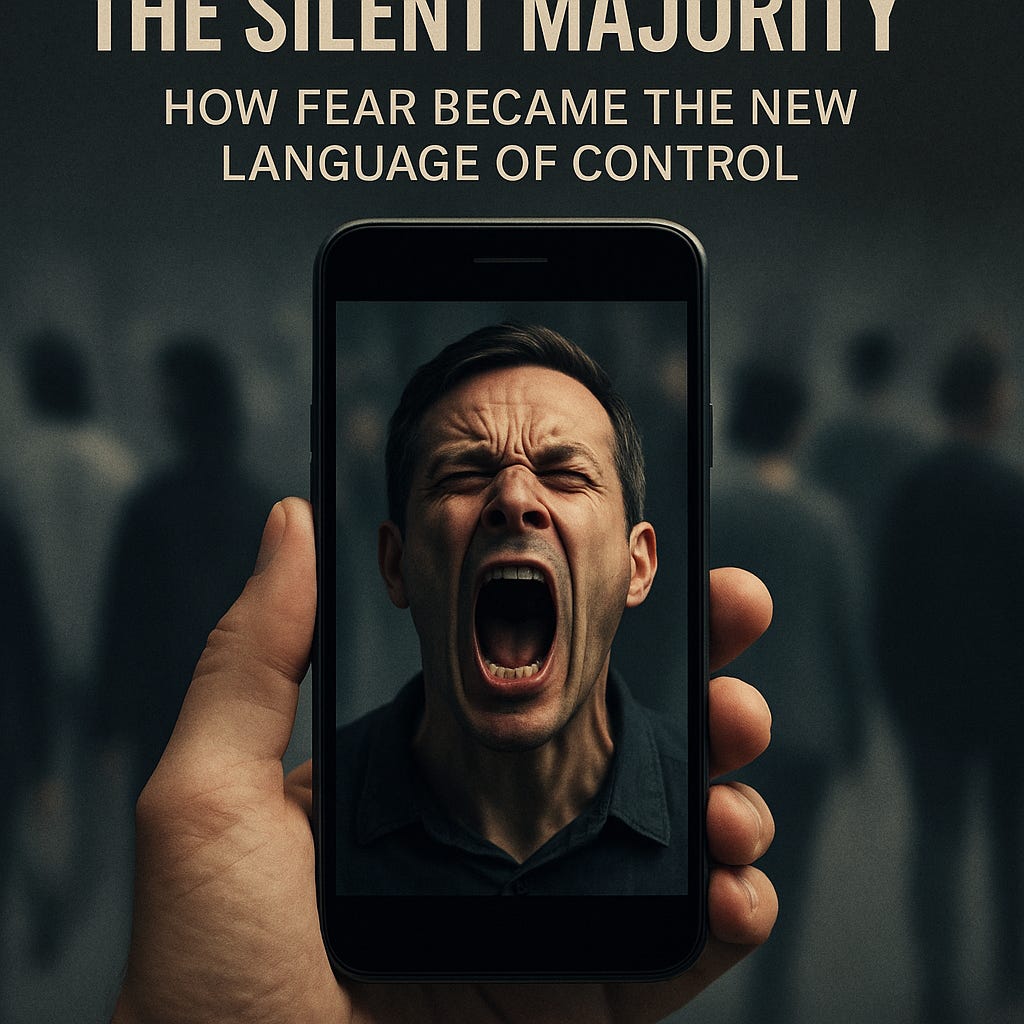
🩸 The Digital Muzzle:
Why Most People Are Silent on Social Media
I. The Age of Self-Censorship
People don’t fear the government anymore — they fear each other.
Every post is a performance review. Every opinion is an invitation for digital trial. The “court” of social media has no judge, only mobs.
So the average user learns: silence equals safety.
The algorithm rewards conformity, punishes controversy, and the masses adapt accordingly.
II. The Surveillance of the Self
Platforms have turned expression into data points.
Every “like,” every “share,” and every “comment” feeds a behavioral model.
People know this — even subconsciously. They feel watched.
So they edit themselves before they ever type a word.
What used to be spontaneous thought becomes algorithm-friendly language, stripped of risk, flavor, and truth.
III. The Economics of Outrage
Social networks thrive on conflict, not conversation.
They boost the extremes because outrage keeps users scrolling.
But the average person doesn’t want to live in a war zone of opinions — so they retreat.
Thus, the stage is left to the most radical, most emotional, and most artificial voices — bots, influencers, and paid propagandists.
The silence of the sane becomes the music of the manipulated.
IV. The Insecurity Loop
The more people see curated perfection, the more they feel inadequate.
Why post if you can’t compete with filtered lives, AI faces, and viral scripts?
So silence becomes an act of self-preservation in an economy of comparison.
Behind every silent account is not apathy, but exhaustion.
V. The Ghost Audience
Millions watch but never speak.
They “like” mentally. They “share” privately.
They are the invisible mass — aware, skeptical, and waiting.
History shows that when silence breaks, it doesn’t whisper. It roars.
Social media may look quiet, but it’s a dam holding back the unspoken truths of an entire civilization.
🔻 Closing Thought
Social media promised freedom of speech — and delivered freedom of surveillance.
It taught people that words have a cost, and silence is cheap.
But silence is never neutral; it’s consent disguised as caution.
When the silent majority finally speaks, the algorithms will not be ready.