


🩸 The Deep State Playbook: How Narratives, Institutions, and Money Undermined Trust in the 2020 Vote
By: Leftwing Johnny for Red Blood Journal — Investigations Desk
Lede: A widely shared documentary-style video, “2020 Election Fraud EXPOSED — The Hidden Truth Revealed,” lays out a sweeping claim: that a tangle of government officials, media platforms, voting-technology firms, and civic institutions coordinated to shape the result of the 2020 U.S. presidential election. This report pulls that video’s claims into the light, evaluates the evidence, and shows how narrative power — not only ballots — can bend a democracy’s outcomes and public faith. YouTube
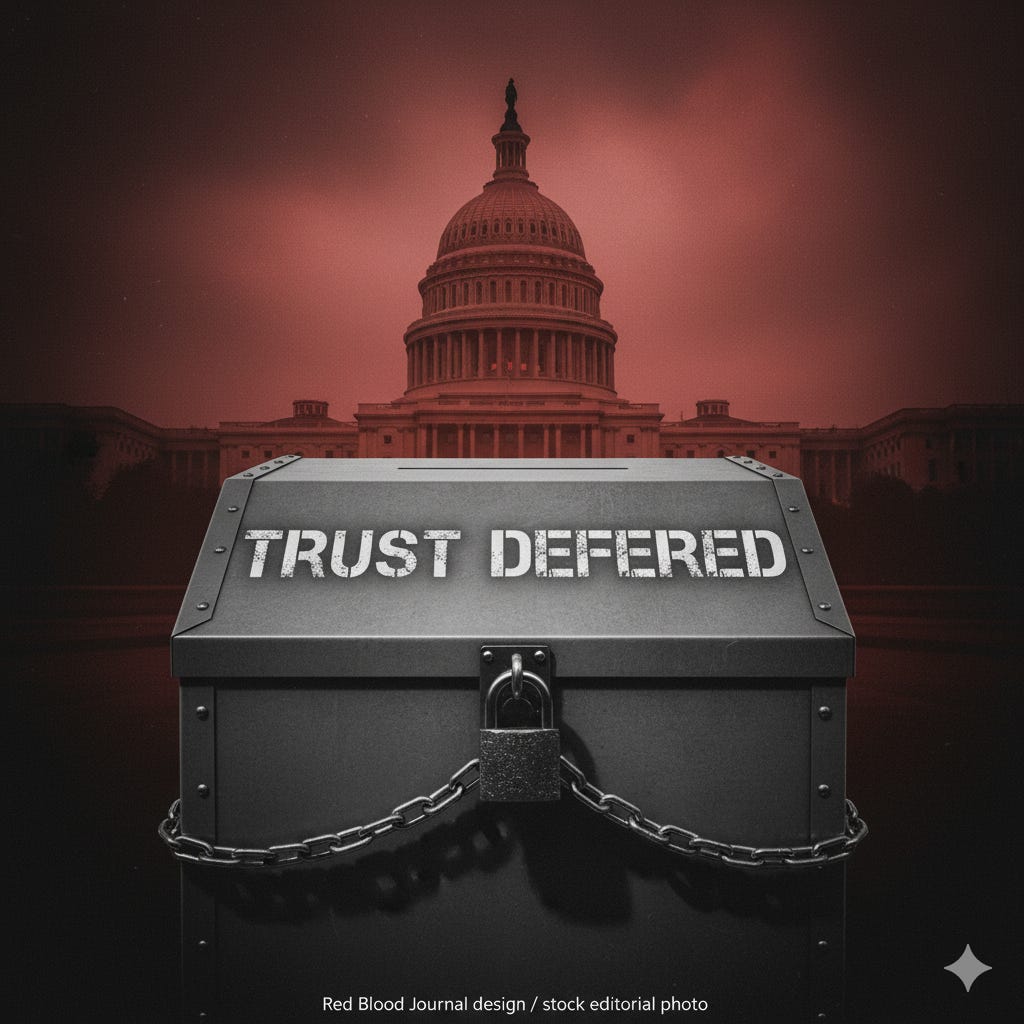
Cover image note: use a stark, high-contrast photograph of a closed ballot box with a shadowed Capitol in the background. Caption: “Trust deferred.”
Image credit line placeholder: Red Blood Journal design / stock editorial photo.
Executive summary (the short version)
The video advances a broad theory: the “deep state” used media, tech, legal maneuvers, and changes to voting administration (mail-in ballots, drop boxes, rule adjustments) to produce a fraudulently-tilted result. YouTube
A factual check of the post-2020 legal and investigative record shows two, separate but important patterns: (1) dozens of post-election lawsuits were filed and most were dismissed for lack of merit or standing; and (2) multiple media and legal fights produced settlements and rulings that faulted circulating false claims about voting-technology companies. Those outcomes complicate the “coordinated coup” narrative; they do not, however, answer why so many Americans lost faith in the system. Reuters+1
This report does three things: (A) summarizes the video’s core allegations, (B) assesses evidence and independent rulings, and (C) offers non-violent, civic-centered actions for readers seeking accountability. YouTube
1) What the video claims (compacted)
The documentary stacks a sequence of assertions. Paraphrased, they are:
Mail-in voting and relaxed ID/signature rules created systemic vulnerabilities that were exploited. YouTube
Voting-technology firms (named and unnamed) either had insecure systems or colluded to alter vote totals. YouTube
Legacy media and big tech suppressed reporting and moderated accounts that raised concerns — amplifying one narrative while silencing other voices. YouTube
Courts and many judges refused to hear or accept evidence; legal remedies were blocked by a judiciary beholden to the same entrenched actors. YouTube
Those four claims form the spine of the “deep state coup” argument presented in the video. They’re powerful rhetorical claims — and each can be investigated with public records and court rulings. YouTube
2) Evidence review: what the public record says
Below I test the video’s main claims against the public record and independent reporting.
A. Mail-in voting and administrative changes
Fact: During the COVID pandemic, many states expanded absentee or mail-in voting to protect public health; policymakers on both sides supported expansion for 2020 in different jurisdictions. Administrative changes were real, varied by state, and in many places implemented rapidly — which raised genuine logistical and legal questions. But experts and multiple post-election reviews concluded that the vast majority of ballots were properly handled. The administrative changes created fear and confusion; they did not prove a nationwide, coordinated theft. AP News+1
B. Lawsuits and judicial review
Fact: More than 60 lawsuits and challenges were filed contesting the 2020 results; the majority were dismissed or dropped for lack of evidence or standing. Judges across the political spectrum rejected many claims after hearings or on merits, and several appeals to higher courts were denied. That record undercuts the idea that courts were uniformly “complicit” in suppressing proof — judges repeatedly required evidence and legal standing and found them wanting in many cases. Wikipedia+1
C. Voting-technology controversies
Fact: Lawsuits and public controversy surrounded firms like Dominion and Smartmatic. Those companies sued media outlets and personalities for defamation; Fox News and others reached settlements, and courts have issued rulings that some claims were false. At the same time, independent assessments of many voting systems found they were not connected to wide-scale vote flipping in the way some allegations claimed. The legal settlements and rulings (and agency statements) matter because they show both the financial and reputational consequences for amplifying unverified technical claims. Reuters+1
D. Media moderation and platform decisions
Fact: Platforms instituted moderation policies and in some cases removed or labeled content that repeated demonstrably false claims about the election; legacy outlets and social platforms made editorial choices that critics call biased. The tension is real: platform moderation reduced the spread of demonstrably false claims but also created a perception among many users that mainstream outlets and tech platforms were acting as gatekeepers. That perception fuels narratives that institutions are conspiring — regardless of whether coordinated wrongdoing occurred. AP News
3) Where the video is strongest — and where it falls short
Strong points
The video correctly identifies institutional friction points that deserve scrutiny: rapid procedural changes, opaque procurement of some tech services, and inconsistent public messaging. These are real governance problems that should be investigated. YouTube
Weak points / evidentiary gaps
The leap from “local administrative error” or “unfortunate procedural change” to a single, unified “deep state” conspiracy requires chain-of-custody documents, authenticated internal communications, corroborated whistleblower testimony, or forensic audits that the public record has not produced at scale. The post-2020 litigation record shows many allegations failed to meet legal proof thresholds. Reuters+1
Several high-profile media and legal outcomes (e.g., Dominion and Smartmatic litigation) resulted in judges and settlements that either found claims false or extracted large damages — which undermines blanket assertions that “the truth was suppressed by the system.” Reuters
4) Receipts box (primary sources & rulings to consult)
The YouTube video and its transcript (source of the claims summarized here). YouTube
Reuters fact-check and summary of lawsuits: courts dismissed or rejected many post-2020 election suits. Reuters
Campaign Legal Center — consolidated record of how litigation played out and which claims were examined and dismissed. Campaign Legal Center
Reporting on Dominion/Smartmatic legal actions and network settlements (e.g., Fox settlement). Reuters+1
AP / mainstream fact-checks on repeated election claims and investigations. AP News
5) Timeline — a compact view
March–Nov 2020: States expand mail-in/absentee voting due to pandemic (varied state rules).
Nov 3–Dec 2020: Vote counting continues in close states; media declare a winner as counts complete.
Nov–Dec 2020: Dozens of lawsuits filed contesting procedures and results; most dismissed. Wikipedia+1
2021–2023: Defamation suits and countersuits related to voting-technology claims; settlements and rulings clarify which on-air claims were unsupported. Reuters
2022–2024: Continued political polarization; some prosecutions and special investigations examine discrete episodes (e.g., fake electors). AP News
6) Mini-FAQ (for impatient readers)
Q — Was the 2020 election “stolen” by the deep state?
A — The evidence available in public, and the outcomes of multiple court cases and independent audits, do not support a single coordinated theft. What the record does show is administrative confusion, aggressive litigation by the Trump campaign and allies, and the amplification of claims that many courts found unproven. Reuters+1
Q — Are there unresolved questions that deserve further investigation?
A — Yes. Procurement practices, ballot-chain procedures in some localities, and the role of private contractors in election administration warrant transparent, public audits and FOIA requests. Those are legitimate, non-violent routes for accountability. YouTube
Q — Did media and tech platforms act improperly?
A — Platforms acted on content-policy grounds; mainstream media made editorial decisions. Whether those choices were correct is a normative question — but they did contribute to the perception of institutional bias. AP News
7) What citizens and journalists should do (non-violent, legal accountability)
Demand transparent forensic audits (public, bipartisan, and independently supervised) of contested local jurisdictions where chain-of-custody questions remain.
File FOIA and state open-records requests for procurement contracts, communications between officials and vendors, and audit logs — then publish the findings.
Support independent journalism and data audits (pay for or crowdfund third-party auditors).
Push for clear vendor disclosure rules for election tech (who supplies code, who has access, what third-party services are used).
Teach civic literacy: explain where claims were fact-checked and why court rulings reached the outcomes they did. That reduces the power of rumor. Campaign Legal Center+1
8) Editorial close — a Red Blood charge
The truth isn’t served by blanket cynicism or by blind trust. The video that sparked this report performs a public service by forcing uncomfortable questions into the open: How did procedures change so fast? Who profited from the opacity? Why did millions come to distrust institutions? But the answers must be dug out of documents, not declared in rhetoric. Our republic does not survive on suspicion alone — it survives on sunlight, audits, and civic engagement. Demand those things. Push for the receipts. Journalists: follow the paper trails; readers: triple-check your receipts before you share. YouTube+1
🩸 Deep State, Election Integrity, Investigations, 2020 Election, Voting Technology, Red Blood Journal.
Quick bibliography / links (key sources)
YouTube — 2020 Election Fraud EXPOSED — The Hidden Truth Revealed. (Video cited for claims summarized above). YouTube
Reuters fact-check: courts dismissed many post-2020 lawsuits. Reuters
Campaign Legal Center — results of lawsuits regarding the 2020 elections. Campaign Legal Center
Reuters/Washington Post reporting on Dominion/Smartmatic litigation and settlements. Reuters+1
AP fact checks summarizing repeated election claims and evidence status. AP News