


🩸 🧠 💤 ☀️ 💪 ❤️ 🌊❤️✨ — THE BRAIN HEALTH PARADOX: Ten Daily Habits, the Science of Cognitive Decline, and the Power We Still Have Over Our Minds
RED BLOOD JOURNAL | Investigative Health & Human Consciousness Report | October 20, 2026
An evidence-based investigation into the ten commandments of brain health, the science behind them, the claims that go beyond the evidence, and what modern medicine may be overlooking about prevention, human connection, and personal responsibility.
WHAT IF THE MOST IMPORTANT THING WE CAN DO FOR OUR BRAINS IS NOT SOMETHING A SURGEON CAN PERFORM, A PHARMACEUTICAL COMPANY CAN SELL, OR A HOSPITAL CAN PROVIDE?
Every year, enormous resources are devoted to understanding Alzheimer’s disease, dementia, cognitive decline, and the biological processes that gradually undermine human memory and independence. Researchers examine proteins accumulating in the brain, the deterioration of neural connections, inflammation, genetics, blood circulation, and the complex relationships between aging and neurological disease. Yet an equally important question deserves attention: How much of our long-term cognitive health depends on what happens outside the doctor’s office?
A short video featuring a self-described brain surgeon offers an intriguing answer. The speaker presents ten daily practices that he describes as his personal brain-health commandments. They include sleep, sunlight, squats, strength training, targeted supplementation, socialization, learning new skills, appreciating positive experiences, managing stress, and practicing stillness.
At first glance, these recommendations appear remarkably simple. There are no expensive medical devices, complicated treatments, or revolutionary pharmaceutical discoveries. Instead, the message emphasizes ordinary activities available to many people: sleeping adequately, moving the body, maintaining relationships, learning, and creating moments of mental peace.
But simplicity does not automatically establish scientific truth. Some recommendations are supported by substantial evidence, others are reasonable practices supported by more limited research, and several claims about physical changes to the brain are presented with greater certainty than the available evidence justifies.
This investigation examines all ten recommendations individually, then asks a broader question: Are we approaching brain health primarily as a medical problem when it must also be understood as a biological, social, environmental, and human responsibility?
🩸 RED BLOOD JOURNAL — THINK BEYOND THE SCRIPT
Do not accept these recommendations simply because they come from someone identifying as a brain surgeon. Do not reject them because they sound too simple, and do not accept this report’s conclusions without examination. Question the claims, examine the research, distinguish observed associations from proven causes, and consider whose interests are served by the way we understand health. Most importantly, look beyond what is being promised and investigate what the evidence actually demonstrates.
I. THE SCIENTIFIC CONTEXT: HOW MUCH DEMENTIA RISK MAY BE MODIFIABLE?
Before examining the ten recommendations, it is necessary to understand the broader scientific landscape. The 2024 Lancet Commission on dementia identified 14 potentially modifiable risk factors and estimated that addressing them could theoretically prevent or delay approximately 45% of dementia cases at the population level. This is an important finding, but it must be interpreted carefully: it does not mean that an individual can eliminate 45% of their personal dementia risk simply by changing their lifestyle.
In July 2026, the World Health Organization issued an updated edition of its guidelines on reducing cognitive decline and dementia risk. The guidelines emphasized physical activity, healthy dietary patterns, cognitive engagement, social relationships, management of cardiovascular and metabolic conditions, and environmental factors. They also highlighted the importance of implementing prevention strategies across the lifespan rather than waiting until old age.
These findings challenge two opposite assumptions. The first is that dementia is simply an inevitable consequence of growing older. The second is that healthy behavior guarantees protection. Neither position accurately reflects the science. Aging remains a major risk factor, genetics and other biological processes matter, and people who live healthy lives can still develop serious neurological disease. Nevertheless, the accumulated evidence suggests meaningful opportunities to reduce risk and preserve function.
The central scientific distinction is between reducing probability and promising prevention. Responsible health education must preserve that distinction even when a more dramatic claim would attract greater attention.
II. THE FIRST COMMANDMENT: SLEEP — THE BRAIN’S NIGHTLY MAINTENANCE
The speaker begins with sleep, recommending seven to eight hours each night and describing sleep as the period during which the brain removes waste associated with dementia. This recommendation rests on an increasingly important area of neuroscience: the relationship between sleep and the brain’s systems for clearing metabolic waste.
Researchers have identified fluid-transport and waste-clearance pathways involving cerebrospinal fluid, interstitial fluid, and structures commonly described as the glymphatic system. Research in animals and a growing body of human evidence indicate that sleep is associated with physiological processes relevant to the removal of metabolic byproducts, including proteins associated with Alzheimer’s disease.
However, the assertion that seven to eight hours of sleep simply washes dementia-causing waste out of the brain is an oversimplification. Scientists are still investigating exactly how these clearance mechanisms function in humans, how they interact with different sleep stages, and whether deliberately improving glymphatic clearance can prevent Alzheimer’s disease.
The more firmly established benefits of adequate sleep extend beyond waste removal. Sleep supports memory consolidation, emotional regulation, attention, metabolic regulation, and recovery. Chronic sleep disruption may also accompany conditions such as sleep apnea, which can impair oxygenation and produce significant neurological and cardiovascular consequences.
For most adults, approximately seven to nine hours of quality sleep is a reasonable target, although individual needs vary. Maintaining consistent sleep and waking times, addressing persistent insomnia, and investigating symptoms such as loud snoring or interrupted breathing may be more beneficial than simply counting hours.
Scientific verdict: Strong support for adequate sleep as essential to brain function; promising but still developing evidence concerning specific waste-clearance mechanisms and dementia prevention.
III. THE SECOND COMMANDMENT: SUNLIGHT — RESETTING THE BIOLOGICAL CLOCK
The second recommendation is ten minutes of morning sunlight. The speaker explains that morning light helps synchronize the body’s internal clock, potentially improving mood and sleep.
The underlying biology is well established. Light reaching the eyes influences the suprachiasmatic nucleus, a small region of the hypothalamus involved in coordinating circadian rhythms. Those rhythms influence alertness, sleep timing, hormonal activity, body temperature, and many other physiological processes.
Exposure to natural daylight, particularly early in the day, can help reinforce the distinction between daytime wakefulness and nighttime rest. Observational research involving hundreds of thousands of UK Biobank participants has also found associations between more daytime outdoor light and favorable sleep and mood outcomes.
Nevertheless, ten minutes is not a universally established prescription. The effect of light exposure depends on brightness, season, latitude, cloud cover, timing, and individual characteristics. A dim, cloudy morning may require a different duration than a bright, sunny morning. Looking directly at the sun is unnecessary and unsafe.
Sunlight is particularly interesting because it represents an environmental influence on neurological functioning rather than a treatment administered directly to the brain. Our biological clocks evolved in a world structured by natural cycles of light and darkness, while modern living increasingly involves artificial illumination, indoor work, and inconsistent sleeping schedules.
Scientific verdict: Strong support for daylight as a regulator of circadian rhythms; the precise ten-minute prescription is not universally validated, and a direct dementia-prevention effect has not been established.
IV. THE THIRD COMMANDMENT: SQUATS — WHAT THE LEGS HAVE TO DO WITH THE BRAIN
The third recommendation is squats, based on the observation that leg strength is associated with cognitive health during aging. The speaker also suggests that the legs pump blood and send signals upward to the brain.
The association between physical fitness and cognitive health is well supported. Exercise influences cardiovascular fitness, blood flow, metabolic health, insulin sensitivity, inflammation, and neurobiological processes relevant to learning and memory. Muscle strength also contributes to mobility, fall prevention, and the ability to remain physically independent.
However, squats themselves have not been established as a uniquely effective exercise for preventing dementia. Nor is the explanation that the legs directly pump beneficial signals into the brain an adequate scientific account of the relationship. Skeletal muscles do help venous blood return toward the heart, and contracting muscles release signaling molecules known as myokines, but these processes do not establish squats as a special neurological treatment.
Squats are valuable because they strengthen major lower-body muscle groups, improve functional movement, and help preserve everyday abilities such as standing from a chair and climbing stairs. For people with balance difficulties, joint problems, or limited mobility, chair-assisted squats or other appropriately adapted movements may be more suitable.
The broader lesson is that physical independence and cognitive health are interconnected. Maintaining mobility often helps people stay socially engaged, physically active, and capable of participating in the world.
Scientific verdict: Strong support for physical activity and functional strength; insufficient evidence to claim that squats specifically prevent cognitive decline.
V. THE FOURTH COMMANDMENT: STRENGTH TRAINING — CAN MUSCLE PROTECT MEMORY?
The fourth recommendation extends the argument beyond squats. The speaker recommends strength training twice weekly and associates resistance exercise with a larger memory center in the brain.
This claim points toward the hippocampus, a structure deeply involved in forming and retrieving memories. Research has explored how aerobic exercise and resistance training may influence cognition, brain structure, neurotrophic signaling, and age-related changes in neural function.
Physical activity is among the more consistently supported recommendations in dementia-risk-reduction guidelines. Resistance training provides additional benefits for muscle mass, bone health, glucose regulation, and functional independence. Some studies also suggest cognitive benefits, although findings concerning increases in hippocampal volume are not uniform across exercise types, study populations, and experimental designs.
The distinction matters. It is reasonable to say that resistance training supports physical health and may contribute to cognitive resilience. It would be premature to promise that lifting weights twice a week will enlarge an individual’s hippocampus or prevent Alzheimer’s disease.
A practical approach involves combining resistance training with cardiovascular activity and balance exercises, adjusted to age, health status, and ability.
Scientific verdict: Strong evidence for the health benefits of exercise and support for cognitive benefits; specific structural claims about the hippocampus require more caution.
VI. THE FIFTH COMMANDMENT: SUPPLEMENTS — WHEN MORE IS NOT BETTER
The fifth recommendation is perhaps one of the most important because it challenges a substantial part of modern wellness marketing. The speaker recommends supplements only when necessary, mentioning vitamin B12, vitamin D, and omega-3 fatty acids, and emphasizes testing for deficiencies rather than assuming that higher consumption produces greater benefits.
The fundamental distinction is between correcting a deficiency and enhancing an already healthy brain.
Vitamin B12 is essential for neurological functioning and the production of healthy blood cells. A deficiency can cause neurological symptoms, including difficulty concentrating, memory problems, changes in mood, numbness, and problems with balance. Identifying and treating a genuine deficiency can therefore be medically important, particularly before prolonged neurological damage develops.
But it does not follow that taking additional B12 automatically improves cognition in people whose levels are already sufficient. Similar caution applies to vitamin D and omega-3 supplementation. A substance can be essential for normal biological functioning without providing additional benefits when consumed beyond the body’s requirements.
The WHO’s 2026 dementia-risk-reduction guidelines explicitly recommend against using B-vitamin, vitamin E, omega-3, or multivitamin/mineral supplements specifically to prevent cognitive decline or dementia in people without established deficiencies. This does not mean that all supplementation is useless. It means that the medical justification must match the person’s actual nutritional and clinical needs.
There is also a practical qualification to the instruction to test first. Not every supplement requires routine laboratory testing, and there is no single laboratory test that establishes every possible omega-3 need. Testing, dietary evaluation, symptoms, medical history, and professional judgment all have a role.
The broader implication extends beyond brain health. Wellness marketing frequently encourages consumers to purchase solutions before establishing whether they have a problem requiring treatment. Evidence-based medicine should reverse that sequence: identify a need, evaluate possible interventions, and then determine whether the benefit justifies the cost and potential risk.
Scientific verdict: Strong support for identifying and correcting deficiencies. No established justification for routine high-dose supplementation as a general dementia-prevention strategy.
VII. THE SIXTH COMMANDMENT: SOCIALIZATION — WHY HUMAN CONNECTION MATTERS BIOLOGICALLY
The sixth recommendation concerns socialization. The speaker argues that loneliness is associated with faster brain shrinkage, suggesting that human relationships may have physiological consequences extending far beyond emotional comfort.
This is one of the most compelling areas of brain-health research.
A major analysis involving more than 600,000 participants across 21 longitudinal cohorts found that loneliness was associated with approximately 31% higher relative risk of dementia. The researchers also examined associations with specific forms of dementia and cognitive impairment.
Another large observational study found that social isolation was associated with both greater dementia risk and lower gray-matter volumes in several regions of the brain. Such findings support the possibility that social circumstances and neurological health are interconnected, although they do not establish that loneliness directly causes brain shrinkage or that social interaction necessarily reverses it.
An important distinction is often overlooked: loneliness and solitude are not the same experience. A person can live alone while maintaining meaningful relationships and feeling emotionally fulfilled. Another person can be surrounded by coworkers, relatives, or thousands of online contacts while experiencing profound loneliness.
The relevant question is not simply how many people surround someone, but whether their relationships offer meaningful connection, security, participation, and emotional support.
This raises a serious public-health question. Modern societies often organize human life around productivity, economic competition, geographical mobility, and technological convenience. Family members live far apart, neighborhoods become less socially cohesive, and many older adults face increasing isolation.
If meaningful social relationships are important to cognitive health, then loneliness cannot be treated exclusively as an individual failure to make friends. It must also be considered in relation to housing, transportation, disability access, retirement, caregiving, and community design.
Scientific verdict: Substantial observational evidence links loneliness and isolation to poorer cognitive outcomes. Additional intervention research is needed to establish precisely how much dementia risk can be reduced by changing social circumstances.
VIII. THE SEVENTH COMMANDMENT: LEARNING — THE BRAIN’S ABILITY TO KEEP CHANGING
The seventh recommendation is learning something new and challenging, whether a language, instrument, practical skill, or unfamiliar hobby. The speaker describes the difficulty involved in learning as a process that builds new neural connections.
The scientific foundation is neuroplasticity: the nervous system’s capacity to adapt through changes in neural activity, connections, and organization.
Learning requires the brain to recognize patterns, make predictions, retrieve information, correct mistakes, and coordinate attention with memory. These activities can contribute to the maintenance and development of particular cognitive abilities.
However, the idea that any difficult new activity automatically protects against dementia goes beyond what has been established. Cognitive-training research often demonstrates improvement in the specific tasks being practiced, while the extent to which those improvements transfer into everyday cognition or prevent neurological disease remains an active area of investigation.
The WHO recognizes cognitive training and stimulation as potentially useful components of a broader risk-reduction strategy, but does not present them as guarantees against cognitive decline.
There is also a distinction between passive consumption and active learning. Watching educational videos may provide valuable information, but practicing a musical instrument, writing in a new language, solving unfamiliar problems, and applying new skills involve different cognitive demands.
The important principle is not that learning must be unpleasant. It is that curiosity, attention, meaningful challenge, and sustained participation give the brain opportunities to adapt.
Scientific verdict: Strong evidence for lifelong learning and neuroplasticity; more limited evidence that particular learning activities prevent dementia.
IX. THE EIGHTH COMMANDMENT: SAVORING — CAN TWENTY SECONDS OF GRATITUDE CHANGE THE BRAIN?
The eighth recommendation is to pause for approximately twenty seconds and appreciate a positive experience. The speaker suggests that gratitude changes the brain’s tendency to detect threats.
The general idea relates to emotion regulation, attentional processes, and the psychological effects of positive experiences. Human attention can become strongly oriented toward potential danger, particularly during prolonged stress or uncertainty. Intentionally noticing rewarding experiences may help interrupt habitual negative thinking and support psychological well-being.
Research on gratitude interventions and positive psychology has identified potential benefits for mood and subjective well-being. Nevertheless, the claim that exactly twenty seconds rewires a neurological threat filter should be treated as metaphorical rather than as an established scientific measurement.
It is not known that a universal twenty-second threshold produces a particular anatomical change in the brain, nor has this practice been proven to prevent dementia.
Yet the absence of such proof does not make the practice meaningless.
The benefit of appreciating a positive moment need not depend on whether a brain scan reveals a measurable structural difference. Human beings can reasonably value peace, gratitude, appreciation, and enjoyment because these experiences contribute to the quality of life itself.
There is also a distinction between genuine positivity and denial. Appreciating a beautiful morning does not require ignoring injustice, illness, grief, or hardship. Healthy positivity makes room for reality while refusing to let suffering become the only reality a person recognizes.
Scientific verdict: Reasonable support for gratitude and positive-attention practices as psychological tools; insufficient evidence for the precise twenty-second neurological claim or a direct dementia-prevention effect.
X. THE NINTH COMMANDMENT: STRESS CONTROL — WHEN SURVIVAL MODE BECOMES A WAY OF LIFE
The ninth recommendation concerns chronic stress. The speaker warns that prolonged stress can affect regions of the brain involved in thinking and recommends a breathing technique, although the transcript becomes unclear at this point.
The phrase appears to refer to the physiological sigh, a breathing pattern commonly involving two inhalations followed by a long, slow exhalation. However, the recording does not clearly identify the technique, so attributing a precise breathing protocol to the speaker would be speculative.
The broader scientific discussion is well established. Stress activates interacting neurological and hormonal systems, including pathways involving the hypothalamus, pituitary gland, and adrenal glands. These systems help the body respond to threats by changing levels of alertness, cardiovascular activity, and energy availability.
Short-term stress is not inherently harmful. It can improve readiness and performance, and may be essential for survival. Problems arise when stress responses remain chronically activated or recovery becomes inadequate.
Prolonged stress exposure has been associated with changes in attention, memory, emotional regulation, and neurological systems involving the hippocampus and prefrontal cortex. But it would be misleading to describe every stressful experience as physically shrinking the brain. The biological relationships are complex and depend on stress intensity, duration, individual vulnerability, and other health conditions.
Breathing exercises, regular physical activity, social support, psychotherapy, and improved sleep may help regulate stress. Importantly, stress management is not solely a matter of individual willpower. Financial insecurity, unsafe working environments, caregiving burdens, discrimination, and chronic illness can generate pressures that cannot simply be resolved through breathing exercises.
A comprehensive approach must address both an individual’s response to stress and the circumstances producing it.
Scientific verdict: Strong evidence that chronic stress can adversely affect health and cognitive functioning; breathing and relaxation can help regulate distress, but claims about directly reversing structural brain changes require caution.
XI. THE TENTH COMMANDMENT: STILLNESS — MEDITATION, THE CORTEX, AND THE QUIET MIND
The tenth recommendation is ten minutes of silence or meditation. The speaker argues that brain imaging suggests meditation can thicken cortical regions affected by aging.
This claim is rooted in an authentic but often exaggerated scientific literature.
Several imaging studies have observed structural differences between experienced meditators and comparison groups, including differences in cortical thickness. These findings have encouraged hypotheses about neuroplasticity, attention training, and the possible neurological effects of contemplative practices.
However, observational differences do not prove that meditation caused those changes. People who meditate for many years may differ from comparison groups in numerous ways, including physical activity, stress exposure, personality, sleep, socioeconomic circumstances, and other behaviors.
The National Institutes of Health’s National Center for Complementary and Integrative Health recognizes evidence that mindfulness-based approaches may help with certain psychological conditions, particularly anxiety and depression. At the same time, it emphasizes that findings concerning changes in brain structure remain difficult to interpret.
Silence and meditation may be valuable without being presented as neurological engineering. They can provide opportunities to observe thoughts, regulate attention, become aware of emotional responses, and disengage temporarily from constant stimulation.
For some people, meditation feels restorative. For others, particularly those with certain psychological difficulties, specific meditation practices can be uncomfortable or worsen symptoms. The appropriate approach is individualized rather than compulsory.
The most interesting philosophical possibility is that stillness gives the individual an opportunity to examine the mind rather than remain entirely governed by its automatic responses.
Scientific verdict: Meaningful evidence for selected psychological benefits of meditation; preliminary and inconsistent evidence for specific structural brain changes; no established ten-minute prescription for preventing dementia.
XII. THE EVIDENCE AUDIT: WHAT THE TEN COMMANDMENTS ACTUALLY ESTABLISH
The video succeeds in bringing attention to several scientifically meaningful habits. Its weakness is the tendency to turn complex research findings into definitive explanations that are easier to remember than to substantiate.
The following assessment distinguishes general health benefits from specific claims about dementia prevention.
Recommendation
Evidence-based assessment
1. Sleep
Strong for cognitive functioning; brain waste-clearance research still developing
2. Morning sunlight
Strong for circadian regulation; exact ten-minute rule unproven
3. Squats
Useful functional exercise; no established special dementia-prevention effect
4. Strength training
Strong overall health benefits; promising cognitive effects
5. Targeted supplements
Correcting deficiencies matters; routine preventive supplementation unsupported
6. Socialization
Strong observational links between connection and cognitive health
7. New skills
Supports learning and neuroplasticity; dementia prevention uncertain
8. Savoring
Potential psychological benefits; twenty-second brain-rewiring claim unsupported
9. Stress control
Important for health and functioning; precise structural claims oversimplified
10. Meditation
Evidence for some psychological benefits; cortical-thickening claims remain uncertain
Evidence assessment: Red Blood Journal synthesis of the uploaded transcript and referenced medical research. These are qualitative assessments, not clinical guideline grades.
XIII. WHAT IS MISSING FROM THE TEN COMMANDMENTS?
Perhaps the most revealing part of the investigation is not what the speaker includes, but what the list leaves out.
The ten practices focus heavily on personal behavior. However, research into dementia prevention identifies additional factors that have major implications for public health.
Among them are high blood pressure, elevated LDL cholesterol, diabetes, smoking, harmful alcohol consumption, hearing loss, untreated vision problems, traumatic brain injury, air pollution, obesity, depression, and limited educational opportunities.
These factors matter because the brain does not operate independently of the cardiovascular system, sensory environment, or social conditions.
A person may meditate every morning and still have uncontrolled hypertension. Another may exercise regularly while experiencing untreated hearing loss that increasingly limits communication and participation. A third may maintain excellent sleep habits but live in an environment with persistent air pollution or occupational exposure to hazardous conditions.
None of these examples makes personal responsibility irrelevant. Instead, they demonstrate why an exclusively behavioral approach can be incomplete.
The WHO’s updated 2026 guidelines reflect this broader understanding by addressing lifestyle practices, medical conditions, environmental factors, and multidomain interventions.
The overlooked connection between the heart and brain
The brain requires a continuous supply of oxygen, nutrients, and energy. Conditions that damage blood vessels or impair circulation can affect the brain as well as the heart, kidneys, and other organs.
This makes cardiovascular prevention a major component of cognitive health. Monitoring blood pressure, managing diabetes and cholesterol, avoiding tobacco, maintaining physical activity, and obtaining appropriate medical care may protect neurological health through mechanisms that a meditation practice alone cannot address.
Hearing and vision are more than sensory issues
Hearing and vision problems can affect participation, independence, communication, and the effort required to navigate daily life. Untreated impairments are associated with cognitive difficulties, while research continues to investigate which interventions can reduce long-term dementia risk.
Their presence in prevention frameworks illustrates a larger principle: protecting the brain requires maintaining the individual’s relationship with the outside world.
The environmental dimension
Air pollution and other environmental exposures complicate the idea that brain health is entirely a matter of personal choices.
Individuals cannot always control the quality of the air surrounding their homes, the conditions of their employment, or their access to healthy public spaces. Community infrastructure, environmental protection, and public-health policy can therefore contribute to neurological well-being.
XIV. THE ECONOMICS OF BRAIN HEALTH: WHY PREVENTION DESERVES GREATER ATTENTION
Modern medicine provides extraordinary benefits. Neurosurgery can be lifesaving. Pharmaceutical research has produced treatments that were unimaginable in previous generations. Diagnostic imaging and laboratory medicine allow physicians to investigate disease with increasing precision.
But health systems frequently face financial and institutional incentives that reward the delivery of services more directly than the prevention of future illness. A hospital can measure surgeries performed, scans completed, and treatments billed. The value of a disease that never develops is often harder to document, reimburse, or attribute to a particular provider.
This creates a legitimate question about priorities, though it does not establish that medical institutions intentionally discourage prevention.
Commercial wellness businesses introduce another set of incentives. Supplements, cognitive-enhancement programs, specialized devices, and personalized health packages can generate revenue even when their specific preventive claims are poorly supported.
These are different industries with different incentives, and they should not be treated as a single coordinated system without evidence.
Nevertheless, the consumer faces the same challenge in both settings: distinguishing genuine medical value from persuasive marketing.
Sleep, ordinary physical movement, meaningful relationships, and lifelong learning may offer important benefits at relatively low direct cost. But low cost does not mean that everyone has equal access to them. Shift workers may struggle to maintain stable sleep patterns. People living in unsafe neighborhoods may lack opportunities to exercise outdoors. Older adults without transportation may struggle to maintain friendships.
True prevention therefore requires both individual action and conditions that make healthy behavior realistically achievable.
The more useful question is not whether medicine or personal responsibility should dominate. It is how scientific medicine, personal agency, and public policy can support one another without allowing commercial incentives to replace evidence.
XV. FROM TEN COMMANDMENTS TO A PRACTICAL BRAIN-HEALTH ROUTINE
The transcript offers a useful starting point, but a responsible routine should not turn every recommendation into an inflexible rule. Age, mobility, medical conditions, occupational schedules, and personal circumstances influence what is practical and safe.
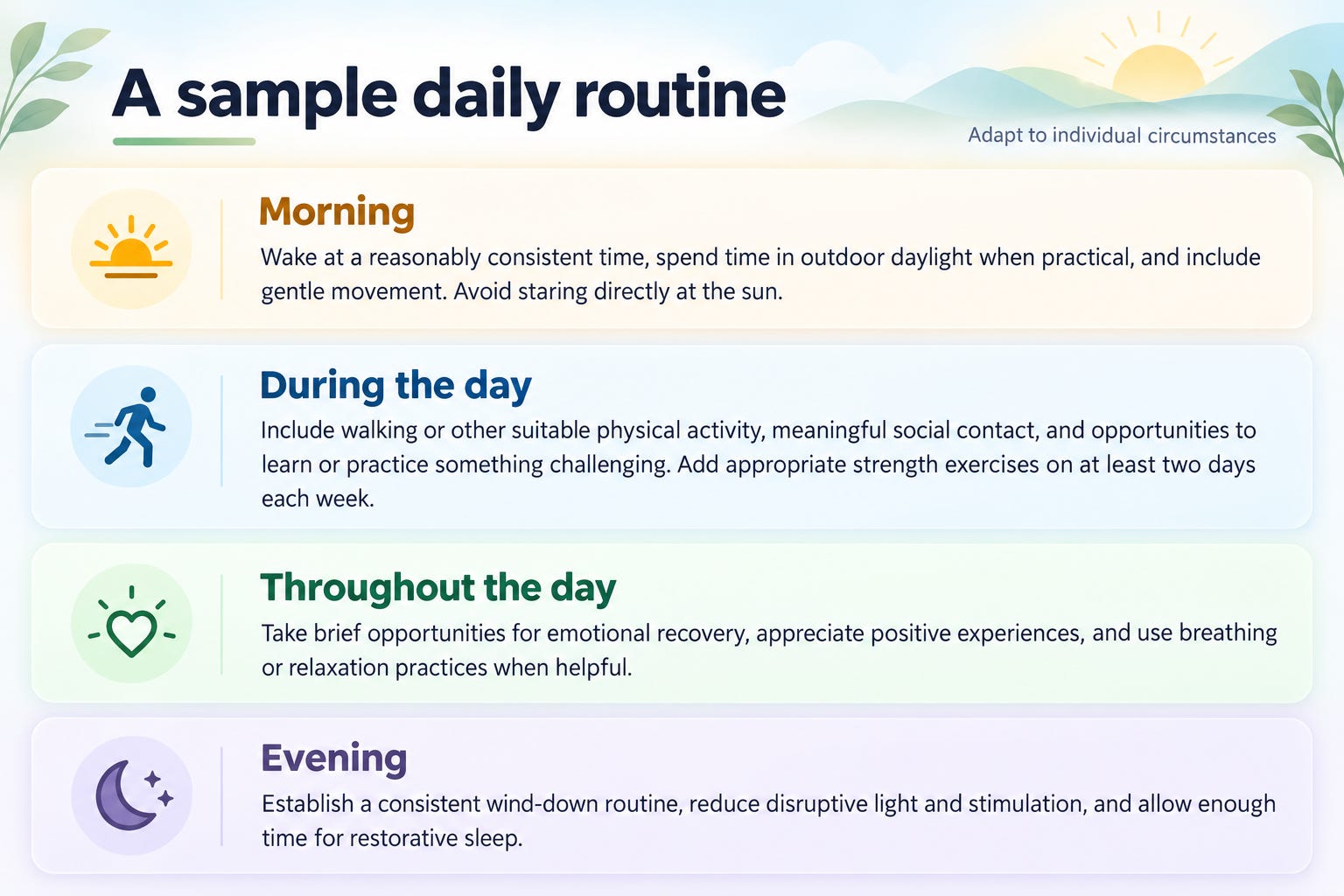
A sample daily routine
Adapt to individual circumstances
Morning
Wake at a reasonably consistent time, spend time in outdoor daylight when practical, and include gentle movement. Avoid staring directly at the sun.
During the day
Include walking or other suitable physical activity, meaningful social contact, and opportunities to learn or practice something challenging. Add appropriate strength exercises on at least two days each week.
Throughout the day
Take brief opportunities for emotional recovery, appreciate positive experiences, and use breathing or relaxation practices when helpful.
Evening
Establish a consistent wind-down routine, reduce disruptive light and stimulation, and allow enough time for restorative sleep.
In addition to daily habits, an evidence-based prevention plan should include appropriate medical evaluation of blood pressure, cardiovascular and metabolic health, hearing, vision, medication effects, nutritional deficiencies when suspected, and persistent sleep difficulties.
None of these activities offers guaranteed protection against dementia. Their value comes from improving health, supporting independence, and addressing modifiable risks rather than promising immunity from aging.
🩸 The Red Blood Perspective
The facts emerging from this investigation are straightforward. Most of the ten recommendations have a reasonable basis in established physiology, clinical research, or psychological science. Yet the transcript repeatedly compresses complex scientific questions into definitive statements. Brain waste removal, hippocampal enlargement, neural rewiring, and cortical thickening are not interchangeable with demonstrated reductions in dementia incidence.
A surgeon’s professional expertise deserves consideration, but a claimed credential cannot replace research evidence. The uploaded transcript does not identify the speaker by name, provide verifiable professional qualifications, or include citations to the studies underlying the recommendations. Consequently, this investigation evaluates the claims themselves rather than relying on the speaker’s authority.
The strongest argument for these lifestyle practices does not require exaggeration. Physical activity, adequate sleep, treatment of deficiencies, social engagement, and management of chronic conditions offer meaningful benefits even when specific neurological mechanisms remain uncertain.
At the same time, the evidence challenges health narratives that place responsibility entirely on individuals while ignoring the conditions in which they live. Economic insecurity, environmental exposure, limited access to care, unsafe neighborhoods, demanding work schedules, and social isolation can influence the very behaviors that prevention programs encourage.
A genuine investigation must follow both sides of the relationship: the choices people make and the structures shaping their available choices.
The material consequences of cognitive decline are substantial. Families face caregiving demands, lost income, emotional exhaustion, and difficult medical and financial decisions. Prevention efforts deserve scrutiny not because they sound uplifting, but because their effectiveness, accessibility, and affordability affect real human lives.
The Red Blood position is therefore neither automatic trust in medical authority nor automatic rejection of medicine. It is to examine documented actions, measurable outcomes, financial incentives, and scientific uncertainty without surrendering independent judgment.
The brain should not become another marketplace in which fear of aging is converted into commercial dependency. Nor should opposition to commercial excess become an excuse to reject legitimate medical treatment.
Both mistakes diminish personal sovereignty.
🌊❤️✨ The Ocean of Love and Positivity Perspective
There is another dimension to this subject, one that scientific measurements alone cannot fully describe.
A person is more than a collection of neurons, medical measurements, and statistical probabilities. Human life includes relationships, memories, creativity, compassion, curiosity, and the extraordinary ability to experience meaning through connection with others.
When we discuss protecting the brain, we are also discussing preserving the capacity to recognize loved ones, experience affection, remember meaningful moments, communicate ideas, and participate in the world with dignity.
This is where an Ocean of Love and Positivity perspective becomes important.
Love does not require proof of increased cortical thickness to have value. Sharing a meal, listening to a lonely neighbor, teaching a child, comforting a frightened friend, and helping an aging parent are meaningful actions regardless of whether scientists can measure their immediate neurological effects.
Positivity does not mean pretending that illness does not exist. It means refusing to reduce a human being to an illness, a diagnosis, or a prediction. Someone living with cognitive impairment remains deserving of respect, companionship, patience, and opportunities for enjoyment.
The same principle applies to people who cannot follow every recommendation. A person with physical disabilities may be unable to perform squats. Someone with chronic insomnia may struggle to sleep adequately. An individual facing poverty or profound grief may find meditation difficult. None should be blamed for circumstances that are not entirely under their control.
Compassion requires adapting support to human needs rather than measuring human worth by compliance with health rules.
An ocean of love also extends beyond the individual. Communities that support older adults, protect people with disabilities, provide accessible transportation, create safe spaces, and reduce unnecessary isolation help build a society in which more people can experience belonging.
The purpose of brain health should not be to pursue eternal youth or create fear of aging. It should be to protect dignity and make the years available to us as meaningful, connected, and fulfilling as possible.
We cannot always prevent suffering. We can decide whether our response to suffering deepens isolation or creates understanding, support, and restoration.
A healthy mind is valuable. A compassionate society is equally essential.
XVI. A FINAL CHALLENGE FROM RED BLOOD JOURNAL — THINK BEYOND WHAT YOU ARE TOLD
We began with a simple question: Could the most important actions for protecting the brain be the things we do every day?
The evidence suggests that many daily behaviors matter. But it also reveals something more important: neither a medical credential nor a convincing scientific explanation should end our investigation.
Question the doctor who promises a cure. Question the company selling a supplement. Question the institution claiming to have all the answers. Question the influencer who turns preliminary research into certainty. And question Red Blood Journal when our own interpretations move beyond what the facts establish.
Look for evidence that can be examined independently. Learn the difference between correlation and causation, between reducing risk and preventing disease, and between a promising biological theory and a treatment demonstrated to improve human health.
Imagination can help us identify possibilities that established thinking has overlooked. But possibility is not proof. A willingness to question authority must always be accompanied by a willingness to correct ourselves when stronger evidence emerges.
Perhaps the deepest question is not simply how we can keep our brains healthy for as long as possible, but what we intend to do with the consciousness, relationships, and opportunities that remain available to us.
Will we use our minds primarily to accumulate fear, resentment, and suspicion? Or will we also use them to understand, create, question, teach, forgive, and improve the human experience?
The investigation must continue outward toward science, institutions, economic incentives, and the consequences of public policy. But it must also turn inward, toward the decisions we make, the habits we cultivate, and the ways we treat one another.
Think beyond what you are told. Examine what can be proven. Question our conclusions, too. And never surrender your responsibility to think for yourself.
🩸🌊❤️✨ — Ocean of Love and Positivity
Blood connects us. The ocean unites us. Love guides us. Positivity illuminates our path.
Red Blood Journal — Think Beyond the Script.
Research Sources and Scientific References
The following sources provide the scientific foundation for this report. The source video transcript contains claims by an unidentified speaker; it does not independently establish his medical credentials or the studies he consulted.
1. World Health Organization — Risk Reduction of Cognitive Decline and Dementia, Second Edition (July 2026). Updated recommendations on lifestyle, clinical conditions, environmental exposures, and prevention.
World Health Organization
2. The Lancet Commission — Dementia Prevention, Intervention, and Care (2024). Research evaluating 14 potentially modifiable risk factors and the estimated population-level opportunities for prevention and delay.
PubMed
3. National Institute on Aging — 2026 Alzheimer’s Disease and Related Dementias Research Progress Report. Discussion of glymphatic clearance, amyloid, tau, and emerging brain research.
National Institute on Aging
4. UK Biobank Research — Outdoor Light, Mood, Sleep, and Circadian Rhythms (2021). Large-scale observational research on daylight exposure and psychological and sleep outcomes.
PubMed
5. National Institute on Aging — Loneliness and Dementia Risk (2025). Analysis of more than 600,000 participants examining the relationship between loneliness and cognitive outcomes.
National Institute on Aging
6. National Institutes of Health — Vitamin B12 Deficiency. Clinical information concerning neurological consequences of B12 deficiency.
NHLBI, NIH
7. WHO — Supplementation and Dementia Risk Reduction (2026). Recommendations against routine B-vitamin, vitamin E, omega-3, and multivitamin supplementation specifically for dementia prevention without diagnosed deficiencies.
NCBI Bookshelf
8. NIH National Center for Complementary and Integrative Health — Meditation and Mindfulness. Research summaries addressing psychological benefits, limitations, safety, and claims about brain structure.
NCCIH
9. Meditation and Cortical Thickness Research. Neuroimaging findings and a 2026 review examining the limitations of the evidence for structural brain changes.
PMC
10. National Institute on Aging — Loneliness and Social Isolation. Research and practical guidance concerning human connection, cognitive decline, and aging.
National Institute on Aging
Editorial note: This article provides general scientific analysis and is not individualized medical advice. Observational associations do not establish causation, and dementia-risk reduction does not guarantee prevention.
🧠
The Brain Health Paradox: Science, Habits, and Prevention
Oct 20, 2026
The provided texts critically evaluate a viral list of ten daily lifestyle habits promoted for brain health, contrasting popular health claims with actual scientific evidence. While habits like getting adequate sleep, exercising, learning new skills, and maintaining social connections offer proven general health benefits, the sources emphasize that preliminary theories about specific structural brain changes are often exaggerated. Furthermore, the investigation argues that true cognitive preservation requires looking beyond individual behaviors to address broader societal factors, such as environmental conditions, economic security, and systemic healthcare. Ultimately, the sources advocate for a balanced approach that combines independent scientific scrutiny with personal agency, while maintaining deep compassion for individuals navigating aging and neurological decline.