


🩸 🌊 RedBloodJournal.com — Report #1308
THE BLOOD LABEL ILLUSION, PART III: IS PERSONALITY WRITTEN IN BLOOD?
When Biology, Belief, and Consciousness Challenge What We Think We Know
By Red Blood | October 30, 2026
Introduction: The Description That Fit Too Well
An ordinary conversation about blood types opened an extraordinary question. After examining the biological diversity of human blood and the historical use of labels to divide humanity, a new subject emerged: Could people who share a blood type also share particular personality characteristics?
In Japan, traditional blood-type personality descriptions associate type A with conscientiousness, type B with creativity, type AB with analytical thinking, and type O with confidence. When one AB-positive individual encountered the description associated with that blood group, the resemblance to their own self-perception seemed remarkable. The experience was sincere, yet it was not an experiment. It raised a question rather than answering one.
Was the resemblance biological, psychological, cultural, or coincidental? Could descriptions be broad enough to fit many people? Does discovering a label change how we understand ourselves? This report examines what the evidence establishes, what remains uncertain, and what is lost when a useful classification becomes a definition of human character.
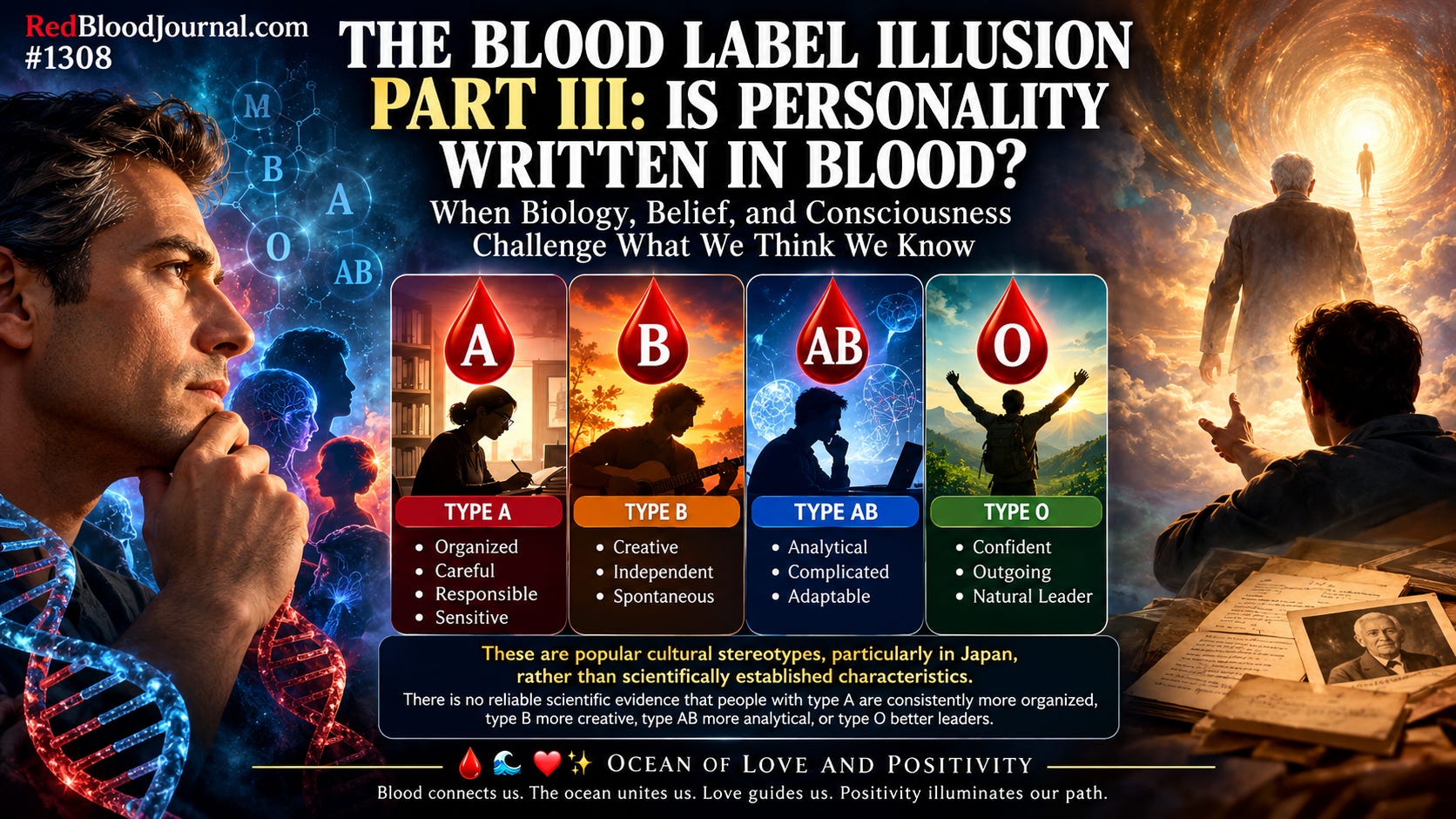
The Four Blood Types and Their Traditional Personality Labels
The following personality descriptions are popular cultural beliefs, particularly in Japan. They are not scientifically established personality profiles. Their inclusion allows readers to compare the traditional classifications and consider whether these descriptions accurately represent their own personalities.
🩸 BLOOD TYPE A — The Organized Personality
People with type A blood are traditionally described as organized, careful, responsible, and sensitive. They are often portrayed as individuals who value structure, planning, reliability, and attention to detail.
🩸 BLOOD TYPE B — The Creative Personality
People with type B blood are traditionally associated with creativity, independence, and spontaneity. They are often characterized as free-thinking individuals who prefer flexibility, personal freedom, and opportunities for self-expression.
🩸 BLOOD TYPE AB — The Analytical Personality
People with type AB blood are traditionally described as analytical, complicated, and adaptable. They are often portrayed as independent thinkers who examine situations from multiple perspectives, adjust to changing circumstances, and resist simple categorization.
🩸 BLOOD TYPE O — The Confident Personality
People with type O blood are traditionally characterized as confident, outgoing, and natural leaders. They are frequently associated with determination, sociability, initiative, and the ability to influence or motivate others.
What Does Science Say?
These descriptions reflect cultural stereotypes rather than established biological relationships. There is no reliable scientific evidence that people with type A blood are consistently more organized, type B more creative, type AB more analytical, or type O better leaders. Rh-positive and Rh-negative status also do not provide scientifically validated personality profiles.
Nevertheless, the popularity of these descriptions raises an intriguing psychological question: Why do some individuals recognize themselves so strongly in the personality characteristics traditionally assigned to their blood type?
The answer may involve coincidence, broadly applicable descriptions, personal experiences, cultural conditioning, or the psychological tendency to recognize ourselves in general personality statements. Understanding the difference between recognizing a description and establishing its biological cause is essential to this investigation.
There is no reliable scientific evidence that people with type A are consistently more organized, type B more creative, type AB more analytical, or type O better leaders. Rh-positive or Rh-negative status does not provide a validated personality profile either.
Figure 1. Traditional blood-type personality stereotypes, shown as cultural claims—not validated psychological categories.
The graphic deliberately places all four descriptions side by side. Readers may recognize themselves in one or several categories, regardless of their actual blood type. That recognition is precisely why the claims deserve testing rather than immediate acceptance.
How a Medical Classification Became a Personality Theory
ABO blood types describe inherited antigens on the surface of red blood cells. They matter enormously for transfusion medicine and can sometimes be associated with differing responses to particular infections. They do not, by themselves, measure conscience, creativity, intelligence, leadership, or compassion.
Nevertheless, blood-type personality theories spread widely through Japanese popular culture during the twentieth century. Books, social discussions, entertainment, and informal compatibility judgments gave these categories an influence far beyond medicine. Once familiar, a claim can feel like common sense, especially when others repeatedly interpret their own experiences through it.
The most revealing question may therefore be not whether a label accurately predicts a person, but how the label shapes others’ expectations. A category can become socially consequential even when the premise behind it is weak.
What the Research Found
In 2014, Kengo Nawata examined large-scale survey data from Japan and the United States comprising more than 10,000 participants. Across 68 personality-related questions, 65 showed no statistically significant blood-group differences. Blood type accounted for less than 0.3 percent of the variance in the measured responses. The findings did not support blood type as a useful personality predictor.
A 2015 study by Shoko Tsuchimine and colleagues analyzed 1,427 Japanese participants, examining ABO genetic variation and personality inventory measures. It reported a small preliminary association involving persistence. That result did not establish that ABO type causes a personality trait, and it should not be treated as validation of popular blood-type character descriptions.
These studies illustrate why the difference between statistical association and individual prediction matters. Even if a weak association appears in one dataset, it cannot tell us whether a particular individual is honest, kind, independent, or a good leader. Strong conclusions require replication, sound measurement, and appropriate control for alternative explanations.
The Barnum Effect: Why a Description Can Feel Uncannily Accurate
Psychologists use the term Barnum effect for the tendency to find personal meaning in descriptions broad enough to fit many people. Someone may be orderly in professional life yet spontaneous with friends, independent in judgment yet cooperative with loved ones. Each trait can seem accurate when the reader supplies their own context.
This does not imply that a person is mistaken about their own qualities. The question is whether blood type explains those qualities. A useful test would conceal the blood-group labels and ask participants to select whichever description best matches them. Researchers could then examine whether their selections correspond to actual blood groups more often than chance would predict.
Even stronger designs would use standardized personality instruments, larger samples, preregistered methods, and appropriate demographic controls. A promising hypothesis must be allowed to fail. Recognition is the beginning of inquiry, not a substitute for it.
When a Label Changes Opportunities
A stereotype can have effects even if it does not describe an underlying biological difference. When employers, partners, classmates, or institutions act on presumed traits, the classification may influence opportunities, confidence, and expectations. Those measurable consequences can later be mistaken for evidence that the original label was correct.
A 2025 working paper by Hideto Koizumi for Japan’s Research Institute of Economy, Trade and Industry investigated blood-type discrimination and described associations with social and economic outcomes. Its findings are important as a research contribution, but estimates from a single working paper should not be treated as settled causal conclusions.
The distinction is decisive: A blood-type label may fail to predict personality while still shaping a person’s experience through the behavior of others. That is a question about institutions, discrimination, and the power of repeated belief—not a demonstration that blood determines character.
Documentation, Testimony, and the Limits of an Explanation
Another question arose during the same conversation: What should we do with experiences that appear meaningful but do not fit easily within established explanations? A family account described a deceased father appearing in a son’s recurring dreams, reportedly communicating names, addresses, and instructions connected to unfinished affairs. The family describes the information as consequential and, in some instances, accurate.
The testimony deserves respectful treatment, but it does not independently establish communication after death. An investigation would need to distinguish what was recorded before later verification, what the dreamer already knew, which details were independently confirmed, and which alternative explanations remain plausible. Memory, coincidence, unconscious inference, and prior knowledge must be considered alongside spiritual interpretations.
The larger lesson is not that science has explained everything, nor that any unexplained event proves a preferred supernatural conclusion. It is that documentation is evidence to examine, not an authority to worship. The absence of documentation does not prove an event never happened; the presence of documentation does not guarantee that a particular interpretation is correct.
A sincere experience, a documented observation, and a verified causal explanation are different levels of knowledge. Confusing them weakens an investigation even when the investigator has good intentions.
Inheritance Is Not a Finished Character
Personality arises through interactions among genetic influences, temperament, developmental conditions, upbringing, social experiences, and choices made across a lifetime. A person may develop greater confidence after hardship, more compassion through loss, or greater independence through experience. Biology can influence dispositions without determining every response.
The same individual can also use a quality in opposite ways. Analytical thinking can support careful inquiry or rationalization. Independence can become courage or indifference. Persuasiveness can serve reconciliation or manipulation. Character cannot be measured adequately by a blood-group symbol.
That is why the question “What type am I?” should never replace “What am I becoming?” The first may identify a legitimate biological fact. The second calls attention to responsibility and development.
The Possibility of Graduation
A spiritual perspective sometimes imagines physical life as a period of learning, followed by a graduation into an understanding unavailable within ordinary human experience. It is a meaningful philosophical possibility, but it is not established by the ABO studies or by individual reports of extraordinary dreams.
If the metaphor has practical value, it lies in humility. We may not know every answer, and we should not pretend otherwise. Yet uncertainty about an afterlife does not postpone responsibility for the harm or compassion we create today. A life of learning requires us to revise beliefs when evidence changes and to remain open to the lived experiences of others without treating every interpretation as proof.
🩸 The Red Blood Perspective — Follow the Label, the Incentive, and the Consequence
The scientific record supports the medical reality of blood-group differences but does not support assigning character or human worth through ABO labels. The investigation must therefore ask who promotes personality claims, how those claims acquire credibility, what commercial and social incentives keep them alive, and which individuals bear the consequences when institutions act on them.
A media company may profit from an attractive personality system; an employer may use a simplistic label to justify a hiring decision; an individual may adopt the label as a convenient explanation for their behavior. These possibilities should be evaluated through identifiable actions and outcomes rather than presumed universal coordination.
The same discipline applies to scientific papers and personal testimony. A publication is not infallible because it is peer reviewed, and a moving experience is not sufficient to prove a causal theory. We should examine methods, chronology, corroboration, alternative explanations, and actual consequences. Where a claim is unproven, the honest description is unproven—not impossible and not established.
The Red Blood conclusion is that labels become dangerous when they are granted authority beyond the evidence supporting them. Their misuse can create exclusion, commercial advantage, and false certainty. The corrective is not abandoning documentation, but examining it critically and refusing to let categories replace individual human beings.
🌊❤️✨ The Ocean of Love and Positivity Perspective — The Person Beyond the Type
We enter life carrying genetic characteristics we did not choose, along with names, languages, cultures, and inherited expectations. These can shape our experiences, but they need not become prisons for our identity. The person who recognizes themselves in an AB personality description may use that moment as an invitation to self-examination rather than as a verdict written in blood.
Being analytical does not guarantee wisdom. Being independent does not guarantee integrity. Even a genuine inherited tendency offers no automatic exemption from the work of becoming kinder, more accountable, and more aware. Love becomes meaningful through how we respond to other people, particularly when their identities and beliefs differ from our own.
Experiences of grief, dreams, and mystery may invite reflection on the possibility of consciousness beyond death. They do not need a forced explanation to awaken compassion. A family can take meaning from an extraordinary experience while remaining humble about what it proves. Positivity is not pretending to know; it is refusing to turn uncertainty into contempt.
The ocean does not require every wave to have the same shape. Humanity does not require every person to share a personality, ancestry, or belief. The challenge is to remember that individuality and dignity can coexist—and that each choice offers an opportunity to express the love we claim to value.
Final Reflection: What Is Written in Blood, and What Is Written Through Choices?
This third installment began with a coincidence worth examining: An AB-positive person encountered a traditional personality description and recognized much of themselves within it. The finding was personally compelling, but science asks a further question: Does the pattern survive controlled comparison with other people and other descriptions? Current evidence does not support using ABO blood type to reliably predict personality.
The investigation also exposes a second truth: Beliefs about categories can change how people are treated, even when the categories do not explain character. That makes the social consequences of labels important in their own right. Meanwhile, extraordinary personal experiences remind us to distinguish what happened, what can be corroborated, and what explanation remains open.
We may never obtain every answer during physical life. But neither uncertainty nor faith excuses us from careful thought. The value of a human being cannot be reduced to antigens, stereotypes, documents, or a single unexplained event. We inherit a body; we develop character through experience, reflection, and action.
A blood type can inform a transfusion. It cannot tell us the worth of the person receiving it. A label can begin a conversation, but it should never be allowed to finish the story.
🩸🌊❤️✨ — Ocean of Love and Positivity
Blood connects us. The ocean unites us. Love guides us. Positivity illuminates our path.
Research References
Nawata, K. (2014). No relationship between blood type and personality: Evidence from large-scale surveys in Japan and the US. The Japanese Journal of Psychology, 85(2), 148–156. https://doi.org/10.4992/jjpsy.85.13016
Tsuchimine, S., Saruwatari, J., Kaneda, A., & Yasui-Furukori, N. (2015). ABO Blood Type and Personality Traits in Healthy Japanese Subjects. PLOS ONE, 10(5), e0126983. https://doi.org/10.1371/journal.pone.0126983
Koizumi, H. (2025). Quantifying Social Construction: Evidence from Blood Type Discrimination in Japan. RIETI Discussion Paper 25-E-017 (working paper). https://www.rieti.go.jp/en/publications/summary/25020013.html
Editorial note: The family dream account is reported testimony, not independently verified evidence of communication after death.
RedBloodJournal.com • Report #1308 • By Red Blood
🩸
The Blood Label Illusion
1 source·Oct 30, 2026
The provided material investigates the cultural belief that human personality traits are determined by blood types, a popular concept particularly prevalent in Japanese society. Although individuals often experience a strong personal resonance with these generalized character descriptions, empirical data from large-scale studies fails to establish any legitimate scientific correlation between biological blood groups and psychological profiles. Furthermore, the text addresses the social consequences of categorization, highlighting how unproven stereotypes can unfairly influence institutional opportunities and human expectations. While medical classifications remain vital for healthcare and transfusions, the narrative emphasizes that true human character is shaped through personal choices, experiences, and lifelong development rather than inherited biological markers. Ultimately, the sources caution against allowing superficial labels to dictate human worth, urging a balanced approach that respects personal mysteries while relying on critical inquiry and genuine compassion.