


🩸 🌍 ⚖️ 🔒 🧠 🎭 ❤️ 🌊 — THE ARCHITECTURE OF OBEDIENCE
From Iran’s Religious Authoritarianism to the West’s Post-COVID Expansion of State Power
RED BLOOD JOURNAL | INVESTIGATIVE REPORT
Publication Date: October 25, 2026
Classification: Government Accountability / Civil Liberties / Political Power / Spirituality
Historical Reference: February 23, 2013 — Radio Sedaye Mardom Interview with Ruhollah Zam
Research Period: 2020–2026
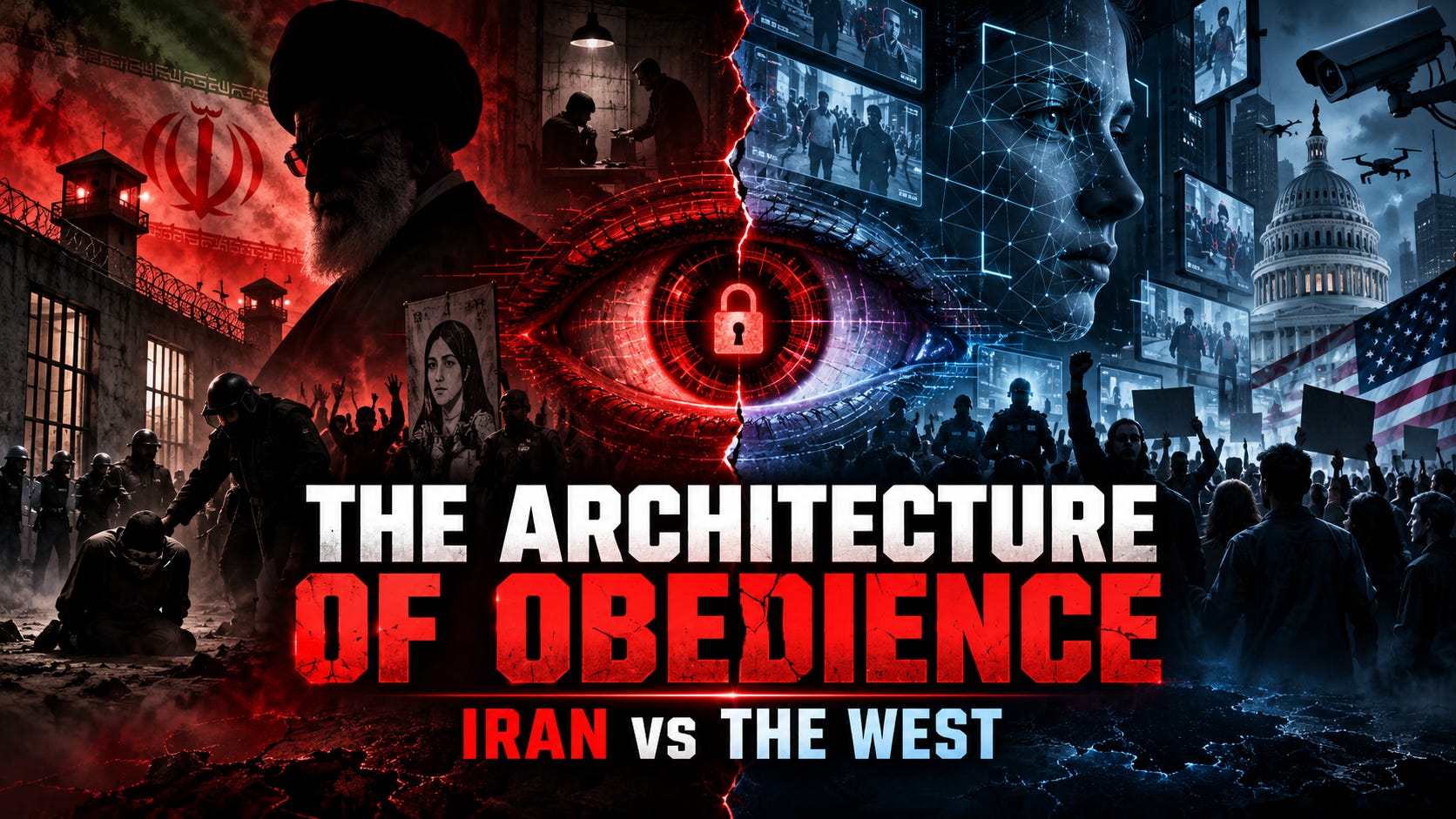
PROLOGUE — THE WARNING FROM A COUNTRY THAT ALREADY KNOWS
When people living under authoritarian governments describe the machinery of repression, democratic societies often listen with sympathy. They recognize the arrests, intimidation, surveillance, censorship, and manipulation of justice as abuses committed somewhere else, by institutions they consider fundamentally different from their own.
But what happens when certain mechanisms associated with authoritarian control begin appearing within democracies, introduced through different legislation, different language, and different justifications?
In Iran, religious authority has provided political power with a framework for enforcing obedience. In Western democracies, restrictions have more commonly been defended through public health, national security, public order, child protection, and digital safety. These justifications are not inherently illegitimate, and they do not produce equivalent abuses. Yet all government power deserves examination, particularly when refusing an official requirement carries serious consequences.
The question is not whether Europe and North America have already become Iran. They have not. The question is whether democracies are accumulating powers that, if left without effective limits, could gradually weaken the freedoms that distinguish them from authoritarian systems.
A radio interview recorded on February 23, 2013, offers a revealing starting point. Its speaker, Ruhollah Zam, described the personal consequences of disagreement with Iran’s political and religious establishment. More than a decade later, his account provides a lens through which to examine emerging systems of compliance, surveillance, and enforcement elsewhere.
The central principle of this investigation is straightforward: judge governments not only by the purposes they announce, but by the powers they exercise, the consequences they impose, and the protections available to those who disagree.
I. THE SON OF THE SYSTEM WHO BECAME ITS OPPONENT
Ruhollah Zam grew up within a family closely connected to Iran’s post-revolutionary cultural establishment. His father, Mohammad Ali Zam, was a cleric and cultural official associated with the Islamic Republic’s artistic institutions. Through this family environment, the younger Zam encountered both the official ideology of the state and the internal contradictions of those entrusted with advancing it.
In the 2013 interview, Zam recalled political disagreements emerging within his family as he became increasingly critical of government practices. He described an assault he attributed to members of a Basij-affiliated group during a filming project, conflicts with security-linked individuals, alleged retaliation for filing complaints, and his subsequent detention following the disputed 2009 presidential election.
His descriptions of imprisonment were particularly personal. He spoke about prolonged solitary confinement, demanding interrogations, separation from his young daughter, and the fear that his detention would damage the only stable family relationship on which his daughter depended.
These are allegations and firsthand recollections from the interview, not independent proof of every claimed incident or perpetrator. Yet the broader practices they describe are consistent with patterns subsequently documented by international human-rights organizations.
Human Rights Watch reported in February 2026 that Iran’s security institutions had carried out large-scale arbitrary arrests and detentions, including cases involving torture, enforced disappearance, and serious risks of unfair trials and executions. Amnesty International has likewise documented systematic abuses of prisoners, restrictions on expression, and persecution of people exercising fundamental rights.
The interview therefore illustrates something larger than one individual’s suffering. It demonstrates how a political order can turn disagreement into a security issue, transform personal relationships into sources of pressure, and use institutions supposedly established to protect society against those who challenge the authorities.
II. EIGHTEEN METHODS OF POLITICAL CONTROL
The Iranian interview and wider documentation reveal a range of methods by which authorities can suppress unwanted political activity. They include political surveillance; monitoring communications; identifying opponents before major events; treating dissent as a security threat; physical intimidation; arbitrary arrest; solitary confinement; prolonged interrogation; psychological pressure; family intimidation; interference in private relationships; travel restrictions; ideological enforcement; manipulation of religious legitimacy; interference with judicial independence; unsupported criminal accusations; retaliation for complaints; and pressure to demonstrate outward conformity.
These methods differ in severity. Surveillance is not torture, a restriction on travel is not an execution, and an unlawful arrest is not necessarily equivalent to enforced disappearance. Nevertheless, they can operate together within a broader architecture of political control.
The governing principle is that an individual’s security, livelihood, movement, family relationships, or liberty becomes increasingly dependent on the approval of powerful institutions. Independent thought remains possible, but exercising it may carry escalating personal costs.
This is the point at which a society must distinguish ordinary law enforcement from the punishment of peaceful dissent. Governments have legitimate authority to investigate crimes, protect public safety, and respond to threats. They cross a fundamental boundary when opposition itself becomes treated as evidence of wrongdoing or when legal processes become instruments of political retaliation.
Understanding that boundary is essential before comparing Iran with the West.
III. COVID-19 — WHEN EMERGENCY POWERS ENTERED EVERYDAY LIFE
The COVID-19 pandemic presented governments with a real and serious public-health emergency. Protecting vulnerable people, maintaining medical services, and limiting disease transmission were legitimate objectives. However, emergency measures also expanded the reach of government into employment, movement, commerce, education, and personal medical decisions.
Across Western countries, citizens experienced different combinations of lockdowns, distancing requirements, vaccination policies, workplace restrictions, testing obligations, and access conditions. The rules varied significantly by jurisdiction and changed as circumstances evolved.
In the United States, the Occupational Safety and Health Administration introduced a rule requiring employees at large employers to be vaccinated or comply with testing and masking requirements. On January 13, 2022, the Supreme Court stayed the rule, concluding that OSHA was likely acting beyond the authority Congress had granted it. On the same date, the Court allowed a separate vaccination rule affecting certain federally funded healthcare facilities.
These decisions illustrated a continuing conflict between urgent executive action and constitutional or statutory limits. The existence of a public-health emergency did not eliminate the requirement that government agencies act within their lawful authority.
The European Union’s Digital COVID Certificate offers another instructive example. Introduced in July 2021, it enabled verification of vaccination, recovery, or testing status for travel-related purposes. The system expired on June 30, 2023. Its expiration is important because it demonstrates that at least one major emergency framework was temporary rather than permanent.
Nevertheless, the pandemic established a powerful political lesson: governments could make participation in important aspects of daily life conditional on compliance with extraordinary requirements.
Such restrictions were not automatically illegitimate, nor were they equivalent to imprisoning political opponents. The lasting concern is whether future emergencies might normalize unnecessarily broad restrictions, inadequate exemptions, or weak mechanisms for challenging official decisions.
Medical consent, religious conscience, public health, and collective responsibility are real interests that sometimes conflict. A free society must address those conflicts openly rather than dismissing every objection as irresponsible or treating every health measure as tyranny.
IV. CANADA — WHEN A POLITICAL PROTEST REACHED THE BANK ACCOUNT
Perhaps the clearest post-COVID example of the dangers of emergency authority emerged during Canada’s Freedom Convoy protests in 2022.
Protesters opposed pandemic-related mandates and restrictions, while authorities faced road blockades, disruption to residents, and interruptions of important border crossings. The government invoked the Emergencies Act on February 14, 2022, introducing extraordinary measures intended to resolve the crisis.
Among those measures were financial restrictions that enabled designated accounts connected to prohibited activities to be frozen under emergency regulations.
This development raised a troubling institutional question: under what circumstances should a government be able to interrupt access to financial services as part of responding to political protest?
The answer cannot be that financial activity is immune from lawful investigation. Funding violence, fraud, or other crimes can legitimately trigger enforcement. But financial powers used during political demonstrations require strict legal limits, individualized evidence, proportionality, and opportunities for review.
On January 16, 2026, Canada’s Federal Court of Appeal upheld findings that the government’s invocation of the Emergencies Act was unreasonable and beyond its lawful authority. The court also found infringements of constitutional protections involving freedom of expression and unreasonable search or seizure.
This is a particularly significant case because the concerns about government overreach were not confined to political commentary. They received formal judicial recognition.
The ruling also illustrates both the value and the limitations of democratic checks and balances. Independent courts could challenge the government’s conduct, but judicial correction occurred years after the emergency measures had affected those involved.
The lesson is not that Canada operates like Iran’s security apparatus. It is that extraordinary financial powers can have serious consequences for civil liberties, even within democracies, and that a legal victory after the event does not necessarily eliminate the harm experienced while the measure was in force.
V. BRITAIN — WHEN PROTEST BECOMES A MATTER OF PREVENTIVE CONTROL
Public demonstrations have historically been among the most important instruments available to ordinary citizens seeking political change. Protest is often inconvenient by nature; it draws attention to grievances that institutions might otherwise prefer to ignore.
Yet there is a legitimate distinction between peaceful assembly and conduct that seriously endangers others or obstructs essential services. The controversy begins when governments expand the meaning of unacceptable disruption so broadly that peaceful political expression becomes increasingly risky.
Britain’s Police, Crime, Sentencing and Courts Act 2022 and Public Order Act 2023 expanded powers related to the policing of demonstrations. These measures included new offenses and restrictions addressing tactics such as locking on, interference with key infrastructure, and certain disruptive protest activities.
British authorities have argued that such powers are necessary to protect public safety, transportation, businesses, and the rights of others. Civil-liberties organizations have warned that the expanded framework can also restrict legitimate demonstrations and discourage people from exercising their rights.
Human Rights Watch’s 2026 assessment criticized the continued use of restrictive protest laws and anti-terrorism powers in ways it considered harmful to freedom of expression and assembly.
The comparison with Iran must remain precise. Britain retains political pluralism, independent courts, electoral competition, and protected avenues for challenging government authority. Iran’s far more severe system of repression cannot be reduced to a comparable dispute over public-order legislation.
But a democratic government can still weaken its own principles when preventive policing becomes so expansive that nonviolent political activity faces disproportionate restrictions.
The essential test is whether the government is preventing demonstrable harm or increasingly protecting itself from the inconvenience of being challenged.
VI. THE EUROPEAN UNION — WHO CONTROLS THE DIGITAL PUBLIC SQUARE?
Political expression has moved from physical meeting places into digital environments. Social media, websites, messaging services, video platforms, and search engines now influence how information reaches the public.
Consequently, regulating these platforms affects more than business operations. It can influence which opinions become visible, which accounts retain audiences, and which organizations can participate effectively in public debate.
The European Union’s Digital Services Act became generally applicable on February 17, 2024. It established requirements relating to illegal content, transparency, platform accountability, and systemic risks. Its stated objectives include making the digital environment safer while protecting fundamental rights.
The Act does not simply prohibit criticism of governments or make political disagreement illegal. It also contains mechanisms intended to improve transparency and users’ ability to challenge certain moderation decisions.
Nevertheless, the system raises important questions about the relationship between government authorities, large technology companies, and political expression. If regulatory incentives encourage platforms to remove borderline or controversial lawful material, censorship-like outcomes can occur without a government directly ordering every individual removal.
This is a potential risk that requires evidence from enforcement decisions, platform transparency reports, appeal outcomes, and particular cases of lawful speech being restricted.
The United Kingdom’s Online Safety Act presents related challenges. Important illegal-content duties took effect in March 2025, followed by child-protection and age-assurance requirements in July 2025. These rules pursue objectives such as preventing exploitation, protecting minors, and addressing unlawful conduct online.
Those objectives deserve serious consideration. But a system intended to protect children can also create privacy concerns when identity verification becomes widespread, and content-monitoring systems can produce errors affecting lawful communications.
Neither the EU nor British framework should be characterized as identical to Iranian censorship. The appropriate investigation is whether regulatory safeguards are sufficiently strong to prevent lawful disagreement from becoming an unintended casualty of enforcement.
VII. THE NEW TECHNOLOGY OF CONTROL — SURVEILLANCE WITHOUT A HUMAN INFORMANT
Traditional authoritarian surveillance depended heavily on informants, interrogators, telephone monitoring, and institutional networks. Digital technology creates the possibility of collecting and processing information on a far greater scale.
Modern systems can connect identity records, biometric information, communications metadata, financial activity, and location histories. Artificial intelligence can make such systems more efficient, creating risks of intrusive profiling and automated decisions that individuals cannot easily understand or challenge.
These capabilities are not inherently authoritarian. They can support fraud prevention, public services, law enforcement, and security. Their impact depends on who controls them, which purposes are legally permitted, and whether effective oversight exists.
In 2024, the European Union adopted its AI Act, with prohibitions on certain unacceptable practices beginning in February 2025. These restrictions cover specified forms of social scoring, manipulative AI systems, sensitive biometric classification, and certain real-time facial-identification practices, subject to defined exceptions.
That legislation is important evidence against the claim that Europe is moving uniformly toward unrestricted surveillance. Some institutions are actively establishing barriers against technologically enabled abuses.
At the same time, exceptions, implementation practices, future legislative changes, and the expanding availability of surveillance technologies all require scrutiny.
The relevant warning is not that every digital identity system is a political prison. It is that the infrastructure required for extensive monitoring may become easier to repurpose than citizens expect.
The fundamental principle should be that surveillance powers are limited by demonstrated necessity, and that individuals have meaningful rights to know, challenge, and correct decisions made about them.
VIII. DIFFERENT JUSTIFICATIONS, SIMILAR QUESTIONS OF POWER
The comparison between Iran and Western democracies becomes more revealing when attention shifts from official ideology to institutional incentives.
Iran’s authorities have often defended restrictions through religion, national security, revolutionary legitimacy, and the preservation of the Islamic Republic. Western governments typically employ different frameworks, including public health, safeguarding democracy, preventing serious disruption, national security, and protecting vulnerable populations.
These differences matter. A public-health requirement designed to prevent infection is not morally or legally identical to imprisoning someone for criticizing a supreme leader. An online safety rule targeting child exploitation is not automatically equivalent to prohibiting opposition journalism.
But different justifications can still raise common institutional questions.
Who defines the threat? Who determines the necessary response? Who benefits from enlarged powers? How long do those powers remain available? What happens to someone who refuses? Can a court intervene effectively? And what consequences follow if officials misuse their authority?
These questions should be applied consistently across political systems.
A government does not become trustworthy simply by declaring its intentions benevolent. Nor should a policy be condemned merely because it involves government authority. Its legitimacy depends on lawful purpose, reliable evidence, proportionality, accountability, and respect for fundamental rights.
This is the difference between investigating mechanisms of power and assuming that every exercise of power is part of a hidden conspiracy.
IX. THE JUDICIARY — THE DIFFERENCE BETWEEN A RIGHT AND A REMEDY
One of the most troubling elements of Zam’s 2013 testimony concerned his allegations that judicial officials lacked practical independence when security institutions opposed his release.
The precise details require corroboration, but the principle is unmistakable: if judges cannot decide cases independently, a citizen’s formal rights may provide little protection.
The Western examples reveal a more complicated picture.
The United States Supreme Court restricted OSHA’s pandemic-related authority in 2022. Canadian courts subsequently found that the federal government’s 2022 emergency declaration exceeded legal limits. These decisions demonstrate that democratic judicial institutions can impose meaningful constraints on executive power.
Yet timing also matters. A restriction affecting employment, income, movement, or financial access may produce consequences before a court reaches its conclusion. The existence of an eventual remedy does not always mean an effective remedy existed when it was needed.
An important measure of institutional freedom is therefore not simply whether courts can reverse unlawful government action, but whether individuals can obtain timely protection before irreparable damage occurs.
A system with independent courts is fundamentally different from one in which the judiciary routinely defers to security authorities. Nevertheless, judicial delay, excessive litigation costs, and limited access to remedies can diminish the practical value of rights even within democracies.
X. RELIGION IN IRAN — WHEN FAITH BECOMES AN INSTRUMENT OF GOVERNMENT
The philosophical turning point in the 2013 interview came when Zam discussed his personal religious beliefs.
He explained that religion, in his understanding, concerned the relationship between an individual and God. Whether another person was Muslim, Christian, Jewish, Baha’i, or followed another belief did not determine that person’s humanity.
This distinction became central to his criticism of Iran’s religious establishment. Zam described interrogators using religious quotations while allegedly engaging in humiliating and psychologically abusive conduct. He questioned the value of outward religious symbolism when the behavior accompanying it contradicted the moral teachings that those symbols were supposed to represent.
The interviewer raised another difficult question: could officials committing abuses genuinely believe they were fulfilling religious duties? If so, hypocrisy alone would not explain the danger. Sincere conviction itself could become destructive when it eliminated moral questioning and placed ideological obedience above human dignity.
This is an important philosophical distinction. Religious belief does not automatically produce authoritarian conduct, and devotion can inspire extraordinary compassion, sacrifice, and resistance to injustice. But political power becomes dangerous when authorities claim that obedience to their interpretation of religion is equivalent to obedience to God.
Under such conditions, challenging political authority can be portrayed as a spiritual offense, and accountability may be obstructed by claims of sacred legitimacy.
The deepest problem is not belief in God. It is the claim that a political institution possesses the authority to compel everyone else’s conscience.
XI. THE RED BLOOD FANTASTIC PERSPECTIVE — SPIRITUALITY WITHOUT COMPULSION
Red Blood Journal approaches spirituality through a different philosophical understanding: human beings are spiritual beings undergoing a human experience, and life is an opportunity for learning, awareness, and personal growth.
From this perspective, religion may provide valuable early guidance, but spiritual development cannot be limited to unquestioning acceptance of inherited doctrines. A mature conscience must be free to investigate, doubt, reconsider, forgive, and grow.
The distinction between religion and spirituality is therefore not necessarily a rejection of religious tradition. It is a rejection of compulsory belief and of the assumption that outward conformity demonstrates inner moral development.
The comparison with Iran’s state-religious model becomes especially clear when considering the treatment of disagreement. In a coercive system, dissent may be interpreted as disobedience that must be corrected or punished. Within the Red Blood Fantastic philosophy, disagreement can be part of the educational process through which individuals develop understanding.
This principle applies equally to secular institutions. Replacing religious orthodoxy with political, scientific, corporate, or technological orthodoxy does not automatically create freedom. Legitimate science depends on evidence and open scrutiny; legitimate government depends on accountable authority; and genuine spirituality depends on conscience rather than compulsion.
Love and positivity are not substitutes for investigation or justice. They provide the moral direction in which evidence and accountability should be used.
The objective is not to excuse harmful conduct, ignore victims, or deny the need for laws. It is to ensure that the pursuit of justice does not become another instrument of hatred, humiliation, or domination.
XII. THE MATERIAL INCENTIVES BEHIND OBEDIENCE
Political power rarely operates through ideology alone. It is also sustained by institutional interests, financial incentives, professional hierarchies, access to resources, and the fear of losing status or livelihood.
A government official may defend an expansion of authority because of a sincere belief that it is necessary. An agency may simultaneously benefit from a larger budget, a broader mandate, or reduced oversight. A technology company may support regulation for public-safety reasons while also discovering that the costs of compliance disadvantage smaller competitors.
These possibilities deserve investigation, but an identifiable financial benefit does not by itself prove a corrupt motive or hidden coordination.
The important question is how incentives shape decisions in practice.
In Iran, powerful political and security institutions have operated within an economic and administrative system closely tied to state authority. In Western democracies, governments increasingly rely on private digital platforms, financial institutions, contractors, and technology providers to implement public policies.
This creates an accountability challenge. Decisions that materially affect individuals may be implemented by organizations that are not themselves directly answerable to voters.
The Red Blood approach asks investigators to follow the decision, the money, the authority, and the consequences. Who requested a restriction? Which organization implemented it? What evidence justified it? Was there a way to appeal? Did anyone profit from the arrangement? And did the restriction ultimately achieve its stated public purpose?
These questions offer a more reliable method of investigation than assuming that a common hidden director controls every institution.
XIII. THE DANGER OF GRADUAL NORMALIZATION
Authoritarian power does not always begin with an openly declared intention to eliminate freedom. It may expand through a sequence of decisions presented as temporary, exceptional, or narrowly necessary.
An emergency introduces a new authority. An institution develops procedures to use it. Citizens become accustomed to the additional requirement. The emergency ends, but some related capabilities, expectations, or administrative habits may remain.
This is a recognizable risk in democratic governance, although it is not an inevitable historical progression.
Since 2020, the Western record has moved in more than one direction. Some authorities expanded restrictions on protest and digital platforms. Courts challenged unlawful uses of emergency powers. Temporary COVID measures expired. New European AI rules established limits on specified surveillance technologies.
These contradictory developments prevent a simple conclusion that the West has marched steadily and uniformly toward authoritarianism.
The stronger conclusion is that democratic societies are engaged in a continuing struggle over the boundaries of government power. Some developments strengthen institutional control, while others reinforce individual protections.
This struggle matters because democracies do not preserve themselves automatically. Their survival depends on citizens, journalists, courts, legislators, and institutions consistently defending the principles that make disagreement possible.
XIV. WHAT THE EVIDENCE ESTABLISHES — AND WHAT IT DOES NOT
The evidence establishes that Iran’s government has engaged in severe, systematic repression of dissent, including arbitrary detention, torture, unfair judicial proceedings, and executions. International human-rights organizations have documented these abuses independently of the 2013 interview.
It also establishes that Western governments expanded several categories of emergency, public-order, and digital-regulatory authority after 2020. Some measures raised serious civil-liberties concerns, while others were expressly designed to protect public rights or respond to documented threats.
Canada’s 2022 emergency declaration provides a particularly important case because appellate judges found that the government exceeded its lawful authority. Britain’s protest laws illustrate how public-order concerns can produce restrictions criticized by human-rights observers. The EU’s digital framework presents unresolved questions about moderation incentives, privacy, and regulatory accountability.
The evidence does not establish that Western governments have collectively adopted Iran’s political system, that they exercise equivalent levels of repression, or that their policies originate from a coordinated plan to eliminate democratic freedoms.
Those distinctions are essential. Exaggeration would weaken the investigation by confusing the documented expansion of particular powers with the much broader claim that Western democracies have already become authoritarian states.
The warning remains serious without requiring that conclusion.
XV. THE REAL TEST OF A FREE SOCIETY
A society’s commitment to freedom is easiest to proclaim when everyone agrees with the authorities. Its real strength is revealed when individuals object to a popular policy, reject an accepted explanation, criticize an influential institution, or refuse to adopt the prevailing political or religious viewpoint.
This does not mean every refusal is lawful or that individual freedom has no limits. Society must balance rights against legitimate obligations to protect others. But restrictions should remain based on evidence and law rather than political convenience, institutional embarrassment, or a desire for unquestioning obedience.
The crucial safeguards are independent courts, transparent decision-making, freedom of expression, protection of private life, limited surveillance, proportionate penalties, and meaningful remedies for government misconduct.
Iran’s experience illustrates the consequences when these protections become subordinate to political-security institutions. The Western cases demonstrate why democratic societies must examine expansions of authority before exceptional powers become ordinary habits.
The lesson is not that every government is identical. It is that no government should be trusted without accountability.
🩸 The Red Blood Perspective
The record of the past six years reveals both warning signs and meaningful resistance to excessive government power. Western democracies have introduced or expanded some policies affecting movement, work, public assembly, digital expression, and financial access. Courts and legislatures have also constrained or ended certain measures, showing that the direction of institutional change is neither uniform nor predetermined.
The defining concern is the cumulative relationship between government authority and individual independence. The more easily institutions can restrict access to essential economic, social, and informational systems, the more important legal safeguards become. Power should be measured by its actual effects, not by the reassuring language used to authorize it.
The comparison with Iran is most useful as a warning about mechanisms, not as a declaration of equivalence. The severe repression documented in Iran demonstrates what can happen when political power escapes independent control. The Western examples demonstrate that established democracies must also confront the risks of overreach, delayed accountability, and disproportionate restrictions.
The essential investigative principle remains unchanged: follow the actions, identify the decision-makers, examine the incentives, measure the consequences, and demand evidence before reaching conclusions.
🌊❤️✨ The Ocean of Love and Positivity Perspective
Humanity’s challenge is not simply to choose between religious government and secular government, or between Eastern and Western political traditions. It is to move beyond the belief that human beings must surrender their conscience to an institution in order to become responsible members of society.
The spiritual journey of humanity cannot be completed through forced obedience. Love cannot be legislated into existence, integrity cannot be measured through outward displays of loyalty, and moral understanding cannot flourish where honest questioning is treated as disloyalty.
If life is a school for spiritual growth, disagreement, uncertainty, and even the recognition of past mistakes become opportunities for learning. The objective is not to condemn every person working within imperfect institutions, but to build systems in which conscience and accountability can prevail over fear and material incentives.
A free society should not require citizens to adopt one religion, one ideology, or one official interpretation of truth to be treated with dignity. It should encourage responsibility through evidence, fairness, compassion, and an honest recognition of the humanity shared by those who disagree.
The highest form of political progress is not replacing one ruling group with another while preserving the same habits of domination. It is creating a society in which power no longer needs to control conscience to maintain legitimacy.
Freedom begins with the protection of the person who disagrees. Spiritual growth begins with the willingness to understand that person. And a truly civilized society must learn to defend both.
🩸🌊❤️✨ — Ocean of Love and Positivity
Blood connects us. The ocean unites us. Love guides us. Positivity illuminates our path.
RESEARCH SOURCES AND DOCUMENTATION
Primary historical material
Radio Sedaye Mardom, February 23, 2013. Persian-language interview with Ruhollah Zam. Transcript supplied for this investigation. Zam’s accounts are treated as testimony requiring independent corroboration where appropriate.
Iran and human rights
Human Rights Watch, February 24, 2026. Iran: Tsunami of Arbitrary Arrests, Enforced Disappearances.
https://www.hrw.org/news/2026/02/24/iran-tsunami-of-arbitrary-arrests-enforced-disappearancesAmnesty International, April 21, 2026. Iran: Human Rights in Iran — Review of 2025/2026.
https://www.amnesty.org/en/documents/mde13/0658/2026/en/
United States and pandemic authority
Supreme Court of the United States, January 13, 2022. National Federation of Independent Business v. Department of Labor, OSHA.
https://www.law.cornell.edu/supremecourt/text/21A244
European Union and COVID restrictions
Council of the European Union. EU Digital COVID Certificate: How It Works.
https://www.consilium.europa.eu/en/policies/coronavirus/eu-digital-covid-certificate/
Canada and emergency authority
Federal Court of Appeal of Canada, January 16, 2026. 2026 FCA 6 — Attorney General of Canada et al. v. Canadian Civil Liberties Association et al.
https://www.fca-caf.ca/en/pages/decisions/plain-language-decision-summaries/2026-fca-6
United Kingdom and protest rights
UK House of Commons Library, July 1, 2026. Police Powers: Protests.
https://commonslibrary.parliament.uk/research-briefings/sn05013/Human Rights Watch. World Report 2026: United Kingdom.
https://www.hrw.org/world-report/2026/country-chapters/united-kingdom
Digital regulation and surveillance
Council of the European Union. Digital Services Act.
https://www.consilium.europa.eu/en/policies/digital-services-act/UK Government. Online Safety Act.
https://www.gov.uk/government/collections/online-safety-actEuropean Commission. AI Act — Prohibited AI Practices, Article 5.
https://ai-act-service-desk.ec.europa.eu/en/ai-act/article-5
Editorial note: This report distinguishes firsthand testimony, independently documented abuses, judicial findings, enacted legislation, and prospective civil-liberties risks. Philosophical interpretations represent Red Blood Journal’s editorial perspective, not findings of the cited institutions.
⚖️
The Architecture of Obedience
Oct 25, 2026
The provided investigative report examines the creeping expansion of state power and control, contrasting the severe, institutionalized repression seen in Iran’s religious authoritarianism with the more subtle accumulation of emergency, digital, and public-order restrictions in Western democracies. By analyzing post-COVID measures, protest laws, online regulations, and surveillance technologies, the text evaluates how governments utilize various justifications to enforce compliance and test the limits of civil liberties. It underscores the vital role of independent judiciaries and legal safeguards in challenging executive overreach before temporary emergency powers become permanent fixtures of daily life. Ultimately, the report argues that true freedom requires constant vigilance against institutional control, advocating for a society where individual conscience, accountability, and human dignity take precedence over compelled obedience.