


🩸 Red Blood Journal Investigative Report
“Tariffs, Deals & Global Jockeying: Trump’s Brazil Pull-Aside Reveals a New Axis of Power”
I. The Setting: A Whispered Summit in Plain Sight
It was billed as a sideline discussion—just a quiet “pull-aside” between President Trump and the President of Brazil. But in the shadows of staged diplomacy, power speaks loudly. Behind the press smiles and “nimble” negotiations, something far more revealing was on display: a new template for U.S.-Brazil alignment, emerging in real time under the glare of international media.
Trump, flanked by negotiators Jamison, Scott, and a reluctant Marco Rubio, slipped into the familiar bravado—declarations of “great deals,” warnings to “not shout,” and assurances that “we move quickly.” But in the coded language of statecraft, every sentence was a breadcrumb.
II. Behind the Tariffs: The Real Battlefield
The U.S.–Brazil tariff standoff isn’t about steel or soybeans. That’s just currency. The real contest is spheres of influence—who gets Latin America, who controls hemispheric supply chains, and who China has on speed dial.
Key Signals:
Trump indicates tariffs are “fair,” then immediately opens the door to “conditions” for reversal.
Brazil arrives not just prepared, but with an agenda in hand, “already in English.”
The subtext: Brazil wants U.S. economic cover as it steps back from its China tilt.
Will Trump deliver? “We can do things fast,” he says. But speed is just part of the theater. The audience is multinational: China, Russia, Europe—and Bolsonaro, watching from a legal bunker in Brazil.
III. The Ghost of Bolsonaro: A Cautionary Tale
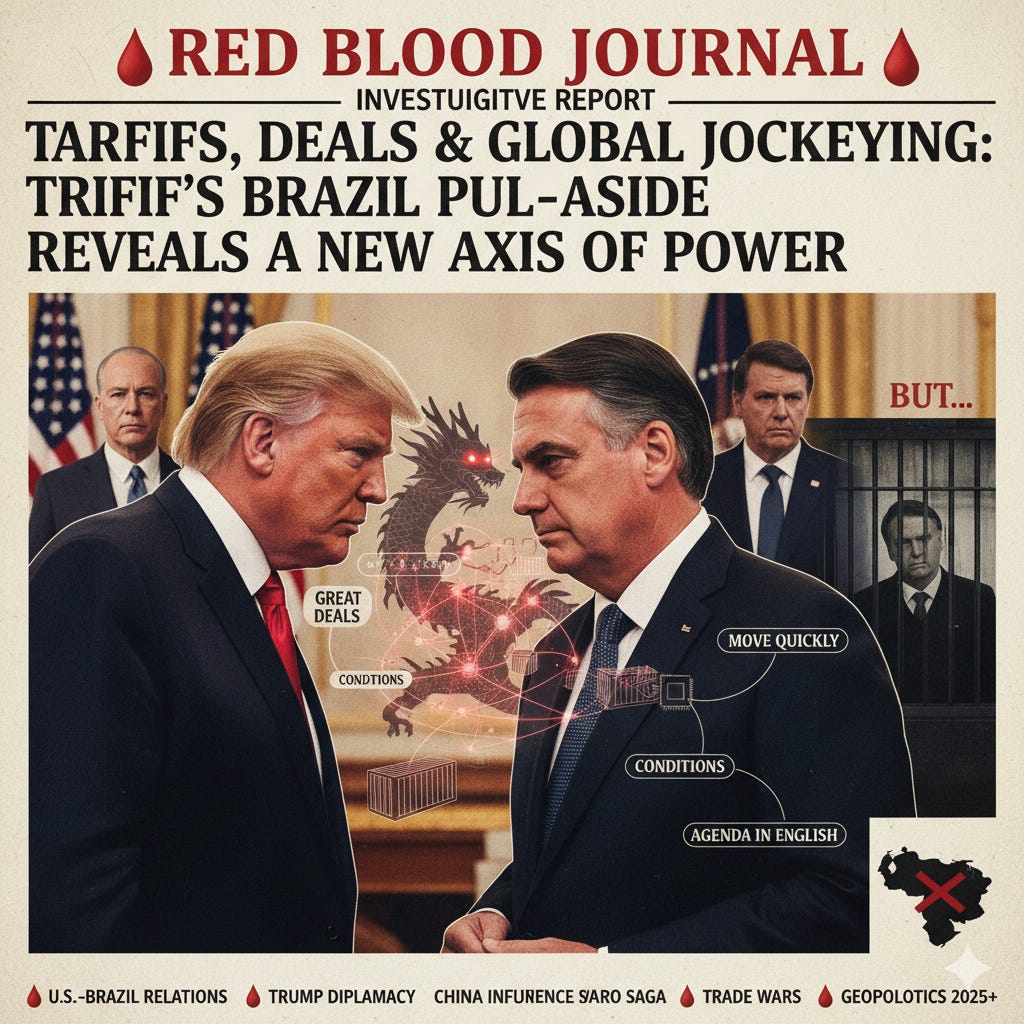
A few questions in, reporters pressed Trump on Jair Bolsonaro—Brazil’s former president, now sidelined in scandal and exile. Trump’s response?
“I feel very badly about what happened to him. I’ve always thought he was a straight shooter, but...”
That “but” hangs over the room like a warning flare. The fall of Bolsonaro is more than a local political drama—it’s a cautionary tale about populist power without a lifeline. Trump didn’t deny loyalty. He denied involvement.
Behind this silence: the shadow fight over who owns the future of the “global right.”
IV. China: The Ever-Present Third Party
Every line of this exchange has a ghost name behind it: China. The dragon in the room. Trump talks of meeting Xi “in South Korea” and then in “either Washington or Mar-a-Lago.” He talks of having “done eight” peace deals, “looking to do nine”—and that ninth is Russia-Ukraine. In other words: U.S. as peace broker, Brazil as regional anchor, China as the wildcard.
Brazil’s part in it? As Trump said: “They’re not involved with Venezuela.”
Translation: They don’t get a say in the Monroe Doctrine. But the U.S. will need Brazil’s ports, logistics, and mineral capacity in coming supply chain wars.
V. The World Stage: A Bigger Game
This was not just about Brazil. It was a declaration that the U.S. intends to stay player-in-chief, even in China’s “backyard.” Trump frames it as a “fair deal” for “both countries,” but the geometry is triangular: U.S. ↔ Brazil ↔ China.
And there, in the awkward pauses, the finger-pointing, and the “boring questions,” lie clues to the architecture of power post-2025: blocs, partnerships, pull-asides, and private agendas brought “already in writing.”
VI. Conclusions: Behind the Press Lines
Brazil wants stability. U.S. wants leverage. Both want distance from China—but not too much.
Bolsonaro is still a card—symbolic, volatile, perhaps redeemable.
Venezuela is “not involved,” but only because it already is—in silence, in sanctions, and in oil fields.
China is everywhere, even here. As Trump said: “We don’t just meet in a vacuum.”
VII. Red Blood Journal Tags
🩸 U.S.–Brazil Relations
🩸 Trump Diplomacy
🩸 China Influence Wars
🩸 Bolsonaro Saga
🩸 Hemispheric Economics
🩸 Trade Wars
🩸 Geopolitics 2025+