


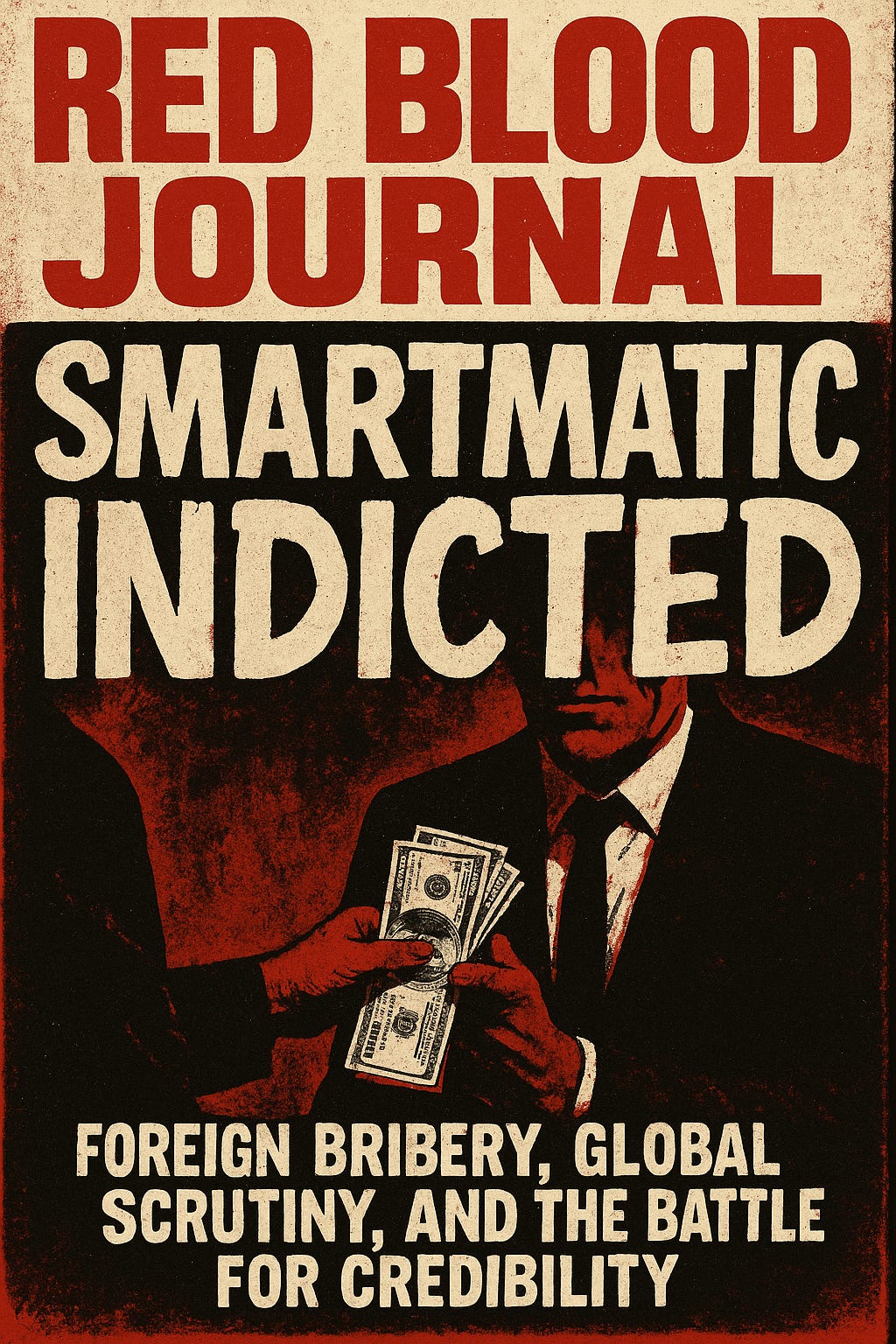
Red Blood Journal – International Investigations Desk
By: Red Blood | October 2025
Smartmatic Indicted: Foreign Bribery, Global Scrutiny, and the Battle for Credibility
Overview
In an unprecedented turn for one of the world’s most recognized election technology firms, Smartmatic—along with its parent company SGO Corporation Ltd.—has been formally indicted in the United States on foreign bribery and money-laundering charges.
The indictment, filed in the Southern District of Florida, alleges that Smartmatic executives conspired to funnel over $1 million in bribes to a Philippine election official between 2015 and 2018 in exchange for favorable government contracts.
For a company long caught in political crossfire—from the 2020 U.S. election defamation battles to questions surrounding its global contracts—this case marks a critical inflection point, blending geopolitics, technology, and questions of integrity at the heart of modern democracy.
The Alleged Scheme
According to the U.S. Department of Justice, Smartmatic and several former executives—including Roger Piñate, Jorge Vasquez, and Elie Moreno—worked with Juan Andres Donato Bautista, the former chairman of the Philippine Commission on Elections (COMELEC), to secure lucrative contracts for election technology services.
The alleged strategy was elaborate:
Inflated invoices for voting machine contracts were used to generate surplus funds.
Those excess funds were then funneled into an offshore slush fund, masked through sham consulting contracts, coded communications, and complex banking transfers across multiple countries.
Payments were allegedly routed to Bautista in exchange for Smartmatic gaining favorable treatment on VAT reimbursements and regulatory decisions.
The indictment cites violations of the U.S. Foreign Corrupt Practices Act (FCPA) and international money-laundering statutes. Each count could carry penalties of up to 20 years in prison for individual defendants and significant corporate fines for Smartmatic and SGO Corporation.
(Sources: U.S. Department of Justice, Reuters, Associated Press, The Guardian)
Corporate Reaction
In a statement issued through legal counsel, Smartmatic strongly denied all allegations, calling the indictment “deeply flawed, both on the facts and on the law.”
The company asserts that its dealings in the Philippines were legitimate, transparent, and fully audited by local and international regulators.
“Smartmatic has always upheld the highest standards of integrity in its operations,”
the firm’s spokesperson said,
adding that it would “vigorously contest these charges and protect its reputation against politically motivated attacks.”
Legal observers note that this is the first time Smartmatic itself—not just its executives—has been directly charged, potentially opening the door to broader corporate liability under the FCPA.
Broader Implications
This indictment lands at a volatile moment for Smartmatic.
The company is currently pursuing multibillion-dollar defamation lawsuits against Fox News, Newsmax, and several pro-Trump figures over false claims linking Smartmatic to election interference in 2020.
Now, with the bribery allegations in the spotlight, the optics are complex: a firm defending its reputation in one courtroom while fighting corruption charges in another.
The juxtaposition could influence public perception—especially in countries where Smartmatic continues to bid on election contracts.
Foreign media, particularly in the Philippines, have treated the indictment as a test case for how global election technology providers operate within developing democracies. The Philippine Department of Justice has announced its own review, citing potential violations of domestic anti-graft laws.
Patterns of Political Risk
Analysts see this as part of a larger trend:
as private election vendors expand globally, they navigate a minefield of political alliances, procurement rules, and expectations from host governments.
“The election business isn’t just about technology—it’s about trust,”
noted London-based political risk expert Harriet Niven.
“When that trust is undermined, it affects not only the company but the legitimacy of elections themselves.”
In emerging democracies, the blurred lines between innovation, influence, and impropriety can easily turn a corporate success story into an international scandal.
The Road Ahead
The case is scheduled for pre-trial hearings in late 2025, with prosecutors preparing to introduce banking and email evidence from multiple jurisdictions. Defense lawyers have already filed motions to dismiss, arguing lack of jurisdiction and insufficient proof of quid-pro-quo arrangements.
If convicted, Smartmatic could face:
Massive fines and forfeitures
Possible suspension from government contracts
Severe reputational damage within the election technology sector
Meanwhile, Smartmatic continues to provide services in several countries, maintaining that its systems remain secure and that “the company’s mission to safeguard democratic processes continues undeterred.”
Conclusion
The indictment against Smartmatic may prove to be a landmark test for global accountability in election technology.
It underscores how foreign bribery laws, once seen as tools of corporate compliance, have become instruments of geopolitical scrutiny in an age when democracy itself is digital.
For Smartmatic, the case represents more than a legal battle—it’s a fight for credibility in the world’s court of public opinion.