


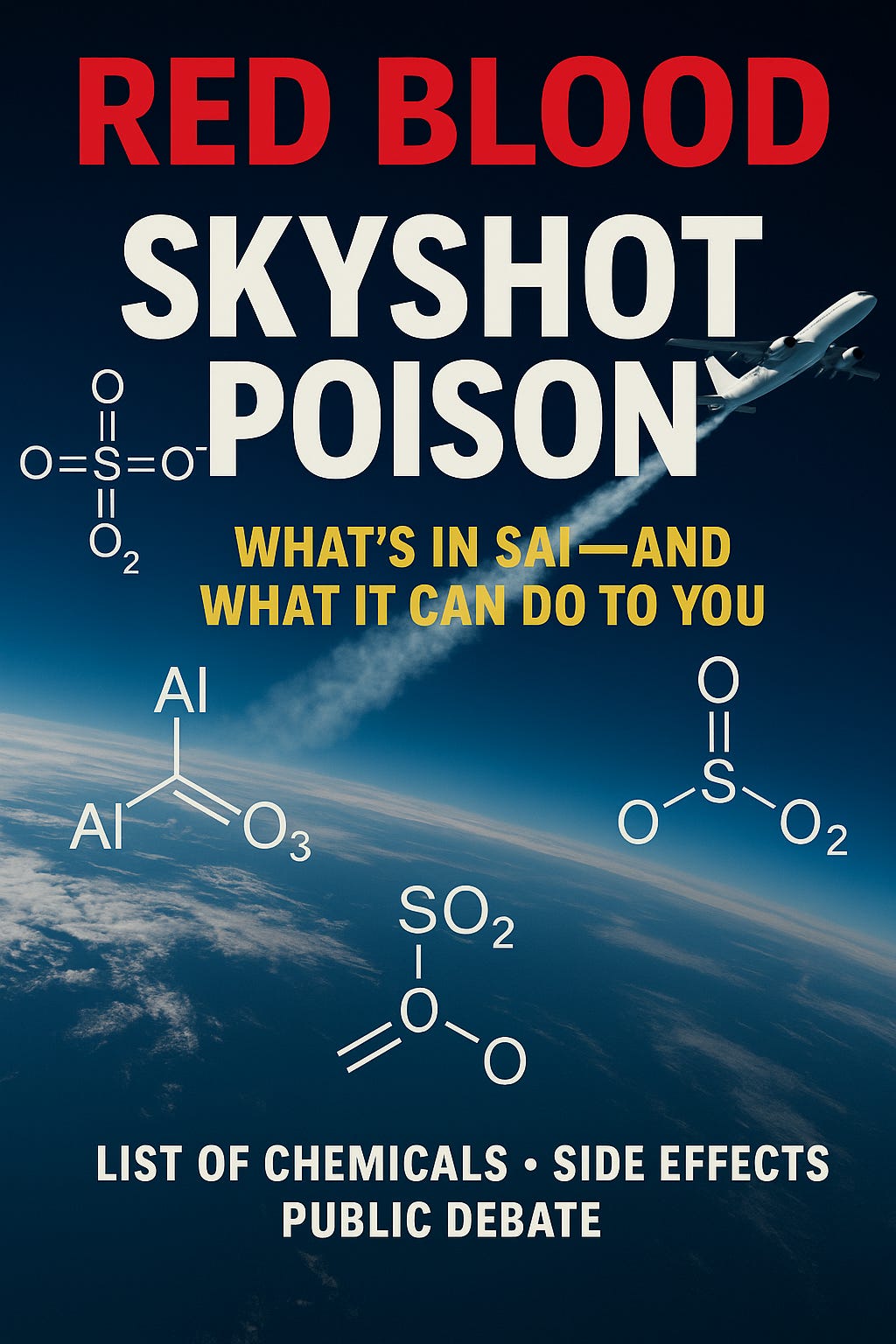
“Skyshot Poison: The Hidden Chemistry of SAI and Its Human Toll”
1. The Aerosol Arsenal: What’s in the Spray?
Any credible assessment of SAI must begin with which particles or precursor gases are being considered (or secretly deployed). The difference between “what’s proposed” and “what’s sprayed” is crucial. Below is a working inventory, drawn from peer-reviewed literature, climate-model proposals, whistleblower filings, and contested disclosures.
Chemical / Material: Sulfur dioxide (SO₂) and derivatives: sulfate aerosol
Role in SAI / Rationale: The classical “volcano mimic” — SO₂ injected into the stratosphere oxidizes into sulfate particles, which scatter sunlight.
Known or Hypothesized Hazards: Respiratory irritation, bronchoconstriction, exacerbation of asthma, formation of fine particulate matter (PM₂.₅), acidification of rain, airway damage.
Source: Sulfur Dioxide Effects on Health – U.S. National Park Service
Notes & Uncertainties: Widely studied in atmospheric science. Some models estimate injection of many millions of tons annually for meaningful cooling.
Chemical / Material: Alumina / Aluminum oxide (Al₂O₃)
Role in SAI / Rationale: A solid, non-reactive candidate in some newer SAI schemes (less ozone damage, less heating).
Known or Hypothesized Hazards: Dust inhalation risks, silicosis-type lung injury, long persistence in tissues, possible neurological toxicity if mobile aluminum forms.
Source: The Salata Institute – Solar Geoengineering Research
Notes & Uncertainties: Less studied in real-world deployment; coating with sulfate or aggregates may alter behavior.
Reference: AGU Publications
Chemical / Material: Calcite / Calcium carbonate (CaCO₃)
Role in SAI / Rationale: Proposed alternative to sulfate to reduce ozone depletion and stratospheric heating.
Known or Hypothesized Hazards: Inhalation dust hazards, respiratory irritation, possible carbonate or local pH shifts in lung fluid, but likely lower chemical reactivity.
Source: The Salata Institute – Solar Geoengineering Research
Notes & Uncertainties: Modeling is preliminary and constrained by lack of stratospheric aging data.
Chemical / Material: Hydrogen sulfide (H₂S), carbonyl sulfide (COS)
Role in SAI / Rationale: Sometimes proposed as precursor gases to produce sulfates in situ.
Known or Hypothesized Hazards: H₂S is acutely toxic — eye irritation, respiratory distress, neurological symptoms, possible death in high concentrations.
Source: PMC Article – Assessing the Direct Occupational and Public Health Impacts of Solar Geoengineering
Notes & Uncertainties: Because of detectability and toxicity, large-scale use is controversial; but small “pulsed” dosing remains a speculative vector.
Chemical / Material: “Coal fly ash” and trace metals (Al, Barium, Arsenic, Lead, Thorium, etc.) (alleged in whistleblower/independent filings)
Role in SAI / Rationale: Some claim aerosol fleets (or chemtrail programs) use ultra-fine fly ash as particulate carrier or co-sprayed agents.
Known or Hypothesized Hazards: Heavy metals, radioactive isotopes, oxidative stress, neurotoxicity, carcinogenicity, kidney/liver damage, cardiovascular stress, etc.
Sources:
Alachua County – Evidence of Coal-Fly-Ash Toxic Chemical Geoengineering
PMC Article – Human and Environmental Dangers Posed by Ongoing Global Geoengineering
Notes & Uncertainties: Highly contested in mainstream science but widely cited in alternative analyses. Many rainwater tests show coal fly ash element signatures (e.g., aluminum leachates).
Important caveats:
Not all of these materials may be used in any single program; you may see hybrid mixes or alternate deployment phases.
Particle size (diameter, surface coating, aggregation) matters enormously: ultra-fine (< 1 µm) penetrates deeper into lungs; coarse particles fall out faster.
Chemical aging: once in stratospheric conditions (low humidity, UV, reactive gases), particles may transform (coatings, reactions, fragmentation). The original pure formulas may not remain intact. AGU Publications+1
Official transparency is minimal; many deployment claims come from modeling, patent disclosures, or leaked “chemtrail / whistleblower” claims — not open government admissions.
2. The Body as Battleground: How Aerosols Can Harm You
When these aerosol particles or precursor gases descend (through slow fallout, atmospheric mixing, or inhalation), they interact with the human respiratory system, circulation, and possibly neurological systems.
Here’s a selection of known or plausible health effects — gathered from occupational exposure studies, air pollution data, toxicology literature, and projection models.
a) Respiratory & Pulmonary Effects
Irritation of eyes, nose, throat: Sulfates, SO₂, fine particulates provoke mucosal inflammation. National Park Service+1
Bronchoconstriction, asthma exacerbation: Sensitive individuals may suffer wheezing, shortness of breath, especially with SO₂ or acidic aerosols. National Park Service+1
Chronic lung injury: Repeated inhalation of fine alumina, silica-like dust, or metal-laden particulates may lead to fibrosis, scarring, reduced lung capacity. (Analogous to silicosis, pneumoconiosis)
Reduced lung function (FEV₁ decline): Controlled experiments show sulfuric acid aerosols at moderate levels reduce forced expiratory volume in humans over repeated exposure. arXiv
b) Cardiovascular, Hematologic, & Systemic Effects
Particulates can enter the bloodstream via alveolar capillaries—triggering oxidative stress, inflammation, endothelial dysfunction, atherosclerosis risk, and possibly arrhythmias.
Metal ion release: Ingestion or inhalation of heavy metals (e.g. aluminum, arsenic, lead) from ash or coated particles may lead to nephrotoxicity, hepatotoxicity, neurotoxicity, or carcinogenesis. PMC+2Alachua County+2
Radioactive decay risk (in case of ash containing thorium, uranium): Some coal fly ash is alleged to harbor trace radioactive material; body fluids could enable leaching and radiological stress. PMC
c) Neurological & Mental Health Concerns
Mobile aluminum species have been linked (in epidemiological and speculative literature) to neurological impairment, Alzheimer’s risk, and cognitive decline. Some meta-reviews raise mental health risks with chronic exposure to aluminum forms used in geoengineering contexts. Wiley Online Library
Neuroinflammation, oxidative stress: Fine metal-laden particulates could cross the blood-brain barrier, triggering microglial activation, chronic inflammation, or subtle neuronal damage.
d) Dermatologic, Ocular & UV Exposure Effects
Increased UV radiation: If SAI deployment leads to ozone depletion, more UV-B reaches the surface. This raise risks of skin cancer, cataracts, DNA damage. RSC Publishing+2Climate.gov+2
Drying, irritation of skin and eyes from aerosol dust, acidity, or UV stressing.
Allergic / immunologic reactions: Some individuals may develop sensitivity or hypersensitivity to aerosol particulates or adsorbed toxic compounds.
3. Putting It All Together: Risk Multipliers & “Layered Effects”
The individual effects above become more dangerous when they combine in real-world exposure contexts. Here are compounding factors:
Synergistic toxicity: simultaneous exposure to metals + particulate + acidic species amplifies harm beyond simple sums.
Vulnerable populations: children, elderly, immunocompromised, pregnant women, asthmatics are at disproportionate risk.
Chronic low-level exposure: the slow buildup of bioaccumulated metals and inhaled dust over decades may lead to cumulative disease.
Geo-political layering: populations in downwind zones, drought-stricken regions, or zones of aerosol “dumping” get a disproportionate chemical burden.
Termination shock: if SAI programs suddenly stop (for political or budget reasons) while greenhouse levels remain high, the “rebound warming” would stress already damaged bodies and ecosystems. Frontiers
4. Gaps, Coverups, and Investigative Threads
No systematic medical monitoring: I found no credible large-scale epidemiological study tracking “SAI-exposed zones” vs. control zones.
Opacity in deployment data: Many aerosol flights are labeled “contrails” or “atmospheric tests.” Flight manifests, chemical logs, and payload specs are rarely disclosed.
Leaked rainwater/soil tests: Some independent researchers claim to detect aluminum, barium, boron, uranium in rainwater and local dust matching fly ash signatures. These claims are controversial and denied by authorities. Alachua County+1
Patent threads: Some patents hint at aerosol composition, injection mechanisms, and atmospheric control systems. These are clues, not proof.
Policy and regulation gaps: Very few national or international laws explicitly forbid large-scale aerosol injection; oversight is murky.
5. Verdict & Urgent Questions
Verdict (Red Blood lens): The chemical side of SAI is not benign. Whether sulfur-based or solid-mineral-based, the aerosols bear nontrivial risks to human health. If SAI is already in covert operation or paired with reactive dispersal (e.g. chemtrail sprays), the health toll may be significantly undercounted.
Urgent investigative leads:
Leaks & Whistleblowers: Seek chemical payload manifests from aerial fleets, HAARP campaign logs, or contractor records.
Medical clustering: Look for disease clusters (respiratory, neurological) in regions under frequent aerosol routes.
Rainwater / dust forensics: High-resolution isotopic and elemental analysis of precipitation and surface dust before, during, and after putative SAI events.
Biomonitoring: Urine, hair, and tissue sampling for trace metals, especially aluminum, arsenic, uranium, etc.
Regulatory and contract review: Probe aerospace, defense, climate-engineering contracts and SUPPLIER networks for aerosol material vendors.
If I were to run a six-part deep dive series, I’d start with “Flight paths & payloads” and “Health clusters on the grid”. We’d cross-pollinate with local doctors, toxicologists, whistleblower sources, and atmospheric chemists.