


🩸 Red Blood Journal Series: The Family Question (Part IV)
“The Post-Family State: Bureaucracy as Parent, Policy as Partner”
1. The Quiet Transfer of Power
No coup was declared, no decree signed, yet a monumental shift occurred over the last century: the family quietly surrendered its sovereignty to the state.
Once, the home handled education, eldercare, welfare, and justice.
Now each function has been nationalized or digitized.
Birth is certified by government, childhood managed by schools, morality outsourced to algorithms, and death documented by code.
The family, once the most local form of governance, has become a client of larger systems.
2. From Kinship to Citizenship
Industrial economies required citizens who could be relocated, taxed, and tallied.
Extended families were unpredictable—they shared property, pooled income, and resisted bureaucratic oversight.
To standardize the population, governments encouraged nuclear households: a man, a woman, two dependents, and a mortgage.
Predictable. Containable. Accountable.
The 20th century perfected this model through policy:
Public schooling replaced parental apprenticeship.
Retirement systems replaced filial duty.
Welfare and insurance replaced kin solidarity.
In the name of efficiency, love was made measurable.
3. The Corporate Parent
When the state grew weary, the corporation adopted the orphan.
Health plans, HR departments, “work families,” and digital ecosystems now provide belonging, guidance, even ritual.
Tech companies don’t just sell devices; they curate identity.
The smartphone became the new hearth — glowing at every table where family once gathered.
The algorithm replaced the grandmother.
4. Welfare as Religion
Policy became moral philosophy.
Every new social program carried an unspoken sermon: dependence is care.
The language of compassion justified permanent management.
To need help became to belong.
Yet as state and market expanded their embrace, the citizen became infantilized — protected, entertained, and endlessly observed.
5. The Loneliness Dividend
For all its surveillance and support, the post-family state cannot teach love.
It can regulate housing, but not warmth; distribute benefits, but not loyalty.
And so loneliness became the defining epidemic of prosperity.
Every vanished family yields two new clients — one for the government, one for the corporation.
Dependency, once a flaw, is now a growth industry.
6. The Algorithmic Heir
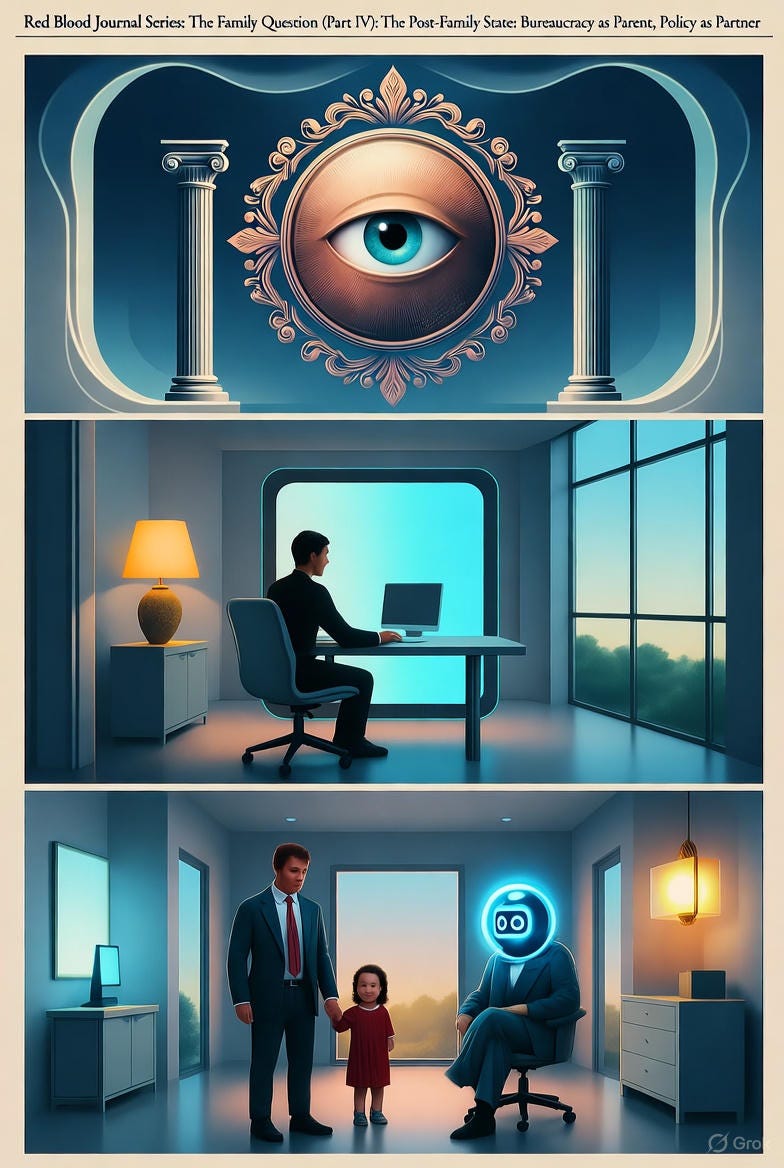
The latest guardian is artificial intelligence: a system that promises personalization while erasing personality.
It watches our spending, guides our opinions, and soon may raise our children through adaptive screens.
Where the father once offered instruction and the mother intuition, the algorithm offers optimization.
The future household may consist of one adult, one child, and one omnipresent digital adviser.

7. What Was Lost
The state can educate, medicate, and adjudicate—but it cannot initiate.
It cannot pass down purpose, myth, or memory.
Those are born only from blood, commitment, and the small, repeated acts that make humans real.
“A civilization that replaces parents with programs may keep its citizens alive,
but not necessarily human.”
8. Foreshadowing the Finale
The closing chapter, Part V – “The Reconstruction of Belonging”, will ask:
Can the family be rebuilt without regression?
Can technology serve kinship instead of replacing it?
What new forms of household could anchor freedom in the age of automation?
Tags
#RedBloodJournal #FamilyQuestion #PostFamilyState #Culture #Sociology #Technology #Governance #Loneliness #AI