


🩸 Red Blood Journal Series: The Family Question (Part III)
“The Gendered Machine: From Factory to Ideology”
Part I explored Polygamy as Function;
Part II examined Monogamy and Industrial Romanticism;
Now Part III moves into ideology — how gender, work, and politics turned family into a battleground.
1. The Invention of the Working Identity
When the factory replaced the farm, it did more than relocate labor — it redefined the human being.
Men became “providers,” women “dependents,” children “cost centers.”
The family, once a self-sufficient micro-economy, was recoded as an emotional refuge from the market that had swallowed every other part of life.
The Industrial Revolution didn’t just mechanize production; it mechanized roles.
Men were valued for output.
Women were praised for restraint.
Both were punished when they deviated from the script.
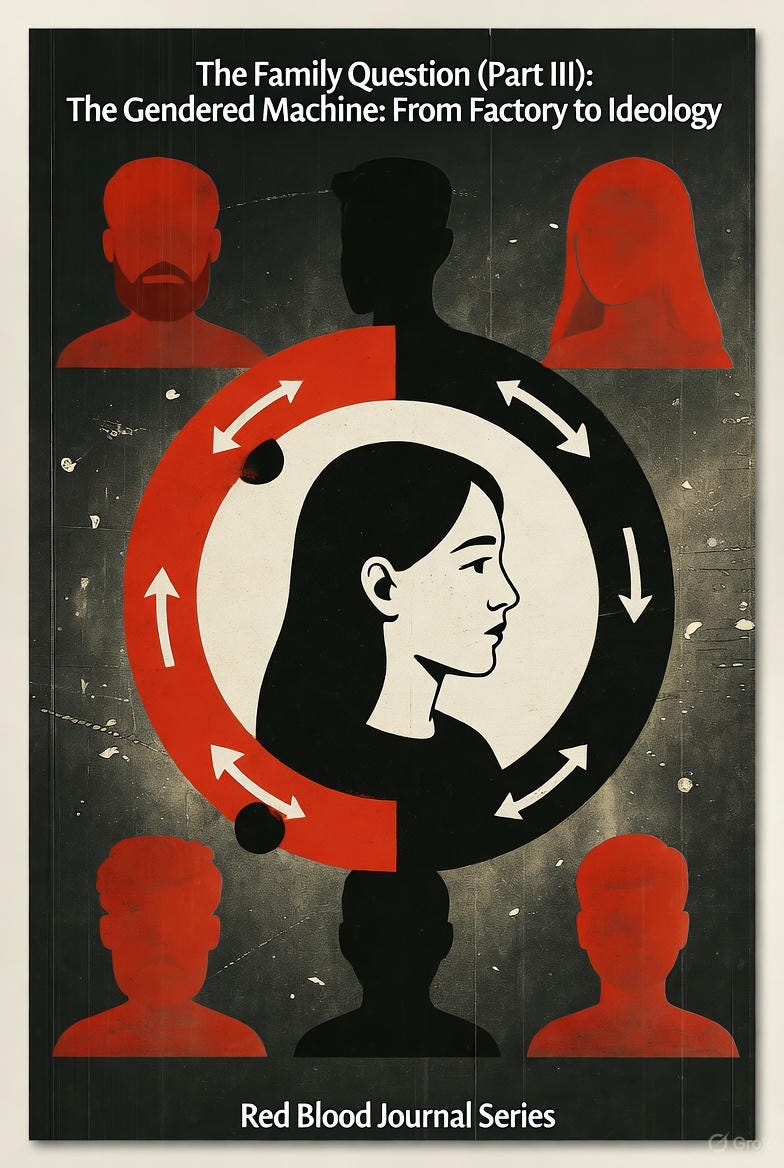
2. Early Feminism and the Two-World Paradox
The first feminists were not enemies of family; they were refugees from economic confinement.
Denied property, pay, or education, they demanded entry into the system that had exiled them.
What they gained in wages they lost in community.
By the late 19th century, industrial capitalism and early feminism formed an uneasy alliance:
one sold independence through consumption, the other through ideology.
Both quietly agreed that dependence — once called interdependence — was the enemy.
3. The Market Learns to Speak Gender
Advertising noticed before academia did: the modern citizen could be engineered through desire.
Soap ads promised purity, cigarettes sold rebellion, fashion marketed freedom.
Every purchase came with a personality.
What began as liberation soon became segmentation — men vs. women, modern vs. traditional, career vs. motherhood.
A society that once organized around families now organized around demographics.
The household was no longer the cell of civilization but the consumer unit of an economy that required both partners at work and both children in daycare.
4. The Ideological Factory
By the mid-20th century, ideology took over where industry had left off.
Universities, media, and policy began manufacturing new moral products: identity, autonomy, equality, empowerment.
Each was noble in isolation; together they produced a cultural supply chain that replaced cooperation with competition inside the home.
Men were told to shed dominance; women to shed dependence; children to shed obedience.
The result wasn’t equality — it was estrangement.
5. The Fallout
Divorce became a civil right rather than a civil failure.
Fertility declined as ambition rose.
Domestic technology replaced domestic intimacy.
When every household member became a self-brand, the family’s old purpose — to unite difference into continuity — evaporated.
In its place: isolated individuals performing togetherness for screens.
6. The Unspoken Truth
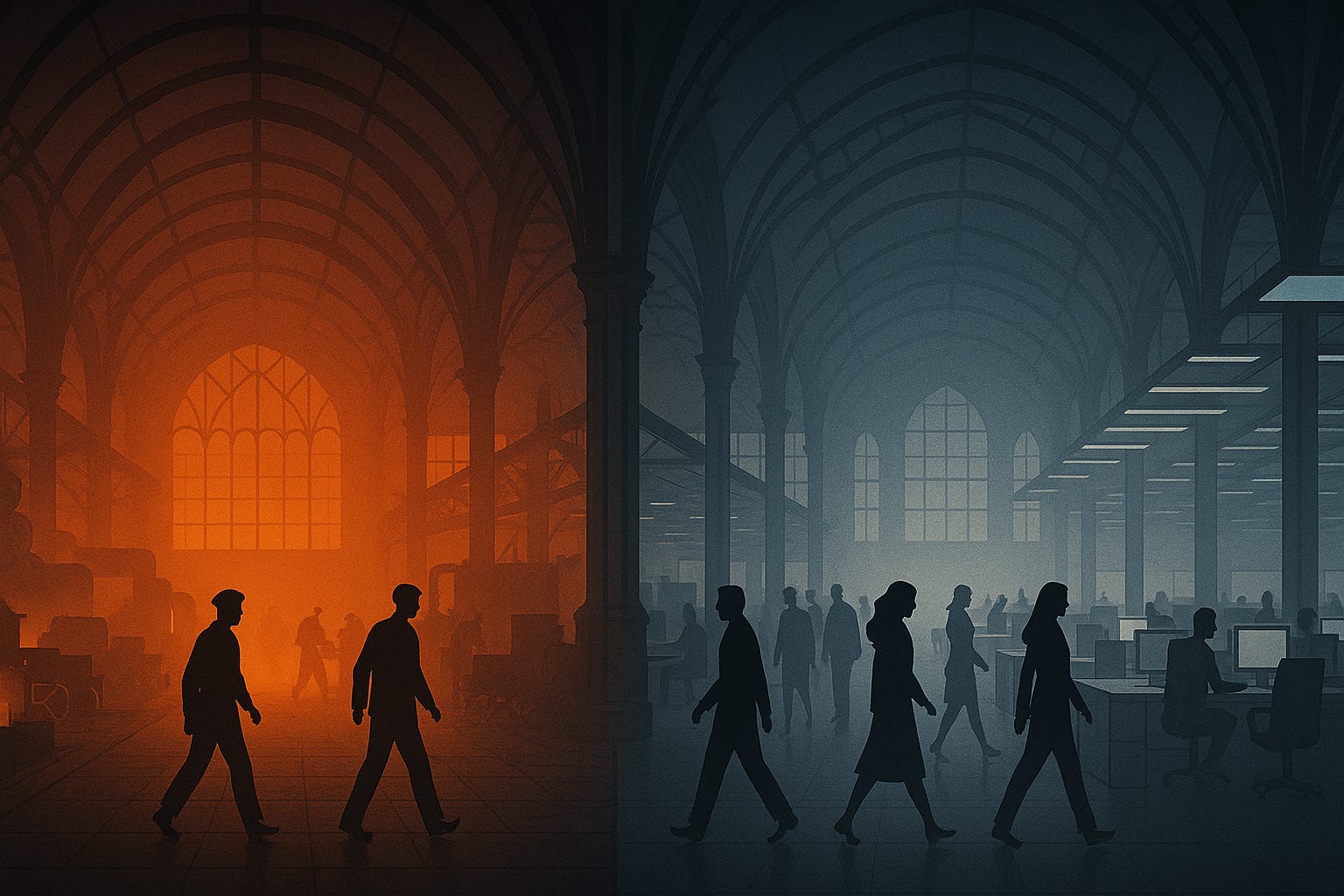
Industrial civilization never ended; it simply digitized itself.
The assembly line now runs through social media and HR departments, where algorithms assign roles more precisely than any foreman ever could.
The modern citizen is still a worker — only now the product is identity.
7. Foreshadowing the Next Chapters
Coming next:
Part IV – “The Post-Family State” — how government and corporations filled the vacuum once occupied by kinship.
Part V – “The Reconstruction of Belonging” — can family, faith, or community be rebuilt without turning backward?
Each step moves closer to the question haunting this series: Can a civilization without families survive its own freedom?
🩸 Closing Reflection
Machines can build nations, but only families build humans.
When ideology replaces love and labor replaces lineage, the gears still turn — but they grind the soul that powers them.
“Progress is the art of forgetting what we once called enough.”
Tags
#RedBloodJournal #FamilyQuestion #Gender #IndustrialSociety #Feminism #Culture #Sociology #History