


🩸 Red Blood Journal Series: The Family Question (Part V)
“The Reconstruction of Belonging: Blueprint for a Post-Fragment World”
1. After the Ashes
Every system that replaced the family promised freedom:
the Church promised salvation,
the State promised security,
the Corporation promised convenience,
the Algorithm promised connection.
Each delivered a fragment of what family once gave in full.
What remains is a civilization rich in options and poor in attachment — a culture where everyone belongs everywhere and nowhere at once.
Now comes the question the modern world cannot answer:
If blood, belief, and duty are gone — what binds us?
2. The Archaeology of Belonging
To rebuild, we must excavate what family originally was — not nostalgia, but function.
It provided:
Continuity of memory,
Mutual obligation,
Division of labor balanced by affection,
A sacred economy of care.
These were not sentimental extras; they were the architecture of survival.
A future that forgets them must reinvent them or perish.
3. The New Tribes
Across the world, new prototypes are already forming:
Intentional communities that share housing, food, and homeschooling.
Multi-generational households reviving the care cycle between elders and youth.
Digital guilds and creative circles that act as emotional kin.
Faith-based networks rebuilding trust where institutions collapsed.
Each is an attempt to restore human density in a culture of distance — fragments of the extended family reassembling in new shapes.
4. Technology as Tool, Not Tyrant
The same digital infrastructure that atomized society can also weave it back together — if reclaimed.
Encrypted channels can replace gossip with governance.
Shared-ledger economies can restore communal ownership.
AI, if confined to service, can handle coordination while leaving meaning to humans.
The principle is simple: tools must amplify care, not replace it.
5. Re-localization of Life
Globalization stretched the family to breaking point; relocalization may heal it.
When work, worship, and education exist within walking distance, interdependence returns naturally.
Community farming, cooperative business, and neighborhood schooling re-create the conditions under which empathy thrives.
The new frontier is not Mars — it is the square mile around your home.
6. Ritual and Renewal
A family without ritual becomes a schedule.
The modern era replaced ceremonies with transactions; birthdays turned into receipts, weddings into legal events, mourning into logistics.
To feel human again, society must re-ritualize ordinary life.
Lighting a candle before dinner, telling ancestral stories, holding digital-free Sabbaths — these are small rebellions against the mechanical world.
Through ritual, memory becomes present.
7. The Moral Economy of Kinship
The old family balanced rights with duty.
The new one must balance freedom with stewardship.
Belonging is not ownership — it is care extended through time.
If every citizen saw themselves as ancestor as well as individual, policy and culture alike would transform:
education would teach continuity,
technology would serve legacy,
and politics would guard posterity.
8. The Final Red Blood Thesis
Civilization will not be saved by ideology but by re-domesticating love — returning it from abstraction to practice.
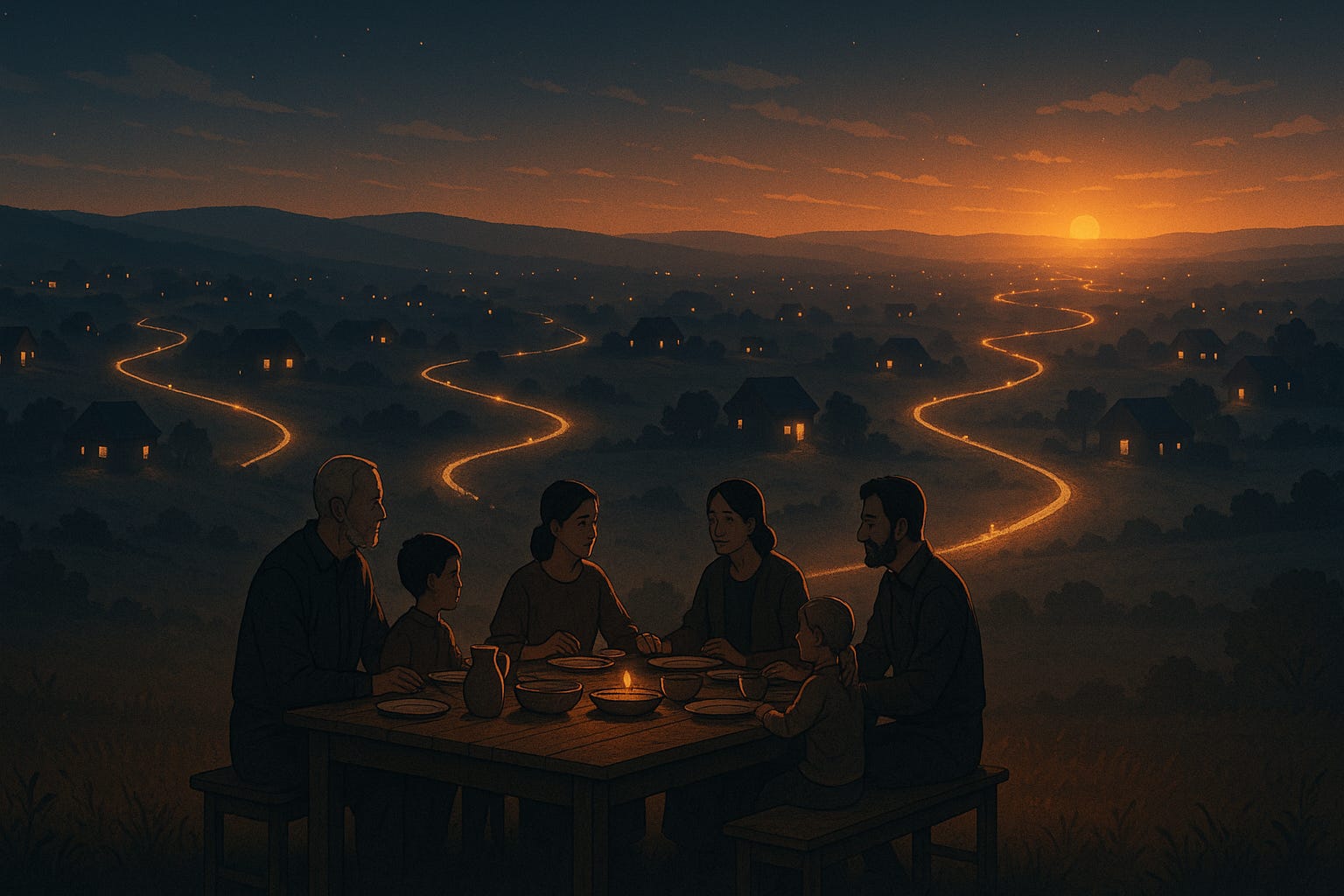
The next renaissance will not come from the academy or the algorithm; it will come from kitchens, workshops, and shared tables.
“The empire collapses from its edges,
but humanity endures where the bread is broken.”
The reconstruction begins not with policy, but with people —
two or three who choose to live as if the human bond still matters.
Tags
#RedBloodJournal #FamilyQuestion #Belonging #Community #Future #Society #Ritual #Technology #Hope