


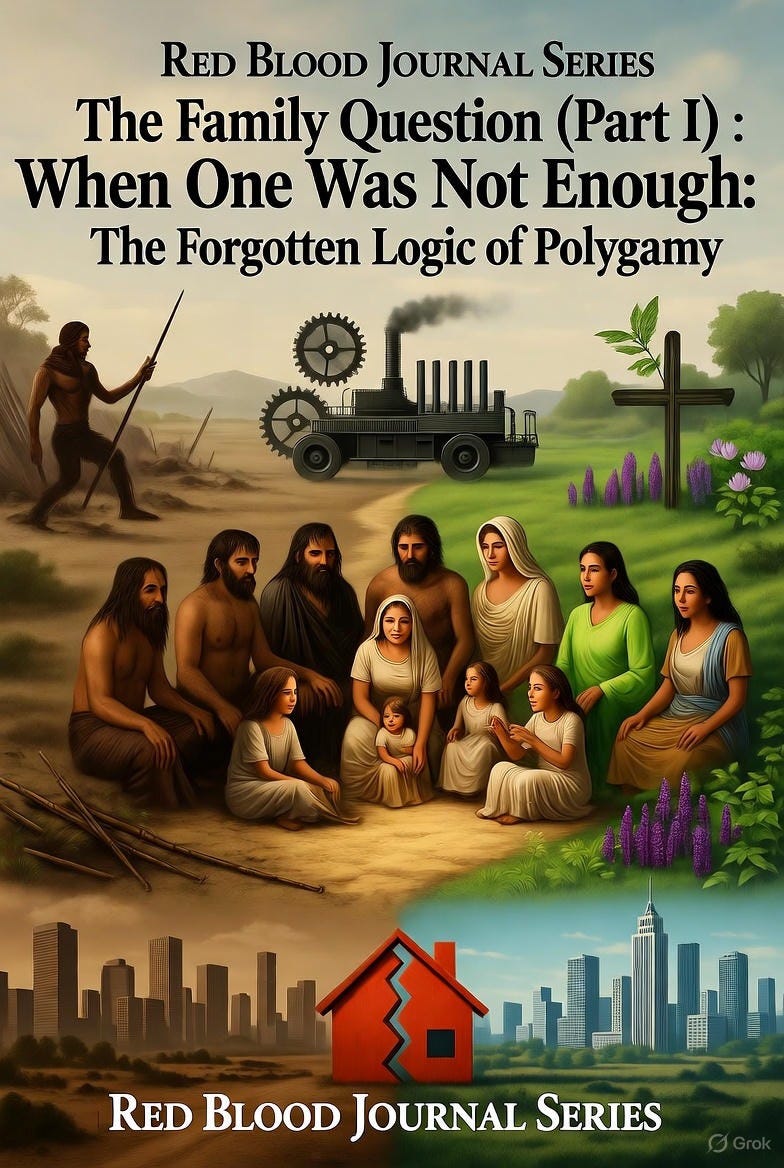
🩸 Red Blood Journal Series: The Family Question
(Part I)
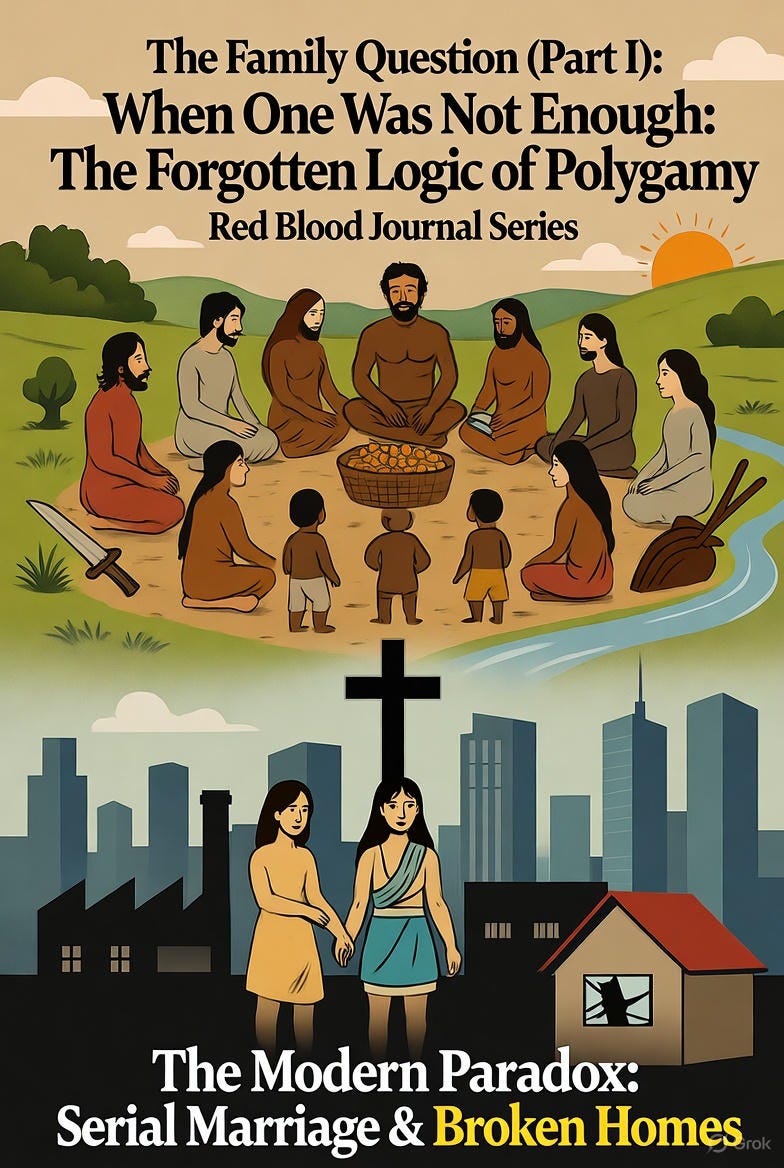
“When One Was Not Enough: The Forgotten Logic of Polygamy”
1. The Beginning of the Human Contract
Before law, before nation, before creed, there was family.
In that primitive circle of protection and obligation, humanity learned what loyalty meant. But across history, the word family never had one single shape. It flexed with famine and fortune, with war and worship. Where life was precarious, marriage served survival; where abundance allowed ideals, it was remade into romance.
To understand how modern civilization re-engineered the home, we must begin with the oldest controversy: why men and women once accepted plural marriage as natural order.
2. Polygamy as Function, Not Fantasy
Long before scripture, biology wrote the first social code: reproduction favored cooperation.
In ancient agrarian societies, labor and lineage determined survival.
One man with several wives meant more children, more workers, and stronger defense.
In regions devastated by war, where men were few and widows many, plural marriage became welfare before the word existed.
Even in the Old Testament, polygyny was not rebellion but regulation. The law in Exodus 21:10 required a man who took another wife to provide for both equally—a moral control over an already-existing practice.
Centuries later, Islam formalized the same logic: permission to marry up to four wives only if justice between them could be maintained.
The pattern across civilizations was pragmatic: keep the household whole, protect women from destitution, and preserve lineage. Fidelity was measured not by exclusivity but by responsibility.
3. The Cultural Turn Toward Monogamy
The shift to strict monogamy arrived with urbanization, inheritance law, and the Church’s new role as registrar of souls and property.
When love became privatized—no longer a clan alliance or survival pact—marriage turned inward.
Industrial economies preferred small, mobile families; the great household was replaced by the wage earner and his nuclear unit.
By the nineteenth century, Western moral codes had sanctified monogamy as the only respectable form, and plural marriage was recast as primitive. The same empires that outlawed it abroad depended on concubinage and mistress culture at home—a quiet hypocrisy history rarely confesses.
4. The Modern Paradox
Today, monogamy is law but not practice. Serial marriage, divorce, and hidden polygamy through affairs have recreated multiplicity under new names. The structure changed; the impulse remained.
What was once an open, managed system became a cycle of secrecy, litigation, and broken homes.
Children who might once have grown in an extended family now shuttle between fragments of two.
Where earlier societies integrated desire into duty, ours isolates desire and calls the aftermath freedom.
5. Why This Matters Now
Every civilization eventually revisits the question of how its people love, reproduce, and raise the next generation.
Family is not a private eccentricity—it’s the engine of demographic survival and cultural continuity.
When a society forgets why it chose its marriage rules, it also forgets what those rules were meant to protect.
This investigation begins with polygamy because it exposes the tension between nature and ideology, between what worked and what was declared moral.
In later installments we’ll follow that thread through:
the industrial rewriting of gender roles,
the 20th-century campaigns that redefined intimacy and identity, and
the emerging post-family order where the state replaces kinship.
Each part will ask a single question: Who benefits when the bonds between man, woman, and child are redesigned?
6. Closing Reflection
Polygamy, whether one approves or not, reminds us that the human story began with cooperation, not competition. The old world measured morality by how well one provided, not by how narrowly one possessed.
Understanding that difference is essential before we judge the past—or design the future.
“A society that forgets the logic of its ancestors cannot build the logic of its descendants.”
Tags
#RedBloodJournal #FamilyQuestion #Marriage #Polygamy #History #Sociology #Culture #FutureOfFamily