


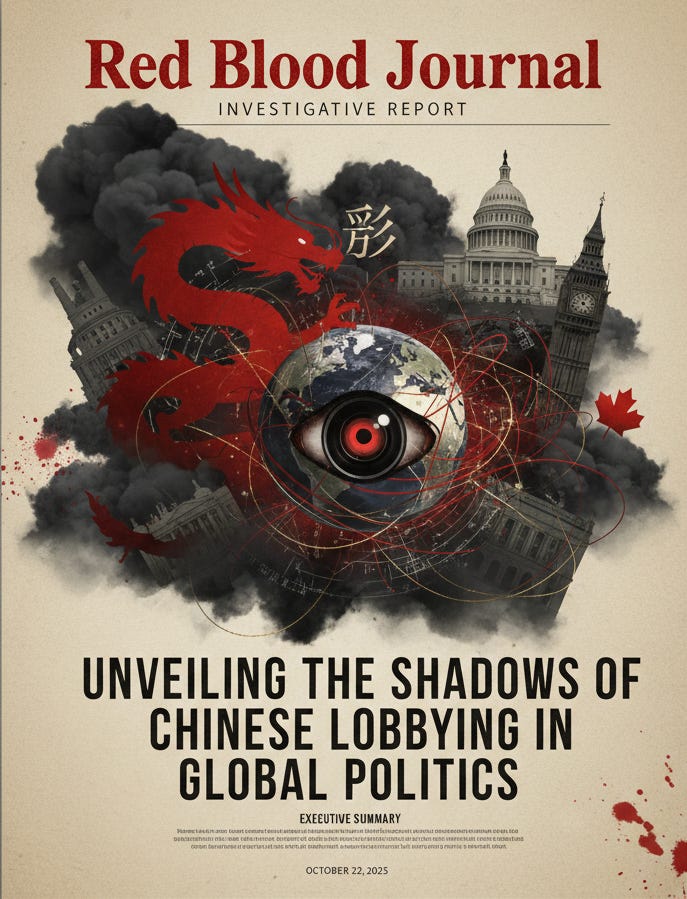
Red Blood Journal Investigative Report: Unveiling the Shadows of Chinese Lobbying in Global Politics
Red Blood Journal Investigative Team, October 22, 2025
Executive Summary
In an era of escalating geopolitical tensions, the influence of the People’s Republic of China (PRC) on foreign political landscapes has come under intense scrutiny. This investigative report, compiled for the Red Blood Journal, delves into the multifaceted strategies employed by Chinese entities to shape policy decisions in Western democracies, particularly the United States. Drawing from declassified intelligence, lobbying disclosures, academic analyses, and recent media exposés, we uncover a network of overt and covert operations that blend traditional lobbying with propaganda, economic leverage, and elite capture. While China’s spending on registered lobbying remains modest compared to other nations—estimated at under $10 million annually in the U.S.—its broader influence campaigns, including through the United Front Work Department (UFWD), have amplified its reach. This report examines historical precedents, contemporary tactics, key actors, and the implications for democratic integrity, highlighting both substantiated efforts and areas of debate.
Historical Context: From the “China Lobby” to Modern Influence
The term “China Lobby” originated in the mid-20th century, referring to advocacy groups supporting the Republic of China (Taiwan) against the communist mainland. During the 1950s, figures like Alfred Kohlberg funded pro-Taiwan media outlets such as The China Monthly to denounce U.S. policies toward Mao Zedong’s regime. This lobby successfully delayed U.S. recognition of the PRC until 1979, leveraging congressional allies and public sympathy for Chiang Kai-shek. By the 1980s, as Deng Xiaoping’s reforms opened China to trade, the dynamic shifted. PRC-linked entities began cultivating U.S. business interests, with companies flocking to exploit new opportunities.
Fast-forward to the 21st century, and the PRC’s approach has evolved into a sophisticated “autocratic lobbying” model. According to Foreign Agents Registration Act (FARA) records, over 10,000 lobbying activities by Chinese government entities occurred in the U.S. between 2005 and 2019. This includes efforts to sway votes on bills related to national security, trade, and human rights. Research by Erin Baggott Carter indicates that such lobbying doubles the likelihood of U.S. legislators sponsoring pro-China legislation. Unlike the overt pro-Taiwan lobby of old, modern PRC influence often operates through proxies, avoiding direct confrontation while embedding in economic and cultural spheres.
Current Lobbying Tactics: A Multi-Pronged Assault
Chinese lobbying in the U.S. and Western politics is characterized by a blend of legal registrations, economic incentives, and covert operations. The Quincy Institute’s 2024 research brief notes that China spends “next to no money on traditional lobbying or campaign activities,” focusing instead on indirect channels. However, this understates the broader ecosystem.
Registered Lobbying and Former Officials
Firms like Squire Patton Boggs and Brownstein Hyatt Farber Schreck have represented Chinese clients, including state-owned entities. Former House Speaker John Boehner, after advocating for China’s most-favored-nation status in the 1990s, joined Squire Patton Boggs to represent the Chinese Embassy. Similarly, ex-Senator Barbara Boxer and former Louisiana Rep. Charles Boustany have lobbied for Chinese interests. Huawei, despite U.S. sanctions, spent millions on lobbying, hiring figures like former national security official Samir Jain to challenge restrictions. In 2024, amid tightened scrutiny via the Department of Defense’s “1260H list” of Chinese military-linked companies, several U.S. lobbyists dropped clients like DJI and Hesai.
The Wilson Center’s project on CCP lobbying reveals that such efforts make Congress members more likely to support China-friendly bills while opposing hostile ones, based on FARA data covering over 10,000 activities. A 2023 U.S.-China Economic and Security Review Commission testimony by Baggott Carter quantified this: targeted legislators are at least twice as likely to back pro-China votes.
Propaganda and Media Influence
Beyond direct lobbying, China invests heavily in shaping narratives. China Daily spent over $19 million since 2016 on U.S. media inserts, including in The Wall Street Journal and USA Today, promoting economic cooperation while downplaying issues like military rivalry or religious persecutions. Sponsored trips for journalists—over 200 from major outlets between 2015-2020—often result in softened coverage. Social media amplification, with an estimated $2 million on X ads in 2022, counters negative stories on Xinjiang or Hong Kong.
In the UK, Labour MP Barry Gardiner received £428,000 from Christine Lee, linked to the UFWD, funding staff and activities between 2013-2020. MI5’s 2022 alert labeled this as “covert political interference.” Similar patterns emerge in Canada, where CSIS reported Chinese infiltration of provincial and federal party leadership races in 2022, including clandestine funding for a mayoral candidate. A 2022 memo revealed $250,000 in illegal donations to Canadian politicians, breaching elections laws.
Economic and Diaspora Leverage
The UFWD coordinates diaspora groups to lobby locally, suppressing criticism of China’s policies. Investments in U.S. firms create dependencies, pressuring avoidance of anti-China stances. In regional organizations like ASEAN, China uses development finance to gain influence, as seen in a 2025 Cambridge study. Think tanks and universities receive funding to produce favorable reports, indirectly influencing policymakers.
Recent X discussions highlight concerns: One post notes Chinese diaspora lobbying in the U.S. during the 1980s-90s, while another alleges CCP bribes to derail U.S. political agendas in 2025. A 2023 Rasmussen report claimed 60% of illegal funds to Democratic group ActBlue originated from China, though this remains unverified.
Key Cases: Hikvision, ZTE, and Beyond
Hikvision and ZTE: These sanctioned firms hired former Congress members to lobby against restrictions tied to Uyghur abuses. Case studies show lobbying’s promise and limits in pivoting media coverage toward economic cooperation.
Huawei’s Campaign: A seven-figure effort in 2024 involved suing the U.S. government and hiring ex-officials to challenge sanctions.
Election Interference: In Canada, CSIS documented $250,000 in illegal donations and infiltration of 2022 races. In the U.S., a 2025 House report uncovered billions in taxpayer funds indirectly aiding Chinese military research.
Hong Kong’s Efforts: The Hong Kong government spent millions lobbying against U.S. human rights bills, per a 2023 HKDC report.
Impacts on Democratic Integrity
Chinese influence has tangible effects: A 2025 Senate hearing noted PRC interference in global elections, skirting lobbying laws. Critics argue it distorts policy, enabling issues like trade imbalances and human rights oversights. However, sources like the Quincy Institute contend China’s low traditional spending limits its direct sway, emphasizing bias in media portrayals. Proposed reforms include banning lobbyists for foreign adversaries (e.g., the SHAME Act) and stricter FARA enforcement.
Conclusion: Vigilance in an Asymmetric Arena
This report substantiates China’s strategic use of lobbying to advance its interests, often through indirect means that challenge democratic transparency. While not the dominant foreign influencer—trailing nations like Israel or Saudi Arabia in spending—the PRC’s integrated approach poses unique risks. Policymakers must balance engagement with safeguards, ensuring foreign influence does not undermine national sovereignty. Future investigations should probe emerging tactics, such as AI-driven propaganda and deeper economic entanglements.