


1) The Oldest Propaganda Still Standing
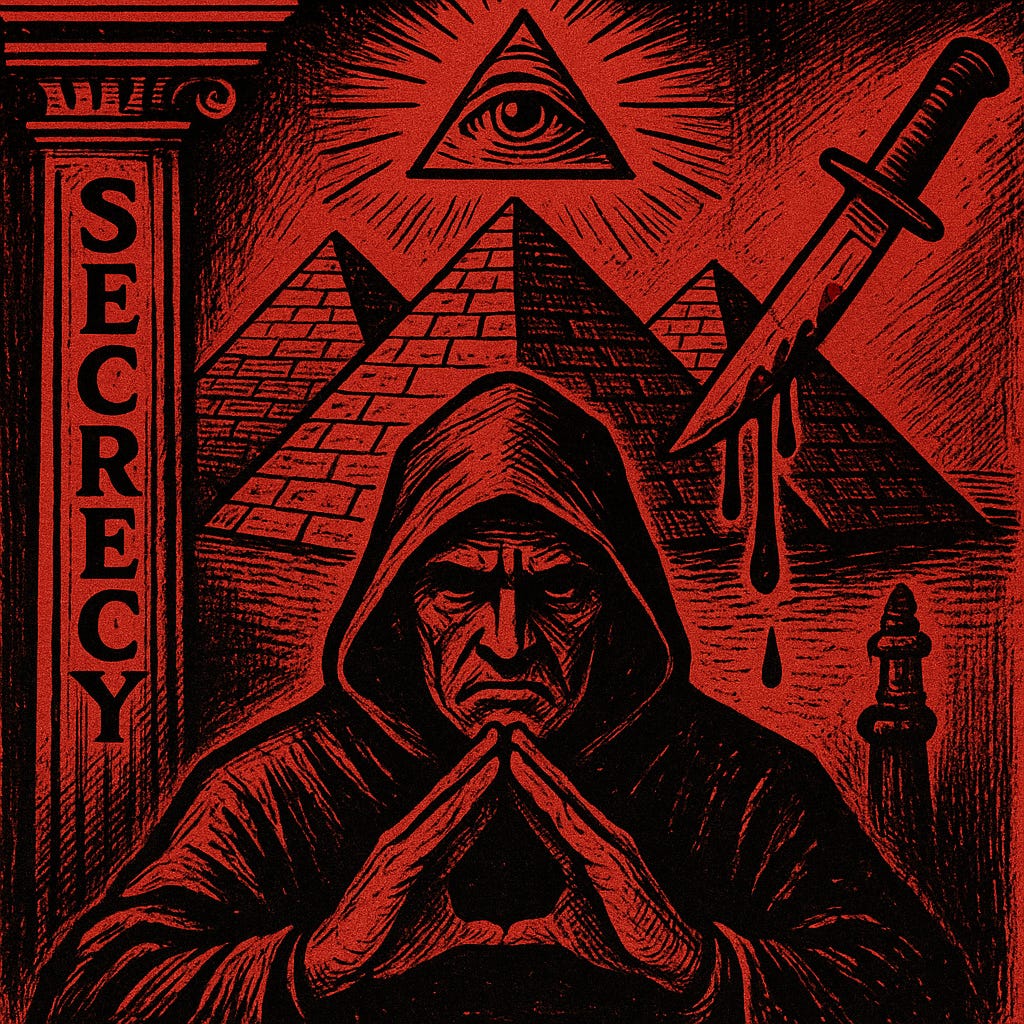
The Great Pyramids were not just tombs; they were messaging—stone-carved press releases from the state. Monumental scale told ordinary people that the ruling order could mobilize resources for generations. The geometry—four faces converging to a point—said something else: hierarchy. Many at the base, one at the apex. That shape, once seen, is hard to unsee. It becomes a mental template for society itself.
Working theory: the pyramid is the original “org chart,” cast in limestone.
2) Why Triangles Keep Coming Back
Triangles are the simplest stable structure in engineering—and in storytelling. Three points make a pattern humans can’t help but notice: father–mother–child, thesis–antithesis–synthesis, executive–legislative–judicial. When elites flash a triangle with their hands, believers see confession; cynics see coincidence; practitioners of stagecraft see brand.
Key idea: the triangle persists because (1) it’s easy to make, (2) it signals balance and strength, and (3) it carries the visual grammar of upward flow—energy, attention, tribute—toward a top.
3) Hand Signs, Semiotics, and “The Tell”
Do some public figures intentionally use triangle hand poses? Sometimes, yes—because directors, photographers, and stylists choreograph images. Repetition creates an association: a leader framed as the apex of a shape—hands steepled, elbows wide—reads as control. Whether that’s occult or merely optics, the effect is the same: a carefully crafted hierarchy baked into the photo.
Investigative lens:
Intent vs. Accident: Is the sign repeated across unrelated shoots with different teams?
Context: Is the pose paired with other power iconography—compass-and-square motifs, pyramid backdrops, “all-seeing eye” graphics?
Distribution: Do allied outlets reinforce the imagery at scale?
Symbolism doesn’t need a secret lodge to work. In a media economy, an image that converts attention into authority is ritual enough.
4) Secrecy: The Operating System of Power
Secrecy isn’t mystical. It’s logistics. Empires run on compartmentalization: you only know your piece. The ancients used priest-scribes and initiation; modern states use classification stamps and need-to-know bubbles. Corporations call it “confidential,” platforms call it “proprietary,” and intelligence services call it “sources and methods.” Different costumes, same function: restrict information to maintain asymmetry.
Rule of thumb: The more centralized the pyramid, the higher the secrecy overhead. The more secrecy, the easier it is to move money, law, and war without consent.
5) Murder, Sacrifice, and State Violence
Ancient rulers buried workers? Evidence suggests skilled laborers were fed, housed, and honored. But let’s not kid ourselves: the system still consumed lives—through corvée labor, risky logistics, and the permanent diversion of human time to eternal monuments for a few. Today’s equivalents are not limestone blocks; they are wars of choice, black-budget programs, off-ledger deals, and policies with foreseeable body counts. In both cases, the apex writes the epitaph.
Modern euphemisms for the same old thing: “Collateral damage.” “Regrettable costs.” “National security imperative.” Each is a priestly phrase absolving the pyramid’s top from the blood at its base.
6) The Meme That Rules: Pyramid as Management Software
The pyramid shape is a control meme:
Architecture: Tombs turned landmarks—fixed narrative anchors.
Economy: Tribute flows up; crumbs trickle down.
Law: Exceptions are granted at the apex, compliance enforced at the base.
Media: Cameras frame the apex; algorithms amplify it; symbols baptize it.
Culture: Citizens internalize the geometry—“that’s just how things are.”
When elites flash triangles, whether as fashion or fealty, they’re tapping a meme with a 4,500-year conversion rate.
7) Case Files (Patterns to Examine, Not dogma)
Ritualized Optics: Summits staged with pyramidal seating, stepped backdrops, “eye” lighting rigs. The set is the sermon.
Charity as Cloak: Foundations that launder reputation, data, and influence, then pose under an “uplift” triangle logo.
Security Theater: Classification used not only to protect operations but to bury embarrassment and criminality.
Corporate-State Convergence: Gov contracts awarded to firms whose boards interlock with media and defense; photo ops wash the arrangement in symbolic legitimacy.
Red Blood test: If the shots, slogans, and spending all form a triangle pointing to the same few names, you’re not looking at coincidence—you’re looking at workflow.
8) How Symbols Become Weapons
A symbol turns weaponized when it accomplishes three tasks:
Concealment: It hides the mechanism—who pays, who profits.
Consent-Manufacture: It persuades the base that serving the apex is noble, inevitable, or “for safety.”
Coordination: It signals in-group status to move money, media, and enforcement in sync.
Triangles do all three. They hide power in plain sight: it’s just a shape. Meanwhile, the shape trains the eye to accept the structure.
9) Murder by Process, Not Dagger
Modern power rarely needs assassins in cloaks. It uses:
Policy: Regulatory decisions that predictably shorten lives.
Delay: Withholding treatments, truths, or votes until the outcome is locked.
Distraction: Flooding the zone so the blood never clots into a headline.
Delegation: Outsourcing the harm to contractors, proxies, and “plausible deniability.”
The body count lives in spreadsheets, not scrolls. But the geometry is the same: decisions at the apex, funerals at the base.
10) Counter-Rituals: How Citizens Break the Shape
You don’t topple the pyramid by shouting at the capstone. You dissolve it by rewiring the base:
Fork the Stack: Open records, open models, open meetings. Sunlight collapses the secrecy premium.
Flatten the Org: Cooperatives, local juries on surveillance, citizen budget vetos—less vertical, more mesh.
Audit the Image: Treat every staged triangle as a prompt: what money, what law, what war sits behind this photo?
Trail the Tribute: Follow the contracts, foundations, and revolving doors. Publish maps, not manifestos.
Name the Externalities: Translate abstractions (“policy choice”) into plain counts of lives, years, and dollars. Put the base back in frame.
11) What This Isn’t
This is not a catechism about an all-powerful cabal moving pawns with hand signs. It’s an indictment of how simple, durable symbols help ordinary, repeatable systems—state secrecy, corporate capture, and media choreography—do extraordinary harm while remaining respectable.
If there is a “cult,” it is the cult of hierarchy itself. The triangle isn’t just a sign. It’s the schema of obedience.
Red Blood’s Working Questions (Use these on every “elite” tableau)
Where does the money start and where does it stop?
What is classified or “proprietary,” and why?
Which images are repeated across outlets, and who benefits from the repetition?
What measurable harms flow from the apex’s decisions—and who pays them?
How could this decision be made in a mesh network instead of a pyramid?
Starter Reading (evidence lanes you can audit)
Archaeology of pyramid labor organization and logistics (peer-reviewed Egyptology; look up large-scale stone supply chains and worker villages).
Political communication & propaganda studies (how leaders use pose, framing, and symbols).
State secrecy law histories (classification growth, oversight failures).
Corporate-state revolving door research (defense, health, data).
Media production handbooks (shot lists, pose direction—how power is “blocked” for camera).
Closing Shot
If the camera loves triangles, it’s because power does. The first pyramid taught rulers that stone can tell a story longer than any law. Today, pixels do the same job. The geometry is immortal. The cure isn’t to fear the symbol; it’s to break the structure it normalizes.
—Red Blood