


President Trump Hosts Rose Garden Lunch, Highlights White House Renovations, Economic Wins, and Blasts Democrats Over Potential Shutdown
By Elena Ramirez, Political Correspondent Red Blood Journal October 21, 2025
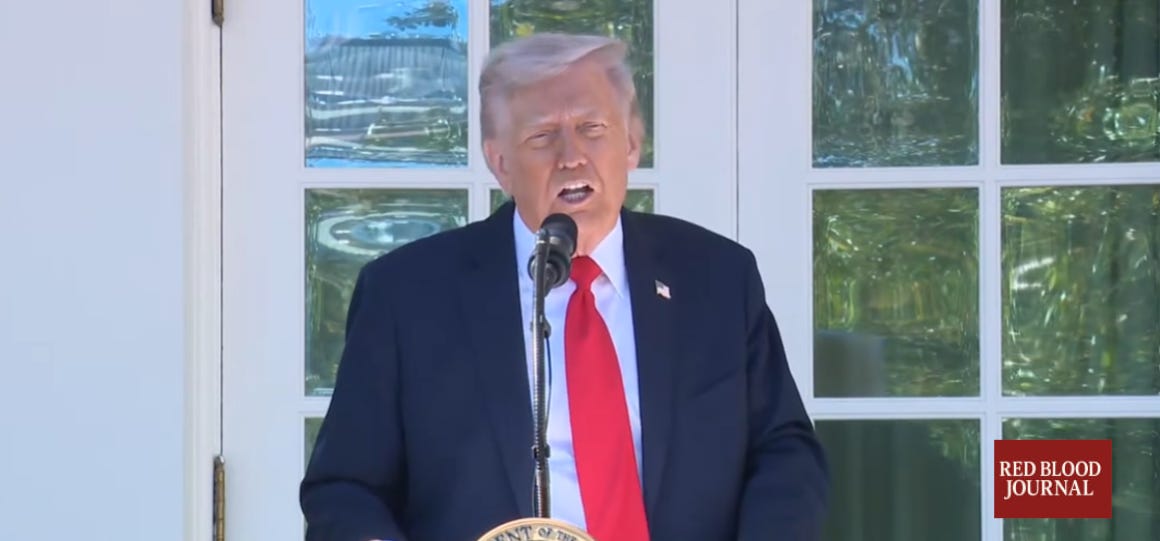
WASHINGTON, D.C. — In a lively and wide-ranging address at the newly renovated Rose Garden, President Donald J. Trump hosted a luncheon for Republican senators and key allies, celebrating recent legislative victories, touting the economic benefits of tariffs, and issuing sharp warnings about an impending government shutdown orchestrated by Democrats. The event, dubbed the “Rose Garden Club Lunch,” served as both a victory lap for the administration’s first year back in office and a rallying cry against partisan obstructionism.
Speaking to a crowd that included Senate Majority Leader John Thune, Majority Whip John Barrasso, and other prominent Republicans like Tim Scott and Lindsey Graham, Trump praised the group’s unity and achievements. “This has been a labor of love,” he said, reflecting on the transformation of the White House grounds. The president detailed extensive renovations, including replacing the muddy grass with stone matching the White House’s facade to accommodate press conferences without the previous complaints from media personnel. “We finished it about a month ago. This is, as you see over here, the Presidential Walk of Fame,” Trump noted, gesturing to the new features.
The speech quickly pivoted to economic policy, where Trump emphasized tariffs as a cornerstone of national security and prosperity. He claimed tariffs have generated hundreds of billions in revenue, making the U.S. “the wealthiest nation ever in the history of the world.” Citing recent discoveries of surplus funds, he recounted an anecdote: “Last week, they found $31 billion. They came to see me. Sir, we found $31 billion.” Trump attributed this windfall directly to tariffs, arguing they deter unfair trade practices and even prevent international conflicts. “Of the eight [wars] I mentioned, five were based solely on trade and tariffs,” he asserted, referencing interventions in disputes like India-Pakistan tensions.
Trump lauded the Senate Republicans for their role in confirming over 175 nominees in recent weeks, including cabinet members and judges, following procedural changes to counter Democratic delays. “Boy, did we have a couple of weeks, huh? We got—I signed like 150 of them,” he said, crediting Thune and others for the “avalanche” of approvals. He urged the group to address the “blue slip” rule, which he blamed for blocking U.S. attorney confirmations in states with Democratic senators, calling it unconstitutional and unfair to qualified nominees.
Legislative accomplishments took center stage, with Trump highlighting the “Great Big Beautiful Bill”—described as the largest ever passed by Congress. This omnibus legislation includes extensions of his previous tax cuts, no taxes on tips, Social Security, or overtime, and measures like the Lake and Riley Act for deporting illegal immigrants convicted of crimes. He also pushed for Kate’s Law, a proposal to impose 10-year sentences on repeat illegal border crossers, invoking the tragic 2015 shooting of Kate Steinle in San Francisco. “If they would have had that, Kate Steinle would be alive today,” Trump said solemnly.
The president reserved his harshest criticism for Democrats, accusing Senate Minority Leader Chuck Schumer and his party of engineering a “Schumer shutdown” out of “partisan spite.” He contrasted this with past bipartisan continuing resolutions (CRs) under previous administrations, noting Democrats had voted for them 13 times during Biden’s term. “We will not be extorted on this crazy plot of theirs,” Trump declared, blaming the impasse for unpaid federal workers, delayed air traffic systems, and closed D.C. museums. He highlighted cuts to Democratic priorities, crediting Mick Mulvaney—whom he nicknamed “Darth Vader”—for wielding the budget ax effectively.
On foreign affairs, Trump previewed an upcoming meeting with Chinese President Xi Jinping in South Korea, expressing optimism about negotiations amid ongoing tariffs. “I think we’re going to do well in that negotiation,” he said, while stressing fairness. Domestically, he boasted of record investments exceeding $17 trillion, with projections reaching $20 trillion by year’s end, attributing much to companies relocating to avoid tariffs.
Trump also touched on urban revitalization, claiming dramatic reductions in crime in Washington, D.C., thanks to National Guard deployments and deportations. “We have no crime here now,” he proclaimed, describing tours of the city where streets are now safe and graffiti-free.
The luncheon underscored Trump’s narrative of a resurgent America under Republican leadership, with the president warning of midterm challenges despite strong polling. “We have the hottest country anywhere in the world,” he said, crediting his team but cautioning against complacency. Absent from the event was one unnamed senator, whom Trump described as an “automatic no” on votes, though he extended a begrudging invitation.
As the group prepared for lunch, Trump reiterated his open-door policy for collaboration, contrasting it with what he called the radical left’s extremism. The event, held amid the “beautiful sound of construction” for a new White House ballroom—funded privately by the president—symbolized his vision of a restored and secure nation.
Republicans left the gathering energized, with several senators echoing Trump’s calls for unity. As midterm elections loom, the speech served as a blueprint for the party’s messaging: economic strength through tariffs, swift governance, and unyielding opposition to Democratic tactics. Whether this momentum carries through remains to be seen, but for now, the Rose Garden stands as a testament to Trump’s hands-on approach to both policy and aesthetics.