


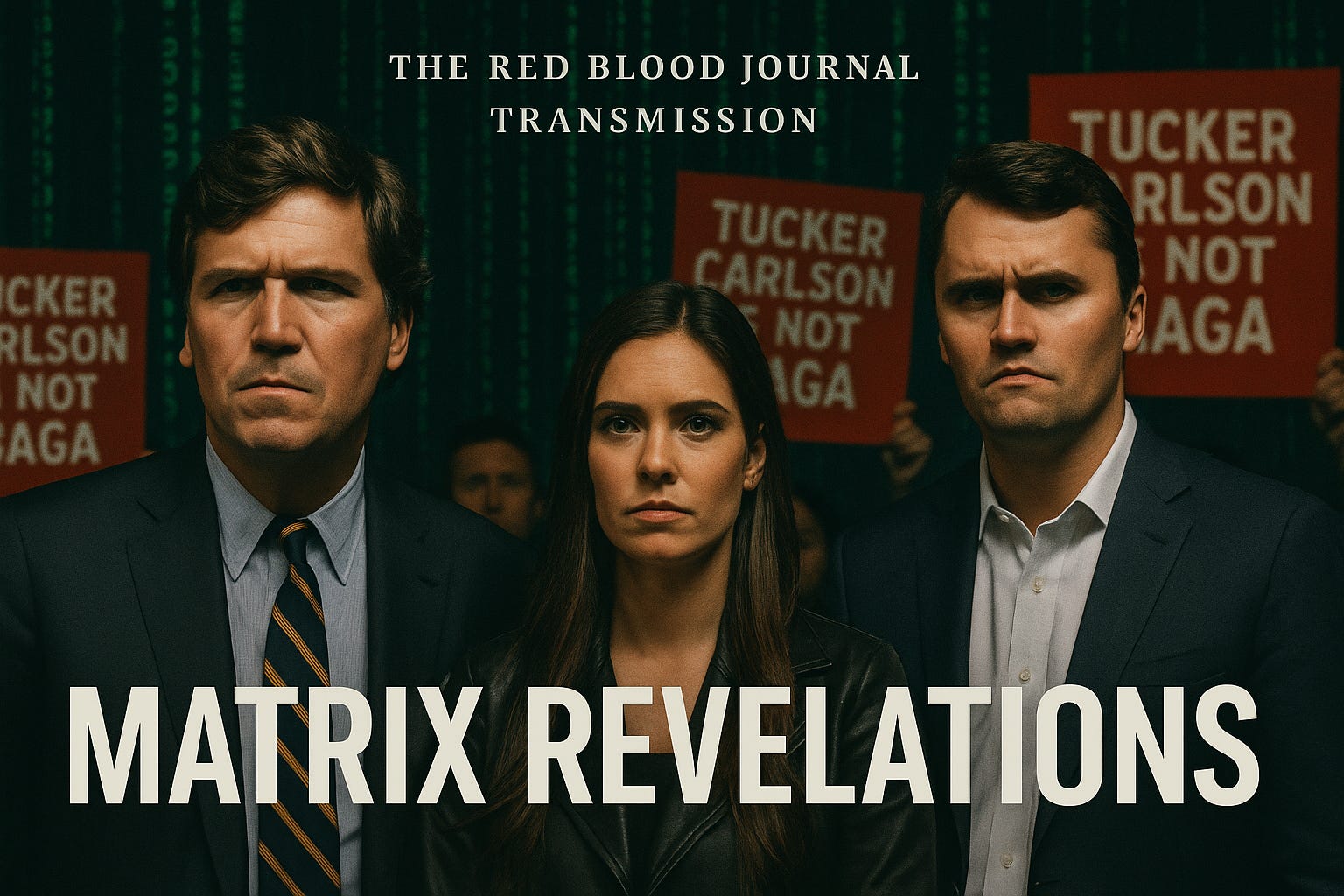
🩸 MATRIX REVELATIONS
Erika, Tucker, and the Battle to Inherit Charlie Kirk’s Legacy
A Red Blood Journal Transmission
Summary
The week’s media cycle tried to sell “MAGA civil war.” Look closer and you’ll see a more precise conflict: an organized effort to cancel Tucker Carlson, recode Charlie Kirk posthumously as an Israel-first icon, and corral a skeptical audience back into approved narratives. What follows is not fan service. It’s a map of power—names, tactics, and pressure points—drawn from on-the-record statements, public clips, and the movement’s own internal memories.
I. The Manufactured “Civil War”
You were told there’s a schism on the right: populists vs. populists, friends against friends. But the pattern is older and simpler. When a figure becomes too large to gatekeep—too platform-independent, too cross-audience—the message machine labels them dangerous and tries to quarantine the brand.
This week’s script hit its marks. Tucker Carlson interviewed Nick Fuentes; outrage followed on cue; the talking points harmonized across familiar faces. “Tucker is not MAGA.” “Tucker is laundering vile ideas.” “Tucker betrayed Charlie.” The copy changed, the choreography didn’t.
Why the obsession? Because Tucker is the one thing centralized media can’t buy back once lost: audience permission. He speaks across factional lines and—crucially—outside institutional control. In brand management terms, he’s a free radical with scale. To a command-and-control machine, that’s existential.
II. Stagecraft and the Spice-Girls Politics
At the Republican Jewish Coalition gathering, the optics were unmistakable: pre-printed red placards declaring “Tucker Carlson is not MAGA” waved to cue lines, as if a boy-band reunion were happening on stage. Senator Lindsey Graham told voters that anti-Israel sentiment is incompatible with Republican politics. Randy Fine, in full moral-panic color, tried to stick a Hitler cosplay label on Tucker.
The intent wasn’t persuasion; it was boundary-setting. These spectacles operate like corporate HR memos for the base: Here are the beliefs that get you promoted; here are the thoughts that get you fired. But the crowd that built the modern right is not a corporate department. They notice when slogans arrive laminated.
Astroturf has a smell.
III. Tucker, Nick, and the Inheritance War
The fight over who gets to define Charlie Kirk is a fight over the direction of post-institutional conservatism. Candace Owens says it plainly: Tucker was a friend to Charlie; Tucker’s presence on TPUSA stages was fought for; and interviews—even with adversaries—are not betrayals but proof of a free press instinct.
This isn’t merely reputational cleanup. It’s asset protection. If Charlie’s legacy can be recoded—if the last months of his life can be rewritten as unconditional alignment with an Israel-first doctrine—then anyone still speaking with the old populist confidence can be declared “anti-Charlie,” “anti-MAGA,” or worse.
Gatekeeping 101: seize the will, rewrite the estate, evict the heirs.
IV. The Shapiro Gambit
Ben Shapiro’s monologue framed Tucker as the nation’s “super-spreader of vile ideas,” then re-cast Tucker as a treacherous friend to the deceased. Owens counters with two claims:
Context laundering—that her own most controversial soundbites were clipped to fit a pre-chosen verdict.
Back-room pressure—that, years ago, Shapiro worked to slow TPUSA’s ascent, a fact she says is visible in the message logs she holds.
The substance, beyond the personalities, is about permission architecture. Who builds it? Who owns it? Who polices it when populists color outside the lines? If the right imports the institutional left’s taboo-enforcement model, it inherits the left’s worst disease: a politics of disinvitation.
V. The Jerusalem Post Flinch and the Erika Question
A Jerusalem Post item asserted that Erika Kirk would accept a posthumous Israel award on Charlie’s behalf for his “steadfast support.” TPUSA’s Andrew Kolvet promptly said they knew nothing about it; the reporter later indicated the government press office had “wavered.” Translation: a confident statement retreated once checked.
Again, this isn’t about whether Charlie supported Israel earlier in his career. He did—openly. The question is what changed in the end and who benefits from declaring that nothing changed. If you can posthumously fix someone’s “final position,” you can deploy their brand against the audiences they were beginning to defend.
On Erika herself, restraint is warranted. Owens’ position: judge statements, not widowhood; judge transparency, not grief. That’s the adult standard.
VI. Cameras, Cases, and the Transparency Doctrine
Erika told Jesse Watters that cameras belong in the courtroom: if the case is strong, let the public see it. She’s right. Sunlight is the cheapest stabilizer. But sunlight can’t be selective. If you demand it for defendants and trials, you owe it to the movement on timelines, communications, and the conduct of powerful friends.
Here’s the Transparency Doctrine Red Blood has pushed for months:
Public chronology: A minute-by-minute reconstruction of the critical day, with time-stamped messages, call logs, and video location data.
Donor firewall: A clear, written policy about donor influence—what it can and can’t touch—and the names of donors removed for crossing lines.
Personnel sunlight: A neutral statement about the roles and histories of every key figure drawn into the narrative (yes, including clergy and confidants).
Platform neutrality: A written, enforceable rule that no guest is banned from stages due to donor or external pressure, only for incitement or violence.
Movements die not from external attack but internal opacity.
VII. The Patel Problem: When Institutions Cosplay Influencers
Kash Patel’s melodramatic defense-tweet—melding personal romance, institutional chest-thumping, and a claim of national peril for criticizing his partner—read like a reality-TV reunion monologue, not the voice of a sober federal steward.
Two distinct issues blurred into one:
Required air travel for senior security officials is standard.
Public posture while asking the nation to trust your judgment in a high-stakes case is not standard when it sounds like a fan-account defense.
You don’t steady a nation by narrating your love life in official voice. You steady a nation by over-delivering facts and under-delivering theatrics.
VIII. The Market Is Always Right
Owens repeats a maxim worth engraving on the movement’s front door: the market is always right. When an audience rebels at managed narratives, the answer isn’t to scold them into compliance with new talking points. The answer is to earn back trust with receipts.
Every time laminated signage tries to exile Tucker, his numbers go up. Every time someone insists Charlie’s doubts never existed, more people dig into Charlie’s own words. Every time outrage is templated, the template shows.
That’s not a civil war. That’s product-market fit reasserting itself against managerial capture.
IX. What This Week Really Proved
Zookeeper Politics is Dying. The base no longer accepts “approved animals only” exhibits.
Legacy Laundering Won’t Hold. Attempts to reprint a dead man’s last paragraph are backfiring.
Populist Media Is Antifragile. Tucker absorbs the hit and grows; cancellation is the new ad buy.
Transparency Is the Only Currency. If TPUSA survives, it will be because it publishes a full ledger—timeline, donors, and decision-logic—not because it wins a PR knife fight.
X. A Movement Standard, Not a Personality Cult
This is not about sainthood for Tucker, Erika, or Candace. It’s about standards that outlive all of them:
Free inquiry beats curated orthodoxy.
Open ledgers beat whispered assurances.
Audience sovereignty beats donor diktat.
Civic seriousness beats influencer drama—especially from people holding badges.
The Red Blood position is simple: If the case is strong, show it. If the legacy is honest, print it. If the friendships are real, they survive speech.
Appendix: Receipts the Audience Deserves
Unredacted, time-stamped communications timeline for the day in question.
A list of donor interventions over booking decisions since last summer.
A neutral roles & relationships memo naming each figure whose conduct is disputed, with dates and duties.
A public stage policy that codifies debate-over-deplatforming.
Publish that, and the temperature drops 30 degrees in a day. Fail, and the market will continue to be right.
Closing Transmission
They called it a civil war to hide a consolidation. They printed signs to fake a verdict. They borrowed the dead to police the living. And still the audience refused the script.
If you want this movement to win, stop asking who is MAGA and start asking what keeps us honest. The answer isn’t laminated. It’s lived—out loud, on camera, and in the sunlight.
— Red Blood Journal
Tags: MAGA, Media, Free Speech, Israel–Gaza, Accountability, Investigations, Tucker Carlson, Charlie Kirk, matrix-revelations-erika-tucker-charlie-legacy
🩸 If you want sunlight, help us force it. Share this dispatch, ask for receipts (politely, publicly), and archive everything. Screenshots beat slogans.
Again, incredible writer. Pithy, chronological perfection. Clarity. Truth. Thank you.
I am confused about the Trump/Neti relationship. And, the Trump /Putin change in friendship. Is it scripted?