


If you already assume the government will lie whenever the stakes are high, Tucker Carlson’s Friday sit-down with Rep. Tim Burchett won’t change your priors—it’ll harden them. But strip away the applause lines and sponsor breaks, and a clearer picture emerges: a story about secrecy, incentives, and power, with unidentified craft (including underwater) as the pretext rather than the plot.
The thesis behind the theatrics
Carlson opens by asserting a 70-year U.S. disinformation campaign on UFOs/UAPs. Burchett doesn’t argue—he amplifies it. The core claim is simple and incendiary: there are real, extraordinary aerial and sub-surface phenomena; the federal apparatus knows more than it admits; the gatekeepers aren’t protecting “national security,” they’re protecting entrenched interests—money, prestige, procurement pipelines, and political insulation.
Burchett’s worldview slots those incentives neatly:
Defense contractors don’t want disruptive tech to upend budgets, platforms, or the oil-war logic of foreign policy.
Agencies and their briefers hide behind classification to launder embarrassment and bureaucratic turf, not secrets alone.
Congressional leadership ducks fights that threaten donors or career safety.
Media trivializes the subject to police reputations and narrow the Overton window.
You don’t have to buy all of that to see why it resonates. The interview treats secrecy not as an exception, but as Washington’s default operating system.
The underwater twist
Plenty of UAP talk fixates on the sky. Burchett adds water. He relays accounts—from naval personnel and pilots—of USOs (unidentified submersible objects) allegedly moving “~200 mph” underwater, and craft “as big as a football field.” The point isn’t just spectacle; it’s physics. If even one such account is true, he argues, it outstrips known hydrodynamics and human g-tolerances, implying either non-human tech or a breakthrough that’s been hermetically sealed away.
Burchett’s narrative architecture:
Clusters: multiple “miles-deep” oceanic regions where sightings reportedly concentrate.
Compartmentalization: data flows into a handful of quasi-government contractors, beyond FOIA’s reach.
Risk calculus: no sane military would fly test vehicles inches from elite pilots—therefore “not ours.”
The journalist’s read: this is still anecdote-heavy. But it’s the kind of anecdote that—if corroborated with sensor fusion (radar/EO/IR/sonar/telemetry), chain-of-custody, and timing logs—moves from bar story to evidence. Burchett says some crews saved copies before “scrubs.” That claim begs for receipts.
Disclosure, derailed—again
Policy-wise, we get two competing disclosure models:
Burchett’s “two-page” bill: if it’s about UAPs, disclose—unredacted.
The Schumer-style commission: sprawling, multi-hundred-page scaffolding resembling the Warren Commission playbook.
Burchett’s critique is that commissions metastasize into time-killers; Congress “outruns the clock,” leadership smothers the oxygen, and media attention migrates. The result: permanent intermission.
He’s blunt about incentives: appropriators, committee staff, and defense primes have more to lose than to gain from daylight. The episode repeatedly collapses “national security” into “national embarrassment” + “budgetary self-preservation.” That may be cynical—but it’s an explanation that actually predicts Washington’s behavior.
What makes people believe this? The trust vacuum
Burchett’s stories of redactions, sneering briefers, and reputational attacks hit an audience primed by other breaches of trust. In the same breath he cites:
Weaponized classification (he calls some SCIF briefings “traps” to gag open-source facts retroactively).
Congressional stock-trading farce (popular, bipartisan rhetoric; minimal reform).
Selective prosecutions and performative ethics (George Santos used as morality theater).
Endless wars + no-bid contracts (predictable beneficiaries, opaque processes).
Connect those dots and UAP secrecy reads like another facet of elite impunity. Whether you agree or not, the narrative coherence is why it spreads.
Claims that would change the game (and what real evidence would look like)
If you don’t trust government, you want verifiable, redundantly sourced artifacts. Here’s what would matter:
Multisensor, multi-platform data from a single incident
Raw radar/sonar, IR video, EO footage, ESM logs, and platform telemetry with precise timestamps.
Cross-confirmation from independent platforms (ship + sub + aircraft) and, ideally, allied systems.
Chain-of-custody and provenance
Who recorded it, where it lived, who accessed it, when it was scrubbed. Auditable IT trails beat anecdotes.
Witnesses with risk
On-record operators/commanders + maintenance crews + data managers whose accounts align with the data. Whistleblower protections that actually protect.
Hardware or material science
If there’s “non-human tech,” show isotopic anomalies, lattice structures, machining signatures, or properties that current metallurgy can’t replicate. Publish methods and give samples to independent labs.
Budgetary fingerprints
Follow the money: SAP line-items, contractor sub-awards, shell entities. Unseal contractual clauses that put findings beyond FOIA.
Without at least #1–#3, the conversation never leaves the fog.
The politics beneath the paranormal
Burchett’s most explosive idea isn’t about aliens; it’s about unaccountable power. The interview frames three systemic failures:
Classification creep: “national security” as a reputational shield rather than a narrowly tailored exception.
Privatized secrecy: offloading sensitive programs to contractors to sidestep FOIA while retaining federal funding.
Congressionally enabled opacity: leadership and staff structures that convert reform into “study commissions” and run out the shot clock.
Even the late-segment pivot to a “new 9/11 commission” serves the same thesis: the old commission was performative; the public still doesn’t have names, trades, or timelines; truth dies in process.
A sober skeptic’s bottom line
There’s enough credible pilot and military testimony to warrant serious, transparent, evidence-first inquiry—especially around underwater anomalies.
The strongest counter-argument remains: extraordinary claims require extraordinary proof, not just earnest witnesses and hostile bureaucrats.
The public-trust context—wars, redactions, insider gains—makes official denials discount themselves. Suspicion is earned.
What would real disclosure look like—tomorrow?
If a President (any President) actually meant it:
Declassification by default for UAP incidents older than X years, with narrowly drawn, reviewable exceptions.
Independent records custodian (outside DOD/IC and contractor capture) with subpoena power and a statutory mandate to publish.
Whistleblower safe harbor with immediate legal defense funding and anti-retaliation teeth (loss of appropriations for agencies that retaliate).
Contractor transparency clauses in any program touching UAP data: FOIA-equivalent obligations, audit trails, and penalties for spoliation.
Public evidence dumps in standardized formats (sensor data, logs) so third-party analysts can replicate analyses.
Anything less is choreography.
For readers who don’t believe anything anymore—how to navigate this
Reward receipts, not vibes. Demand data, timestamps, radar tracks, and names.
Follow incentives. Who profits from muddle? Who risks status by going on record?
Separate phenomenon from politics. UAPs might be real and weaponized secrecy definitely is. Don’t let one launder the other.
Archive everything. Screenshots, downloads, hashes. If scrubs happen, custody matters.
Be open, not gullible. Skepticism cuts both ways—apply it to claims you want to be true.
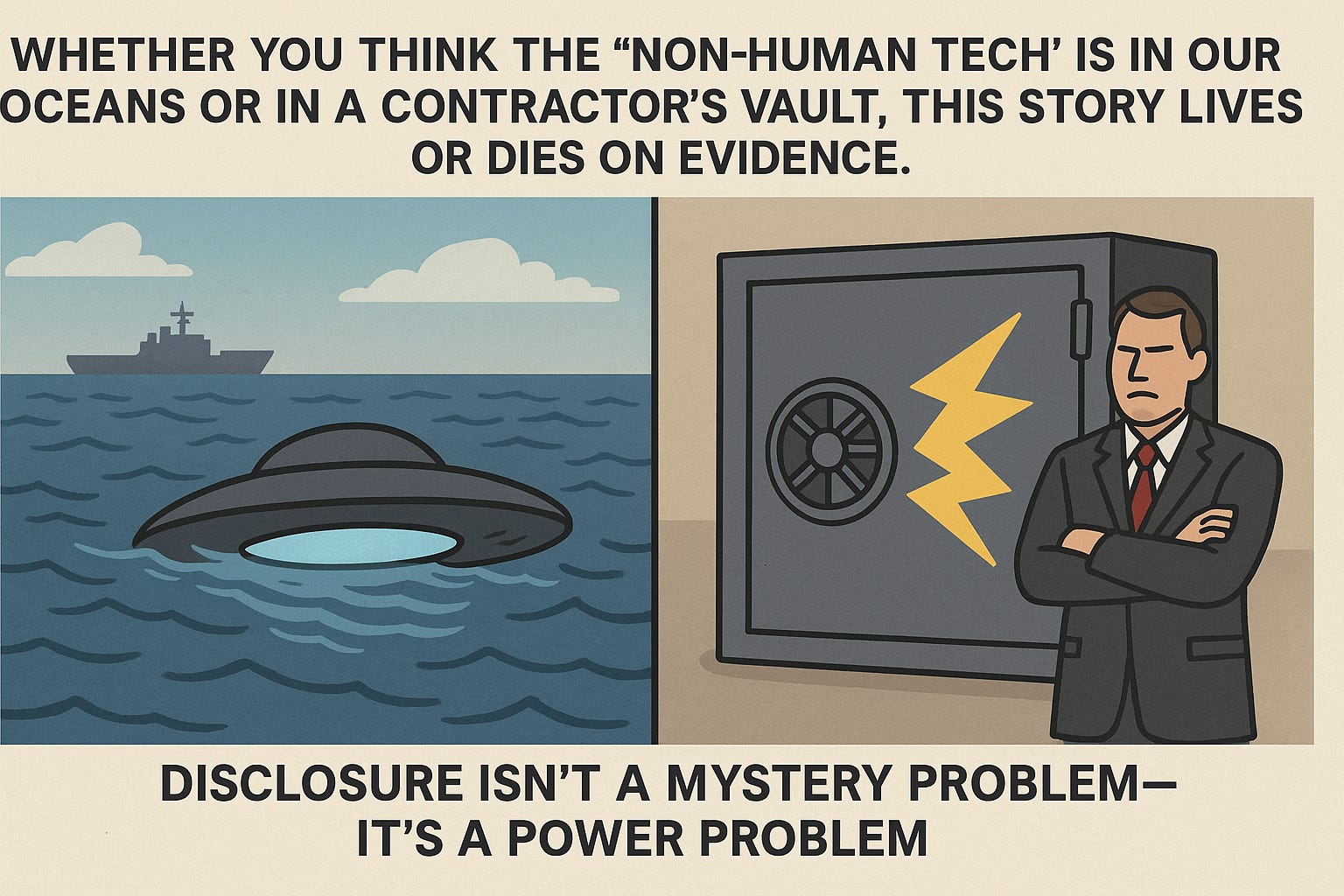
Final word: Whether you think the “non-human tech” is in our oceans or in a contractor’s vault, this story lives or dies on evidence. Burchett’s interview explains why we don’t have it yet. If that explanation is right, disclosure isn’t a mystery problem—it’s a power problem.