



Main lesson:
https://redbloodjournal.com/courses/finding-yourself-through-purpose/step-8-what-makes-you-feel-alive/
Worksheet:
https://redbloodjournal.com/courses/finding-yourself-through-purpose/step-8-what-makes-you-feel-alive/worksheet/
Finding Yourself Through Purpose
Lesson 8 of 12 — What Makes You Feel Alive?
Lesson 7 asked you to remove the audience. It asked what would remain if nobody were watching, applauding, criticizing, rewarding, measuring, or expecting anything from you. Once that audience becomes quieter, another question becomes easier to hear: what actually makes you feel alive?
This is not the same as asking what makes you happy. Happiness comes and goes, pleasure can be temporary, and entertainment can distract without revealing anything deeper about purpose. Feeling alive is different. It often appears when your attention, energy, curiosity, ability, effort, and values begin moving in the same direction. There are moments when time seems to change because you are no longer scattered. You become absorbed, stop checking the clock, and become more awake rather than more numb.
You may feel this while solving a difficult problem, helping someone, creating, repairing, building, organizing, teaching, caring, discovering, learning, or speaking honestly. The activity may not always be easy, but something inside you becomes more present. Lesson 8 is about learning to recognize those moments and taking them seriously as evidence.

Feeling Alive Is Not the Same as Feeling Comfortable
One of the easiest mistakes is to confuse aliveness with comfort. Comfort can be valuable, rest matters, safety matters, and peace matters. But a life built entirely around avoiding discomfort can become very small because some of the most meaningful experiences require effort, uncertainty, and growth.
Learning a skill can be frustrating. Building something can be exhausting. Caring for another person can be demanding. Speaking honestly can be uncomfortable, and beginning again after failure can hurt. Yet these experiences can also create a strange kind of energy because they engage more of who you are.
You can be tired and still feel alive. You can be challenged and still feel alive. You can even be afraid and still feel alive. The better question is not whether something was easy, but whether the experience made you more present, more engaged, and more connected to what matters.

Pay Attention to Energy, Not Just Emotion
Emotions change quickly, but patterns of energy can reveal something important. Some activities leave you depleted because they are unhealthy, forced, repetitive, or disconnected from your values. Other activities may require a great deal of effort but leave you with a deeper sense of energy afterward.
There is a difference between exhaustion and meaningful fatigue. You can spend hours doing something you resent and feel empty afterward, yet you can also spend hours solving a problem, creating something, helping someone, or learning something difficult and finish physically tired but mentally awake.
That difference deserves attention because it may reveal where your effort is being returned to you in another form. Ask yourself what kinds of effort seem to give something back to you instead of only taking something away.

Look for the Moments When Time Changes
One of the clearest signals of deep engagement is the way time can seem to disappear. You may look at the clock and realize that two hours have passed when it felt like twenty minutes. That kind of absorption can happen while writing, repairing machinery, cooking, gardening, designing, researching, teaching, programming, painting, talking deeply with someone, solving a business problem, driving, organizing, exercising, building, or studying.
The specific activity is different for each person. What matters is not the activity itself, but the relationship between your attention and the activity. When your attention naturally gathers instead of constantly escaping, something useful may be happening.
That kind of concentration is worth studying because it can reveal what naturally holds your mind without constant force.

What Do You Return To Without Being Forced?
Another clue is repetition without pressure. Pay attention to the subjects you keep returning to, the problems you continue thinking about, the conversations that attract you, and the things you study when nobody is assigning them to you.
Notice what you read about voluntarily, what videos you watch because you genuinely want to understand, and what you repair, organize, explain, teach, debate, build, collect, study, or improve without needing much external motivation.
This does not automatically reveal your entire purpose, but it reveals where your attention repeatedly travels on its own. Attention is valuable because it is difficult to fake over long periods of time. What repeatedly calls your attention may be telling you something about where your curiosity and natural involvement live.

What Problems Do You Enjoy Solving?
Purpose is often connected not only to what we enjoy but to the kinds of problems we are willing to engage. Some people enjoy technical problems. Others enjoy human problems. Some like organizing chaos, while others like explaining complicated ideas, repairing broken systems, building businesses, caring for people, investigating questions, creating beauty, teaching, making people laugh, or making environments safer, clearer, faster, simpler, or more humane.
Instead of asking only what you like, ask what kind of problem can hold your attention longer than most other problems. That question moves beyond entertainment and begins moving toward contribution.
A problem that repeatedly attracts your attention may reveal something about the role you naturally want to play in the world around you.

What Kind of Work Feels Meaningful Even When It Is Difficult?
Meaningful work is not always pleasant work. A surgeon may experience stress while still finding meaning in the work. A parent may be exhausted while knowing that the effort matters. A business owner may deal with endless problems while still feeling deeply connected to building something. A teacher may face difficult students and bureaucracy while still feeling alive when a student finally understands.
Difficulty does not automatically mean you are on the wrong path. At the same time, repeated emptiness matters too. If an activity consistently leaves you feeling disconnected, resentful, numb, or diminished, that pattern deserves attention.
It does not mean you should immediately leave a job, relationship, or responsibility. It means the pattern belongs in the sifter you learned in Lesson 6. Difficulty and meaning can coexist, but so can difficulty and misalignment. The purpose of examination is to tell the difference.

Contribution Changes the Question
Many people search for purpose by asking what they want from life. That is a reasonable question, but it is incomplete because purpose often becomes clearer when the question expands beyond personal desire.
Ask what seems to move through you that can be useful to someone else. Your ability to organize may help a team. Your patience may help a child. Your technical knowledge may solve a problem. Your storytelling may help someone understand an idea. Your calmness may help during a crisis. Your curiosity may uncover something others missed. Your experience may help someone avoid a mistake.
Purpose often becomes clearer when personal aliveness intersects with contribution. Something can feel good to you and also become useful beyond you. That intersection deserves attention because it is where personal energy can begin turning into service, usefulness, creation, or responsibility.

What Do People Naturally Come to You For?
Sometimes other people notice our abilities before we do. Think about what people consistently ask you for help with. They may come to you for advice, technical problems, emotional support, organization, leadership, writing, fixing things, explaining complicated ideas, making decisions, finding information, resolving conflict, or creating something.
People are not always correct about us, but repeated patterns can contain information. If different people over many years keep coming to you for the same type of help, ask why.
There may be a capability you have normalized because it comes naturally to you. What feels ordinary to you may be difficult for someone else, and that difference can reveal something worth examining.
Natural Ability Is Not the Same as Purpose
Being good at something does not automatically mean it should become your purpose. You may be excellent at something you do not enjoy, or you may have learned a skill because circumstances demanded it.
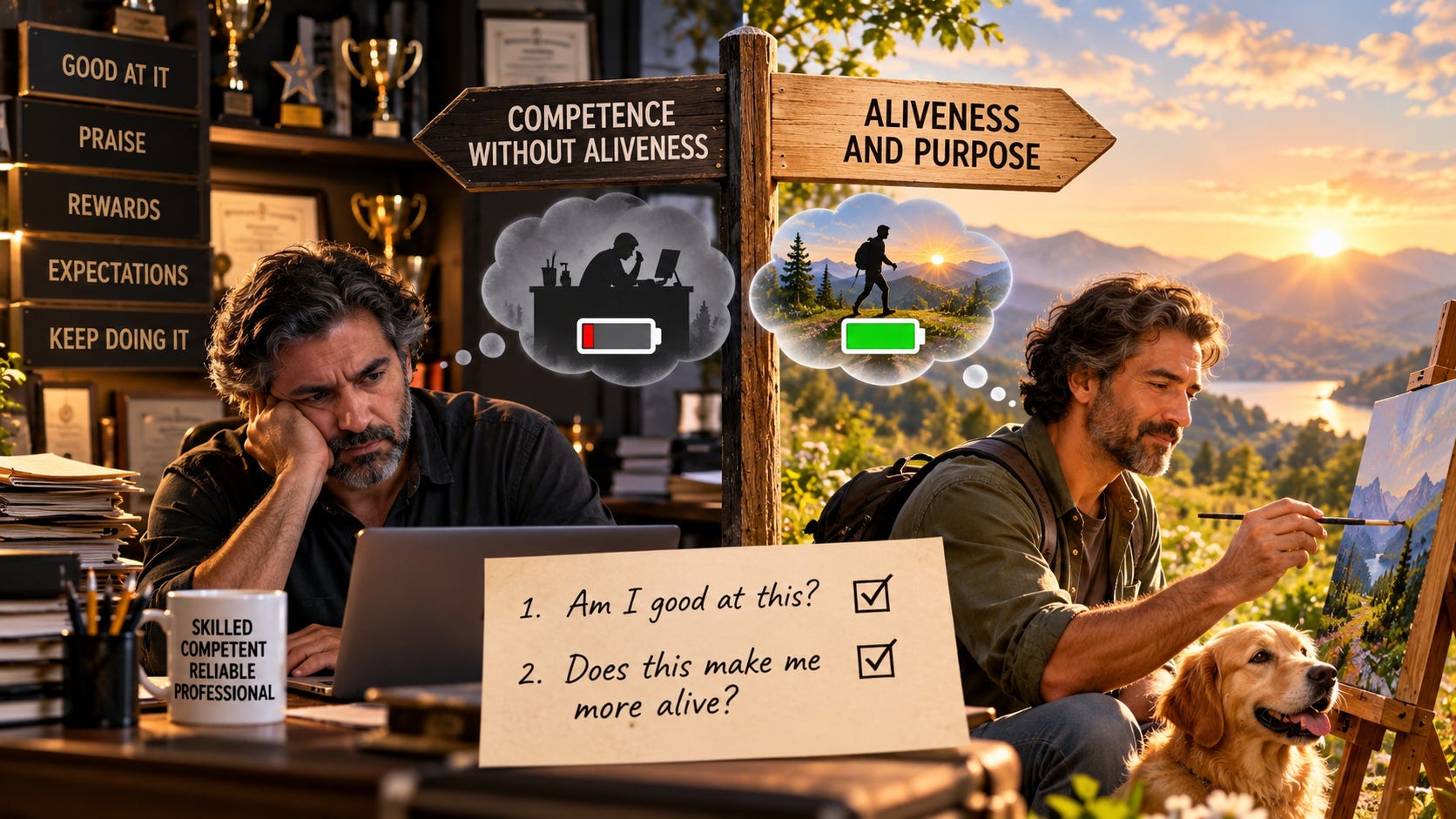
Competence can even become a trap because other people keep rewarding what you do well, even when the activity no longer gives you life. Praise can keep a person attached to a role long after the deeper connection has disappeared.
That is why two questions belong together: Am I good at this? and Does this make me more alive? When both answers are yes, pay attention. When only one answer is yes, examine further.

What Did You Love Before You Learned to Impress People?
Lesson 7 removed the audience. Lesson 8 uses that quiet to look backward. Think about childhood and adolescence before career pressure, status, income, social expectations, and adult responsibilities became dominant.
What did you naturally enjoy? Maybe you liked building things, drawing, taking things apart, reading, exploring, talking to strangers, leading games, helping animals, writing stories, arguing ideas, organizing collections, learning how machines worked, making people laugh, or teaching younger children.
Some childhood interests disappear because they were temporary, while others remain buried under years of practical responsibility. The goal is not to become a child again. The goal is to notice whether an old signal survived underneath the adult structure.

Aliveness Often Lives in the Body
Your body sometimes knows before your explanations do. Notice what happens physically when you talk about certain subjects. Your posture may change, your voice may become faster or stronger, your face may become more animated, your attention may sharpen, or you may lean forward without noticing.
Now notice the opposite. Some subjects seem to drain the room. Your body collapses, your voice becomes flat, you procrastinate, your attention escapes, and everything feels heavier.
These reactions are not perfect evidence. Anxiety, trauma, habit, illness, fatigue, and other factors can affect them. But repeated bodily patterns can still provide useful information. The body is part of the sifter, and its reactions can become one more source of evidence.

Envy Can Contain Information
Envy is uncomfortable, but it can sometimes reveal desire. When you see someone doing something and feel a strong reaction, ask what exactly you envy.
You may think you envy the person when what you actually envy is their freedom, creativity, courage, schedule, independence, ability to travel, ability to teach, ability to build, or ability to speak publicly.
Instead of judging the feeling, investigate it. Envy can become information when it is examined instead of obeyed. It may reveal something you want to develop, recover, or create in your own life.

Admiration Can Be a Compass
Admiration works in a similar way. Think about who you genuinely respect and why. Not who is famous, and not who has the most money, but who impresses you because of a quality you value.
You may admire someone’s courage, discipline, kindness, intelligence, independence, patience, creativity, persistence, fairness, or willingness to serve others. The qualities you repeatedly admire may reveal values you want to develop in yourself.
Purpose is not only about what you do. It is also about who you are becoming while you do it. The people you admire can sometimes reveal the qualities your own life is asking you to strengthen.

What Would You Do Even If You Were Bad at It at First?
Adults often avoid activities that make them feel incompetent because being a beginner can threaten identity. Children are usually more willing to begin badly because they have not yet attached as much shame to the learning process.
Purpose may require beginning badly. You may feel alive writing even though your writing needs work. You may love teaching before you become skilled at it. You may enjoy making videos before you know how to edit them. You may love business before you understand accounting. You may enjoy helping people before you know exactly how to turn that instinct into a profession.
A lack of skill today does not prove a lack of direction. Ask yourself what you are willing to be bad at long enough to become good. That question reveals something about commitment.

What Would You Continue Without Immediate Reward?
Another useful test is delayed reward. Would you keep doing the activity if there were no immediate money, applause, recognition, promotion, followers, or praise?
Practical needs matter, so this is not an argument for working forever without reward. But many meaningful paths require a period when the reward is small while the learning is large.
If you would continue for a meaningful period because the process itself matters to you, that tells you something. If the activity only feels worthwhile when somebody immediately rewards you, the audience may still be involved.

Aliveness Is Not Always Loud
Some people imagine purpose as dramatic passion, but that can be misleading. Feeling alive may be quiet.
You may feel most alive while reading alone, helping one person, working carefully with your hands, tending a garden, caring for animals, writing, walking, solving technical problems, or maintaining something important.
Purpose does not have to look impressive from the outside. A quiet life can be deeply alive, while a public life can be deeply empty. The measurement has to happen from within.

Watch the Difference Between Stimulation and Aliveness
Modern technology makes stimulation extremely easy. Scrolling, gaming, shopping, news, arguments, pornography, gambling, and constant notifications can all create intensity.
But intensity is not automatically aliveness.
Stimulation can produce excitement while leaving you emptier afterward. A useful test is what remains when the stimulation ends. Do you feel clearer, stronger, more connected, more capable, more peaceful, more curious, or more useful? Or do you simply feel ready for another hit of stimulation?
Purpose requires learning that difference because stimulation can imitate energy without creating meaning.

Your Life Leaves Clues
You do not have to invent yourself from nothing because your life already contains evidence. Look backward and examine which experiences made you proud for reasons beyond praise, which activities repeatedly held your attention, what problems you enjoyed solving, when you felt useful, and when your abilities and values seemed to work together.
Think about difficult experiences that taught you something that later became useful to others. Think about the moments that made you quietly feel, “This matters.”
Purpose may not arrive as one dramatic revelation. It may already be scattered through your history as a pattern. Lesson 8 is asking you to stop waiting for one perfect answer and begin studying the evidence that is already there.
Your Lesson 8 Exercise — The Aliveness Map
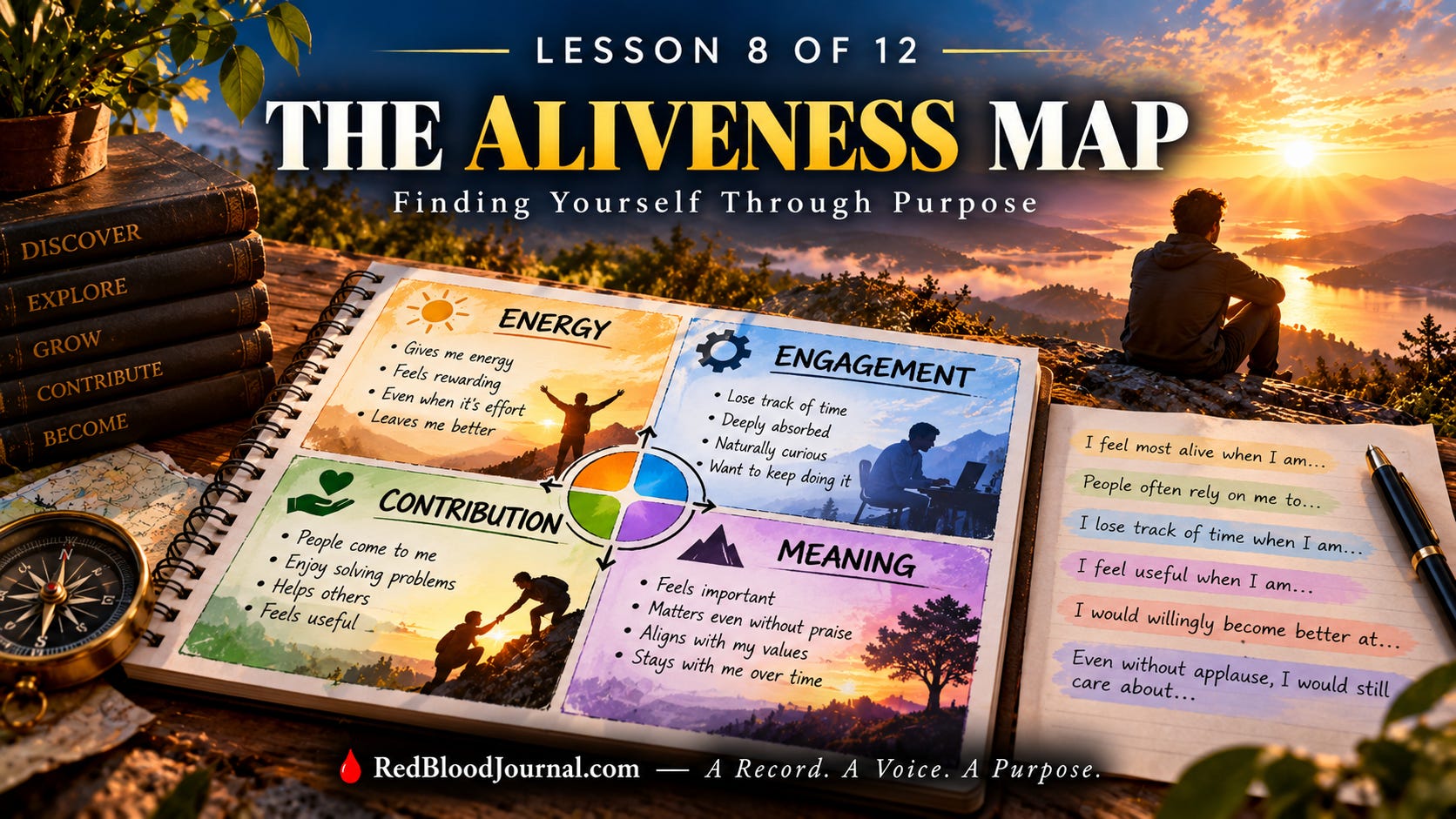
Take a sheet of paper and divide it into four sections: Energy, Engagement, Contribution, and Meaning. Under Energy, write activities that seem to give something back to you even when they require effort. Under Engagement, write activities where you become deeply absorbed or lose track of time.
Under Contribution, write the ways people naturally come to you for help and the problems you enjoy solving. Under Meaning, write experiences that felt important even when nobody applauded.
Then circle anything that appears in more than one section because those overlaps deserve attention. Complete the sentences: I feel most alive when I am... People often rely on me to... I lose track of time when I am... I feel useful when I am... I would willingly become better at... Even without applause, I would still care about...
Do not force these answers into a career title. For now, simply notice the pattern.

What Comes Next
Lesson 8 helps identify the experiences that create energy, engagement, contribution, and meaning, but another danger appears immediately. If something makes you feel alive, does that automatically make it your purpose?
No. A desire can be powerful without being purposeful. A job can be meaningful without becoming your entire identity. A talent can be useful without becoming a profession. Something you love can remain part of your life without needing to become a business.
That is why Lesson 9 asks an important question: Purpose Is Not a Job — and Desire Is Not Purpose.

🩸 The Red Blood Perspective
A system can tell you what success should look like. A family can tell you what career is respectable. A market can tell you which skills are profitable. An audience can tell you what receives applause. None of those things can fully tell you what makes you come alive.
That evidence has to be gathered from your own life. Personal sovereignty does not mean ignoring practical reality. Money matters. Responsibilities matter. Skills matter. Other people matter. But practical reality should not erase the internal evidence of where your attention, energy, values, and usefulness repeatedly meet.
If you never examine what makes you alive, you may spend decades becoming efficient at a life you never consciously chose. The purpose of Lesson 8 is not to hand you an answer. It is to teach you how to notice your own evidence.

🌊✨ Ocean of Love and Positivity Perspective
The Ocean of Love and Positivity does not ask every person to contribute in the same way. One person may teach, another may build, another may protect, another may repair, another may listen, another may create, another may organize, another may discover, and another may care for a family. Different lives can carry value in different forms.
A wave does not need to become another wave in order to belong to the ocean. Perhaps one of the great mistakes of human life is trying to become valuable by becoming identical to what receives the most applause.
Your value may appear in a completely different form. When you discover what brings you alive, the goal is not simply personal pleasure. The deeper question is whether that aliveness can become something constructive that improves your character, strengthens your life, helps another person, solves a problem, creates beauty, reduces suffering, or adds something worthwhile to the world.
That is where aliveness begins moving toward purpose.
In an Ocean of Love and Positivity.
🩸🌊✨ Fantastic!