


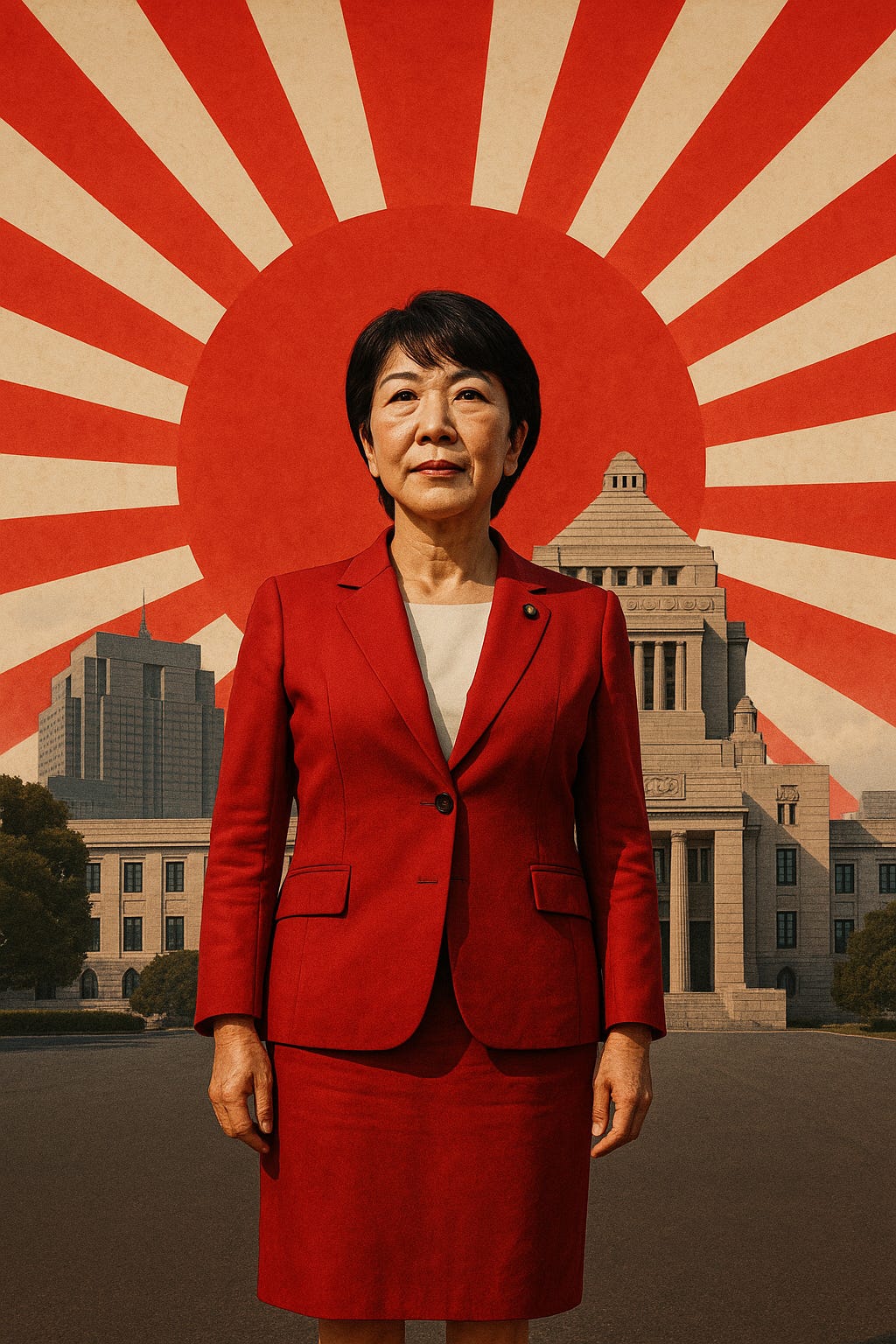
🟥 The Red Blood Journal
Japan’s Iron Lady Shatters the Glass Ceiling
By The Red Blood Journal Staff | October 21, 2025
Lede: The Moment That Changed Japanese Politics
For the first time in its post-war history, Japan has a woman at the helm. Sanae Takaichi, 64, has broken the nation’s political glass ceiling, winning the leadership of the Liberal Democratic Party (LDP) and officially becoming Japan’s first female prime minister.
But Takaichi’s rise isn’t a story of progressive triumph alone. It’s a story of conviction, controversy, and calculation — one that mirrors Japan’s struggle between tradition and transformation.
Profile: From Heavy Metal to Heavy Politics
Born in Nara Prefecture in 1961, Takaichi’s origins are grounded in modest, working-class roots. Her father labored at a Toyota-affiliated plant; her mother served in the prefectural police.
Denied permission to attend elite universities in Tokyo, she instead commuted six hours daily to Kobe University, earning a reputation for relentless drive.
Her youth was anything but conventional — a heavy-metal drummer, biker, and pianist who would later be dubbed Japan’s “Heavy Metal Minister.” After studying at the Matsushita Institute, she crossed the Pacific in 1987 to work under U.S. Congresswoman Pat Schroeder, where she gained firsthand exposure to American policymaking.
Back in Japan, her short stint as a TV Asahi anchor taught her how to command an audience — a skill that later defined her political persona.
Political Trajectory: From Outsider to Power Insider
Her early campaigns were audacious. Running as an independent reformist in 1993, she captured a seat in the House of Representatives, railing against the very party she would later join. By 1996, she had crossed the aisle to the LDP, a move her critics branded “strategic betrayal.”
From there, Takaichi carved her space inside Japan’s male-dominated hierarchy — through loyalty, grit, and an unflinching alignment with Shinzo Abe’s nationalist faction.
Key Milestones:
1990s–2000s: Junior ministerial roles in trade and industry under Obuchi and Koizumi.
2014–2017, 2019–2020: Minister for Internal Affairs and Communications, steering NHK reform and emergency COVID-19 response.
2022–2024: Minister of State for Economic Security — architecting policies to protect Japan’s tech and defense industries.
Her persistence through multiple electoral losses only reinforced her image as a Teflon conservative in an era of shifting allegiances.
Ideological Core: The Iron Lady Doctrine
Takaichi’s political DNA is unmistakably Abeist — nationalist, defense-oriented, and skeptical of liberal reform.
Her blueprint — dubbed “Sanaenomics” — fuses:
Economic revivalism: government spending on AI, fusion energy, and semiconductors.
Social conservatism: opposition to same-sex marriage, female imperial succession, and dual surnames.
Defense assertiveness: open challenge to pacifist Article 9, greater missile cooperation with the U.S., and explicit support for Taiwan.
Her membership in Nippon Kaigi, a right-wing historical revisionist group, further defines her as a cultural nationalist, resistant to apologetic narratives of Japan’s wartime past.
The 2025 Upset: Power, Politics, and Pragmatism
After the sudden resignation of Shigeru Ishiba, Takaichi seized the LDP leadership on October 4, 2025, defeating Shinjirō Koizumi in a tense runoff. The LDP’s fractured alliance with Komeito forced a coalition with the right-leaning Japan Innovation Party, pulling the government further to the right.
Markets celebrated the continuity — Nikkei +4 %, Yen −0.8 %, and investor confidence surged. Yet her cabinet appointments — including Tarō Asō and Shun’ichi Suzuki — signaled an unbroken Abe-era lineage.
On immigration, social media flared with rumors that she had “created a ministry for mass deportations.”
The truth: she has called for tighter visa enforcement and a clampdown on false refugee claims — not mass expulsions. Her rhetoric, however, still pits cultural homogeneity against economic necessity, as Japan’s aging society depends increasingly on migrant labor.
Reception: Feminist Victory or Conservative Consolidation?
To progressives, Takaichi’s victory is bittersweet: a woman has broken Japan’s highest barrier — only to fortify a patriarchal system from within it.
To conservatives, she represents national restoration: a disciplined, moral Japan reclaiming its strength on the global stage.
Her admiration for Margaret Thatcher is no coincidence — she echoes Thatcher’s style of “compassionless conviction.”
Challenges Ahead: The Demographic Cliff
Japan’s next decade will test Takaichi’s resolve more than her ideology.
An aging population, fragile economy, and the tightening U.S.–China rivalry will define her premiership. Her pragmatism — or lack of it — will decide whether she becomes Japan’s Thatcher or its cautionary tale.
Red Blood Verdict
Sanae Takaichi’s rise is both a triumph and a test for modern Japan — the culmination of female ambition wrapped in nationalist resolve.
Whether history remembers her as the Iron Lady who forged renewal or hardened resistance will depend not on her gender, but on her governance.
Sources: npr.org | nbcnews.com | pbs.org | LDP archives | The Red Blood Journal Research Desk