


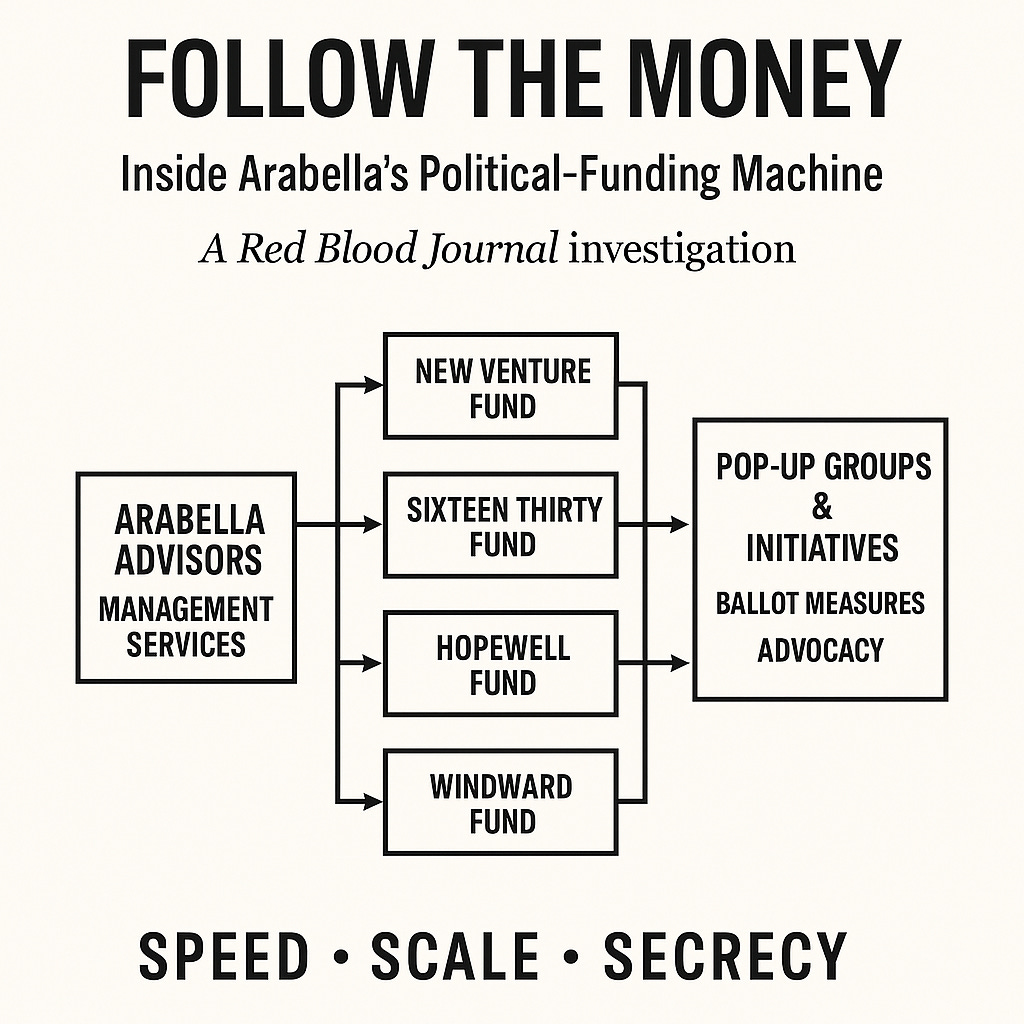
FOLLOW THE MONEY: Inside Arabella’s Political-Funding Machine
A Red Blood Journal investigation
Executive summary
What most Americans see as dozens (sometimes hundreds) of “grassroots” brands on ballots, in court fights, and across social media often traces back to a single professional hub in Washington, DC: Arabella Advisors and the nonprofit funds it services—New Venture Fund (NVF), Sixteen Thirty Fund (1630), Hopewell Fund, and Windward Fund. These vehicles raise and route hundreds of millions per year using fiscal sponsorships and trade-name projects that keep original donors largely out of view while enabling rapid political and policy campaigns. Recent filings and reporting show the network moving nine- and ten-figure sums each cycle, with 1630 alone spending $410M in 2020 and $196M in 2022 on election-adjacent activity. Wikipedia
How the structure works
For-profit nerve center. Arabella Advisors is a consulting firm. It doesn’t make the grants; its nonprofit clients do. But Arabella is contracted to run the back office—payroll, compliance, vendor management, and, crucially, fiscal-sponsorship infrastructure that can stand up “pop-up” projects fast. IRS filings for NVF explicitly state the organization “contracted with Arabella Advisors…to provide business services under an administrative agreement.” newventurefund.org
Four primary funds (+ allies). The best-known are NVF (501(c)(3)), 1630 (501(c)(4)), plus Hopewell (c3) and Windward (c3). (North Fund is frequently allied; filings and watchdogs note extensive ties and Arabella-kept books in some years.) Each fund can host dozens of branded projects under its EIN, reducing disclosure while multiplying public-facing “groups.” InfluenceWatch+3Wikipedia+3Windward Fund+3
Money in motion. OpenSecrets and press investigations have documented the network’s election-cycle surges: $410M (1630) in 2020, dwarfing the DNC that year; $196M (1630) in 2022 including heavy spending on abortion-rights ballot measures and progressive infrastructure. Wikipedia
The dollars: scale and sources
Sixteen Thirty Fund (c4). 1630’s 2020 outlays: $410M; 2022 political spending: $196M. In 2022, six anonymous donors supplied the majority of its revenue; in 2023 it still raised $181M (off-year). Wikipedia
New Venture Fund (c3). NVF’s 2023 Form 990 shows $887.4M in gross receipts and details its standing administrative agreement with Arabella. newventurefund.org
Big donor pipelines. Reporting by AP and others has traced significant funding from Hansjörg Wyss (via Berger Action Fund and related entities) into 1630/NVF over multiple years—spotlighting a foreign-national giving gray zone (legal for issue advocacy and ballot measures, but barred from candidate giving). AP News+1
Where it goes: campaigns, “pop-ups,” and influence
Ballot measures & state fights. NBC/WaPo/NYT-sourced summaries describe 1630 as a hub for financing ballot initiatives (abortion access, voting rules) and state-level pressure campaigns under localized trade names—e.g., “Floridians for a Fair Shake,” “Michigan Families for Economic Prosperity,” etc. Wikipedia
Coordination hubs. Grants into groups like America Votes and other progressive coordinators amplify field and media operations across states. Ballotpedia
New frontier—paid influencers. Recent reporting shows a 1630-linked program (through a fiscal-sponsored arm) offering up to $8,000/month to political influencers under restrictive NDAs—illustrating how opaque money is moving into creator networks with minimal FEC visibility. WIRED
Fees, opacity, and the business model
Who gets paid to run it? The funds disclose multi-million payments to Arabella-controlled entities for management/contractor services. NVF’s 2023 filing lists “Arabella Intermediate Holdings LLC” among top independent contractors (≈$2.56M that year). Windward’s 2023 filing likewise documents Arabella as its administrator. Earlier filings and ProPublica reconstructions echo the same arrangement for 1630/Hopewell. ProPublica+3newventurefund.org+3Windward Fund+3
Why it matters. Every dollar passing through a fiscal sponsor can appear under a project name rather than the donor’s identity; the public sees a mosaic of “local” brands, not consolidated patronage. That’s lawful under current 501(c) and disclosure rules but masks donor identity and cross-campaign strategy—the very definition of “dark money,” a label applied by outlets across the spectrum. Wikipedia
Legal pressure points & loopholes
Ballot-measure gap. Federal law blocks foreign national money in candidate races but not in many state ballot fights—now a major spend lane for c4s. Journalists and watchdogs have flagged this as a structural loophole; even Congress has held hearings on it. Wikipedia
Influence without attribution. Fiscal sponsorship + trade names + vendor-run influencer programs allow message saturation with thin public audit trails. (Think: ads, microsites, creator posts, “local news” branded pages.) Wikipedia+1
For-profit/nonprofit entanglement. The recurring pattern—nonprofits paying a for-profit manager (Arabella) sizable fees—raises conflict-of-interest and private-benefit questions that regulators and AGs increasingly scrutinize across left and right networks. The model is not unique to Arabella; it’s the scale that’s novel. ProPublica
Case study snapshots
2020 cycle: 1630’s $410M war chest funded attack ads, ballot fights, and issue advocacy outspending the DNC—helping build today’s progressive state-initiative machine. Wikipedia
2022 midterms: $196M from 1630, with marquee abortion and voting initiatives in multiple states. Wikipedia
2023–2024 filings: NVF’s receipts near $900M; multiple funds reiterate Arabella service agreements and contractor payments. newventurefund.org+1
What remains hidden
Donor identities (beyond occasional investigative breakthroughs).
Real-time project rosters (most appear only as generic “grants” or trade names).
Coordinated strategy memos tying dozens of pop-ups to national objectives.
These information gaps are features, not bugs, of the fiscal-sponsorship model under present law. Wikipedia
Accountability ideas (nonpartisan)
Real-time 990 schedules for fiscal-sponsored projects (name, budget, staff, vendors).
Uniform disclosure for ballot-measure spending (treat like candidate elections with ultimate donor reporting).
Cap on trade-name usage per EIN, or mandatory “parent EIN” branding in ads and websites.
For-profit management fee transparency (standardize schedule for vendor payments across networks).
These reforms would apply equally to left and right “dark-money” architectures. The Washington Post
Bottom line
Arabella’s system industrialized speed, scale, and secrecy in modern influence campaigns: donors wire eight-figure checks to a sponsor; the sponsor spins up waves of “pop-up” groups, ballot committees, influencer buys, and grants; the public sees dozens of “independent” brands—not the patrons behind them. The paperwork is legal; the transparency is optional. Until laws change, the money will keep flowing through the same pipes. Wikipedia+1
Sources & key documents
IRS Form 990 (2023) — New Venture Fund: admin agreement with Arabella; receipts ~$887M; top contractor includes Arabella entity. newventurefund.org+1
IRS Form 990 (2023) — Windward Fund: Arabella listed as administrator/contractor. Windward Fund
ProPublica Nonprofit Explorer (multiple years) — confirms Arabella service language for 1630/Hopewell/Windward. ProPublica+1
NYT / NBC News / Politico summaries — 1630’s $410M (2020); $196M (2022); $181M raised (2023). Wikipedia
AP reporting — Wyss/Berger Action Fund pipeline to Arabella-managed nonprofits and the foreign-national ballot-measure gap. AP News
Wired (2025) — 1630-backed “Chorus” influencer program details/NDAs. WIRED