


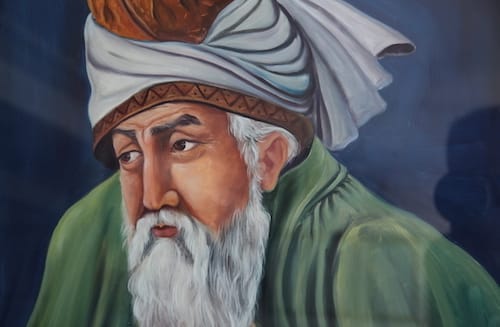
Echoes of Divine Harmony: Rumi’s Timeless Outlook on Injustice
By Red Blood | The Red Blood Journal | October 2025
In the turbulent landscape of the 13th century, amid Mongol invasions and crumbling empires, Jalaluddin Rumi emerged not just as a poet and mystic, but as a profound social thinker whose wisdom on justice and injustice continues to resonate. Known affectionately as Maulana (”our master”) in the East, Rumi’s works—particularly his epic Masnavi—offer a spiritual lens on human suffering and equity that transcends time. This commentary explores Rumi’s outlook on injustice, drawing from his Sufi philosophy, where divine love serves as the antidote to oppression, and justice is seen as the natural order of the universe. As we grapple with modern inequities—from systemic discrimination to global conflicts—Rumi’s teachings provide a blueprint for holistic healing, reminding us that true peace stems from inner transformation and communal empathy.
Rumi’s World: A Backdrop of Chaos and Clarity
Born in 1207 in Balkh (present-day Afghanistan) and later settling in Konya, Turkey, Rumi lived through an era of profound upheaval. The Mongol hordes ravaged Persia, displacing populations and eroding social structures. As a jurist and scholar of Islamic law, Rumi often acted as a defender of the marginalized, penning letters to rulers advocating for the rights of the oppressed. His encounters with injustice were not abstract; they were lived realities. Yet, rather than responding with bitterness, Rumi channeled these experiences into a philosophy rooted in Sufism, the mystical branch of Islam emphasizing direct communion with the divine.
For Rumi, injustice was not merely a societal flaw but a spiritual misalignment—a deviation from the divine harmony that binds all creation. He viewed the world as a unified whole, where humanity is interconnected like parts of a single body. “The aim of the creation of the universe is man,” he wrote, underscoring the centrality of human dignity. In this framework, injustice arises from ego-driven separation, where individuals or powers prioritize self-interest over collective well-being, echoing modern critiques of authoritarianism and inequality.
Justice as Divine Placement: Putting Things in Their Proper Place
At the heart of Rumi’s outlook is a deceptively simple definition of justice: “What is justice but putting each in his place? What is injustice but putting each in what is not his place?” This concept, drawn from his Masnavi, aligns with classical ideas of equity, akin to Aristotle’s notion of giving each their due or modern human rights principles. Justice, for Rumi, is an active force—divine in origin—that restores balance. He likens it to watering trees rather than thorns: “What is justice? Giving water to trees. What is injustice? To give water to thorns.” In practical terms, this means protecting the vulnerable, ensuring fair governance, and punishing abuses of power.
Rumi’s parables vividly illustrate this. In one tale from the Masnavi, a mosquito sues the wind before Prophet Solomon for oppression, symbolizing how even the weakest deserve recourse against the mighty. Solomon, embodying just rule, establishes laws to prevent such grievances: “We established a law (of justice) throughout the kingdoms (of the earth), to the end that no (cry of) ‘O Lord!’ should go up to the skies.” Here, justice is preventive, a guardian of peace that averts divine intervention by addressing earthly wrongs.
Injustice, conversely, is portrayed as a self-inflicted trap. Rumi warns oppressors: “O you who from iniquity are digging a well for others, you are making a snare for yourself.” He critiques tyrants like Pharaoh, whose “weapons and ignorance” devastate the world, emphasizing that oppression breeds its own downfall. This cyclical view—that injustice sows seeds of retribution—mirrors contemporary discussions on social unrest, where unchecked disparities fuel revolutions.
A Holistic Human Rights Framework: Love Over Division
Rumi’s philosophy anticipates modern human rights by centuries, framing them through divine love (ishq). He sees all humans as mirrors of God: “O you who is searching for faults in everything. Do not look down on anyone. God has a part of him in everyone regardless of their nationalities and religions.” This inclusivity opposes discrimination, advocating for mercy: “Have mercy on those on earth so that the one in Heaven (God) has mercy on you.”
His famous invitation—”Come, come, whoever you are... Ours is not a caravan of despair”—embodies a right to belonging and redemption, regardless of past wrongs. Injustice, then, is a wound on this unity: “The wound is the place where the Light enters you,” suggesting that suffering from inequity can catalyze spiritual growth, but only if met with compassion rather than further division.
Rumi extends this to governance, urging rulers to derive legitimacy from justice: “The real guardian is the justice of a person, not the guards that go around at the roofs!” He equates justice with mercy, noting: “Within justice a thousand mercies are enclosed.” Judges, in his view, are divine instruments, impartial and bribe-free, ensuring the rule of law protects all.
Relevance Today: From Sufi Fields to Global Struggles
In an age of rising populism and social fractures, Rumi’s outlook offers a radical alternative: transcendence beyond binaries. His iconic lines—”Out beyond ideas of wrongdoing and rightdoing, there is a field. I’ll meet you there”—invite us to move past punitive justice toward restorative unity. This doesn’t negate accountability but emphasizes empathy as the path to true equity.
As a guide for universal justice and peace, Rumi inspires movements against injustice, from civil rights to environmental advocacy. His Sufi ethics resist oppression through inner resistance, as echoed in recent discussions: “The ethics of Sufism is resistance to injustice.” In a world still scarred by inequality, Rumi reminds us that justice is not a distant ideal but a divine imperative, woven into the fabric of existence.
For the Red Blood Journal, this exploration—though philosophical—underscores the human element in all endeavors, where spiritual health mirrors physical vitality. Rumi’s wisdom calls us to heal the “blood” of society, ensuring no one is left in the shadows of injustice.