


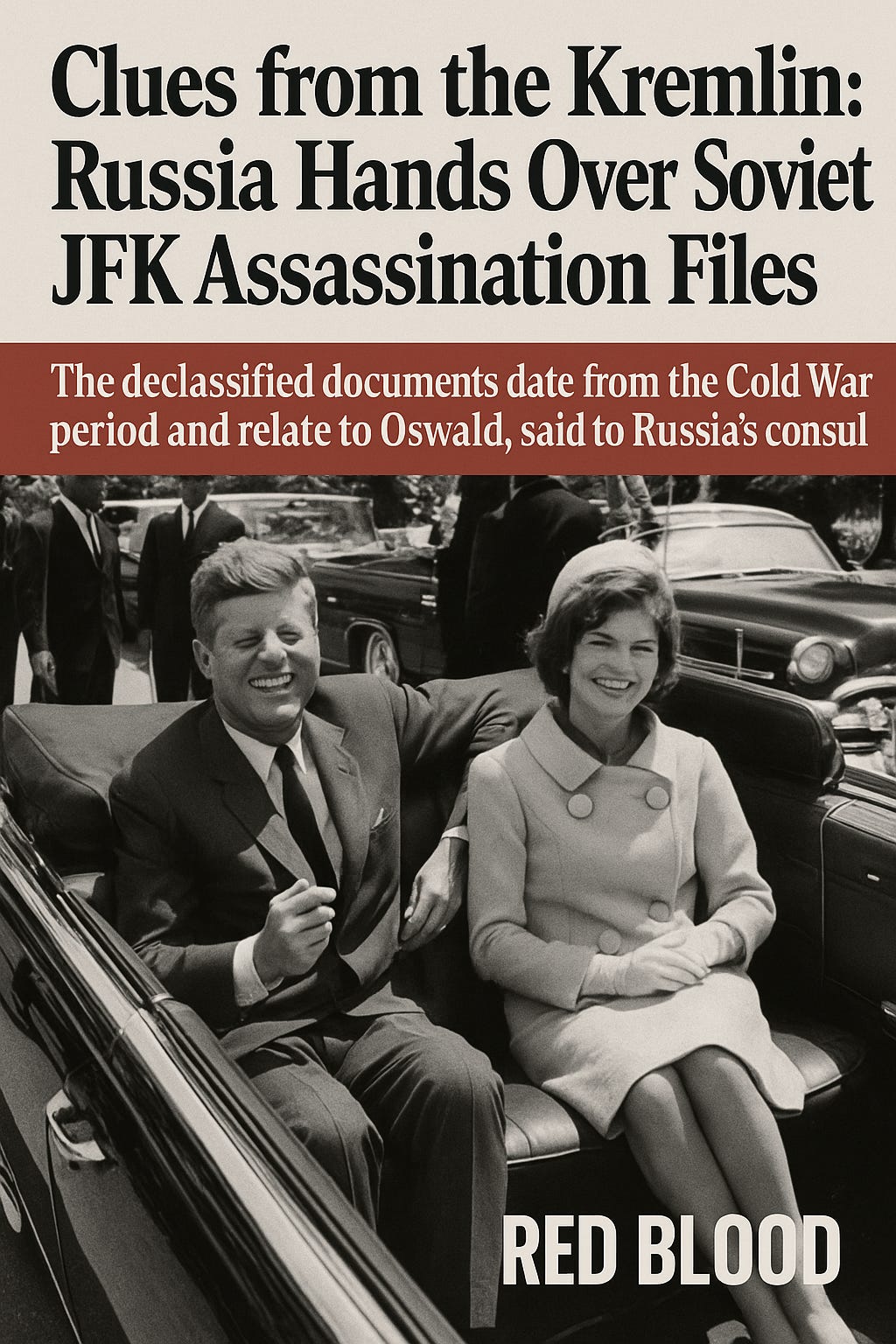
The Day History Knocked Twice
On October 14, 2025, a quiet diplomatic meeting in Washington D.C. made the kind of noise that ripples through history. According to statements confirmed by both U.S. Congresswoman Anna Paulina Luna and Russia’s Embassy in Washington, Moscow has formally transferred a set of declassified Soviet-era documents related to the assassination of President John F. Kennedy.
The files, said to come directly from the state archives in Moscow, were handed over by the Russian ambassador himself — a gesture that has set off waves of speculation in political, academic, and intelligence circles across both nations.
A Cold War Gift Wrapped in Mystery
These documents reportedly stem from KGB and Soviet foreign ministry reports written between 1959 and 1964, the same period when Lee Harvey Oswald — JFK’s alleged assassin — lived in the Soviet Union after defecting from the U.S. Marines.
If authentic, the Russian archives may contain internal analyses of Oswald’s activities in Minsk, reports from his handlers, or assessments made by Soviet intelligence after the assassination. Some diplomatic sources describe the material as “massive in historical importance,” while others caution that it could be part history, part political theater.
Russia’s state news agencies (RT and TASS) claim that Moscow intends to publish the files publicly in November, after official translation and authentication are completed.
The Political Calculus
This handover is not happening in a vacuum. The year 2025 has seen renewed tension between Washington and Moscow — from energy sanctions to cyber-espionage accusations.
Some analysts view this move as a political signal disguised as transparency. By releasing Cold War intelligence to a sitting U.S. lawmaker, the Kremlin positions itself as a truth-teller — turning an American wound into a diplomatic tool.
It also revives a decades-old question: Did the Soviets know something the Americans didn’t?
Echoes from the Past
Oswald’s defection in 1959 remains one of the strangest footnotes in Cold War history. A U.S. Marine radar operator with top-secret clearance defects to the USSR, marries a Russian woman, then returns to the U.S. without penalty — only to assassinate the President four years later.
Every intelligence veteran from that era has wrestled with the same question: Was Oswald a pawn, a spy, or both?
The Warren Commission concluded he acted alone. The House Select Committee on Assassinations (1979) ruled there was “a probable conspiracy.” Now, with Moscow opening its archives, the story threatens to evolve once more — not through speculation, but through paper, ink, and signatures.
What We Don’t Know Yet
Despite headlines, few outside the inner circle have seen the documents. The U.S. National Archives has not confirmed receipt or analysis. No metadata, catalog, or inventory has been released.
That leaves three possibilities:
The files contain routine intelligence chatter—nothing earth-shaking, but valuable for historians.
They hold contradictory evidence—something that reopens the case in substance, not just symbolism.
They’re selective disclosures—a curated version designed to manipulate public perception in the information war of 2025.
Until their full content is verified, every interpretation remains speculative.
The Stakes of Truth
If the Russian files shed new light on Oswald’s motives, handlers, or contacts, they could upend sixty years of official narrative.
But they could also reveal more about the Cold War machinery of secrecy itself — the way both superpowers crafted propaganda from tragedy.
Either way, history’s pendulum swings again.
The truth, long buried under redactions and Cold War politics, may finally be clawing its way into daylight — or into another layer of manipulation.
For now, as one diplomat told Red Blood on background:
“Whether these papers bring clarity or chaos depends entirely on what’s been left in—and what’s been left out.”