


China’s Quiet Gold Gambit: Plumbing a Parallel System to the Dollar
By Red Blood
Executive summary
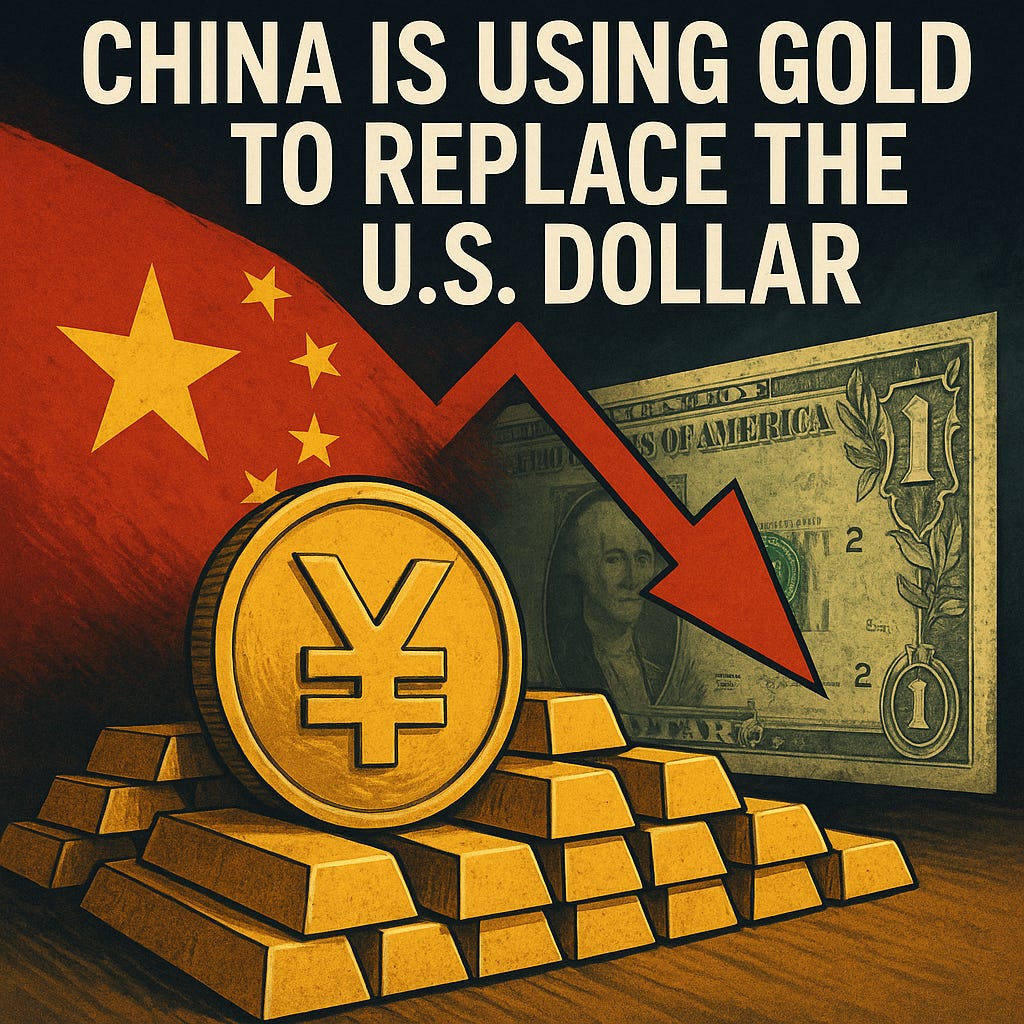
China isn’t trying to flip a switch and “replace the dollar” overnight. It’s doing something more patient—and potentially more durable: building gold-centric market infrastructure (vaults, settlement pipes, trading venues) and encouraging a reserve-management shift already underway among many central banks. This isn’t a press-release program; it’s a plumbing project. The result could be a parallel financing system where gold and yuan play larger roles in trade and development—especially across BRICS+—without formally dethroning the dollar.
Parts of the viral narrative are true and verifiable (heavy official gold buying; new SGE infrastructure; sanctions shock to “trust” in paper reserves). Other claims are unproven or incorrect (e.g., that gold became a “Tier-1 HQLA” in July 2025). This report separates facts from theory—and maps what it would take for a gold-anchored alternative to move from YouTube charts to balance-sheet reality. IMF+3World Gold Council+3World Gold Council+3
Part I — What changed the calculus: trust and custody
Sanctions shock (2022 → )
The U.S., EU, and allies immobilized roughly $300–350B of Russia’s central-bank reserves. Most sits at Euroclear in Belgium; the U.S. controls a relatively small slice. Whatever your politics, this proved a brutal point to reserve managers: fiat assets held in foreign jurisdictions can be frozen. Europe is now debating using the frozen assets’ income—and even levering them—to support Ukraine, while Moscow warns this will corrode trust in Western custody. That signal matters far beyond Russia. Semafor+3Brookings+3Reuters+3Central banks reweight toward gold
Net official gold purchases remain strong through 2024–2025, with China’s PBoC repeatedly reporting monthly additions and total reported holdings now above 2,300 tonnes (true for reported reserves; many analysts believe the broader state system holds more). The World Gold Council’s updates confirm the trend. World Gold Council+2Forbes+2The dollar’s share of reserves is easing—but far from dead
The IMF’s latest COFER work shows the dollar still near the ~58% neighborhood (depending on FX-adjustments), down from ~71% in 1999. “De-risking from dollars” is incremental, not a stampede. Reuters+1
Bottom line: The “trust and custody” lesson is real—and it nudges reserve managers toward assets that can’t be sanctioned or printed. Gold checks those boxes.
Part II — China’s build-out: from market to metal
Shanghai Gold Exchange (SGE) goes offshore
On June 26, 2025, the SGE launched its first offshore physical delivery vault in Hong Kong and introduced HK-delivery contracts. That’s not symbolism; it’s logistics—making it easier for foreign participants to settle physical in an SGE-linked location under Chinese rules. SGEToward a network of vaults
Chinese policy and industry commentary point to expanding bonded storage and vault capacity (Hong Kong and beyond) to attract international bullion into an RMB-friendly ecosystem. Some outlets dub this a “gold corridor”—a phrase used in commentary rather than in official Chinese law—but the infrastructure element is real: more vaults, more delivery points, more clearing options aligned with SGE standards. Treat the branded term as narrative; treat the vault expansion as fact. Discovery Alert+2FinancialContent+2Do BRICS financing pipes hook into this?
The New Development Bank (NDB) is scaling conventional funding programs in RMB, USD, HKD, ZAR, etc. There is no official NDB program that lends explicitly against gold collateral as HQLA. But if gold’s market plumbing gains liquidity and transparent custody, bilateral deals (not necessarily NDB-mediated) could use gold as collateral in practice. For now, file this under “plausible next step,” not policy. ndb.int+1
Bottom line: China is internationalizing the physical gold market in ways that reduce dependence on London/NY infrastructure. That’s incremental power.
Part III — The Basel III reality check (and why it matters)
A key claim online says “as of July 2025, gold is reclassified as a Basel III Tier-1 HQLA (same as cash/USTs).” That is not correct.
What’s true: For regulatory capital risk-weighting, certain forms of allocated, on-balance-sheet gold can receive favorable treatment—some analysts shorthand this as “Tier 1 for capital.”
What’s false: Under the Liquidity Coverage Ratio (LCR) and High-Quality Liquid Assets (HQLA) definitions, gold is not recognized as HQLA (Level 1/2) today. There has been no official July 2025 reclassification. The LBMA publicly corrected this rumor; the World Gold Council’s own brief agrees there’s no announced change (even as they argue gold behaves like HQLA). Under the NSFR, unallocated gold can even attract punitive factors, which hinders its use in short-term funding markets. LBMA+2World Gold Council+2
Why this matters: Repo is the dollar system’s beating heart. Unless and until gold truly attains HQLA status, it won’t easily displace Treasuries in the pipes (haircuts, eligibility, central-bank facilities). That keeps the dollar’s plumbing dominant.
Part IV — The “repatriation” confusion
Another viral claim: “The U.S. is repatriating its gold from London.”
What we actually know: large shipments of central-bank gold moved from London to the U.S. in early 2025, tightening lending supply in London. Reuters reported market participants “queued up to borrow” central-bank gold after “big shipments to the U.S.” That’s a real flow—but it does not equate to an official U.S. government repatriation program like Germany’s earlier moves. Treat it as market logistics and positioning amid changing custody preferences, not a formal declaration that “America is bringing its gold home from London.” Reuters
Part V — What a gold-enabled parallel looks like (next 3–7 years)
Collateralized trade and development
With more SGE-linked vaults and credible bar-tracking, producers (Africa, Central Asia) and consumers (China, the Gulf, India) can arrange gold-secured bilateral credit—without needing Treasuries. This could fund ports, power, roads—on terms negotiated outside IMF/WB channels. Officially, this is not yet standardized; practically, it can happen deal-by-deal once custody and valuation are acceptable to both sides. Reuters+1If HQLA never comes…
Even without HQLA, a thicker physical market (more vaults, more delivery points) plus central-bank accumulation increases gold’s strategic leverage: as a sanctions-resilient reserve, as collateral in bespoke credit lines, and as a unit of account for long-dated commodity contracts (where parties can settle in metal or yuan at term).If HQLA ever comes…
That would be a game-changer: gold would enter the plumbing (repo, LCR portfolios) alongside Treasuries. Today this is speculative; the official stance is “no change.” Markets, however, can front-run the possibility by pricing gold higher and by building infrastructure as if it were coming. LBMA+1
Part VI — Implications for the dollar, commodities, and crypto
Dollar: Still the dominant funding and settlement currency. Expect gradual diversification at the margin, not collapse. The deepest repo/Treasury markets remain an unrivaled moated fortress. IMF
Gold: Heavy official demand + infrastructure build-out support a structurally higher equilibrium price. Banks and houses have been revising forecasts upward amid the 2025 surge—but remember: forecasts chase price. Reuters
Commodities: More producers may accept yuan + optional gold-linked clauses in offtake contracts, especially where Chinese EPC firms build the projects. This nudges trade invoices away from 100% dollars without killing the dollar.
Bitcoin & digital assets: If China leans “metal + state custody,” the U.S. could counter with technology + openness (e.g., tokenized Treasuries, stablecoins in regulated rails). Both archetypes can coexist—hard metal trust vs. cryptographic/market trust—and each pressures fiat debasement in different ways.
Fact-check notes on key viral claims
“Gold was reclassified Tier-1 HQLA in July 2025.”
False. Gold is not HQLA under Basel III today; no official July 2025 reclassification occurred. LBMA and WGC both said so. LBMA+1“China built a ‘Gold Corridor’ that lets yuan convert to physical anywhere.”
Partly narrative branding. What’s real: SGE’s Hong Kong delivery vault (June 26, 2025) and broader efforts to expand vaulting/clearing capacity. A multi-jurisdiction network is emerging; “Gold Corridor” is a commentator’s label, not an official treaty. SGE+1“U.S. repatriating gold from London.”
Ambiguous. Reuters confirms large gold shipments from London to the U.S. early 2025 that tightened lending supply, but that’s not proof of an official U.S. government repatriation program. Reuters“Sanctions proved reserves ‘aren’t yours.’”
Accurate in practical terms: Western authorities froze ~$300B of Russia’s reserves, largely at Euroclear, and are pursuing schemes to use the proceeds. This is a watershed for reserve custodianship. Reuters+1
What to watch next (journalist’s checklist)
Policy arc: Any official consultation by Basel/BCBS, the ECB, Fed, or BOE on gold’s liquidity treatment (LCR/HQLA). The day that docket opens, the narrative jumps from theory to rulemaking. LBMA
Plumbing arc: More SGE-certified offshore vaults (Gulf? Africa?), increased deliverable contracts, and interlinkages with non-Western clearing systems. SGE
Deal arc: First bilateral project loan publicly disclosed with gold collateral housed in an SGE-linked vault—especially in Africa or Central Asia.
Reserve arc: Continued official buying pace; any transparency jump from Chinese state banks/sovereign funds that clarifies the “true” gold total. World Gold Council
The Red Blood conclusion
China’s strategy is plausible because it’s incremental. It doesn’t need a single dramatic “gold standard” declaration. It needs vaults, delivery contracts, custody trust, and patient central-bank flows. That is happening. But without formal HQLA status or a replacement for the dollar’s repo machinery, this is a parallel—not a replacement—system.
A fragmented, multi-standard world is a feature, not a bug. It gives nations choices—and gives citizens a clearer view into how trust is engineered: through laws and plumbing in the West; through metal and custody in China’s expanding sphere. If you want to know who’s winning, don’t just watch speeches. Watch the pipes.
Sources & further reading
World Gold Council (central-bank purchases; China updates). World Gold Council+2World Gold Council+2
IMF COFER & blog (reserve currency shares). IMF Data+1
Reuters, Guardian, and analysis on frozen Russian reserves & Euroclear. Reuters+2The Guardian+2
SGE announcement: Hong Kong certified vault launch (June 26, 2025). SGE
LBMA & WGC on HQLA claims (debunked). LBMA+1
Reuters on gold shipments to the U.S. tightening London lending supply. Reuters
China, BRICS, Gold, De-Dollarization, Basel III, Shanghai Gold Exchange, Euroclear, Sanctions, Reserve Currencies, Repo Markets, Geoeconomics, Red Blood Investigations