


🔺 Introduction: The Mirage Beneath the Desert
Every few years, when the Suez Canal chokes—by accident, war, or politics—someone revives the same fantasy:
“What if Israel built its own canal?”
It sounds clean, modern, visionary—a lifeline between the Red Sea and the Mediterranean. But dig past the press releases and it becomes something else: a ghost of the 1960s nuclear age, resurrected by desperation and geopolitics.
⚙️ The Original Plan: Carving the Desert with Bombs
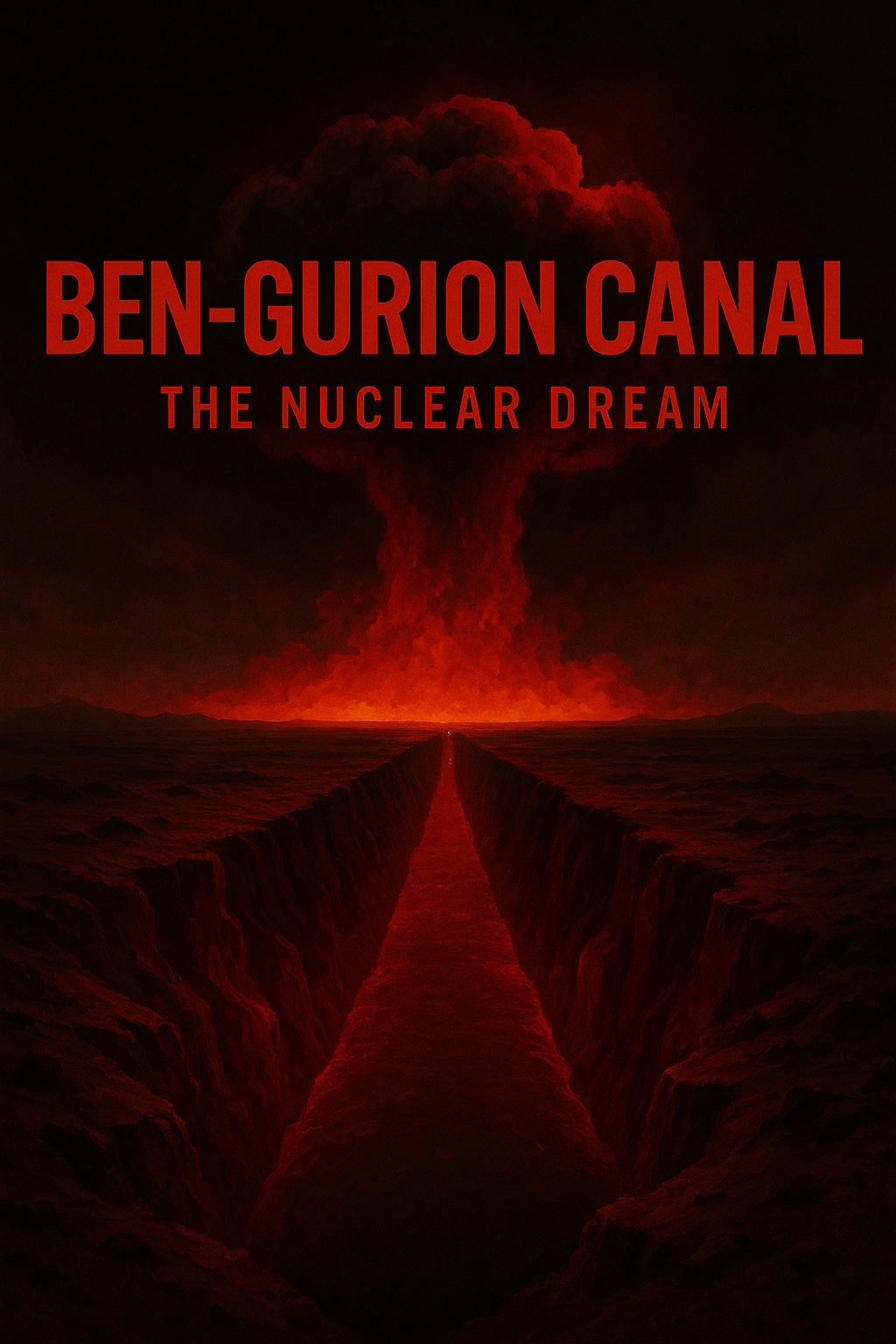
In 1963, during the U.S. Project Plowshare, engineers proposed using nuclear explosives to dig a 160-mile waterway across Israel’s Negev Desert—from Eilat on the Red Sea to Ashkelon on the Mediterranean.
Hundreds of underground blasts would vaporize rock, creating a sea-level trench rivaling Suez.
It was declassified decades later: a canal born from atomic optimism, not feasibility. The plan died quietly, buried under treaties and radiation fears—but not forgotten.
🧱 Engineering Reality: The Wall of Rock
Even without nukes, the topography kills the dream.
The land between Eilat and the Med climbs nearly 250 meters, then drops toward the Dead Sea—an elevation nightmare.
To make it work:
You’d need massive lock systems (like Panama’s) in one of the world’s driest regions.
Locks need freshwater reservoirs. The Negev has none.
A sea-level trench would require moving billions of cubic meters of granite-hard rock—an Earth-moving project on Mars-level energy.
The bill? Conservatively $100–150 billion before a single ship sails.
💣 Security and Politics: A Canal Through Crosshairs
Every kilometer of this hypothetical canal cuts through frontline territory:
The Mediterranean mouth lies near Gaza and Ashkelon, targets in every regional conflict.
The eastern corridor hugs the Jordanian border, monitored and volatile.
A single drone strike could halt shipping for weeks.
For Egypt, whose economy depends on Suez, a competing canal is an existential threat.
For Israel, it’s a permanent magnet for attack.
For global trade, it’s another chokepoint with nukes in its blueprint.
🌍 Environmental Fallout
Beyond politics, the canal would rip through protected desert ecosystems, ancient archaeological corridors, and fragile aquifers.
Linking two salt seas (Red and Med) risks chemical contamination and ecological collapse—echoing warnings from scientists studying the smaller “Red–Dead” water project nearby.
💰 Economics Don’t Float
Global shipping already has cheaper workarounds:
Expanded Suez: Egypt continues widening lanes and deepening channels, adding redundancy for a fraction of the cost.
African rerouting: Expensive but instantly reversible when the Red Sea stabilizes.
Pipelines & rail: Energy and container bridges through Saudi Arabia or the UAE are faster, safer investments.
The Ben-Gurion idea remains a PowerPoint fantasy—no investors, no water, no peace.
🕵️♂️ Red Blood’s Take
Possible? Maybe.
Probable? Never.
The Ben-Gurion Canal survives because it symbolizes something deeper—the dream of control. Whoever owns the corridor between Europe and Asia owns a lever on civilization. Egypt guards it; Israel eyes it; superpowers whisper about it.
But beneath the rhetoric, the canal is not an engineering project.
It’s a political mirage—a monument to power lust and paranoia.