


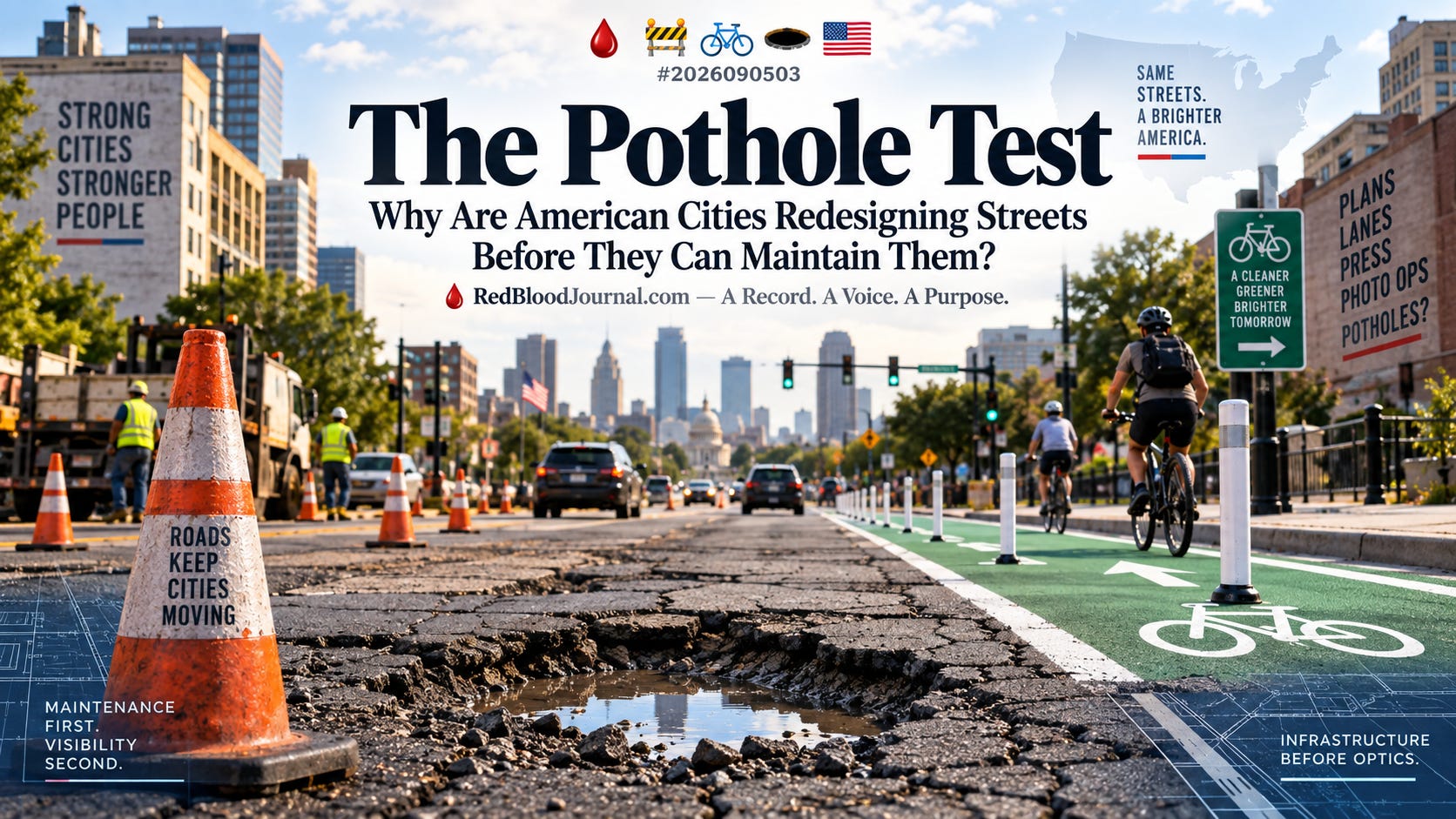
🩸 🚧 🚲 🕳️ 🇺🇸 #2026090503 — The Pothole Test: Why Are American Cities Redesigning Streets Before They Can Maintain Them?
Before a city asks how a street should be redesigned, should it first prove that it can keep the street from falling apart?
🩸 RedBloodJournal.com — A Record. A Voice. A Purpose.
Across the United States, the same contradiction appears in city after city.
Residents drive over cracked pavement, broken asphalt, patched trenches and potholes large enough to damage tires, wheels and suspensions.
Then, sometimes on that same corridor, they see new striping.
New bike lanes.
New traffic-calming features.
New painted zones.
New signs.
New streetscape projects.
And the question becomes almost unavoidable:
How does a city find the money and administrative energy to redesign a street before it can properly maintain the street itself?
This is not an argument against bicycles.
It is not an argument against pedestrians.
It is not an argument against safer streets.
It is an argument about sequence, priorities and basic competence.
A street is infrastructure before it is a policy statement.
The Bureaucratic Answer
The explanation is often more complicated than it appears.
Municipal money is frequently divided into separate categories.
A city may receive:
federal transportation grants,
state climate funds,
bicycle and pedestrian safety money,
transit-oriented development funding,
local sales-tax transportation revenue,
general-fund maintenance money,
or capital-improvement funds.
Those dollars are not always interchangeable.
Money awarded for a bicycle project may not legally be available for general pothole repair.
A city department can therefore have funding available to install a protected bike lane while another department says there is insufficient money to rebuild deteriorated pavement elsewhere.
On paper, both statements can be true.
To the resident driving over the pothole, however, the distinction can feel absurd.
The road does not know which department paid for which stripe.
The Pothole Is a Test of Government
Potholes may seem trivial compared with billion-dollar infrastructure projects.
They are not.
They are one of the most direct ways citizens experience government.
A resident may never read a transportation master plan.
They may never attend a planning commission meeting.
They may never examine a municipal bond.
But they know when their tire hits a hole at 35 miles per hour.
They know when a road has been patched five times instead of properly repaired once.
They know when a newly redesigned intersection looks impressive while the pavement leading into it remains broken.
The pothole becomes a kind of civic report card.
It asks a very simple question:
Can the government maintain the basic thing it already owns?
Maintenance Is Politically Boring
There may also be a deeper incentive problem.
Maintenance is rarely glamorous.
A politician receives little attention for saying:
We replaced deteriorated asphalt before it failed.
There may be no ribbon cutting.
No dramatic rendering.
No major press conference.
No new program name.
No ideological constituency celebrating it.
Proper maintenance often means that nothing noticeable happens.
The road simply works.
That is precisely what makes maintenance so easy to neglect.
New projects are visible.
Maintenance prevents visible failure.
And modern politics tends to reward what can be photographed.
The Problem Is Bigger Than Bike Lanes
Bike lanes are only one example.
The same pattern appears with:
decorative streetscapes,
public art installations,
redesigned plazas,
smart-city technology,
traffic sensors,
new signage,
beautification programs,
climate projects,
and major redevelopment initiatives.
Many of these projects can be worthwhile.
But they expose a fundamental question when basic infrastructure is deteriorating:
Should government expand what it promises to manage before demonstrating that it can maintain what it already has?
That question applies far beyond roads.
A city builds a new park while older parks deteriorate.
A transit agency announces an expansion while existing stations remain dirty or unreliable.
A school district constructs a new facility while older buildings have leaking roofs.
A government launches a new digital system while existing services remain difficult to use.
The pattern is the same.
Expansion attracts attention. Maintenance requires discipline.
The False Choice
The debate is often framed badly.
Drivers versus cyclists.
Cars versus pedestrians.
Climate policy versus road repair.
That misses the point.
Cyclists need smooth pavement too.
A pothole that irritates a driver can seriously injure someone on a bicycle or motorcycle.
Pedestrians benefit when streets are properly engineered and maintained.
Emergency vehicles need reliable roads.
Buses need reliable roads.
Delivery vehicles need reliable roads.
Everyone benefits from basic infrastructure that functions properly.
So the real standard should be:
Maintain first. Improve intelligently. Redesign when justified.
Those goals are not enemies.
Why Not Fix the Road at the Same Time?
This is where citizens have a legitimate question.
If a city is already:
closing lanes,
bringing construction crews,
restriping pavement,
installing barriers,
changing curbs,
modifying intersections,
or rebuilding portions of a corridor,
why not coordinate the work so deteriorated pavement is repaired at the same time?
Sometimes cities do exactly that.
But when they do not, residents see duplicated disruption and duplicated cost.
A street may be opened for utility work.
Patched.
Opened again for another project.
Patched again.
Restriped.
Then scheduled for resurfacing later.
Each department may be following its own budget and timetable.
The result can be administratively correct and practically ridiculous.
The Cost of Deferred Maintenance
Ignoring road maintenance does not make the expense disappear.
It usually makes the eventual repair more expensive.
A small crack allows water into pavement.
Water weakens the underlying structure.
Traffic enlarges the failure.
A repair that might once have required sealing or resurfacing can eventually require excavation and reconstruction.
This is why maintenance is not merely cosmetic.
It is financial management.
Every year that necessary repair is postponed can transfer a larger bill to the future taxpayer.
And the future taxpayer is usually the same citizen who was told there was not enough money to fix the road today.
Dedicated Funding Can Hide the Larger Problem
There is an important defense cities can make.
A grant specifically written for bicycle infrastructure cannot necessarily be redirected to pothole repair.
Rejecting that grant may not magically produce road-maintenance money.
That is fair.
But it does not eliminate the broader policy question.
If cities repeatedly succeed at obtaining grants for new programs while their basic maintenance backlog continues growing, perhaps the funding system itself deserves scrutiny.
Government becomes very good at funding additions while becoming increasingly poor at funding upkeep.
That creates an infrastructure paradox:
We can afford to build it, but apparently not to maintain it.
The National Infrastructure Psychology
America has long been attracted to construction.
New highways.
New bridges.
New stadiums.
New transit systems.
New public buildings.
New technology.
Building something creates a visible accomplishment.
Maintaining something requires sustained attention after the cameras leave.
The less glamorous work is often the more important work.
A bridge does not care whether its maintenance budget produces political excitement.
Neither does a water main.
Neither does a sewer.
Neither does a road.
Infrastructure obeys physics, not public relations.
A Better Standard
Perhaps every major street project should begin with a simple checklist.
Is the pavement structurally sound?
Are drainage problems corrected?
Are utility cuts coordinated?
Are sidewalks safe?
Are intersections functioning?
Can bicycles safely use the roadway?
Can buses and emergency vehicles move reliably?
Only then should the city ask what additional redesign would improve the corridor.
That does not mean freezing cities in the past.
It means establishing an order of operations.
Foundation first.
Enhancement second.
The Red Blood Perspective
The argument is not that America should stop building bike lanes.
The argument is that a government should never use a new stripe of paint to distract from a collapsing road underneath it.
Citizens are not unreasonable when they question priorities.
They understand something very basic:
Government earns credibility through competence.
Fixing a pothole may not be visionary.
Maintaining a sewer is not inspirational.
Replacing a broken water main will not generate a glamorous rendering.
But these are the things government exists to do.
The most sophisticated transportation policy in the world means little if the road underneath it is disintegrating.
A city should certainly imagine the future.
But first it should prove that it can maintain the present.
The Ocean of Love and Positivity Perspective
There is also a broader lesson here.
Human beings often prefer creating something new to caring for what already exists.
The new project excites us.
Maintenance feels repetitive.
That tendency appears in governments, businesses, homes and even relationships.
But much of life is maintenance.
Health requires maintenance.
Trust requires maintenance.
A home requires maintenance.
Knowledge requires maintenance.
Peace of mind requires maintenance.
Civilization itself requires maintenance.
Perhaps the pothole is therefore more than a hole in asphalt.
It is a reminder that progress is not simply the ability to build something new.
Progress is also the discipline to care for what has already been built.
Sometimes the most advanced society is not the one with the most ambitious plans.
It is the one where ordinary things quietly work because someone cared enough to maintain them.
In an Ocean of Love and Positivity.
🩸🌊✨ Fantastic!
🚧
The Pothole Test: The Civic Duty of Maintenance
Sep 5, 2026
The provided text critiques the modern municipal trend of prioritizing aesthetic street redesigns and new infrastructure projects over the essential task of basic maintenance. It highlights a frustrating paradox where cities secure specialized funding for bike lanes and beautification while leaving primary roads riddled with deteriorating pavement and potholes. The author argues that maintenance is a test of government competence, though it is often neglected because it lacks the political glamour and “ribbon-cutting” appeal of new construction. This imbalance is attributed to fragmented bureaucratic funding and a national fixation on expansion rather than the disciplined upkeep of existing assets. Ultimately, the source suggests that true progress requires a “foundation first” approach, where a government proves its reliability by caring for what it already owns before seeking to build more. The pothole serves as a civic report card, reminding leaders that infrastructure must function reliably for all users before it can serve as a policy statement.
#Infrastructure #Transportation #UrbanPlanning #LocalGovernment #PublicPolicy #Potholes #RoadMaintenance #BikeLanes #StreetDesign #CityPlanning #PublicWorks #MunicipalGovernment #RoadSafety #DeferredMaintenance #GovernmentSpending #TaxpayerMoney #AmericanCities #CivicInfrastructure #RedBloodJournal #2026090503