


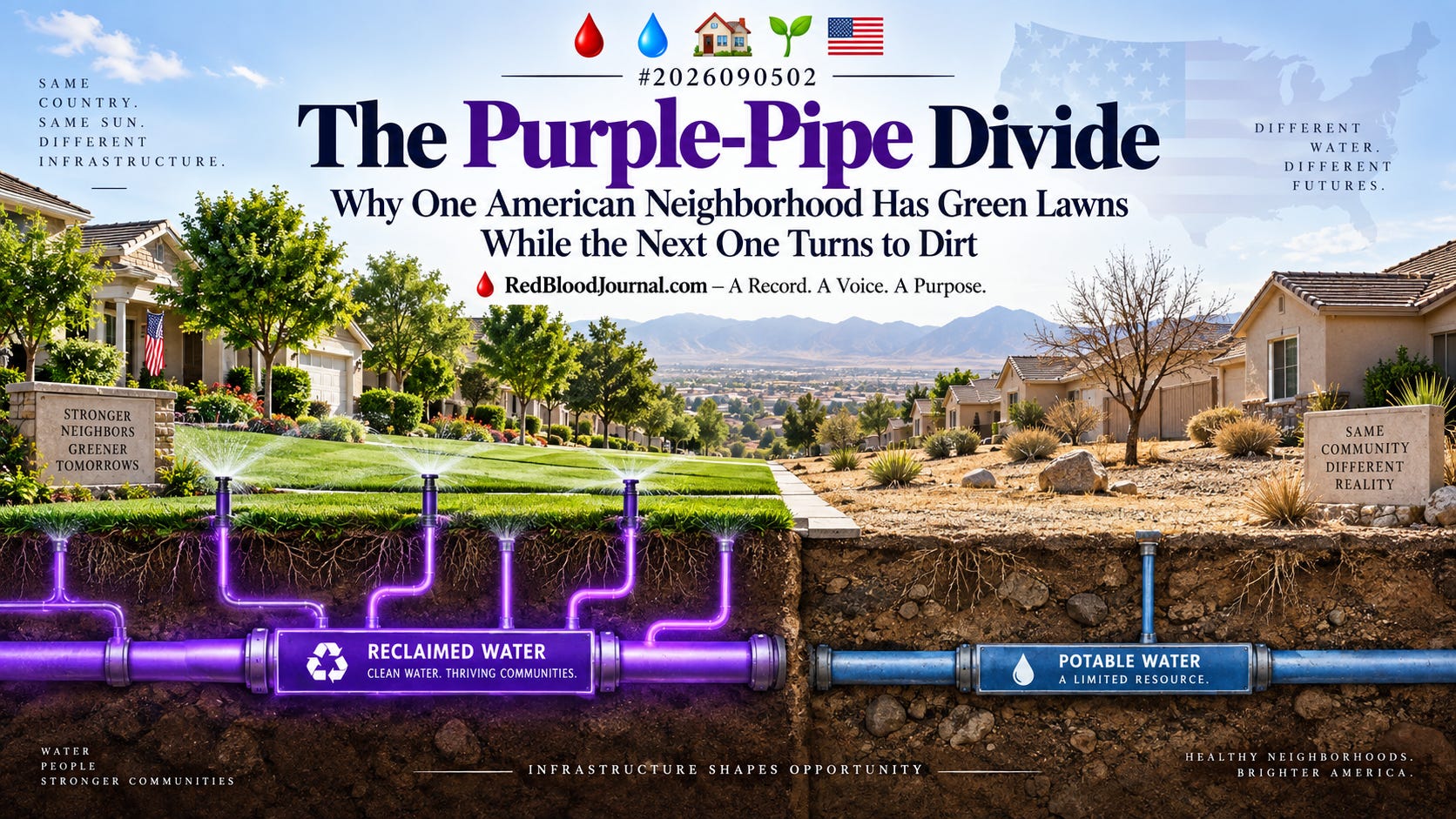
🩸 💧 🏘️ 🌱 🇺🇸 #2026090502 — The Purple-Pipe Divide: Why One American Neighborhood Has Green Lawns While the Next One Turns to Dirt
Same sun. Same drought. Same country. Completely different lawns.
🩸 RedBloodJournal.com — A Record. A Voice. A Purpose.
Drive through Southern California and something becomes difficult to ignore.
One neighborhood is brown.
Grass has disappeared. Front yards have become gravel, mulch, artificial turf, succulents or bare dirt. Homeowners are told that California is dry, water is precious, conservation is necessary and maintaining a traditional green lawn has become an expensive luxury.
Then drive several miles.
Suddenly the medians are green.
The parks are green.
The entrances to subdivisions are green.
HOA common areas are green.
Sometimes enormous expanses of grass remain beautifully irrigated even during periods when surrounding neighborhoods appear almost desert-like.
EastLake in Chula Vista provides one example.
Carlsbad provides another.
But once the question is examined nationally, something much larger appears.
America has quietly constructed two different landscaping economies.
In one, expensive drinking water is used to keep vegetation alive.
In the other, an entirely separate underground water network carries treated wastewater through purple pipes for irrigation.
The difference can determine what an American neighborhood looks like for generations.
The Question Is Not Simply: Who Can Afford Grass?
At first glance, the explanation seems obvious.
Wealthier neighborhood.
Bigger HOA budget.
More expensive homes.
Therefore greener landscaping.
Money unquestionably matters.
But that explanation is incomplete.
In many communities, the decisive advantage is buried underground.
It is called reclaimed water, recycled water or reuse water.
Wastewater from homes and businesses travels to a treatment plant. Instead of simply being discharged after treatment, some of it is treated sufficiently for non-drinking purposes and sent back through a completely separate distribution network.
Across the United States, those pipes are generally identified by the color purple.
The reclaimed water can then irrigate:
parks,
highway medians,
golf courses,
school grounds,
HOA landscaping,
commercial properties,
athletic fields,
and, in some systems, individual residential yards.
The expensive potable-water system remains available for drinking, cooking, bathing and household use.
The grass receives something else.
And that distinction changes the economics.
Irvine, California: A City Designed Around the Second Water System
Perhaps one of the clearest American examples is Irvine.
The Irvine Ranch Water District began integrating recycled water into community development in 1963.
Today, the district says more than 80% of its public and commercial landscaped areas are irrigated with recycled water, including parks, medians, schools, golf courses and homeowners-association landscaping.
That sentence deserves attention.
Not 8%.
Not 18%.
More than 80%.
The district itself explains the consequence: recycled water helps keep its urban landscape green and reduces irrigation expenses for HOAs, parks and other large landscape customers.
The difference also appears directly in pricing.
As of July 1, 2026, Irvine Ranch Water District’s base recycled-water landscape irrigation rate is $2.47 per hundred cubic feet within the normal water budget.
So when someone drives through Irvine and wonders why expansive landscaping remains green while another Southern California neighborhood removes its lawn, the answer may not be that Irvine residents simply care more about grass.
They may be operating on a fundamentally different water system.
Scottsdale, Arizona: Green Golf Courses in the Sonoran Desert
Now travel east into Arizona.
Few landscapes make the contradiction more visually striking.
The Sonoran Desert is naturally brown, rocky and extremely dry.
Yet North Scottsdale contains intensely green golf developments.
How?
Again, look underground.
Since the early 1990s, Scottsdale has operated a reclaimed-water distribution system serving 23 golf courses.
The system can deliver approximately 20 million gallons per day of non-potable water specifically for turf irrigation.
That system was originally developed specifically to reduce the golf courses’ dependence on groundwater.
Think about what that means visually.
A person can stand in one of America’s driest natural environments and see enormous fields of green grass.
A few miles away, ordinary residential landscaping may consist almost entirely of stone, cactus and desert vegetation.
Same desert.
Different pipes.
Texas: The Purple Network Is Expanding
Texas provides another important example.
Austin operates a reclaimed-water network that sends treated wastewater through purple pipes for irrigation, toilet flushing and industrial cooling.
Austin Water says reclaimed water can cost as little as half the price of drinking water, depending on use and circumstances.
Austin is now deliberately expanding the system.
Its GoPurple program is designed to encourage and, in some circumstances, require newer developments to connect to reclaimed water or build onsite water-reuse systems.
The city estimates that expanding reclaimed water and onsite reuse could save 16 million gallons of potable drinking water every day by 2040.
Construction continues.
Austin has been building a central reclaimed-water ring and adding thousands of feet of new purple pipe to neighborhoods and development corridors.
Again, notice the long-term consequence.
A development built today with dual-water infrastructure may enjoy a completely different landscaping economy 20, 30 or 50 years from now than a neighborhood built without it.
San Antonio: More Than 130 Miles of Recycled-Water Pipeline
San Antonio offers an even larger example.
The San Antonio Water System says its recycled-water network stretches more than 130 miles and supplies more than 80 customers including golf courses, parks, universities, military installations, healthcare facilities and industrial users.
The system began delivering recycled water commercially in 1999.
SAWS describes it as one of the largest direct recycled-water systems in the country.
The important point is not simply how much water is recycled.
It is what happens after that infrastructure exists.
Every property connected to it has access to something neighboring properties may not:
an alternative to using drinking-quality water for landscaping.
Florida May Be the Most Extraordinary Example
California gets enormous attention for drought.
Arizona gets attention because it is desert.
But Florida may provide the clearest evidence that reclaimed water is becoming an entire parallel municipal utility.
According to the Florida Department of Environmental Protection, approximately 958 million gallons per day of reclaimed water were beneficially reused in Florida during 2024.
And look at where that water went.
Florida reported reclaimed-water irrigation serving approximately:
591,834 residences
519 golf courses
1,049 parks
and
409 schools.
That is no longer an experimental environmental program.
That is infrastructure at metropolitan scale.
Florida has been doing this for decades.
St. Petersburg’s dual-distribution system, operating since 1977, became one of the country’s best-known examples by delivering reclaimed irrigation water through a separate network directly to thousands of residential lawns, schools, parks and golf courses.
The purple pipe has effectively become another utility.
Two Houses Can Live in Two Different Water Economies
Now imagine two American houses.
They are ten miles apart.
Both experience the same rainfall.
Both experience the same summer heat.
Both have approximately 1,000 square feet of grass.
House A
Its neighborhood was built decades ago.
There is one water pipe.
Every gallon used on the lawn has gone through the same drinking-water treatment and distribution system as the water coming from the kitchen faucet.
As usage rises, the homeowner may enter increasingly expensive water-rate tiers.
Eventually the decision becomes obvious:
Remove the grass.
House B
The subdivision was constructed later.
Underneath the street are two water systems.
One carries potable drinking water.
The other carries reclaimed irrigation water.
The HOA irrigates medians, parks and common areas with that second supply.
The cost is spread among hundreds or thousands of homeowners.
The neighborhood stays green.
The homeowner in House A may look across town and reasonably wonder:
Why am I being told grass is environmentally irresponsible while that community has acres of it?
The answer may be neither hypocrisy nor extravagance.
It may simply be infrastructure.
The Hidden Advantage of the Master-Planned Community
This creates an advantage that is rarely discussed.
When a city or developer builds a large community from scratch, installing a second water network can be incorporated while the roads are already being constructed.
Trenches are open.
Utilities are being installed.
Buildings do not yet exist.
Adding another pipe is still expensive—but it is manageable.
Now imagine installing the same system underneath a 70-year-old neighborhood.
Roads must be excavated.
Existing utilities must be navigated.
Connections must be rebuilt.
Traffic is disrupted.
Thousands of individual properties may need modifications.
The economics become dramatically different.
Therefore the neighborhoods that received recycled-water infrastructure during construction can retain that advantage for generations.
This Creates an Infrastructure Divide
America frequently discusses inequality through:
income,
schools,
housing,
healthcare,
transportation,
internet access,
and taxation.
Water infrastructure deserves a place on that list.
Because infrastructure determines choices.
A homeowner who receives inexpensive reclaimed irrigation water has choices that another homeowner does not.
A city with extensive purple-pipe infrastructure can maintain public greenery without consuming equivalent quantities of potable water.
Another city may have to choose between increasingly expensive drinking water and eliminating landscaping.
Neither community necessarily made the decision today.
The decision may have been made underneath the street 30 years ago.
And That Changes the Meaning of “Conservation”
There is another lesson here.
For decades Americans have often been told that conservation means personal sacrifice.
Take shorter showers.
Turn off the faucet.
Remove the lawn.
Stop watering.
Replace grass with rock.
But water reuse demonstrates another possibility.
Conservation does not always have to mean doing without.
Sometimes conservation means using the same resource twice.
Austin describes the principle remarkably simply:
every gallon of reclaimed water used is essentially another gallon of water that does not have to be withdrawn from its primary drinking-water sources.
That is a very different philosophy.
Instead of:
Use less because water is scarce.
It becomes:
Stop wasting drinking-quality water on jobs that do not require drinking-quality water.
We do not flush most toilets with bottled water.
Why should every lawn necessarily require water purified to drinking standards?
The National Question
The American debate therefore should become larger than lawns.
The real question is:
Why isn’t water reuse infrastructure being treated like sewer, electricity, broadband or natural gas infrastructure in rapidly growing American communities?
If Scottsdale can irrigate 23 golf courses with a reclaimed-water network…
If Irvine can supply more than 80% of its public and commercial landscaping with recycled water…
If San Antonio can construct more than 130 miles of dedicated recycled-water pipelines…
If Florida can irrigate nearly 600,000 residences with reclaimed water…
And if Austin is expanding purple-pipe infrastructure today…
then this is no longer a theoretical technology.
It works.
The more difficult question is who gets it.
The Red Blood Perspective
The green lawn itself is not the important story.
The pipe underneath it is.
A person driving through EastLake, Carlsbad, Irvine, Scottsdale, San Antonio or parts of Florida may see beautiful vegetation and assume the residents simply pay enormous water bills.
Sometimes they do.
But often something much more interesting is happening beneath the surface.
One neighborhood has access to a resource another neighborhood does not.
And once that infrastructure has been installed, the advantage can persist for decades.
This should change how Americans think about drought and conservation.
A brown neighborhood beside a green neighborhood does not automatically prove that one population is more responsible, wealthier or more environmentally conscious than another.
Sometimes it proves that one community inherited better pipes.
And infrastructure has an uncomfortable characteristic:
once it disappears underground, society tends to forget that it is there.
Until the lawn turns brown.
The Ocean of Love and Positivity Perspective
There is something encouraging hidden inside this story.
Human beings often respond to scarcity by assuming somebody must lose.
Less water means less beauty.
Less water means fewer trees.
Less water means brown parks.
Less water means fighting over who gets what remains.
But reclaimed water demonstrates another possibility.
Sometimes the answer is not taking more.
Sometimes the answer is finally learning to use intelligently what we already have.
Water enters a home.
It performs its purpose.
It leaves.
We clean it.
And instead of treating it as waste, we recognize that it still has value.
There is almost a philosophy of life hiding inside that engineering decision.
What appears exhausted is not always useless.
What has already served one purpose may still serve another.
What society once threw away can become something that keeps an entire community alive and green.
And perhaps the deeper lesson extends beyond water.
Before humanity concludes that there is not enough, perhaps we should first examine how much we waste, how poorly we distribute what exists, and how often yesterday’s discarded resource could become tomorrow’s solution.
The greenest future may not come from endlessly demanding more.
It may come from becoming wiser with what already passes through our hands.
In an Ocean of Love and Positivity.
🩸🌊✨ Fantastic!
💜
The Purple Pipe Divide: Water Infrastructure and Landscape Inequality
1 source·Sep 5, 2026
The sources examine the “purple-pipe divide,” a growing infrastructure gap where certain American neighborhoods maintain lush landscapes during droughts while others turn to dirt. This disparity is often driven by underground reclaimed-water networks that distribute treated wastewater specifically for irrigation at a lower cost than drinking water. Cities in California, Arizona, Texas, and Florida serve as primary examples of how dual-piping systems allow communities to conserve potable water without sacrificing greenery. The text emphasizes that access to this infrastructure creates long-term economic and aesthetic advantages for newer or master-planned developments. Ultimately, the narrative reframes water conservation as a matter of intelligent reuse and planning rather than mere personal sacrifice. These sources argue that the future of sustainable urban living depends on recognizing treated waste as a valuable resource for maintaining community vitality.
#WaterConservation #RecycledWater #PurplePipe #UrbanPlanning #WaterInfrastructure #SustainableCities #Drought #AmericanInfrastructure #GreenLawns #WaterReuse #HOA #CaliforniaWater #ArizonaWater #TexasWater #FloridaWater #EnvironmentalPolicy #CityPlanning #Sustainability #RedBloodJournal #2026090502