


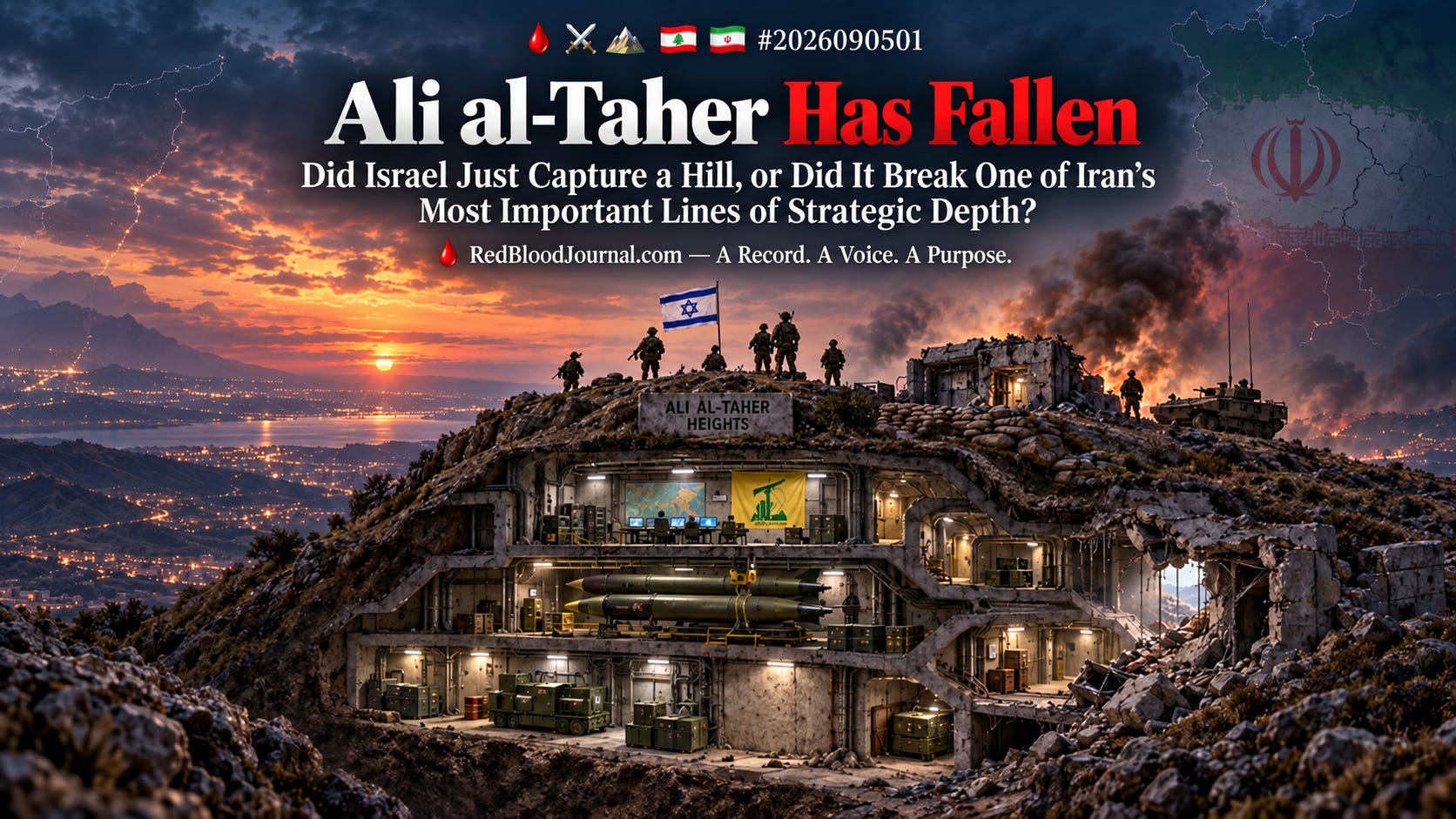
🩸 ⚔️ ⛰️ 🇱🇧 🇮🇷 #2026090501 — Ali al-Taher Has Fallen: Did Israel Just Capture a Hill, or Did It Break One of Iran’s Most Important Lines of Strategic Depth?
🩸 RedBloodJournal.com — A Record. A Voice. A Purpose.
There are moments in war when a piece of land is just a piece of land.
And then there are moments when a hill becomes a message.
According to the material examined for this report, the Ali al-Taher heights in southern Lebanon have become exactly that kind of message.
The transcript describes the area as one of Hezbollah’s most important strategic positions in southern Lebanon: elevated terrain overlooking surrounding territory, with a substantial underground complex beneath it containing command rooms, weapons storage, generators, living quarters, kitchens and other infrastructure intended to sustain fighters for extended periods.
In the speaker’s account, this was not simply a forward observation post.
It was a fortified underground military ecosystem.
And now, according to the same account, Israeli forces have gained operational control of it.
That is what makes Ali al-Taher important.
Not the dirt.
Not the rocks.
Not even the tunnels by themselves.
The important question is what the loss of such a position says about the larger balance of power.
A Fortress Built for a Long War
The transcript says the underground installation took roughly two decades to build and attributes its design and financing to support from the Islamic Republic of Iran.
It describes a complex capable of housing personnel for long periods, with command facilities, weapons depots and supporting infrastructure buried beneath the heights.
That detail matters.
A temporary battlefield position can be replaced.
A twenty-year investment is something different.
It represents strategy frozen into concrete.
It represents assumptions about the future.
Someone believed this location would remain useful, defensible and available for years.
Someone believed Hezbollah would continue to possess the freedom of movement required to operate it.
Someone believed Israel could be deterred from permanently removing it.
If those assumptions are now failing, the real loss may be larger than the installation itself.
Above Ground and Below Ground
The transcript says Israeli forces gradually surrounded the area before gaining operational control both above and below ground.
Two underground routes were reportedly cleared, Hezbollah fighters were killed or forced to withdraw, and Israeli forces began dismantling the underground infrastructure.
The transcript also repeats claims that entrances and exits were struck and that Hezbollah commanders and members of Iran’s Revolutionary Guard may have become trapped within sections of the underground network.
That particular claim should be treated as a claim contained in the source material rather than as an independently established fact.
But even without that claim, the strategic point remains.
A position designed to protect Hezbollah from Israeli pressure is described as having passed into Israeli operational control.
That is an inversion of purpose.
The shield has become the battlefield.
The Silence May Be Louder Than the Explosion
Perhaps the most politically important part of the transcript is not what Israel did.
It is what Iran allegedly did not do.
The speaker repeatedly contrasts earlier declarations that southern Lebanon was a red line with the apparent absence of a major Iranian response after Ali al-Taher came under Israeli control.
That creates a problem far larger than military geography.
Deterrence is built partly from weapons.
But it is also built from belief.
An adversary must believe a threat will be carried out.
An ally must believe a promise of protection means something.
Once threats are repeatedly issued without visible enforcement, the question slowly changes from:
What will Iran do?
to:
Can Iran still do what it says?
That transition can be more damaging than losing a battlefield position.
Even Supporters Are Asking Questions
The transcript quotes pro-regime voices expressing frustration and disbelief over the apparent lack of response.
Some describe Ali al-Taher as vital to Hezbollah and directly question Iranian officials about why the position was allowed to fall without intervention.
That reaction is revealing.
A military defeat hurts.
A military defeat that your own supporters interpret as abandonment hurts differently.
The first damages capability.
The second damages confidence.
And confidence is one of the invisible currencies of power.
Netanyahu’s Message
The transcript also includes remarks attributed to Benjamin Netanyahu presenting the operation as the removal of a longstanding Hezbollah threat to northern Israel.
According to the account, Israeli forces seized weapons and computers from the installation, fought Hezbollah forces attempting to hold it and ultimately took control of the heights.
Whether one accepts Netanyahu’s framing or not, the political message is unmistakable:
A site built to threaten northern Israel is being presented by Israel as territory Hezbollah can no longer use for that purpose.
That symbolism matters in the psychological dimension of war.
The Larger Word Is “Rollback”
The transcript repeatedly returns to one concept:
rollback.
The argument is that Hezbollah is not being viewed in isolation.
Instead, the speaker places Hezbollah alongside the Houthis, Hashd al-Shaabi and Iranian-backed forces in Syria as components of a larger Iranian regional structure that may be undergoing gradual reduction.
The theory is simple.
Do not begin by striking the center.
First weaken the perimeter.
Reduce the proxies.
Cut financial channels.
Remove strategic positions.
Increase economic pressure.
Gradually eliminate the external structures that provide Tehran with strategic depth.
Then see what remains at the center.
Ali al-Taher fits this theory almost perfectly.
If the hill were the only event, it might be merely tactical.
But if it sits inside a sequence of losses, then it becomes evidence of something larger.
The Soviet Comparison
The transcript goes even further, comparing the current pressure on the Islamic Republic with the rollback of Soviet power during the final stages of the Cold War.
It recalls the withdrawal of Soviet influence from Afghanistan and Eastern Europe and argues that the damage was not simply territorial.
Each retreat weakened the image of Soviet permanence.
Each retreat reduced prestige.
Each retreat made the system appear less inevitable.
Eventually the external contraction met the internal weaknesses: corruption, economic stagnation, repression and dissatisfaction.
The transcript suggests that Iran may now be experiencing its own version of this process.
The analogy is not proof.
History never repeats mechanically.
But the comparison raises a useful question:
What happens when a state whose legitimacy partly depends on projecting strength begins losing the structures through which that strength was projected?
That may be the more important question behind Ali al-Taher.
Hezbollah Was Part of Iran’s Strategic Depth
For decades, Hezbollah has represented more than an allied organization.
Within the strategic logic described in the transcript, Hezbollah functions as part of Iran’s forward defense.
Distance matters in military strategy.
The farther conflict can be kept from the homeland, the more strategic room a government possesses.
That is what “strategic depth” really means.
It is space.
Political space.
Military space.
Geographical space.
Time.
Ali al-Taher therefore matters because every important Hezbollah position that becomes unusable potentially moves the confrontation one step closer toward Iran itself.
And That Creates Tehran’s Dilemma
The transcript ultimately describes Iran as trapped between two dangerous choices.
If Tehran does not respond, its credibility and deterrence may continue to deteriorate.
Allies may begin wondering whether Iranian guarantees still carry the same weight.
Enemies may conclude that previous red lines were mostly rhetorical.
But if Tehran responds with a major escalation, it risks provoking exactly the larger Israeli retaliation it may be trying to avoid.
That is the strategic trap described in the source.
Do nothing and appear weaker.
Act and risk something worse.
That is not freedom of action.
That is shrinking room for maneuver.
The Hill Is Not the Story
This is where the meaning of Ali al-Taher becomes clearer.
The story is not that Israel captured elevated terrain.
The story is not that Hezbollah lost tunnels.
The deeper story is the possibility that a regional architecture built over decades is being dismantled piece by piece.
A tunnel today.
A missile position tomorrow.
A financial channel next week.
A proxy weakened somewhere else.
An ally increasingly unable to respond.
None of those events alone proves systemic collapse.
But systems rarely collapse in a single dramatic moment.
They lose options.
Then they lose confidence.
Then they lose allies.
Then they lose the ability to convince anyone—including themselves—that tomorrow will look like yesterday.
The Red Blood Perspective
Ali al-Taher should therefore be watched not because it is a hill, but because it may be a measuring instrument.
It may tell us whether Hezbollah still possesses the strategic depth it once claimed.
It may tell us whether Iranian warnings still create hesitation in its opponents.
It may tell us whether Tehran’s regional network is capable of defending itself or whether that network is increasingly being forced into retreat.
Most importantly, it may help answer the question that sits underneath every battlefield map:
Is the Islamic Republic still expanding its sphere of influence—or is it now fighting simply to prevent that sphere from disappearing?
Those are two very different historical moments.
If Ali al-Taher represents the second, then its importance will not be measured by its elevation above sea level.
It will be measured by how much strategic ground Iran has lost beneath its feet.
Ocean of Love and Positivity Perspective
There is also a lesson here that reaches beyond governments and wars.
Human beings build their own fortified hills.
Beliefs.
Egos.
Identities.
Stories we have told ourselves for twenty years.
We sometimes defend them simply because we invested so much time building them.
But longevity does not make an idea true.
Strength does not make it permanent.
And a fortress does not become wisdom simply because its walls are thick.
Eventually life tests every structure.
The question is not whether something we built will survive forever.
Nothing does.
The deeper question is whether we can recognize when an old structure no longer serves us and whether we have enough awareness to change before circumstances force the change upon us.
Governments struggle with that.
Institutions struggle with that.
People struggle with it too.
Perhaps the most valuable strategic depth any human being can possess is therefore not territory.
It is self-awareness.
The ability to lose an outer position without losing the inner self.
The ability to examine what is collapsing without collapsing with it.
The ability to ask:
What was I defending—and why?
That question can transform defeat into education.
And education into growth.
In an Ocean of Love and Positivity.
🩸🌊✨ Fantastic!
⛰️
The Fall of Ali al-Taher: Erosion of Iranian Strategic Depth
Sep 5, 2026
The source examines the strategic significance of Israeli forces capturing the Ali al-Taher heights, a fortified Hezbollah stronghold in southern Lebanon. This complex, which took decades to construct with Iranian support, is described as a sophisticated underground ecosystem that once served as a vital pillar of regional deterrence. The loss of this position suggests a “rollback” of Iranian influence, signaling that Tehran’s strategic depth may be shrinking as its red lines are crossed without significant retaliation. By comparing this situation to the decline of Soviet power, the text argues that the physical loss of the hill is less important than the damage to the image of Iranian permanence. Ultimately, the report portrays the event as a potential turning point where long-held military assumptions are being dismantled. The analysis concludes that this shift forces a difficult dilemma upon Iran, caught between appearing weak or risking a catastrophic escalation.
#AliAlTaher #AliAlTaherHeights #Hezbollah #Iran #Israel #Lebanon #SouthLebanon #IRGC #IranIsrael #IsraelHezbollah #MiddleEast #MiddleEastWar #RegionalWar #StrategicDepth #IranianProxies #ResistanceAxis #AxisOfResistance #ProxyWar #MilitaryStrategy #Geopolitics #RollbackStrategy #Deterrence #UndergroundTunnels #MissileBase #RegionalPower #IranRegime #RedBloodJournal #2026090501